
42% Startup Failures Cut by Mastering Entrepreneurship
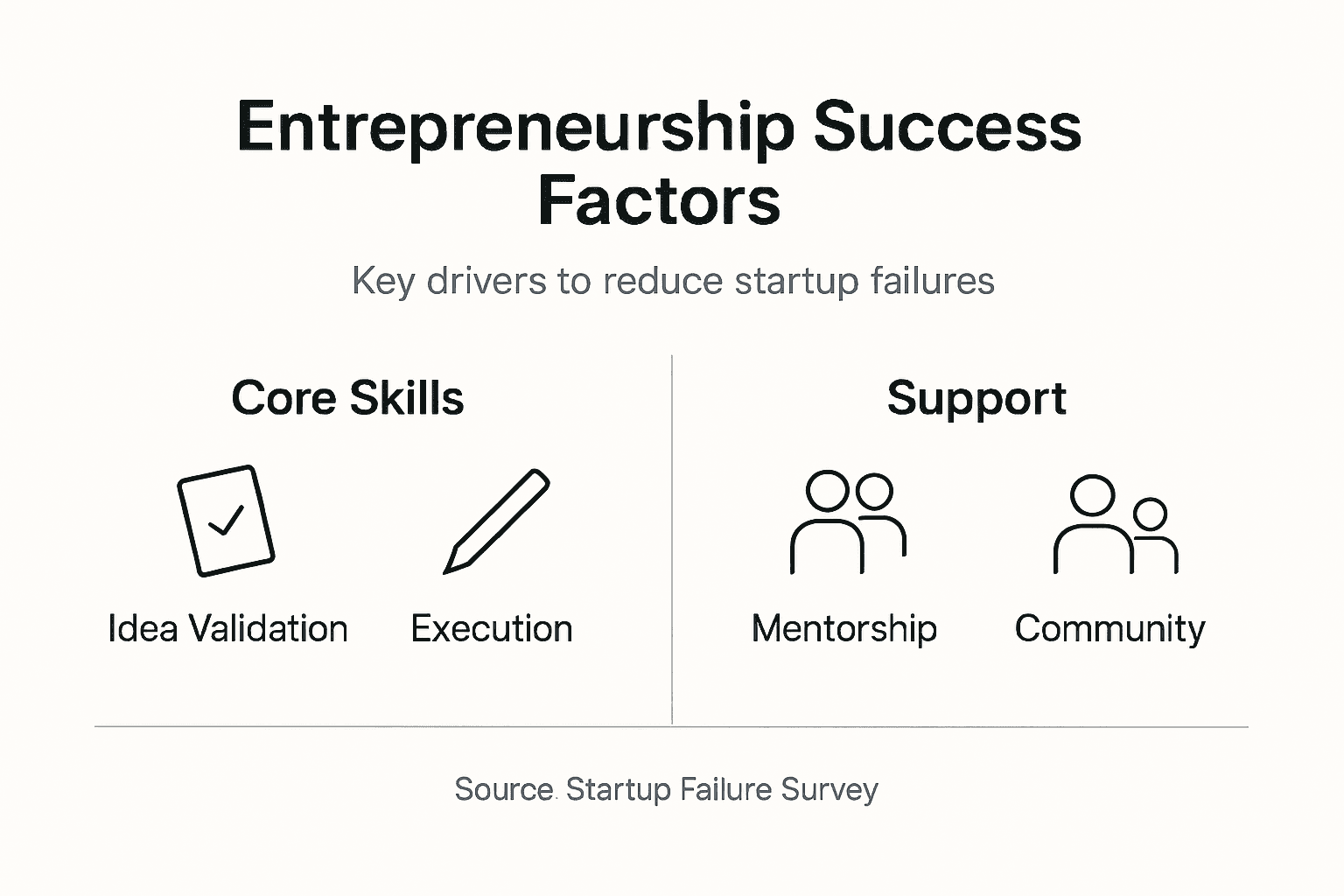
Nearly 42% of startups fail because their ideas don’t meet market needs. This staggering failure rate reveals a critical truth: entrepreneurship involves interconnected aspects like idea validation, skills, community, and execution. Understanding these aspects helps you build a strong entrepreneurial foundation, prevent costly mistakes, and accelerate growth. This guide clarifies the framework aspiring entrepreneurs need to succeed in 2026.
Table of Contents
- Introduction To Entrepreneurship And Its Core Aspects
- Importance Of Idea Validation
- Entrepreneurial Skill Development And Mentorship
- The Power Of Community In Entrepreneurship
- Execution And Discipline In Entrepreneurship
- Common Misconceptions In Entrepreneurship
- Entrepreneurship Frameworks And Models
- The Role Of Immersive Bootcamps
- Accelerate Your Entrepreneurial Journey With Nomad Excel
- Frequently Asked Questions
Key Takeaways
| Point | Details |
|---|---|
| Entrepreneurial success requires mastering five core aspects | Idea validation, skill development, mentorship, community engagement, and execution discipline work together to build sustainable businesses. |
| Idea validation dramatically reduces failure risk | Testing your concept with real market feedback ensures you solve actual problems customers will pay for. |
| Mentorship and skills accelerate growth | Expert guidance and continuous learning help you overcome challenges faster and avoid common pitfalls. |
| Community support enhances resilience | Connecting with fellow entrepreneurs provides emotional backing, resource sharing, and scaling opportunities. |
| Disciplined execution maintains momentum | Structured goal-setting and accountability systems transform strategy into measurable results. |
Introduction to Entrepreneurship and Its Core Aspects
Entrepreneurship is the process of creating and growing a sustainable business by navigating multiple interconnected aspects. Success requires more than a good idea. You need systematic validation, continuous skill development, expert guidance, supportive relationships, and disciplined execution working together.
Understanding entrepreneurial leadership concepts provides clarity on how these elements interact. The entrepreneurial journey is a multidimensional process involving strategic validation, skills, community, and execution discipline. Each aspect reinforces the others, creating momentum toward your business goals.
Five core areas form the foundation of entrepreneurial success:
- Idea Validation: Testing your concept with real market feedback before investing heavily
- Skills Development: Building essential capabilities in marketing, finance, leadership, and operations
- Mentorship: Learning from experienced entrepreneurs who’ve navigated similar challenges
- Community Engagement: Connecting with peers for support, resources, and collaboration opportunities
- Disciplined Execution: Implementing structured systems that maintain progress and accountability
These aspects function as an iterative cycle. You validate ideas, develop skills to execute them, seek mentorship to accelerate learning, engage community for support, and maintain discipline to drive results. Each iteration strengthens your entrepreneurial foundation.
Mastering this framework dramatically improves your odds of building a thriving business. The startup failure analysis shows most failures stem from neglecting one or more of these core aspects. Understanding how they work together helps you avoid common pitfalls and accelerate growth.
Importance of Idea Validation
Nearly 42% of startups fail due to lack of market need, making validation your most critical early-stage activity. Validation means testing whether real customers will pay for your solution before you build a complete product. This process dramatically reduces risk and improves product-market fit.
“42% of startups fail because they build products nobody wants. Validation prevents this costly mistake by ensuring market need before heavy investment.”
Validation transforms assumptions into evidence. Many entrepreneurs fall in love with their ideas without confirming customers share that enthusiasm. Systematic validation through idea validation steps helps you test hypotheses quickly and cheaply.
Key validation techniques include:
- Customer Interviews: Talk directly with 20-30 potential customers about their problems and willingness to pay for solutions
- Landing Pages: Create simple websites describing your offer and measure how many visitors sign up or express interest
- Minimum Viable Products (MVPs): Build the smallest version of your solution that delivers core value and test with early adopters
- Market Research: Analyze competitor offerings, pricing strategies, and customer reviews to identify gaps and opportunities
- Pre-sales: Offer your product before building it fully to gauge genuine purchase intent
Iterative feedback loops refine your concept continuously. You launch a test, gather data, adjust your approach, and test again. Each cycle brings you closer to product-market fit. This process saves months of development time and thousands in wasted resources.
Pro Tip: Focus 80% of early validation efforts on customer interviews. Direct conversations reveal nuanced pain points that surveys and analytics miss. Ask open-ended questions about their current solutions and willingness to switch.
The startup failure statistics consistently show validation as the difference between success and failure. Spending 4-8 weeks validating before building saves you from spending years on products nobody wants. Make validation your first priority, not an afterthought.
Entrepreneurial Skill Development and Mentorship
Acquiring essential skills and engaging with mentors accelerates your entrepreneurial growth dramatically. Structured learning and mentorship significantly improve startup survival and speed to market. These elements help you overcome skill gaps and avoid costly mistakes.
Critical entrepreneurial skills include:
- Marketing: Understanding customer acquisition channels, messaging, and conversion optimization
- Financial Literacy: Reading financial statements, managing cash flow, and making data-driven investment decisions
- Leadership: Inspiring teams, delegating effectively, and building organizational culture
- Negotiation: Securing favorable terms with suppliers, partners, and investors
- Product Development: Creating solutions that solve real problems efficiently
- Sales: Converting prospects into paying customers through consultative approaches
You don’t need to master everything immediately. Focus on skills directly impacting your current growth stage. Early-stage founders prioritize validation and sales skills. Scaling businesses need operational and leadership capabilities.

Mentorship provides shortcuts to expertise. Experienced entrepreneurs share lessons from their successes and failures, helping you navigate challenges faster. The mentorship benefits extend beyond tactical advice to include emotional support and network introductions.
Different mentorship types serve different needs:
- One-on-One Mentorship: Deep relationships with experienced entrepreneurs providing personalized guidance
- Group Mentorship: Learning alongside peers facing similar challenges with expert facilitation
- Peer Mentorship: Mutual support relationships where entrepreneurs at similar stages share insights and accountability
- Advisory Boards: Formal arrangements where multiple mentors provide strategic guidance regularly
The mentorship process works best when you seek mentors aligned with your industry and growth stage. A mentor who scaled a software company offers different insights than one who built a services business. Match mentor expertise to your specific challenges.
Pro Tip: Approach potential mentors by offering value first. Share relevant articles, make introductions, or provide feedback on their projects. This reciprocal approach builds relationships naturally rather than extracting one-sided advice.
Skill-building never stops. Successful entrepreneurs treat learning as a continuous practice, not a one-time event. Combine formal education, mentorship, and hands-on experimentation to accelerate your capabilities. Each new skill unlocks growth opportunities you couldn’t access before.
The Power of Community in Entrepreneurship
Communities provide emotional support, resource sharing, and scaling advantages critical to entrepreneurial success. Supportive communities increase startup scaling likelihood and knowledge spillover benefits. Connecting with fellow entrepreneurs transforms the isolated founder journey into a collaborative adventure.
Entrepreneurship can feel lonely. You face challenges friends and family don’t understand. Community reduces this isolation by surrounding you with people navigating similar struggles. When you hit obstacles, community members offer encouragement and fresh perspectives that reignite momentum.
Knowledge and resource sharing create compounding advantages. One community member discovers an effective marketing channel and shares it with the group. Another finds a reliable developer and makes introductions. These exchanges accelerate everyone’s progress simultaneously.
Networking within communities opens doors you couldn’t access alone. Introductions to potential customers, partners, and investors flow naturally from authentic relationships. The community benefits for entrepreneurs include opportunities that never appear in cold outreach.
Different community types serve different purposes:
- Local Entrepreneurship Groups: In-person meetups for networking and collaboration in your city
- Online Forums: Virtual spaces like communities on platforms where entrepreneurs worldwide share advice
- Mastermind Groups: Small, committed groups meeting regularly for accountability and strategic discussion
- Bootcamps and Accelerators: Intensive programs bringing entrepreneurs together for focused learning and growth
- Industry-Specific Communities: Groups centered on particular sectors like SaaS, e-commerce, or services
The strongest communities balance giving and receiving. Members actively contribute insights, make introductions, and celebrate others’ wins. This reciprocity creates trust and deepens relationships over time.
Building entrepreneurial community requires intentional participation. Show up consistently, offer help without expecting immediate returns, and share your journey authentically. Vulnerability builds connections faster than projecting perfect success.
Community impact extends beyond business metrics. Fellow entrepreneurs become friends who understand your journey deeply. These relationships provide meaning and fulfillment that complement financial success. You grow not just as a business owner but as a person.
Execution and Discipline in Entrepreneurship
Disciplined goal-setting, accountability, and execution frameworks maintain momentum and produce measurable startup results. Daily sprints and accountability techniques correlate with increased project momentum and success. Without execution discipline, even brilliant strategies remain unrealized potential.
Execution separates dreamers from doers. You can attend workshops, read books, and create detailed plans, but nothing changes until you take consistent action. Discipline provides the structure that transforms intentions into outcomes.
Key discipline practices include:
- Daily Goal-Setting: Identifying 3-5 specific tasks each morning that move critical projects forward
- Sprint Cycles: Breaking large projects into 1-2 week focused periods with clear deliverables
- Accountability Partners: Regular check-ins with peers or mentors who track your commitments
- Progress Tracking: Using tools to visualize completion rates and identify bottlenecks
- Time Blocking: Dedicating specific calendar slots to high-priority work without distractions
Focused execution improves progress transparency and motivation. When you see tasks completed daily, momentum builds naturally. Small wins compound into major achievements over weeks and months.
A five-step execution framework keeps entrepreneurs on track:
- Set Weekly Objectives: Define 3-5 measurable outcomes you’ll achieve this week aligned with quarterly goals
- Break Into Daily Tasks: Translate weekly objectives into specific daily actions requiring 2-4 hours each
- Execute First Thing: Complete your most important task before checking email or messages
- Review Daily Progress: Spend 10 minutes each evening assessing what worked and what needs adjustment
- Adjust Weekly Plans: Use Friday reviews to refine next week’s objectives based on learnings and results
This framework creates rhythm and predictability. You know exactly what success looks like each day and week. Clarity eliminates decision fatigue and keeps you moving forward consistently.
Pro Tip: Use project management tools to track tasks and deadlines visually. Seeing your progress builds motivation and helps you identify patterns in your productivity. Tools that integrate with calendars work especially well for time-blocking approaches.
The execution strategies you implement directly impact startup survival rates. Consistent execution beats sporadic brilliance every time. Discipline ensures you show up daily, even when motivation fades. This reliability transforms average entrepreneurs into successful founders.
Common Misconceptions in Entrepreneurship
Correcting widespread myths prevents mistakes and aligns expectations for aspiring entrepreneurs. Misunderstandings about risk, capital, and collaboration often derail otherwise promising ventures. Clarity on these points helps you apply entrepreneurial insights effectively.
Misconception 1: Entrepreneurship Demands High Risk-Taking
Many people think entrepreneurs are reckless gamblers who bet everything on unproven ideas. Reality shows successful entrepreneurs practice strategic risk management. They test ideas cheaply before investing heavily, diversify income streams, and maintain financial buffers. Smart entrepreneurs take calculated risks, not blind leaps.
Misconception 2: More Startup Capital Guarantees Success
People assume raising large funding rounds ensures business success. Statistics show many well-funded startups still fail while bootstrapped ventures thrive. Reality centers on efficient financial planning and capital allocation. How you spend matters more than how much you raise. Focus on proving your model works before scaling investment.
Misconception 3: Entrepreneurship Is a Solo Journey
The myth of the lone genius founder persists in popular culture. Reality demonstrates collaboration and mentorship drive most successful ventures. Even famous solo founders had partners, advisors, and communities supporting their growth. Building a strong network accelerates progress and provides crucial support during challenges.
Misconception 4: You Need a Perfect Plan Before Starting
Many aspiring entrepreneurs delay launching until their business plan covers every contingency. Successful founders know plans change constantly as you learn from real customers. Start with a hypothesis, test it quickly, and adapt based on feedback. Perfection paralysis prevents the learning that actual execution provides.
Misconception 5: Failure Means You’re Not Cut Out for Entrepreneurship
People interpret early setbacks as proof they lack entrepreneurial talent. Most successful founders failed multiple times before finding traction. Each failure provides lessons that increase your odds of future success. Persistence combined with learning from mistakes separates eventual winners from those who quit too soon.
These misconceptions create unnecessary barriers and wrong expectations. Understanding reality helps you make better decisions and stay resilient through inevitable challenges. Entrepreneurship requires strategic thinking, efficient resource use, collaborative relationships, iterative learning, and persistent execution.
Entrepreneurship Frameworks and Models
Prominent entrepreneurship frameworks organize knowledge and help you select actionable strategies. These structured models guide systematic validation, learning, and iteration. Understanding different approaches helps you choose methods matching your situation.
Lean Startup Methodology centers on rapid experimentation and validated learning. The framework’s build-measure-learn cycle minimizes wasted effort by testing assumptions quickly. You create minimal viable products, measure customer response, learn from data, and iterate. This approach reduces risk by discovering what works before scaling investment.
Lean Startup emphasizes:
- Starting with hypotheses about customer problems and solutions
- Building the smallest testable version of your product
- Measuring real customer behavior rather than relying on opinions
- Learning from data to decide whether to pivot or persevere
Design Thinking takes a human-centered approach focused on deep empathy and creative problem-solving. The framework guides you through understanding user needs, ideating solutions, prototyping concepts, and testing with real people. This method works especially well for complex problems requiring innovative solutions.
Design Thinking phases include:
- Empathizing with users through observation and interviews
- Defining core problems based on user insights
- Ideating multiple solution approaches without judgment
- Prototyping quick mockups to make ideas tangible
- Testing prototypes with users and gathering feedback
| Aspect | Lean Startup | Design Thinking |
|---|---|---|
| Primary Focus | Business viability and scalability | User needs and experience |
| Starting Point | Assumptions about market and product | Deep empathy for users |
| Iteration Speed | Rapid cycles, often weekly | Longer cycles for deeper exploration |
| Best Use Cases | Tech products, platforms, scalable models | Physical products, services, complex problems |
| Metrics Emphasis | Quantitative data and conversion rates | Qualitative insights and user satisfaction |
Both frameworks share core principles of iteration and learning. They help you avoid building complete products before validating core assumptions. The choice between them depends on your product type and industry context.
The entrepreneurship frameworks you adopt should match your business model and resources. Tech startups often favor Lean Startup for its speed and data focus. Service businesses might prefer Design Thinking’s emphasis on understanding complex user needs.
Frameworks reduce guesswork by providing clear next steps. Instead of wondering what to do, you follow proven processes that guide your decisions. This structure is especially valuable when you’re early in your entrepreneurial journey and lack experience with strategic planning.
Successful entrepreneurs often blend framework elements rather than following one approach rigidly. You might use Design Thinking to deeply understand user needs, then apply Lean Startup principles to test solutions rapidly. Flexibility lets you customize methods to your specific situation.
The Role of Immersive Bootcamps
Entrepreneurship bootcamps accelerate skill acquisition, mentorship access, and community engagement for faster growth. These programs combine the article’s core aspects into intensive experiences delivering tangible outcomes. Immersive formats help you apply frameworks practically rather than just understanding them theoretically.
Bootcamps integrate multiple growth accelerators simultaneously. You receive expert mentorship, build peer relationships, develop practical skills, and maintain execution accountability all in one program. This combination creates momentum difficult to achieve independently.
Key benefits of joining business bootcamps include:
- Focused Learning: Dedicated time away from daily distractions to concentrate on business growth
- Expert Guidance: Direct access to experienced entrepreneurs who’ve achieved results you want
- Peer Community: Relationships with fellow founders providing ongoing support and collaboration opportunities
- Structured Accountability: Daily check-ins and progress reviews ensuring you complete commitments
- Immediate Feedback: Real-time responses to your ideas and strategies from mentors and peers
- Accelerated Progress: Accomplishing in weeks what might take months working alone
Successful participants consistently report gaining clarity on their business direction and strategies. The intensive format forces focus and decision-making. You can’t procrastinate when the program has clear milestones and peer accountability.
Many bootcamp graduates experience measurable revenue growth within months of completing programs. The combination of validated strategies, new skills, and supportive community creates conditions for rapid scaling. These outcomes justify the time and financial investment.
Bootcamps work especially well for early-stage entrepreneurs who’ve validated basic product-market fit and need help scaling. The programs provide structure and expertise that independent learning can’t match. You compress years of trial and error into concentrated learning experiences.
The online entrepreneurship bootcamp format makes intensive learning accessible regardless of location. Virtual programs maintain mentorship quality and community connection while eliminating travel barriers. This flexibility suits entrepreneurs balancing existing commitments.
Choosing the right bootcamp requires evaluating curriculum alignment with your needs and growth stage. Programs focused on idea validation serve different needs than those emphasizing scaling strategies. Match bootcamp focus to your current challenges for maximum impact.
Immersive experiences create lasting transformation by combining education with implementation. You don’t just learn concepts; you apply them immediately with expert guidance. This integration of knowledge and action produces results that passive learning never achieves.
Accelerate Your Entrepreneurial Journey with Nomad Excel
Ready to transform entrepreneurial insights into business growth? Nomad Excel runs immersive bootcamps integrating mentorship, community, and execution discipline you’ve learned about here. Our programs help early-stage entrepreneurs worldwide move from confusion to clarity to measurable results.
We offer flexible formats tailored to your needs and schedule. Whether you prefer intensive in-person experiences or virtual programs, our expert coaches guide you through validation, skill-building, and scaling strategies. You’ll join a supportive community that challenges your thinking and celebrates your progress.
The entrepreneurship bootcamps benefits include actionable frameworks, accountability systems, and networking that continues long after programs end. Our participants consistently report sharper strategies, new revenue-driving skills, and confidence to tackle challenges they previously avoided.
Explore our online entrepreneurship bootcamp to see how we help entrepreneurs like you accelerate growth through proven methods and genuine community support.
Frequently Asked Questions
What are the first steps to validate a business idea?
Start by conducting 20-30 customer interviews asking about their current problems and solutions they use. Create a simple landing page describing your offer and measure signup rates. These activities test whether real people care about what you’re building before you invest heavily in development.
How can mentorship accelerate my entrepreneurial growth?
Mentors share lessons from their successes and failures, helping you avoid costly mistakes and identify opportunities faster. The mentorship in entrepreneurship provides shortcuts to expertise that would take years to develop independently. Expert guidance helps you make better strategic decisions and overcome challenges with proven approaches.
What are the unique benefits of joining an entrepreneurship bootcamp?
Bootcamps combine focused learning, expert mentorship, peer community, and structured accountability in one intensive experience. Joining entrepreneurship bootcamps accelerates progress by eliminating distractions and providing immediate feedback on your strategies. You accomplish in weeks what might take months working alone while building lasting relationships with fellow founders.
How important is community support for a startup founder?
Community dramatically reduces the isolation entrepreneurs face and provides emotional resilience during challenges. Fellow founders offer perspectives on problems you’re facing, share resources and connections, and celebrate wins with you. These relationships create knowledge-sharing networks that accelerate everyone’s growth simultaneously while making the journey more enjoyable.
What execution habits lead to consistent startup progress?
Set 3-5 specific daily goals each morning aligned with weekly objectives. Complete your most important task before checking messages or email. Review progress each evening to identify what worked and needs adjustment. This daily rhythm creates momentum through small wins that compound into major achievements over time.
Recommended
- 7 Top Entrepreneurship Tips 2025 for Startup Success
- Online Entrepreneurship Bootcamp – Nomad Excel – Your Entrepreneurial Adventure Starts Here
- How to Start a Bootcamp for Entrepreneurial Success
- Entrepreneurship Skills Guide for Launching Your Own Venture – Nomad Excel – Your Entrepreneurial Adventure Starts Here
- Perché falliscono gli studenti universitari: 45% senza metodo
Comments are closed.