
12 Brainstorming Activities for Teams With Copy Ready Runbooks
The most reliable mix of activities for brainstorming combines silent written methods, structured prompts, and visual mapping, always run through two distinct phases: divergence, then convergence. Start with brainwriting (6-3-5), Crazy 8s, SCAMPER, or mind mapping to generate volume, then switch tools entirely for selection. Below are copy-ready runbooks, session agendas, and the facilitation rules that keep any group from mistaking a sticky-note pile for a decision.
TL;DR:
- Structured activities like brainwriting and silent methods produce significantly higher idea volumes than open discussion, with up to 108 ideas in 30 minutes using the 6-3-5 method.
- Keeping divergence and convergence phases separate prevents premature judgment and ensures a focused, productive brainstorming process.
- Visual mapping techniques such as mind maps and storyboards reveal relationships and sequences that lists or verbal methods might miss.
- Remote and hybrid sessions benefit from digital tools that enable simultaneous contribution, with strict adherence to silence and anonymous contributions during divergence.
- Quick follow-up within 24 to 72 hours and clear ownership assignments are essential to turn raw ideas into actionable projects and maintain momentum.
Table of Contents
- Activities for Brainstorming That Actually Produce Usable Ideas
- Why Warm-Ups Matter Before You Ask for Ideas
- Running Silent Methods Without Production Blocking
- SCAMPER, How Might We, and Reverse Brainstorming Runbooks
- Visual Mapping: Mind Maps, Storyboards, and Morphological Boxes
- Facilitating Remote and Hybrid Brainstorming Sessions
- Turning a Pile of Ideas Into a Prioritized Shortlist
- A Facilitator’s Checklist for Before, During, and After
- Three Copy-Ready Brainstorming Agendas
- How Nomad Excel Sequences Ideation in Bootcamps and Retreats
- Facilitated Workshops vs. Continuous Ideation
- Where to Take Your Best Ideas Next
- Sources
Activities for Brainstorming That Actually Produce Usable Ideas
Most brainstorming sessions fail for a mundane reason: someone starts judging ideas out loud in minute three, and the room quietly stops generating anything risky. A brainstorming activity, properly defined, is a structured, time-bound process split into a divergent phase focused on quantity and a convergent phase focused on selection. Mixing those phases is the single most common facilitation error, and every activity below assumes you keep them apart.
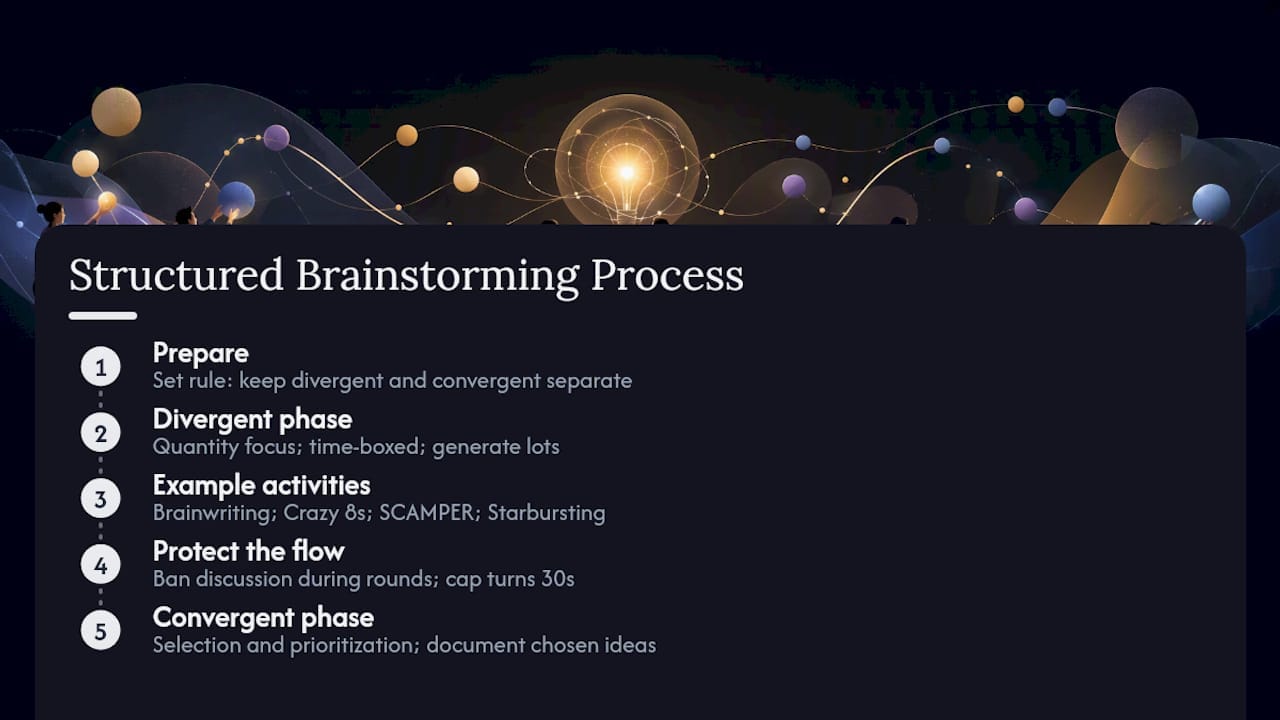
Here are 12 activities worth building into a session, each with the mechanics you need to run it cold.
1. Brainwriting (6-3-5 Method)
Six participants each write three ideas in five minutes, then pass their sheet to the next person for six rounds. The math is blunt: six people, three ideas, six rounds can generate up to 108 ideas in about 30 minutes. Best for groups of 6 to 18 (multiples of six). Tip: ban discussion entirely during rounds, or you’ve just reinvented a slower round-robin.

2. Crazy 8s
Fold a sheet into eight panels and sketch eight distinct ideas in eight minutes, one minute per panel. Works for 1 to 12 people. Tip: the speed is the feature, not a bug. Anyone who fills only three panels is over-refining instead of diverging.
3. Round-Robin
Each person contributes one idea aloud in turn, no debate allowed until every person has spoken twice. Best for groups of 4 to 10. Tip: cap each turn at 30 seconds so a confident talker doesn’t quietly consume everyone else’s airtime.
4. SCAMPER
Run a problem through seven lenses (Substitute, Combine, Adapt, Modify, Put to other use, Eliminate, Reverse), spending roughly three minutes per lens. Ideal for 3 to 8 people tackling an existing product or process. Tip: skip lenses that clearly don’t apply rather than forcing weak answers to hit all seven.
5. Starbursting
Write the core idea in the center of a page, then surround it with six points (like a star) representing Who, What, When, Where, Why, and How. Spend 15 to 20 minutes generating questions before anyone attempts an answer. Works for 2 to 12 people. Tip: resist answering questions as they surface; a half-answered question kills three better ones behind it.

6. Reverse Brainstorming
Ask “how could we make this problem worse?” instead of “how do we solve it?” Then flip each answer into a fix. Best for stuck teams of 4 to 10. Tip: use this when a group has gone quiet on a familiar problem. Reversing the frame almost always shakes something loose.
7. Mind Mapping
Start with a central concept and branch outward with related ideas, letting sub-branches spawn their own connections. Works solo or in groups up to 8. Tip: use one color per major branch so the facilitator can later trace which cluster produced the strongest ideas.
8. Electronic Brainstorming (Brain Netting)
Participants type ideas simultaneously into a shared digital board or chat thread rather than speaking them. Scales from 5 to 50+ people. Tip: structured electronic brainwriting under anonymity increases idea elaboration compared with sequential, spoken sharing, so keep contributions unattributed during the divergent phase.
9. 10-for-10 Exercise
Generate 10 ideas in 10 minutes on a narrow, specific prompt. Works for individuals or pairs. Tip: the constraint forces speed over quality. Rank the list only after time is up.
10. 30 Uses Exercise
Pick an everyday object and list 30 unconventional uses for it in 10 minutes, purely to loosen associative thinking before tackling the real problem. Works for any group size. Tip: use this as a warm-up, never as the main event. It builds fluency, not solutions.
11. Dot Voting
Give each participant a fixed number of votes (typically three) to place silently and simultaneously on a wall or digital board of generated ideas. Works for any group size. Tip: silent, simultaneous placement reduces anchoring, since nobody sees the frontrunner forming in real time.
12. Affinity Mapping
Cluster related sticky notes or digital cards into named groups after the divergent phase ends. Works for 4 to 20 people. Tip: let the group name each cluster themselves. A theme imposed by the facilitator often misses the pattern participants actually saw.
Why Warm-Ups Matter Before You Ask for Ideas
Jumping straight into a brainstorming exercise cold rarely works. Most participants walk into a meeting room still thinking in the analytical, evaluative mode their last task required, and that mode actively suppresses the kind of loose, associative thinking creative brainstorming techniques depend on. A two to five-minute warm-up flips that switch before the real prompt arrives.
Classic writing-center guidance recommends techniques like freewriting and clustering specifically because they lower the bar for a “bad” contribution, which is exactly what a room full of adults needs permission to do.
A few warm-ups worth keeping in rotation:
- 3-2-1 Blastoff: Each person writes 3 words describing the problem, 2 words describing the ideal outcome, and 1 word describing how they feel about it right now. Takes under 3 minutes.
- 30 Uses Exercise: List 30 unconventional uses for a paperclip or brick in 10 minutes, purely to build associative fluency.
- 2-Minute Freewriting: Write continuously about the topic for two minutes with no editing and no stopping, even to write “I don’t know what to write.”
- Yes-And Pairs: Partners trade absurd premises and respond only with “yes, and…” for 90 seconds, borrowed straight from improv training.
Pro Tip: Match the warm-up’s energy to the room. A remote team on their fourth video call of the day needs something physical, like standing up to sketch, not another typing exercise.
Pick warm-ups with cultural sensitivity in mind. Wordplay exercises can exclude non-native speakers, and anything requiring personal disclosure can backfire with a newly formed team. When in doubt, choose a visual or numeric warm-up over a verbal one.
Running Silent Methods Without Production Blocking
“Production blocking” is the technical term for what happens when only one person can talk at a time. While they’re talking, everyone else is either waiting or forgetting the idea they had thirty seconds ago. Silent, parallel methods eliminate that bottleneck by letting every participant generate and write simultaneously.
The 6-3-5 method is the clearest example of the mechanics at work:
- Form groups of six and give each person a sheet with three columns.
- Set a five-minute timer. Each person writes three ideas addressing the prompt.
- At the timer’s end, everyone passes their sheet to the neighbor.
- Each person now reads the ideas already on the sheet and adds three new ones, building on or diverging from what’s there.
- Repeat for six total rounds.
- Collect all sheets. Six people, three ideas, six rounds yields up to 108 total contributions.
Crazy 8s runs on a similar logic but trades text for sketches: eight panels, one minute each, forcing fluency over polish. Nobody has time to second-guess panel four while drawing panel five.
The 108-idea benchmark: A single 6-3-5 round with six participants can generate up to 108 ideas in roughly 30 minutes, a volume almost impossible to hit through open discussion in the same window.
Research on structured electronic brainwriting backs this up from a different angle: presenting the rules of brainstorming simultaneously, rather than introducing them one at a time, measurably improves idea elaboration and selection quality. The takeaway for facilitators is blunt: read every rule aloud before round one starts, not gradually as issues come up.
SCAMPER, How Might We, and Reverse Brainstorming Runbooks
Silent volume methods are excellent at breadth. Structured prompt methods are better when a team is stuck on a specific, well-defined problem and needs a different angle rather than more raw material.
SCAMPER works through seven lenses in sequence: Substitute, Combine, Adapt, Modify, Put to other use, Eliminate, and Reverse. Give each lens roughly three minutes and move on even if the group only generates one or two ideas per lens. The goal isn’t exhaustiveness. It’s forcing a shift in vantage point seven separate times in under 25 minutes.
How Might We (HMW) prompts do the heaviest lifting in any structured session. A well-crafted HMW frame shortens divergent noise and increases useful output far more than any downstream technique choice. A strong HMW prompt:
- Names a specific user or group, not “everyone.”
- States a desired outcome without implying the solution.
- Avoids yes/no framing (“How might we increase referral signups by 20%” beats “Should we add a referral program?”).
After generating a stack of HMW statements, cluster similar ones before ideating against each cluster separately. Ideating against six unclustered HMWs at once produces scattered, shallow answers.
Starbursting flips the usual order: generate questions (Who, What, When, Where, Why, How) before generating answers. Spend a full 15 minutes on questions alone. Teams that rush to answers here tend to solve the first plausible question instead of the sharpest one.
Reverse brainstorming works by asking how to make the problem worse, then inverting each answer. It’s the single best tool for a team that’s circled the same three ideas for weeks. Reversing the frame interrupts a stale mental groove without requiring anyone to admit the group is stuck.
Visual Mapping: Mind Maps, Storyboards, and Morphological Boxes
Written and spoken methods generate a pile of discrete ideas. Visual methods do something different: they surface relationships between ideas that a linear list hides.
Mind mapping starts with a central concept, radiating out through branches and sub-branches. The rules are simple but easy to break under time pressure:
- Use one central node only, written large enough to anchor the whole page.
- Branch outward with single words or short phrases, never full sentences.
- Let sub-branches form freely; don’t force symmetry between branches.
- Color-code by theme so patterns are visible at a glance, not buried in text.
Storyboards work better than mind maps when the idea involves a sequence, a user journey, or a process with multiple steps in a defined order. Sketch four to six panels showing the experience unfolding, even roughly. A storyboard forces the group to confront gaps a bullet list would hide, like the awkward step between “sign up” and “get value.”
Morphological boxes suit problems with multiple independent variables. List the variables down one axis (say, delivery method, price tier, and audience segment) and the possible values across the top, then combine cells to generate concept variants nobody would have proposed individually. This method rewards teams comfortable with a bit of structure, and it consistently surfaces combinations a free-form list never reaches.
Translating a visual cluster into an actual concept means naming the pattern in one sentence before moving on. If a cluster can’t be named in under ten words, it’s probably two ideas pretending to be one.
Facilitating Remote and Hybrid Brainstorming Sessions
Remote and hybrid brainstorming used to mean a muted call and one person typing into a shared document while everyone else watched. That’s no longer necessary. Digital-first parallel ideation, when structured correctly, can match or exceed in-person output, because every participant contributes at once instead of waiting for a speaking turn.
A minimal digital toolkit covers most needs:
- A visual canvas like Miro or Mural for sticky-note style ideation and clustering.
- A structured whiteboard like FigJan for teams that want built-in templates for 6-3-5 or affinity mapping.
- A visible countdown timer shared on screen, not just running silently on the facilitator’s phone.
- A single shared prompt document everyone can see before the session starts.
The single most important hybrid rule: treat every participant as remote, even the six people sitting in the same conference room. A physical whiteboard that isn’t mirrored digitally silently excludes remote contributors from full participation, and they’ll know it. One shared digital canvas, projected in the room and open on every laptop, keeps the playing field level.
Pro Tip: Export the digital board immediately after the session, not the next morning. Ideas typed into an unsecured shared link have a way of vanishing when someone “cleans up” the workspace.
Capturing artifacts matters as much as generating them. Before closing a digital session, export the board as an image and a structured file (CSV or spreadsheet) that lists each idea alongside its theme tag, so convergence work the next day doesn’t start from scratch.
Turning a Pile of Ideas Into a Prioritized Shortlist
Divergence produces volume. Convergence is where most sessions actually fail, because groups either skip it entirely or turn it into a second unstructured debate. A repeatable convergence workflow prevents both:
- Cluster related ideas into named groups (affinity mapping), typically 20 minutes for a session that generated 40 to 100 ideas.
- Label each cluster in one short phrase the whole group agrees on.
- Dot vote silently. Give each participant three votes to place simultaneously across all clusters, not sequentially.
- Map survivors onto an impact/effort grid, sorting the top-voted ideas into quick wins, major projects, fill-ins, and thankless tasks.
- Assign an owner and a next step to every idea that survives the grid, before anyone leaves the room.
Dot voting only works if it’s silent and simultaneous. When participants vote one at a time out loud, the first few votes anchor everyone after them toward the same options, which is exactly the HiPPO bias (Highest Paid Person’s Opinion) that structured brainwriting is designed to avoid in the first place. Give participants 60 to 90 seconds to place dots, then stop, count, and move on immediately.
| Convergence step | Timebox | Output |
|---|---|---|
| Cluster and label | 15-20 minutes | Named idea groups |
| Silent dot voting | 60-90 seconds | Ranked shortlist |
| Impact/effort mapping | 10-15 minutes | Prioritized quadrant |
| Owner and next-step assignment | 10 minutes | Accountable action list |
Don’t let the consolidation wait too long. A 24 to 72-hour cadence for finalizing owners and next steps keeps momentum from evaporating; anything longer and the energy generated in the room simply dissipates into other priorities.
A Facilitator’s Checklist for Before, During, and After
A good facilitator doesn’t contribute the best idea; instead, they follow a decision-intelligence architecture designed for design teams that far better harnesses group creativity. They design the structure that lets everyone else contribute theirs. Anti-HiPPO safeguards like silent voting and anonymous brainwriting exist precisely because the facilitator’s job is architecture, not authorship.
Before the session:
- Draft a specific How Might We prompt and share it 24 hours ahead so participants arrive with pre-formed thoughts.
- Invite a genuinely diverse mix of roles and seniority levels, not just the usual five people.
- Prepare the physical or digital canvas, timers, and materials the day before, not the morning of.
- Send any relevant pre-reads or data so the room starts from shared context.
During the session:
- Read every rule aloud before the first activity, including the no-evaluation rule.
- Timebox everything visibly. An invisible timer is functionally no timer.
- Enforce no evaluation during divergence, even when an idea seems obviously weak.
- Keep a visible parking lot for off-topic but valuable tangents so they don’t derail the agenda.
- Capture metadata (who suggested what, rough theme) as ideas land, not retroactively.
After the session:
- Cluster and prioritize within 24 to 72 hours while the context is still fresh.
- Assign a named owner to every idea that survives the impact/effort filter.
- Schedule a specific follow-up date, not a vague “we’ll circle back.”
- Archive the raw artifacts (photos, exported boards, voting tallies) somewhere searchable.
Three Copy-Ready Brainstorming Agendas
Pick the agenda that fits your window, not the other way around. Stretching a 30-minute problem into 90 minutes produces fatigue, not better ideas.
1. The 30-Minute Rapid Session
Goal: generate a shortlist for a narrow, well-defined problem. Participants: 4 to 8.
- 0 to 3 min: Share the HMW prompt and rules aloud.
- 3 to 5 min: Warm-up (3-2-1 Blastoff).
- 5 to 20 min: Brainwriting, one 6-3-5 round set (compress to two rounds if the group is under six).
- 20 to 27 min: Silent dot voting and quick clustering.
- 27 to 30 min: Name three owners and next steps.
Deliverable: a ranked shortlist of 3 to 5 ideas with owners assigned.
2. The 60-Minute Standard Workshop
Goal: explore a problem broadly, then converge on a testable concept. Participants: 6 to 12.
- 0 to 5 min: Frame the problem and rules.
- 5 to 10 min: Warm-up (30 Uses Exercise).
- 10 to 35 min: Full 6-3-5 brainwriting round set.
- 35 to 45 min: Affinity mapping and cluster labeling.
- 45 to 55 min: Silent dot voting and impact/effort mapping.
- 55 to 60 min: Assign owners and confirm the follow-up date.
Deliverable: a prioritized concept list with a 48-hour follow-up scheduled.
3. The 90-Minute Deep Workshop
Goal: tackle a complex or ambiguous problem needing multiple lenses. Participants: 8 to 16.
- 0 to 10 min: Framing, pre-read recap, and warm-up (Yes-And Pairs).
- 10 to 30 min: SCAMPER across the problem.
- 30 to 50 min: Crazy 8s for visual concept sketching.
- 50 to 65 min: Affinity mapping across both technique outputs.
- 65 to 80 min: Silent dot voting and impact/effort mapping.
- 80 to 90 min: Owner assignment and next-step scheduling.
Deliverable: a small set of validated concepts ready for prototyping.
Swap techniques based on group energy: a tired late-afternoon group does better with Crazy 8s than a text-heavy SCAMPER pass, since sketching demands less sustained verbal focus.
How Nomad Excel Sequences Ideation in Bootcamps and Retreats
Facilitating a room of early-stage founders is a different exercise than facilitating a corporate team, mostly because founders arrive with more conviction and less patience for process. Nomad Excel’s entrepreneurship bootcamps and company retreats sequence ideation deliberately: a divergent block first, always silent or written, followed by a hard break before any group discussion starts.
The pattern that works consistently in practice:
- Mixed group composition matters more than group size. Pairing founders across industries during brainwriting rounds surfaces cross-pollinated ideas neither would reach alone.
- Silent methods go first, every time, before mentors or louder personalities set the tone for the room.
- Convergence happens the same day, never postponed to “next week,” because early-stage founders lose momentum fast without an assigned next step.
Two retreat-tested formats worth adapting directly:
- The Founder Cross-Pollination Round: Group founders from unrelated industries into 6-3-5 brainwriting sets, explicitly banning same-industry pairings, then converge with dot voting the same afternoon.
- The Mentor-Silent Split: Run the divergent phase with mentors physically absent from the room, then bring mentors in only for the impact/effort mapping stage, so their input shapes prioritization, never idea generation.
Facilitated Workshops vs. Continuous Ideation
Here’s the distinction most teams get backwards: a single well-run brainstorming session is a tool for a specific, bounded problem, not a substitute for an ongoing habit of ideation. If your team needs three good ideas by Friday, run a 60-minute workshop. If your team needs a sustained creative culture, no single session, however well facilitated, will build that.
The criteria for choosing full-workshop investment over a quick synchronous session boil down to stakes and scope. A narrow tactical question deserves 30 minutes and a whiteboard. A strategic pivot, a product roadmap, or a team realignment deserves a facilitated offsite where people are physically removed from Slack notifications and the habitual dynamics of their usual meeting room.
That’s precisely where a retreat or bootcamp format earns its cost over a string of individual sessions: distance changes what people are willing to say out loud, and a facilitator with no stake in the outcome asks the uncomfortable questions a manager won’t.
— Amichai
Where to Take Your Best Ideas Next
A great brainstorming session generates the raw material. Turning that material into an actual business, or a team that executes on it together, is a different job entirely. That’s the gap Nomad Excel’s entrepreneurship bootcamps close: instead of leaving a workshop with a sticky-note pile and good intentions, founders spend one to four weeks turning validated ideas into a working offer, backed by mentors who’ve built and scaled their own ventures.
For teams rather than solo founders, the same logic applies through Nomad Excel’s company retreats, which pair professionally facilitated ideation with the kind of sustained focus a single afternoon meeting can’t deliver. If your team’s next planning session needs more than a whiteboard and good luck, check current dates and formats for the online entrepreneurship bootcamp and see which cohort fits your timeline.
Sources
For readers who want to go deeper into the mechanics covered here, a few sources are worth bookmarking:
- Brainstorming | Atlassian
- Structuring Electronic Brainstorming Tasks to Improve Group Creativity | Journal article (Van Eeckhout et al.)
- How to run a brainstorming session that produces usable ideas | Granola