
How to test your business idea effectively in 2026
Most startups don’t fail because of bad execution. They fail because they build something nobody wants. 42% of startups fail because there’s no market need for their product. The difference between success and failure often comes down to one critical step: testing your business idea before you invest months or years building it. This guide walks you through actionable validation techniques that help you uncover real market demand fast, avoid costly mistakes, and dramatically increase your odds of building something people actually want to buy.
Table of Contents
- Understand Why Testing Your Business Idea Matters
- Prepare Effectively: Tools, Frameworks, And Prerequisites For Testing Your Idea
- Execute Your Test: Step-By-Step Strategies To Validate Demand Fast
- Verify Results And Decide: Making Data-Backed Go Or No-Go Decisions
- Explore Immersive Entrepreneurship Programs To Accelerate Your Testing Skills
- Frequently Asked Questions
Key takeaways
| Point | Details |
|---|---|
| Validation increases success rates | Validated ideas achieve 60-70% success rates compared to just 10-20% for unvalidated concepts. |
| Rapid testing reduces risk | Structured validation sprints can compress market research into days, not months. |
| Clear criteria prevent bias | Testing assumptions with pass/fail thresholds helps you make objective go or no-go decisions. |
| Early feedback saves money | Discovering fatal flaws before building prevents expensive pivots or complete failures. |
| Investors demand proof | Demonstrating traction through data increases funding opportunities significantly. |
Understand why testing your business idea matters
You’ve got an exciting business idea. You can picture the product, imagine the customers, and feel confident it will work. But confidence isn’t evidence. The graveyard of failed startups is filled with founders who were absolutely certain their ideas would succeed.
Validation changes the game. Validated ideas achieve 60-70% success rates compared to just 10-20% for unvalidated concepts. That’s not a small difference. It’s the difference between building a sustainable business and burning through your savings on something nobody wants.
Here’s what happens when you skip validation:
- You spend months building features customers don’t care about
- You invest thousands in inventory or infrastructure for a product with no demand
- You discover fundamental flaws after it’s too expensive to fix them
- You waste relationships and credibility launching something that falls flat
The single most expensive mistake is skipping validation. Early failure costs you a weekend and maybe a few hundred dollars. Late failure costs you everything.
Validation isn’t about asking friends if your idea sounds good. It’s a systematic process of gathering real evidence from real potential customers. You’re testing specific assumptions with clear success criteria. Did people sign up? Did they pay? Did they come back? These questions reveal truth that opinions never will.
Think of validation as insurance. You wouldn’t build a house without checking if the land is stable. Why would you build a business without checking if the market is real? Testing business idea validation market demand early gives you the foundation to build something that lasts.
The goal isn’t to prove you’re right. The goal is to discover the truth before it’s expensive to be wrong.
Every assumption you make about your customers, your market, and your solution carries risk. Validation systematically reduces that risk by replacing assumptions with data. The earlier you validate, the cheaper your mistakes become.
Prepare effectively: tools, frameworks, and prerequisites for testing your idea
Before you start testing, you need a plan. Random experiments waste time. Structured validation gets you answers fast.
Start with a framework that forces you to articulate your assumptions clearly. The Lean Canvas and Business Model Canvas are popular because they make you think through every part of your business model on a single page. Who are your customers? What problem are you solving? How will you reach them? What will they pay?

Early-stage market research using these frameworks helps you avoid pitfalls by identifying your riskiest assumptions upfront. Once you know what you’re assuming, you can design tests to prove or disprove those assumptions quickly.
Validation sprints compress your testing into focused timeframes. Instead of spending months on research, a structured validation sprint can compress market sizing, competitor analysis, and demand testing into a single weekend. The constraint forces you to focus on what matters most.
Here’s what you need before you start testing:
- A clear target customer segment (be specific, not broad)
- 3-5 core assumptions written as testable hypotheses
- Success metrics defined upfront (what numbers prove demand?)
- A timeline for each test (48 hours, one week, etc.)
- Low-cost tools for rapid experiments (landing page builders, survey tools)
Your assumptions should be framed as hypotheses you can test. Instead of “people want healthy snacks,” try “busy professionals will pay $8 for portion-controlled healthy snack boxes delivered weekly.” See the difference? The second version is specific enough to test.
| Tool Type | Purpose | Examples |
| — | — |
| Landing page builders | Test interest before building product | Carrd, Unbounce, Webflow |
| Survey platforms | Gather customer insights quickly | Typeform, Google Forms |
| Ad platforms | Drive traffic to test demand | Facebook Ads, Google Ads |
| Payment processors | Validate willingness to pay | Stripe, PayPal |
| Interview scheduling | Book customer conversations fast | Calendly, SavvyCal |
The best preparation combines strategic thinking with tactical speed. You want enough structure to test the right things, but not so much planning that you never actually test anything. Understanding idea validation startup success principles helps you balance rigor with velocity.
Pro Tip: Write down your assumptions as if/then statements. “If I run ads targeting yoga instructors, then at least 5% will click to learn more.” This format makes it crystal clear what you’re testing and what success looks like.
Avoid starting a new venture common mistakes by treating preparation as a foundation, not a delay tactic. Spend one day planning, then start testing.
Execute your test: step-by-step strategies to validate demand fast
Now comes the part where you actually test your idea with real people and real money. This is where most founders get nervous. Good. Nervousness means you’re about to learn something true.
Here’s your execution playbook:
Build a smoke test landing page. Create a simple one-page website that describes your product as if it already exists. Include a clear value proposition, key benefits, and a call to action (sign up, pre-order, join waitlist). Use a tool like Carrd or Unbounce. This should take 2-4 hours, not days.
Drive targeted traffic with ads. Run small ad campaigns on Facebook or Google targeting your specific customer segment. Budget $50-200 to start. The goal isn’t sales. The goal is to see if people care enough to click and take action.
Conduct customer interviews within 24 hours. Reach out to 10-15 people in your target market. Book 3-5 conversations. Ask about their current solutions, frustrations, and whether they’d pay for what you’re proposing. Listen more than you talk.
Track conversion metrics rigorously. How many people visited your page? How many signed up or indicated interest? If 3-5% of visitors sign up from a smoke test, you have a signal worth building on. Below 1%? Your messaging or market might be off.
Test with real payments when possible. Minimum Viable Testing goes beyond interest. Validating demand with real revenue tells you if people will actually pay, not just if they like the idea. Offer pre-orders or early access at a discount.
Testing 3-5 ideas is more efficient than building one without validation. Run parallel tests if you have multiple concepts. Speed matters because each test teaches you something that informs the next one.
| Strategy | Speed | Cost | Strength | Best For |
|---|---|---|---|---|
| Smoke test landing page | 1-3 days | $50-300 | Measures real interest | Digital products, services |
| Customer interviews | 1-2 days | $0-50 | Deep qualitative insights | B2B, complex solutions |
| Minimum viable test | 2-7 days | $100-500 | Validates payment intent | Physical products, subscriptions |
| Social media poll | Hours | $0 | Fast directional feedback | Early-stage concepts |
Your go/no-go thresholds should be defined before you run the test. Decide upfront: what conversion rate means proceed? What number means pivot or stop? This prevents you from rationalizing weak results because you’re emotionally attached to the idea.
Pro Tip: Record your customer interviews (with permission). You’ll catch insights you missed in the moment. Pay special attention to the language customers use to describe their problems. That’s the language your marketing should use.
Apply lean startup rapid validated growth principles by treating each test as a learning loop. Test, measure, learn, adjust, test again. The faster you cycle, the faster you find product-market fit.
Implementing proven growth strategies for startups practical steps starts with validation. You can’t grow what people don’t want. But once you validate demand, growth becomes a matter of scaling what works.
Verify results and decide: making data-backed go or no-go decisions
You’ve run your tests. You have data. Now comes the hard part: interpreting it honestly and making a decision.
Most founders struggle here because they want their idea to work so badly that they see signals in noise. You need a system that removes emotion from the equation.
Use a scoring matrix with clear criteria. Rate your idea across 10 dimensions: market size, competition, customer enthusiasm, willingness to pay, ease of delivery, your unique advantage, scalability, margins, regulatory risk, and personal passion. Score each from 1-10.
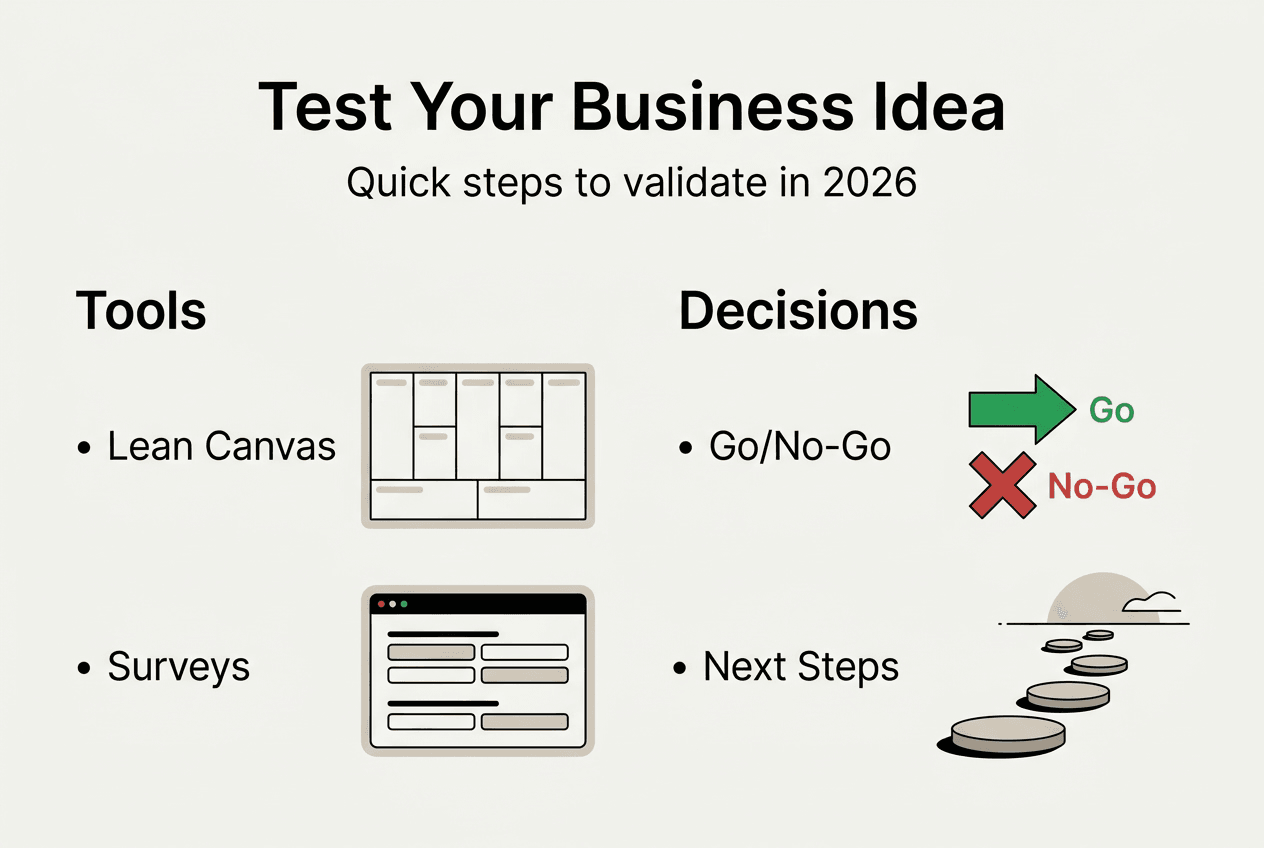
Ideas scoring below 60/100 on a 10-criteria matrix should be pivoted or shelved. Above 70? You likely have something worth pursuing. Between 60-70? Run more tests to reduce uncertainty on your weakest scores.
Here’s when to pivot versus when to proceed:
- Proceed if you hit your conversion thresholds, customers articulate clear pain points you can solve, and people are willing to pay your target price
- Pivot if there’s interest but your solution doesn’t quite fit, or if a different customer segment responds better than your original target
- Shelve if you can’t find real demand after testing multiple angles, or if the economics don’t work even with strong interest
The hardest decision is shelving an idea you love. But shelving isn’t failure. It’s intelligent resource allocation. Every hour you spend on a validated idea instead of an unvalidated one increases your odds of success.
Investors demand traction before funding. Data proofs before checks. When you can show real conversion rates, customer testimonials, and early revenue, you’re not asking investors to bet on your idea. You’re asking them to scale something that already works.
Pro Tip: Create a decision document that lists your key findings, your scores, and your reasoning. Share it with a mentor or advisor who will challenge your thinking. If you can’t defend your decision to someone who wants you to succeed, you might be fooling yourself.
Set clear milestones for your next phase. If you’re proceeding, what metrics will you hit in 30, 60, and 90 days? If you’re pivoting, what’s the new hypothesis and how will you test it? Validation isn’t a one-time event. It’s a continuous practice.
Common pitfalls in interpreting data:
- Counting friends and family responses as market validation
- Ignoring negative feedback or rationalizing why it doesn’t matter
- Confusing interest (“that’s cool”) with intent (“I’ll buy that”)
- Stopping too early before you have statistical significance
- Continuing too long after the market has clearly said no
Leverage insights from business growth strategies startup success 2026 to plan your scale-up phase once validation confirms demand. Implement startup growth hacks 2026 proven strategies success to accelerate momentum when you’ve found product-market fit.
Explore immersive entrepreneurship programs to accelerate your testing skills
Validating business ideas is a skill you can develop. The frameworks and strategies in this guide give you a strong foundation, but nothing replaces hands-on practice with expert guidance and a community of peers tackling the same challenges.
Nomad Excel’s online entrepreneurship bootcamp brings together aspiring founders for intensive sprints focused on validation, execution, and growth. You’ll work directly with experienced entrepreneurs who have built and validated multiple businesses, getting real-time feedback on your testing approach and results.
Discover why join entrepreneurship bootcamp programs that combine structured learning with accountability and community. When you’re surrounded by others validating their ideas, you move faster, think sharper, and avoid the isolation that kills momentum. Explore our program to see how immersive learning accelerates your path from idea to validated business.
Frequently asked questions
What is startup idea validation and why is it crucial?
Startup idea validation is the systematic process of gathering real evidence from potential customers to prove your business concept has genuine market demand before you invest significant time and money building it. It’s crucial because it dramatically increases your success rate by helping you discover fatal flaws early when they’re cheap to fix, ensuring you build something people actually want to buy rather than something you assume they need.
How long does business idea validation typically take?
Effective validation can happen in as little as 48 hours using structured sprints that combine smoke tests, customer interviews, and rapid experiments. Most thorough validation processes take 1-4 weeks depending on your market complexity and the number of assumptions you need to test. The key is setting clear timeframes that force focused action rather than endless research.
What are the best methods for validating a business idea?
The most effective validation methods include smoke test landing pages that measure real interest through sign-ups, customer interviews that uncover deep insights about problems and willingness to pay, minimum viable tests that validate demand with actual purchases, and small ad campaigns that test messaging and targeting. Combining qualitative interviews with quantitative conversion data gives you the clearest picture of market demand.
How much should you spend on testing a business idea early?
You can validate most business ideas effectively with $100-500 in initial testing budget covering landing page tools, small ad campaigns, and basic software subscriptions. The goal is to spend as little as possible while still getting reliable data, treating validation as cheap insurance against the much larger costs of building something nobody wants.
When should you pivot or abandon a business idea based on validation results?
Pivot when you see some interest but your solution doesn’t quite fit the problem, or when a different customer segment responds better than your target market. Abandon the idea when multiple rounds of testing across different angles show no real demand, conversion rates stay below 1% despite iteration, or the unit economics don’t work even with strong interest. Learn more about identifying real business idea validation market demand signals that guide these decisions.
How do investors evaluate validated versus unvalidated business ideas?
Investors heavily favor validated ideas because data reduces their risk significantly. They look for concrete traction metrics like conversion rates, customer acquisition costs, early revenue, and testimonials that prove market demand exists. An unvalidated idea requires them to bet on your vision, while a validated idea lets them invest in scaling something that already works, making funding conversations much easier and valuations higher.
Comments are closed.