
How accountability shapes your startup success
TL;DR:
- Entrepreneurial accountability involves holding oneself to clear standards of performance and ownership, which directly correlates with higher startup survival and innovation. Building strong internal habits before leveraging external accountability structures is crucial for sustainable growth and genuine progress. Developing accountability as a skill through structured routines and community support enhances resilience, learning, and long-term business success.
Most entrepreneurs assume accountability is something you enforce on a team. That assumption can quietly sink a startup before it ever gains momentum. Research shows that self-efficacy and startup survival are directly connected, with personal accountability increasing survival odds by 4.1%, income by 7.9%, and innovation output by 18.4%. These numbers are not minor improvements — they represent the difference between a business that makes it and one that stalls out. This article breaks down what entrepreneurial accountability really means, how it works in practice, and how you can build it into the foundation of your business from day one.
Table of Contents
- Defining entrepreneurial accountability
- Types of accountability: Internal vs. external
- Why accountability drives innovation and survival
- Building an accountability framework for entrepreneurs
- Rethinking accountability: Practical truths for new entrepreneurs
- Ready to accelerate your entrepreneurial journey?
- Frequently asked questions
Key Takeaways
| Point | Details |
|---|---|
| Accountability boosts outcomes | Entrepreneurial accountability increases survival, income, hiring, and innovation. |
| Internal vs external types | Internal accountability drives short-term results; external supports long-term objectives. |
| Ownership mindset first | Begin with personal accountability before scaling to team structures. |
| Practical frameworks matter | Implementing daily and structured processes enables real accountability. |
| Programs amplify growth | Joining bootcamps and mentorship accelerates actionable accountability. |
Defining entrepreneurial accountability
Entrepreneurial accountability is the practice of holding yourself and your business to clear, self-defined standards of performance, progress, and ownership. It goes well beyond showing up to meetings or hitting deadlines. At its core, it is the ongoing commitment to own your decisions, learn from your outcomes, and take deliberate action toward your goals, whether anyone else is watching or not.
It is worth separating entrepreneurial accountability from the kind of accountability you might encounter in a corporate setting. In a traditional workplace, accountability often flows downward through management structures, performance reviews, and reporting lines. For entrepreneurs, especially those in the early stages, that external structure rarely exists. You are the manager, the employee, and the evaluator all at once. That reality demands a completely different kind of ownership.
There are two layers to entrepreneurial accountability worth understanding clearly:
- Internal accountability: The standards, habits, and commitments you set for yourself. This includes your daily routines, how you track your own progress, and how honestly you assess what is and is not working.
- External accountability: The obligations and expectations created by others, such as investors, mentors, partners, or community groups who hold you to your stated goals.
Both matter, but internal accountability is the foundation. If you cannot hold yourself to your own commitments, external accountability becomes a performance rather than a practice. As one perspective on personal ownership mindset puts it, the “buck stops with you” in entrepreneurship, and building that belief before you scale into team structures is what separates founders who grow with integrity from those who constantly blame circumstances.
Pro Tip: Before you set up any external accountability structures, spend two weeks tracking your own daily commitments in writing. Notice where you follow through and where you rationalize delays. That data is more valuable than any external framework you could impose.
Learning how to stay accountable as an entrepreneur starts with this honest self-assessment, and it is a skill that compounds powerfully over time.
Types of accountability: Internal vs. external
With a clear understanding of what accountability is, let’s explore the different forms it takes and how each one shapes your outcomes as a founder.
Internal accountability is driven by your own values, goals, and self-awareness. It shows up as consistent routines, honest self-review, and the discipline to take action even when motivation is low. Entrepreneurs with strong internal accountability tend to be proactive about identifying problems, iterating on their strategies, and holding themselves to high standards of effort and execution.
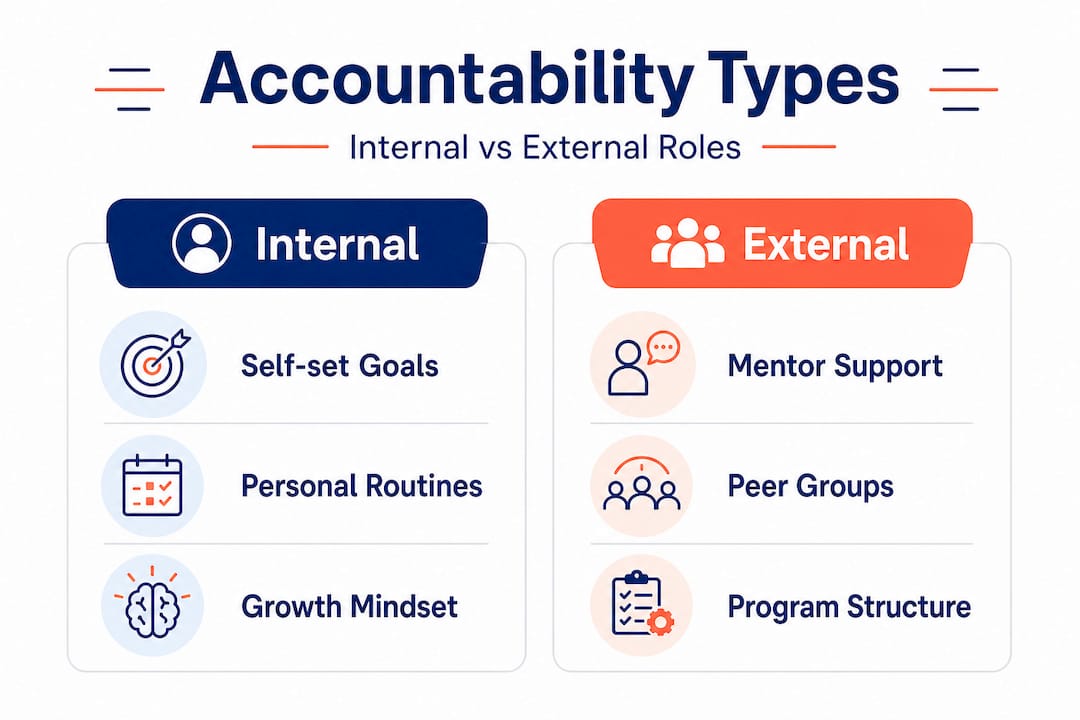
External accountability comes from the environment around you. It might be a business coach who checks in on your progress weekly, a peer group that expects you to report your results, or an investor who monitors your milestones. External accountability is powerful because social commitment activates a different kind of motivation. Telling someone else what you will do raises the psychological stakes.
| Feature | Internal accountability | External accountability |
|---|---|---|
| Source | Self-set goals and values | Others: coaches, peers, investors |
| Primary focus | Short-term execution and habits | Long-term goals and positioning |
| Motivation driver | Intrinsic commitment | Social obligation |
| Consistency | Requires strong self-discipline | Can be inconsistent if external support wavers |
| Best for | Daily operations, personal growth | Strategic milestones, brand-building |
Research supports an interesting contrast between the two. External accountability shifts focus toward longer-term objectives like branding and market positioning, while internal accountability tends to prioritize short-term execution and immediate revenue. Neither approach is superior on its own. The most effective entrepreneurs learn to use both strategically, deploying external accountability for big-picture direction while relying on internal accountability for daily discipline.
The benefits of strong internal accountability, specifically through what researchers call self-efficacy (your belief in your ability to achieve goals), are well documented. Entrepreneurs with high self-efficacy see startup survival increase by 4.1%, along with measurable gains in income, hiring, and innovation.
“The most dangerous gap in early-stage entrepreneurship is not a lack of ideas or resources. It is the gap between what a founder says they will do and what they actually do each day.”
Key characteristics that distinguish each type in practice:
- Internal accountability develops resilience because it does not depend on external conditions
- External accountability is highly effective for breaking through stagnation and blind spots
- The two work best as a system, not as substitutes for each other
- Building a daily accountability process that integrates both creates compounding results over time
- The goal setting impact on accountability is significant — without clear goals, neither form of accountability has a clear target
Why accountability drives innovation and survival
Knowing how accountability presents itself, let’s see what it actually does for business outcomes, because the evidence here is genuinely striking.
The connection between self-efficacy and measurable business results has been studied across thousands of entrepreneurs. The data shows a consistent pattern: founders who operate with strong internal accountability do not just feel more confident. They produce objectively better outcomes.
| Business outcome | Impact of strong self-efficacy |
|---|---|
| Startup survival | +4.1% increase |
| Personal income | +7.9% increase |
| Hiring probability | +8.8% increase |
| Innovation (patents filed) | +18.4% increase |
These figures from entrepreneurship research reveal something worth sitting with: accountability does not just improve discipline. It drives innovation. Why? Because a founder who owns their outcomes is far more likely to take calculated risks, experiment with new approaches, and push through the uncertainty that precedes breakthroughs.
Here is how accountability translates into those results in practice:
- Accountability creates follow-through. When you commit clearly to specific actions, you are far more likely to complete them. Completion builds momentum, and momentum is what moves a business forward.
- Accountability improves learning speed. Founders who review their outcomes honestly, without deflecting blame, learn from failures faster than those who rationalize poor results.
- Accountability attracts talent. People want to work with and for founders who operate with integrity and clarity. A reputation for doing what you say you will do is a hiring advantage.
- Accountability supports innovation. Ownership of outcomes creates psychological safety for experimentation. If you are not afraid to own a failure, you are more willing to try something new.
- Accountability signals credibility. Investors, partners, and customers all pay attention to whether a founder operates with consistency and transparency.
Developing a growth mindset works hand in hand with accountability, because both require the ability to view setbacks as data rather than verdicts. Entrepreneurs who combine a growth-oriented perspective with strong accountability habits build businesses that adapt and endure.
It is also worth noting that accountability is a learnable skill. Organizations like youth entrepreneurship programs are building these habits in young people precisely because the earlier you internalize accountability, the more powerful it becomes over time. The same principle applies to adult founders. It is never too late to develop the skill, and the returns grow the longer you practice it.

The entrepreneurship skills that lead to successful launches almost always include some form of structured accountability, whether founders recognize it explicitly or not. And effective goal setting strategies give your accountability practice a clear direction so your discipline is channeled toward outcomes that matter.
Building an accountability framework for entrepreneurs
With outcomes proven, here’s how you can implement entrepreneurial accountability in your own business. The key is to make it structural, not motivational. Relying on willpower alone is fragile. A well-designed framework creates the conditions for consistent follow-through regardless of how you feel on any given day.
Follow these steps to build an accountability system that holds up under real business pressure:
- Define your goals with specificity. Vague goals produce vague accountability. Instead of “grow my business,” commit to “acquire five new clients by the end of Q3.” Precision gives you something concrete to measure against.
- Create a daily check-in ritual. Every morning, write down the three most important actions you will take that day. Every evening, review what you completed and what you did not. This simple habit closes the loop between intention and execution.
- Establish a weekly review process. Set aside time each week to assess progress against your goals, identify what is working, and decide what needs to change. Weekly reviews prevent small drifts from becoming major course corrections.
- Build in external accountability at key milestones. Find a mentor, peer group, or advisor who will hold you to your stated commitments at meaningful intervals, such as monthly or quarterly. This is not about replacing your internal system but reinforcing it.
- Create a consequence structure. Accountability without consequences is just intention. Decide in advance what happens when you do not follow through, whether that is financial, social, or behavioral, and what happens when you do.
- Review and adjust your framework quarterly. Your business will change, and your accountability system should evolve with it. Build a regular audit into the process so the framework remains relevant and effective.
Pro Tip: One of the most common mistakes early-stage founders make is treating accountability as a performance they do for others rather than a system they run for themselves. If your accountability practice disappears the moment no one is watching, it is external accountability disguised as internal discipline. The fix is to build habits so embedded in your daily routine that they feel automatic.
Connecting your framework to structured entrepreneurship principles gives your accountability system a scaffolding that supports growth at each stage of your business. Structure is not a constraint. It is what makes freedom sustainable.
The research reinforces the value of this approach. Founders who develop strong self-efficacy through consistent accountability practices are measurably more likely to survive, earn more, hire effectively, and innovate at a higher rate.
Rethinking accountability: Practical truths for new entrepreneurs
Here is something most accountability articles will not tell you. Many new entrepreneurs rush to set up external accountability structures, hiring coaches, joining masterminds, and building reporting systems, before they have ever genuinely held themselves accountable for a single week. That sequence tends to backfire.
External accountability is amplifying. It makes your existing habits stronger. If those habits are weak or inconsistent, external accountability amplifies inconsistency. You end up performing accountability for your coach or peer group without actually internalizing the discipline. The result is a cycle of short bursts of effort followed by drift, rather than genuine sustained progress.
The personal ownership mindset is not just a motivational concept. It is the operating system every founder needs before they can benefit from external structures. When you genuinely believe the buck stops with you, you stop waiting for someone else to create the conditions for your success. That shift is subtle but transformative.
There is also an unexpected benefit to developing internal accountability early. It builds what might be called “outcome literacy,” the ability to read your own results accurately and without emotional distortion. Most founders, when they fall short, instinctively look for an external explanation. The economy shifted. A competitor undercut them. Their timing was off. Some of those explanations may even be true. But founders with strong internal accountability ask a harder question first: “What did I control, and did I execute on it?” That question leads to faster learning, smarter iteration, and compounding improvement over time.
External accountability has its place. Peer groups, mentors, and structured programs can dramatically accelerate your growth, particularly when you are navigating unfamiliar territory or need perspectives you cannot generate from inside your own experience. But treat these as accelerants, not substitutes. Build the foundation of daily accountability yourself first, and then bring in external structures to amplify what you have already built.
Ready to accelerate your entrepreneurial journey?
Accountability is a skill that grows fastest when it is practiced inside a community of driven founders who are all committed to the same standard of follow-through. Nomad Excel’s entrepreneurship bootcamps are built around exactly this principle: daily accountability, structured sprints, and real-world execution in an environment where every participant is invested in each other’s success. If you want to understand how expert guidance, peer accountability, and immersive learning can transform your growth trajectory, explore the mentorship program guide to see what structured support looks like in practice. For flexible access to the same frameworks and community from anywhere, the online entrepreneurship bootcamp brings the full experience to you wherever you are building.
Frequently asked questions
How does accountability improve startup survival rates?
Entrepreneurial accountability, particularly the internal kind, strengthens self-efficacy, and stronger self-efficacy has been shown to increase startup survival by 4.1% while improving income, hiring outcomes, and innovation rates significantly.
What is the difference between internal and external accountability?
Internal accountability is driven by your own commitments and self-set standards, while external accountability comes from obligations to others such as coaches, investors, or peer groups. Research indicates that external accountability tends to shift focus toward longer-term goals like branding, while internal accountability prioritizes short-term execution.
Why should entrepreneurs develop accountability before scaling teams?
Without a personal ownership mindset already in place, team accountability systems often become performative rather than functional. The personal ownership principle establishes that the foundation must be solid before it can support a larger structure.
How can I build an accountability framework for my business?
Start with precise goal-setting, establish a daily check-in ritual, and create a structured weekly review process. Research consistently shows that founders who build strong self-efficacy habits through consistent accountability practices outperform those who rely on motivation or external pressure alone.
Comments are closed.