
Step by Step Goal Setting for Entrepreneurs Success
Setting out to launch a business can leave even the most determined entrepreneur feeling pulled in a hundred directions at once. Without a clear structure, dreams can fade under the weight of daily decisions and inevitable setbacks. Building on proven frameworks, this guide walks you through crafting a guiding vision and actionable goals that transform ideas into measurable progress. Discover how effective goal-setting turns determination into momentum so your next steps are always grounded in purpose.
Table of Contents
- Step 1: Define Your Business Vision
- Step 2: Break Down Long-Term Goals
- Step 3: Set Specific Action Steps
- Step 4: Establish Accountability Systems
- Step 5: Review and Adjust Progress
Quick Summary
| Key Point | Explanation |
|---|---|
| 1. Define your business vision | Establish a clear vision based on the specific problem you solve and your motivation to address it. |
| 2. Break down long-term goals | Transform large targets into manageable yearly and quarterly milestones for better focus and actionability. |
| 3. Set specific action steps | Identify measurable actions needed to achieve quarterly goals and prioritize the most impactful tasks. |
| 4. Establish accountability systems | Regularly review progress with partners or groups to maintain focus and adjust plans as necessary. |
| 5. Review and adjust progress | Conduct quarterly reviews to assess goals, identify obstacles, and make informed adjustments based on outcomes. |
Step 1: Define Your Business Vision
Your business vision is the foundation for everything you build. It’s the clear picture of what your business exists to achieve and the impact you want to create. Without it, you’re navigating without a map.
Start by asking yourself one core question: What problem are you solving, and why does it matter to you? This isn’t about crafting a polished mission statement yet. It’s about getting honest with yourself about your true motivation.
Your vision serves as a guiding force for decisions. When opportunities come your way (and they will), your vision filters them. It tells you what aligns with your direction and what to pass on. Understanding entrepreneurial vision’s role/01%3A_The__Entrepreneurial_Perspective/1.02%3A_Entrepreneurial_Vision_and_Goals) helps you see how clarity now saves time and confusion later.
Here’s what to include in your vision statement:
- The specific problem you’re addressing (not vague, but concrete)
- Who you’re helping and why they need it
- The change or outcome you want to create
- Why this mission personally drives you
Write freely without self-editing. You can refine language later. The goal is to capture the real substance of what you’re building.
Your vision must be clear enough to guide decisions and compelling enough to sustain you through tough moments.
Don’t overthink perfect wording at this stage. Clarity beats polish. Many entrepreneurs revise their vision within the first few months as they learn more about their market and customers. That’s normal and healthy.
Once you have a rough draft, test it by explaining your vision to someone in your bootcamp cohort. If they’re confused or it sounds generic, you need to go deeper. Specificity is what makes a vision real.
Pro tip: Write your vision as a single paragraph describing the future state your business creates, not as corporate jargon. Read it aloud—if it doesn’t energize you, keep revising until it does.
Step 2: Break Down Long-Term Goals
Long-term goals can feel overwhelming. A five-year revenue target or scaling to ten employees sounds massive when you’re starting out. Breaking them into smaller, manageable pieces transforms them from intimidating into actionable.
Start by identifying your primary long-term goal. This is what you want to achieve in three to five years. Be specific: not “grow the business” but “reach $500,000 in annual revenue” or “build a team of five people.”
Now work backward. How to set business goals for growth requires dividing your big target into yearly milestones that feel achievable. If your five-year goal is $500,000 in revenue, what does year one need to look like? Year two? Write these down.

Once you have yearly targets, break those into quarterly goals. This is where the real momentum builds. Quarterly goals are close enough to stay urgent without being so immediate that they feel reactive.
Here’s the breakdown process:
- Write your long-term goal clearly
- Divide it into yearly milestones
- Break each year into quarterly targets
- Identify the key metrics that prove progress
Your long-term goal guides direction, but quarterly goals create momentum.
Don’t aim for perfection in these numbers. You’re making educated guesses based on what you know now. As your business evolves, these targets will shift, and that’s fine. The structure itself is what matters.
Test your breakdown by checking if each quarterly goal logically leads to the next. If jumping from Q1 to Q2 requires a massive leap with no clear bridge, you need another intermediate goal or a different approach.
Share your quarterly goals with your bootcamp mentor or accountability partner. They’ll spot unrealistic expectations faster than you will and help you refine the sequence.
Pro tip: Use a simple spreadsheet to map your goals across years and quarters, then review it monthly to track progress and adjust as reality teaches you what’s actually possible.
Step 3: Set Specific Action Steps
Goals stay abstract until you translate them into concrete actions. “Increase sales by 30% this quarter” sounds great on paper, but what actually gets you there? Specific action steps do.
Start by listing everything required to hit your quarterly goal. Don’t filter yet—just dump ideas. Need more customers? List every channel: social media, email outreach, partnerships, paid ads, referrals. Need to improve product quality? List testing phases, feedback sessions, revisions.
Now prioritize ruthlessly. You have limited time and energy. Transforming goals into specific, measurable action steps means identifying the three to five actions with the highest impact. Skip the nice-to-have tasks. Focus on what directly moves the needle.
For each priority action, define exactly what success looks like. Not “improve marketing” but “publish two blog posts per week” or “send three outreach emails daily.” Measurable targets keep you accountable.
Break bigger actions into smaller, weekly tasks:
- Task one identifies what needs to happen
- Task two specifies who owns it
- Task three sets the deadline
- Task four includes a success metric
Vague actions create vague results. Specificity creates momentum.
Write your action steps where you’ll see them daily. A shared document, a project management tool, or even a whiteboard on your desk works. The format matters less than visibility.
Your bootcamp community helps here. Share your action steps and ask if they’re specific enough. If someone says “I don’t understand exactly what you’re doing,” your steps need clarification.
Review progress weekly. Did you complete the actions? If not, why? Adjust next week’s plan based on reality, not intention.
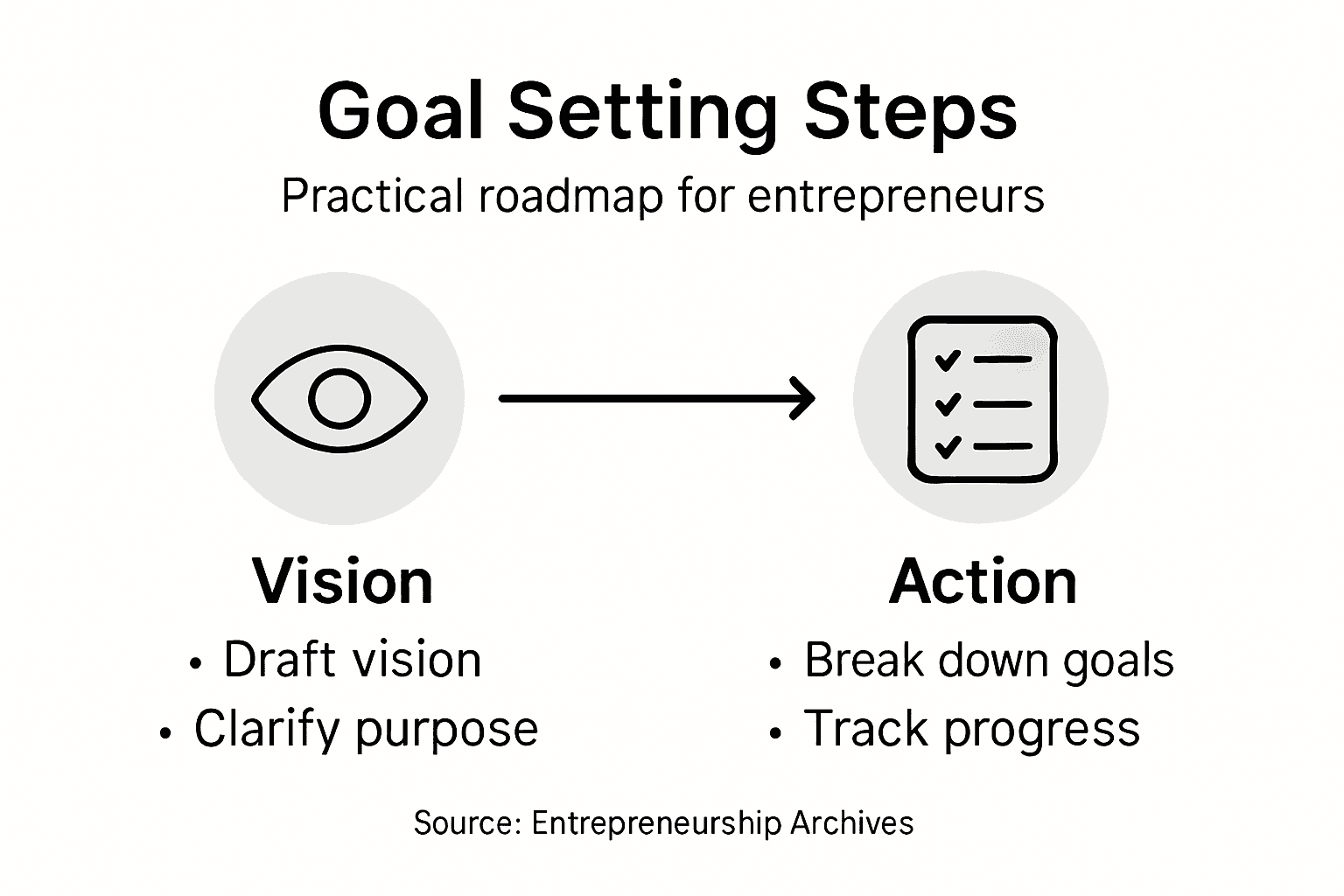
Pro tip: Assign each action step an owner and a hard deadline, then share it publicly with your accountability group—this transforms vague intentions into commitments with real consequences.
Step 4: Establish Accountability Systems
Having goals is one thing. Actually hitting them requires accountability. Without systems to track progress and measure results, goals drift into the background while urgent tasks consume your attention.
Accountability means having regular review cycles built into your routine. Weekly check-ins work best for most entrepreneurs. Block thirty minutes every Monday morning to ask three questions: Did I complete last week’s action steps? If not, why? What’s blocking progress?
Create a simple tracking document. List your quarterly goals at the top, then track weekly progress against your action steps. Regular review and adjustment of goals based on measured progress prevents you from drifting off course without noticing.
Pick an accountability partner or join an accountability group. This is non-negotiable. Someone outside your head sees things you miss and calls you on excuses. Your bootcamp cohort is perfect for this. Choose someone equally committed and meet biweekly to discuss goals and obstacles.
Your accountability system needs these elements:
- A clear tracking method (spreadsheet, app, document)
- Weekly personal review time
- Biweekly or monthly check-ins with your partner
- Honest conversations about what’s working and what’s not
- Permission to adjust goals when reality changes
Accountability transforms goals from wishes into commitments.
Don’t make accountability punitive. The goal is learning, not shaming. If you miss a target, the conversation is “What happened and what do we change?” not “You failed.” This keeps momentum alive even when progress is slower than planned.
Measure what matters. Track revenue, customers, team growth, or completion of key projects—whatever proves your quarterly goal is getting closer. Vanity metrics feel good but don’t drive real progress. Focus on outputs that matter to your business.
How to stay accountable as an entrepreneur shows how consistent review prevents losing momentum and keeps your business moving forward.
Pro tip: Share your weekly progress publicly in your bootcamp Slack or group chat, even if progress is slow—social visibility creates accountability that internal tracking alone never will.
Compare the benefits of personal vs. group accountability in business goal tracking:
| Accountability Type | Main Benefit | Potential Challenge |
|---|---|---|
| Personal | Flexible self-paced reflection | Easy to lose focus alone |
| Group/Partner | External motivation and feedback | Requires mutual commitment |
| Public Progress Share | Increases visibility and pressure | May feel intimidating weekly |
Step 5: Review and Adjust Progress
Goals aren’t set-it-and-forget-it. The market changes, your business learns new things, and circumstances shift. Regular review ensures your goals stay relevant and your actions stay aligned with reality.
Schedule a formal review every quarter. This is different from your weekly check-ins. During quarterly reviews, you zoom out and assess the bigger picture. Did your quarterly goal move forward? Did market conditions change? Did you discover new opportunities or obstacles?
Monitoring key metrics and adapting action plans ensures you stay resilient and improve outcomes even when setbacks occur. Look at the data honestly. What worked? What didn’t? Why?
Start your review by comparing actual results to your projections. You hit 70% of your target instead of 100%. That’s useful information. Ask yourself what caused the gap. Was the goal unrealistic? Did you lack the resources? Did unexpected competition emerge? Did your team struggle with execution?
Your quarterly review should cover these areas:
- Actual results versus projected targets
- Obstacles that slowed progress
- Wins worth celebrating and repeating
- Market or customer feedback that emerged
- Resource constraints you discovered
Honest assessment of what happened beats optimistic planning for what should happen.
Now adjust. If your goal was too ambitious, lower it. If you discovered a faster path to success, accelerate it. If the market moved, reposition your goals accordingly. Reflection on successes and failures helps businesses realign strategies and stay agile.
Involve your accountability partner in this conversation. They provide perspective you can’t see solo. Sometimes you’re too close to the situation to assess it fairly.
Don’t view adjustment as failure. It’s evidence you’re learning. The entrepreneurs who win are those who adapt fastest based on real data, not the ones who stick rigidly to original plans.
Pro tip: Document your review findings in writing and share them with your bootcamp mentor or peer group, then commit to one specific change you’ll make next quarter based on what you learned.
Here’s a summary of how each step contributes to sustainable business growth:
| Step | Main Contribution | Key Outcome |
|---|---|---|
| Define Your Vision | Creates clarity and direction | Purpose-driven decisions |
| Break Down Goals | Makes big targets manageable | Achievable milestones |
| Set Specific Action Steps | Translates goals into daily work | Measurable progress |
| Establish Accountability | Maintains focus and momentum | Consistent execution |
| Review and Adjust Progress | Keeps goals relevant and effective | Continuous improvement |
Accelerate Your Entrepreneurial Journey with Nomad Excel
Setting clear goals and establishing accountability are core challenges every entrepreneur faces on the path to success. If you’ve struggled to break down overwhelming long-term goals, translate them into actionable steps, or maintain momentum through regular progress reviews this article’s insights will resonate with you. At Nomad Excel we understand these pain points deeply and provide immersive bootcamps designed to embed these exact frameworks into your daily business practice.
Join our Entrepreneurship Archives community and experience hands-on mentorship, structured accountability systems, and a vibrant network of driven founders who will help you transform your vision into measurable results. Don’t wait for clarity and execution to happen by chance take the step today and unlock accelerated growth by visiting https://nomadexcel.co. Your entrepreneurial success starts with action—make it real now.
Frequently Asked Questions
What are the key components of a business vision for entrepreneurs?
Your business vision should clearly define the specific problem you’re addressing, who you’re helping, the change you want to create, and why this mission matters to you. Start by writing a rough draft that captures your true motivation, ensuring it’s specific enough to guide your decisions.
How can I break down long-term goals into manageable steps?
To break down long-term goals, start by identifying your primary long-term goal and then divide it into yearly milestones. For example, if your goal is to reach $500,000 in annual revenue, outline what you need to achieve in each year and quarter to stay on track.
What specific action steps should I take to achieve my quarterly goals?
List all the actions required to meet your quarterly goals without filtering. Then prioritize the top three to five actions that will have the highest impact and define clear success metrics for each to hold yourself accountable.
How can I create an effective accountability system for my business goals?
Establish a regular review cycle, such as weekly check-ins, to track your progress against your goals. Pick an accountability partner to meet biweekly and openly discuss your goals and obstacles, ensuring you stay committed and make necessary adjustments.
How often should I review and adjust my business goals?
Schedule a quarterly review to assess your progress and determine if your goals remain relevant. Analyze the results compared to your projections, identify any obstacles, and adjust your goals based on what you’ve learned to stay agile and focused.
What should I do if I don’t meet my goals?
If you miss your goals, assess what factors contributed to the gap honestly. Use this reflection to adjust your targets and action steps to be more realistic and aligned with your current business situation.
Recommended
- 7 Essential Goal Setting Tips for Entrepreneurs’ Success
- Goal Setting’s Impact on Entrepreneur Success
- How to Set Business Goals for Entrepreneur Growth
- How to Build a Growth Mindset for Entrepreneurial Success
- The 7 Most Common Mistakes Companies Make When Starting a Digital Project – Agifly Posts
- How to Manage Client Expectations Effectively in 2025
Comments are closed.