
Why clarity is the real edge for startup founders
TL;DR:
- Most startup failures result from poor decision-making rooted in muddled thinking rather than flawed ideas. Clarity of thought is essential for making confident decisions, articulating value, and building trust with investors and teams. Developing structured habits and seeking community support are key to cultivating genuine clarity and avoiding common pitfalls.
Many promising businesses collapse not because the ideas were flawed, but because founders made critical decisions from a place of muddled thinking. Investors, accelerators, and seasoned operators consistently single out one trait as a reliable predictor of startup quality: clarity of thought. Yet most early-stage entrepreneurs misunderstand what clarity actually means, chasing certainty when they should be building structured understanding. This article breaks down what clarity in entrepreneurship truly is, why it shapes outcomes at every stage, and the specific habits and frameworks you can use to develop it deliberately.
Table of Contents
- Why clarity matters in entrepreneurship
- What clarity actually means for founders
- When clarity can mislead: Avoiding common traps
- Building lasting clarity: Practical frameworks and community habits
- What most founders get wrong about clarity
- Develop clarity with expert support and community
- Frequently asked questions
Key Takeaways
| Point | Details |
|---|---|
| Clarity drives results | Founders with real clarity of thought make better decisions that boost hiring, funding, and growth. |
| Clarity is multifaceted | Success comes from mapping your own clarity formula, not seeking one right answer. |
| Balance clarity and vision | Sometimes expanding perspective matters more than narrowing in for simple clarity. |
| Clarity is a learned habit | Ongoing reflection, community feedback, and structured learning all help build lasting clarity. |
Why clarity matters in entrepreneurship
Having raised the importance of clarity, let’s look at specifically why it serves as a competitive edge for entrepreneurs. Clarity is not a soft, feel-good concept. It directly shapes the quality of every decision a founder makes, from who they hire to how they pitch investors and how they structure daily operations.
“Founder clarity of thought is treated as a key sifter for startup quality because many downstream outcomes, including hiring, sales, and fundraising, all rely on it.”
When you speak clearly about your business model, the right candidates self-select. When you articulate your problem space with precision, investors trust that you understand your market deeply. When your operational decisions reflect a coherent strategy, your team executes with confidence rather than second-guessing every move. Clarity is the throughline that makes all of these outcomes possible.
Cultivating the right founder mindset and clarity is especially vital in the earliest stages, when resources are thin and every decision carries outsized consequences. Acting without clarity at this stage is like navigating without a map. You might make progress, but you are burning fuel you cannot afford to waste.
Signs of clarity among high-performing founders:
- They can describe their core customer problem in one or two precise sentences.
- They articulate what success looks like for the next 90 days without vague language.
- They admit what they do not yet know and have a process for finding out.
- Their team members can accurately summarize the company’s top priorities without being coached.
- They change their minds based on data, not social pressure or wishful thinking.
Common mistakes when acting without clarity:
- Hiring generalists when a specific skill gap is the real bottleneck.
- Launching marketing campaigns before the target audience is well-defined.
- Chasing investor meetings before the business model is legible to an outsider.
- Pivoting on gut instinct without testing the underlying assumption first.
Bringing structured entrepreneurship into your process is one of the most effective ways to build clarity systematically rather than hoping it appears on its own.
What clarity actually means for founders
With the stakes established, it is critical to define what clarity looks like and does not look like for real-world founders. Many people conflate clarity with confidence. They walk into a pitch full of conviction, believing that projecting certainty is the same thing as thinking clearly. These are not the same.
Clarity means identifying your core drivers and mapping how they interact, without insisting there is only one correct answer. It means holding a working model of your business loosely enough to update it when reality pushes back. True clarity is structural, not emotional.
A cognitive and social mechanisms study on entrepreneurial opportunity evaluation found that success is not driven by a single “clearly correct” trait. Instead, multiple interdependent cognitive and social mechanisms combine in different configurations to produce strong opportunity beliefs and expected returns. This concept, called equifinality, means there is no single blueprint for founder clarity. Different combinations of traits and thinking patterns can all lead to the same high-quality outcomes.
This is an important and often liberating insight. You do not need to become a certain type of person to think clearly. You need to develop the habits and structures that surface your best thinking, whatever form that takes for you.
Different clarity types that lead to entrepreneurial success:
| Founder type | Primary clarity mechanism | Common outcome |
|---|---|---|
| Analytical | Data-driven hypothesis testing | Precise product-market fit |
| Relational | Customer empathy and network feedback | Strong early adoption |
| Visionary | Clear long-term narrative with flexible tactics | Investor confidence |
| Systems thinker | Process mapping and operational clarity | Scalable operations |
Each of these founders demonstrates clarity differently, but all of them share a structured approach to understanding their situation. The founder journey map looks different for each type, but the underlying discipline of honest self-assessment is consistent across all of them.
Steps to building clarity as an individual founder:
- Write down your current working model. Articulate your core assumption about who your customer is, what problem you solve, and why your solution is meaningfully better than alternatives.
- Identify the three assumptions most critical to your model. These are your highest-risk beliefs. Everything else depends on whether these are true.
- Design a minimum test for each assumption. A small, cheap experiment that gives you real signal within two to four weeks.
- Review your model weekly. Update it based on what you learned, not what you hoped to find.
- Seek outside perspective monthly. A peer, mentor, or structured group that will challenge your assumptions without agenda.
Investing in your entrepreneurship education at this stage is not a luxury. It is one of the fastest ways to accelerate the clarity-building process by learning from people who have already made the costly mistakes you are trying to avoid.

Pro Tip: Do not confuse confidence with clarity. Confidence is an emotional state. Clarity is an analytical one. A founder who sounds certain but has not stress-tested their assumptions is operating on wishful thinking, which is one of the most common and damaging blind spots in early-stage businesses.
When clarity can mislead: Avoiding common traps
Understanding the dual-edged nature of clarity is key to using it wisely. Here is how to spot and avoid the most common traps founders fall into when they pursue clarity without nuance.
Clarity is powerful, but it can also narrow your vision at exactly the wrong moment. The drive to simplify is natural and often helpful, but it becomes a liability when it causes you to shut down creative exploration before you have fully understood the problem.
As one candid look at founder decision-making notes, sometimes expanding the problem with vision and grounded naming of reality is the actual need, rather than contracting into more clarity. This is a counterintuitive but important distinction. Some problems are genuinely complex, and the answer is not to reduce them to something manageable but to develop a bigger, more honest view of what you are actually dealing with.
Healthy clarity vs. premature clarity:
| Situation | Healthy clarity | Premature clarity |
|---|---|---|
| Early customer research | “We have three distinct customer hypotheses to test” | “We know exactly who our customer is” (after two conversations) |
| Product direction | Clear prioritization based on tested insights | Locking scope before validating the core need |
| Competitive positioning | Grounded view of where you genuinely differ | Oversimplifying competitors to feel more confident |
| Fundraising narrative | Honest, evidence-based story with known unknowns | Polished pitch that papers over unresolved risks |
Developing growth with clarity means knowing when to narrow your focus and when to expand it. These are genuinely different skills, and the better founders are fluent in both.
Classic pitfalls of premature clarity:
- Confusing simplicity with truth. A clean narrative feels good, but if it leaves out uncomfortable facts, it creates blind spots that compound over time.
- Shutting down brainstorming too early because you feel you already know the answer.
- Treating your current business model as settled before you have enough market evidence to justify that confidence.
- Using clarity as a reason to avoid difficult conversations with co-founders or customers.
Strengthening your mindset frameworks for founders is one of the most effective ways to build the mental flexibility needed to tell the difference between genuine clarity and premature simplification. These frameworks give you language for what you are experiencing, which makes it much easier to catch yourself before a costly mistake.
Pro Tip: Before searching for clarity, pause and ask yourself whether you are facing ambiguity or true complexity. Ambiguity means you need more information. Complexity means the situation has many interacting parts that will not reduce to a simple answer. These two situations call for completely different responses, and conflating them is where many founders go wrong.
Building lasting clarity: Practical frameworks and community habits
Equipped with the results and perils of clarity, here is how you can build and sustain it through concrete, repeatable habits. The good news is that clarity is not something you either have or do not have. It is a practice, and like any practice, it responds to consistency and good structure.
Research on entrepreneurial opportunity evaluation confirms that founder clarity impacts multiple critical areas, including how you assess opportunities and the returns you ultimately expect. This means building clarity is not just a personal growth exercise. It is a direct driver of business performance.
Actionable habits for developing founder clarity:
- Daily decision journaling. Spend five minutes each evening writing down the one most important decision you made that day and why. Over time, you will start seeing patterns in your thinking, including recurring blind spots.
- Weekly hypothesis review. Review your top three business assumptions and record any new evidence that supports or contradicts them. Keep this document visible and honest.
- Monthly peer review sessions. Share your current working model with a small group of peers who will push back on your logic. Clarity built in isolation is fragile. Clarity tested by real people is durable.
- Quarterly model resets. Set aside two hours to revisit your core business model from scratch. Ask whether you would make the same foundational choices today that you made three months ago. Often the answer is no, and that is valuable information.
- Mentor feedback loops. Work with someone who has built businesses before. Expert trainers in entrepreneurship can accelerate your clarity curve significantly because they have pattern recognition you are still building.
Resources and structures that support ongoing clarity:
- Mentorship relationships with founders who are two or three stages ahead of you.
- Structured education programs and hands-on entrepreneurship experiences that give you frameworks rather than just inspiration.
- Mastermind groups where accountability and honest feedback are built into the format.
- Bootcamps that combine learning with real execution in a compressed, high-feedback environment.
- Books and courses focused on decision-making, mental models, and cognitive bias.
Understanding why you should invest in business education goes beyond credentials. A strong educational environment accelerates clarity by forcing you to articulate your thinking, test it against new ideas, and learn from the experience of people who have navigated similar challenges.
Community matters more than most founders expect. When you are surrounded by peers who are equally committed to honest, structured thinking, clarity becomes a shared standard rather than a personal aspiration. You hold each other to it. That social accountability is one of the most powerful and underrated clarity-building tools available to early-stage entrepreneurs.
What most founders get wrong about clarity
After working through these insights and frameworks, it is time to look candidly at where founders most often go astray in their quest for clarity. The honest answer is that most founders pursue the wrong version of it entirely.
Clarity is widely understood as certainty. Founders feel they lack clarity when they feel uncertain, and they seek clarity as a way to feel certain again. But this is a fundamental misreading of what clarity actually does. The most effective founders we observe are not the ones who feel certain. They are the ones who have a clear working model of their situation and the intellectual honesty to update it regularly. That is a very different posture.
Rigid clarity is a closed door. When you believe you have figured something out completely, you stop being curious about it. You stop noticing the signals that might tell you your model is drifting from reality. The best founders treat clarity as a tool to surface assumptions, not a destination to reach and then rest in.
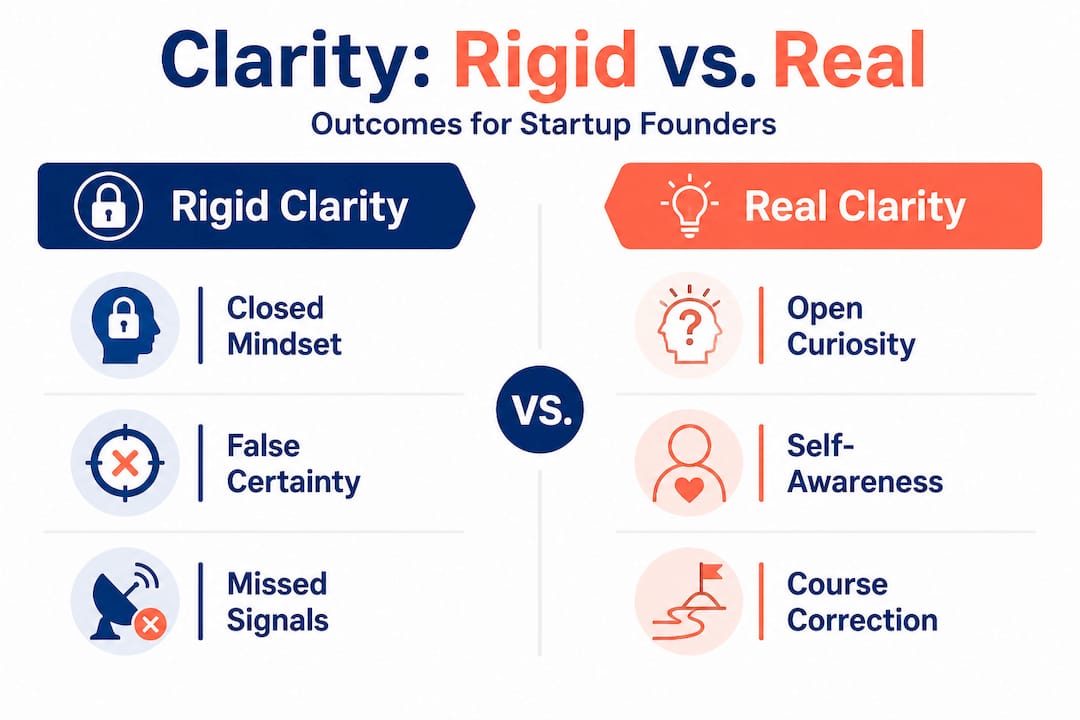
The recommended adjustment is to expand using vision and grounded reality-naming, so that clarity becomes about direction and truth rather than the comfort of feeling settled. This is a more demanding standard, and it is also a more useful one. It keeps you honest when the market surprises you, and it keeps you agile when the original path stops working.
Real clarity is the absence of self-deception, not the absence of ambiguity. The founders who internalize this distinction tend to build more resilient companies because they are genuinely oriented toward truth rather than toward feeling good about their current plan.
Develop clarity with expert support and community
For aspiring founders ready to take action, the most effective next step is finding an environment where clarity is built with structure, feedback, and community rather than pursued in isolation. That is exactly what Nomad Excel designs its programs around. Whether you are joining an online entrepreneurship bootcamp to sharpen your strategy or exploring why to join an entrepreneurship bootcamp to understand what immersive learning can do for your business, you will find that the Nomad Excel model puts clarity, execution, and accountability at the center of every experience. The Nomad Excel community brings together driven founders who challenge each other’s thinking, share honest feedback, and grow faster together than any of them would alone.
Frequently asked questions
Is clarity a personality trait or a skill in entrepreneurship?
Clarity is a skill that founders can build through practice, reflection, and structured frameworks, since entrepreneurial success relies on multiple interdependent mechanisms rather than any single inborn trait.
Can having too much clarity ever be a problem for startup founders?
Yes. Over-focusing on clarity can narrow your thinking at exactly the wrong moment, and sometimes expanding the problem rather than contracting into more certainty is what the situation actually calls for.
How can I practice developing clarity as an entrepreneur?
Build consistent habits like daily decision journaling, weekly hypothesis reviews, and structured peer feedback sessions, since founder clarity shapes opportunity evaluation and expected returns across every stage of your business.
Do investors really prioritize clarity over other founder traits?
Yes. Clarity of thought is treated by investors as a fundamental signal for startup quality because so many critical outcomes, from hiring to fundraising, depend directly on a founder’s ability to think and communicate clearly.
Recommended
- Structured Entrepreneurship: Accelerate Growth With Clarity
- Founder mindset: The real key to startup success
- 7 Must-Have Founder Skills for Aspiring Entrepreneurs
- Mindset shifts for founders: 7 frameworks to grow startups
- Enterprise-Grade Engineering for Founders | H-Studio
- balancing innovation clarity and time in an ai-driven world
Comments are closed.