
Purpose-driven entrepreneurship: build impact and profit
TL;DR:
- Most founders believe they must choose between doing good and building a profitable business, but purpose-driven companies grow faster and achieve higher ROI. Authentic integration of purpose into operations attracts talent, loyal customers, and resilient growth, creating a competitive advantage. Building a truly impact-driven business requires ongoing self-examination, structured systems, and community support to maintain authenticity and avoid mission drift.
Most founders assume they have to choose between doing good and building a profitable business. That assumption is one of the most costly mistakes in modern entrepreneurship. Research shows that purpose-led companies grow 2.3x faster, with 58% more revenue growth and 63% higher ROI on capital than their traditional counterparts. Purpose and profit aren’t opposing forces. When integrated authentically, purpose becomes the engine that drives growth, attracts top talent, and builds the kind of resilient businesses that thrive even when the market gets rough. This guide breaks down exactly what purpose-driven entrepreneurship is, why the evidence so strongly supports it, and how you can put it into practice starting today.
Table of Contents
- Defining purpose-driven entrepreneurship
- Why purpose matters: Evidence and advantages
- How to build a purpose-driven business: Step-by-step framework
- Risks and pitfalls: Authenticity, backlash, and the scaling challenge
- The real difference: Why most founders miss the mark on purpose
- Taking the next step: Community and guidance for purpose-led founders
- Frequently asked questions
Key Takeaways
| Point | Details |
|---|---|
| Purpose boosts performance | Purpose-driven businesses grow faster and outperform in revenue and innovation. |
| Define and integrate early | Clarifying your purpose from the start ensures it guides all business decisions. |
| Measure more than profit | Track both financial outcomes and your social or environmental impact for lasting success. |
| Authenticity is crucial | Superficial efforts risk backlash—real impact comes from embedding purpose in everything you do. |
| Community accelerates growth | Support, mentorship, and like-minded peers help purpose-led founders scale sustainably. |
Defining purpose-driven entrepreneurship
Purpose-driven entrepreneurship means building a business where positive impact isn’t a side project. It’s the foundation. This model overlaps with several related approaches you may have encountered, including social entrepreneurship, impact entrepreneurship, and sustainable entrepreneurship. While each has its own nuance, they all share a core commitment to generating value beyond pure financial return.
According to a detailed breakdown, purpose-driven entrepreneurship involves building businesses that prioritize positive social, environmental, or societal impact alongside financial profitability. That “alongside” is critical. This isn’t charity. It’s a business model that treats impact as a core value driver, not an afterthought.
“A purpose-driven business doesn’t sacrifice profit for impact. It recognizes that sustained positive impact requires a financially healthy enterprise, and that genuine impact is one of the most powerful competitive advantages available to modern founders.”
Purpose-driven businesses often organize themselves around one or more of the following aims:
- Environmental stewardship: reducing carbon footprints, building circular supply chains, protecting natural resources
- Community development: creating local jobs, investing in underserved communities, building infrastructure for long-term regional growth
- Social equity: expanding access to education, healthcare, financial services, or technology for historically marginalized groups
- Ethical governance: transparent operations, fair labor practices, and inclusive leadership structures
These aren’t abstract values. They shape product decisions, hiring practices, pricing strategies, and growth plans. As exploration into future entrepreneurship education evolves, purpose-driven thinking is increasingly being treated as a core entrepreneurial competency rather than a specialty track.
Why purpose matters: Evidence and advantages
With a foundational understanding in place, here’s why purpose isn’t just a philosophy. It’s a proven competitive edge.
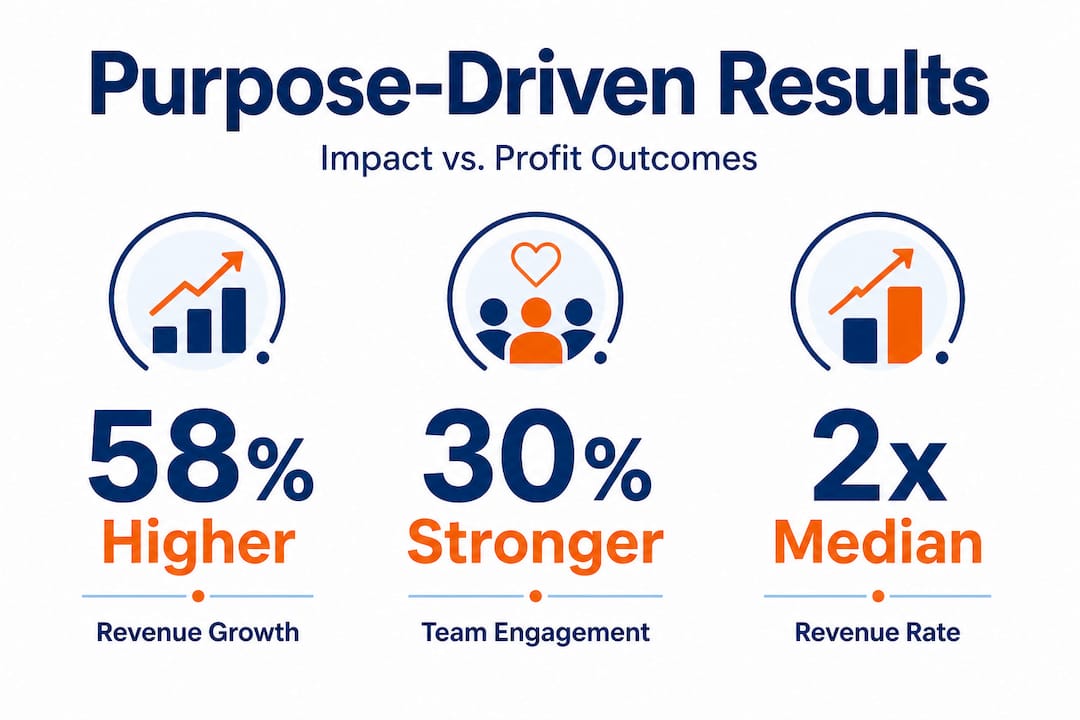
The numbers are striking. Companies with integrated purpose-driven systems report 2x higher median revenue and 30% higher innovation rates compared to peers who separate mission from operations. These aren’t marginal differences. They represent a structural advantage that compounds over time.
| Metric | Purpose-driven companies | Traditional companies |
|---|---|---|
| Revenue growth | 58% higher | Baseline |
| Innovation rate | 30% higher | Baseline |
| ROI on capital | 63% higher | Baseline |
| Revenue growth speed | 2.3x faster | Baseline |
| Performance self-reported | 69% report better performance | 28% report better performance |
The data is consistent: purpose not only proves ethical but financially superior, attracting talent, capital, and customers while also providing a stabilizing buffer during economic downturns.
Why does purpose deliver these advantages? Several mechanisms are at play:
- Talent attraction and retention: Younger professionals, especially Millennials and Gen Z, actively seek employers whose values align with their own. Purpose-driven companies report significantly lower turnover and stronger team cohesion.
- Customer loyalty: Consumers who connect with a brand’s mission buy more frequently and refer others more readily. Purpose creates emotional stickiness that transactional brands simply can’t replicate.
- Investor confidence: Impact investors and ESG-focused funds now manage trillions of dollars globally. Purpose-driven companies access a wider and often more patient capital base.
- Resilience in downturns: When revenue dips, purpose-driven companies have a mission that sustains morale and guides difficult decisions. Teams rally around a reason to persist beyond the next quarterly report.
- Regulatory favor: Governments and regulatory bodies increasingly support businesses that demonstrate environmental and social responsibility through grants, tax advantages, and preferential contracts.
Understanding these advantages isn’t just motivating. It’s a practical reason to invest in your business education benefits early, before you’ve locked yourself into a model that’s harder to pivot.
How to build a purpose-driven business: Step-by-step framework
Knowing that purpose is a business accelerator, here’s how you can embed it from the very beginning.
Research on impact entrepreneurship makes a clear recommendation: start by articulating a specific purpose that answers three questions: What change do you want to create? Who benefits from that change? What uniquely positions you to create it? From there, integration into every business element is what separates scalable impact from good intentions that stall.
Here’s a practical five-step framework to guide you:
- Discover: Reflect on your personal values, lived experience, and the problems you feel most equipped to address. Conduct interviews with your intended beneficiaries and research the systemic causes behind the problem you’re targeting.
- Define: Write a purpose statement that is specific, measurable, and tied directly to your business model. Avoid vague language like “making the world better.” Instead, say precisely what change, for whom, and how your business creates it.
- Align: Map every element of your business, including product design, pricing, hiring, supplier relationships, and marketing, back to your purpose statement. If any element contradicts your stated purpose, resolve that conflict before scaling.
- Measure: Establish both financial and impact key performance indicators (KPIs). Track revenue and profitability alongside metrics like carbon reduction, jobs created, communities served, or educational outcomes delivered.
- Scale: Build systems that allow your impact to grow proportionally with your revenue. This means documenting processes, training teams on both business and mission, and finding partners who amplify your purpose rather than dilute it.
| Stage | Key questions to answer | Useful tools |
|---|---|---|
| Discover | What problem matters most to me? Who is most affected? | Stakeholder interviews, problem mapping |
| Define | What is our specific promise of change? | Purpose statement canvas, theory of change |
| Align | Does every decision reflect our purpose? | Business model canvas, values audit |
| Measure | Are we creating the impact we promised? | Impact dashboards, dual KPIs |
| Scale | How do we grow without losing our mission? | Systems documentation, partner vetting |
Pro Tip: Avoid writing a mission statement that lives only on your website. Real purpose shows up in who you hire, what you decline to sell, how you price, and what you do when profit and impact seem to conflict. If your purpose doesn’t guide hard decisions, it isn’t really your purpose.
Studies on microenterprise resilience confirm that purpose-driven approaches build resilience in turbulent contexts by giving small and growing businesses a clear mission that guides adaptive strategies. When market conditions shift, purpose-driven founders know which core elements to protect and which to flex. That clarity is invaluable.
Applying this framework is far more effective in community with peers who are navigating the same challenges. The design principles behind experiential entrepreneur education reflect exactly this insight, prioritizing real-world application over passive learning. Similarly, the role of entrepreneur community support in sustaining founders through the discovery and alignment stages cannot be overstated.
Risks and pitfalls: Authenticity, backlash, and the scaling challenge
As you shape your business model for good, be aware of the potential obstacles that can derail even well-intentioned founders.

The greatest risk in purpose-driven entrepreneurship isn’t lack of ambition. It’s a lack of authentic integration. Research examining mission-driven founders reveals a nuanced pattern: mission-driven founders benefit more from discovery activities but face greater challenges in exploitation phases, and they risk commitment escalation, continuing to invest in a direction that isn’t working because they feel too emotionally attached to pivot. Additionally, purpose initiatives face significant backlash, including consumer boycotts, negative press, and employee disillusionment, when the stated mission doesn’t align with actual behavior.
Here are the most common pitfalls to watch for:
- Mission drift: As revenue pressure mounts, it’s tempting to make small compromises that gradually move the business away from its original purpose. Each small compromise seems reasonable in isolation, but collectively they hollow out the mission.
- Superficial statements: Launching with a powerful-sounding purpose that has no operational counterpart is arguably worse than no stated purpose at all. Stakeholders who discover the gap between words and actions become vocal critics.
- Scaling without systems: Many purpose-driven founders build great early-stage models but fail to document and systematize their impact processes. Growth then dilutes quality and accountability.
- Neglecting financial health: Overemphasis on impact at the expense of business fundamentals leads to unsustainable operations. A company that can’t survive financially can’t create long-term impact.
- Ignoring feedback loops: Purpose claims need to be tested against actual outcomes. Without structured measurement, founders can’t know whether their business is delivering real impact or simply feeling like it is.
“Superficial purpose statements are not neutral. They actively damage trust, invite regulatory scrutiny, and empower competitors who operate with genuine integration to distinguish themselves clearly in the market.”
The solution is consistent, structured accountability. Measure both financial and impact metrics regularly, and whenever possible, bring in third-party audits to validate your claims. This isn’t just about optics. It’s about genuinely knowing whether your business is doing what you set out to do.
Building a strong network of fellow founders who challenge your thinking is one of the most effective early safeguards against these pitfalls. Exploring entrepreneur networking examples reveals how even informal peer accountability structures dramatically reduce the likelihood of mission drift and blind spots.
Pro Tip: Schedule a quarterly “purpose audit” where you review the previous 90 days of business decisions against your stated purpose. Ask honestly: did we honor our mission when it cost us something? If the answer is always “yes,” you’re either incredibly disciplined or not being honest with yourself.
The real difference: Why most founders miss the mark on purpose
Understanding the pitfalls brings us to a key lesson many overlook about real, sustainable purpose-driven entrepreneurship.
Here’s the uncomfortable truth: most founders who describe themselves as “purpose-driven” are actually just purpose-adjacent. They’ve written a compelling mission statement, chosen an attractive cause, and woven that narrative into their marketing materials. But when it comes to operational decisions, hiring choices, supplier negotiations, and product tradeoffs, the purpose isn’t actually in the room.
That gap is where the real work lives. And it’s where most early-stage entrepreneurs underestimate what they’ve signed up for.
Authentic purpose-driven entrepreneurship requires something most business frameworks don’t emphasize enough: ongoing self-examination. Purpose isn’t a destination you arrive at after writing your mission statement. It’s a daily discipline. It’s the question you ask when a profitable customer relationship turns out to conflict with your environmental commitments. It’s the decision you make when a faster-growing competitor is cutting corners your values won’t allow.
The founders who build genuinely impactful and profitable companies treat purpose as the DNA of their organization, not a layer applied over the top. It shapes who gets hired and who doesn’t, what metrics matter and which get ignored, and which partnerships get pursued versus politely declined. This kind of integration is what distinguishes a sustainable mission-driven business from one that generates great press for 18 months and then quietly drifts.
The good news is that this level of integration is learnable. It’s a skill built through practice, mentorship, and honest community feedback. That’s precisely why hands-on entrepreneurship matters so much at the early stage. It puts you in situations where your purpose is tested, where you learn to make decisions under pressure, and where the gap between stated values and actual choices becomes visible and correctable before it becomes consequential.
The most successful purpose-driven founders also share a common trait: they attract exceptional teammates and partners. When your purpose is specific, credible, and embedded in how you operate, it becomes a powerful signal to the world about who you are. The right people find you and want to contribute. That’s not accidental. It’s what authentic purpose does.
Taking the next step: Community and guidance for purpose-led founders
If you’re ready to make your purpose a living part of your business, support and accountability make the difference.
Purpose-driven entrepreneurship is a demanding path, and it’s one that’s dramatically easier with the right community around you. At Nomad Excel, we’ve built our programs specifically to help aspiring and early-stage founders move from intention to execution. Whether you’re still clarifying your core purpose or actively scaling a mission-driven venture, structured mentorship and peer accountability accelerate every stage of the journey. Our online entrepreneurship bootcamp gives you hands-on frameworks, direct expert guidance, and a curated community of founders who take both impact and profitability seriously. If you’re weighing whether structured programming is the right investment for your stage, exploring why join entrepreneurship bootcamp will give you a clear sense of what to expect. Learn more about the full range of Nomad Excel programs and find the experience that fits where you are right now.
Frequently asked questions
What is the main goal of purpose-driven entrepreneurship?
The main goal is to create businesses that generate positive social, environmental, or societal impact while remaining financially viable. As one definition clarifies, purpose-driven entrepreneurship prioritizes positive impact alongside financial profitability, treating both as equally essential outcomes.
How does purpose-driven entrepreneurship improve business performance?
Purpose-led companies experience faster growth, higher revenue, and stronger innovation than traditional competitors. Research confirms that purpose-led companies grow 2.3x faster, with 58% more revenue growth and 63% higher ROI on capital, making purpose a measurable financial advantage, not just a moral stance.
What are common risks when implementing a purpose-driven strategy?
Risks include lack of authenticity, insufficient integration into core operations, and potential public backlash when stated mission doesn’t align with actual business behavior. Studies show that purpose initiatives face backlash such as boycotts when they are perceived as performative rather than genuine.
How do you measure success in purpose-driven entrepreneurship?
Success is measured across both financial and social or environmental dimensions, using clearly defined KPIs for each. Experts consistently recommend the practice to measure both financial and impact metrics side by side, and to use third-party audits when credibility and accountability are critical to stakeholder trust.
Recommended
- Why execution matters most in entrepreneurship success
- Structured Entrepreneurship: Accelerate Growth With Clarity
- Global Entrepreneurship: Accelerating Business Growth Worldwide
- Execution Focused Entrepreneurship Guide for Fast Growth
- Mastering profit and loss for smarter business decisions | Ready Accounting
- Strategic Planning for Nonprofits: Driving Engagement and Impact|CS
Comments are closed.