
Why community-driven bootcamps accelerate business growth
TL;DR:
- Community-driven bootcamps focus on cohort collaboration, mentorship, and accountability over solo learning.
- Strong peer networks and mentorship access significantly boost business outcomes and long-term relationships.
- Active engagement, transparency, and cultural fit are key to choosing an effective community-focused program.
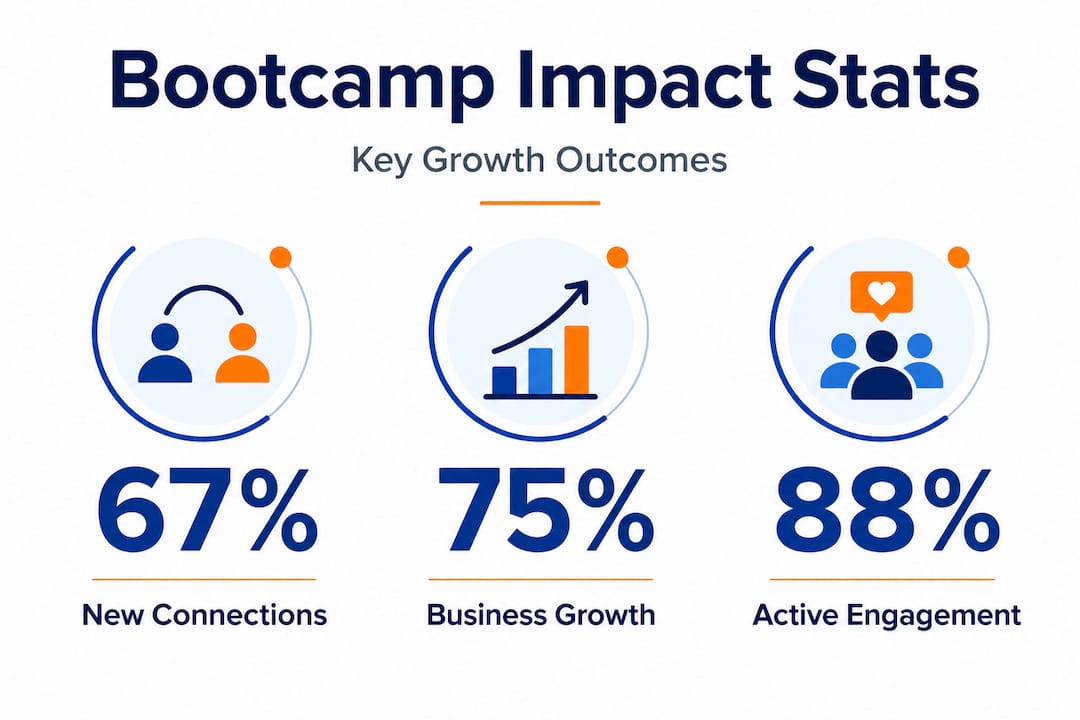
Most entrepreneurs assume that learning more content, buying more courses, or finding the perfect mentor in isolation is the fastest path to building a successful business. That assumption is worth questioning. Research from a community-focused accelerator program found that 75% of participants launched, grew, or stabilized their businesses through the program, while 67% gained new business connections and 60% accessed mentors they otherwise would not have reached. Community-driven bootcamps are changing what entrepreneurial education looks like, and this guide breaks down exactly why they outperform traditional models and how you can make the most of them.
Table of Contents
- What are community-driven bootcamps?
- How collaboration accelerates business growth
- Mentorship and its multiplier effect
- The role of commitment and program transparency
- How to choose the right community-driven bootcamp
- What most entrepreneurs miss about community-driven bootcamps
- Start your growth journey with community-driven support
- Frequently asked questions
Key Takeaways
| Point | Details |
|---|---|
| Collaboration powers growth | Entrepreneurs thrive in bootcamps that encourage peer support and shared learning, leading to faster business progress. |
| Mentorship multiplies results | Programs with hands-on mentorship help founders overcome challenges more quickly and develop stronger skills. |
| Engagement is essential | Active participation and choosing the right program are critical for success—passivity rarely pays off. |
| Vet programs carefully | Select bootcamps with transparent outcomes, active communities, and accessible mentors for the best experience. |
What are community-driven bootcamps?
Community-driven bootcamps are immersive, cohort-based programs where founders learn alongside each other, not just from instructors. The defining feature is shared progress. Every participant brings real business challenges to the table, and the group works through those challenges together through live sessions, peer masterminds, collaborative projects, and structured access to experienced mentors.
This is a meaningful departure from traditional entrepreneurship programs, which tend to emphasize competitive individual performance, solo project work, and theoretical frameworks. In those environments, you might absorb useful information, but you rarely build the kind of relationships or accountability structures that drive real execution. The startup bootcamp structure in community-driven programs is deliberately designed around interaction, not just instruction.
Research consistently shows that community focus in accelerators drives higher engagement and measurably better outcomes for participants. The reason is straightforward: when founders are surrounded by peers who are facing similar challenges and actively rooting for each other’s success, motivation stays high and problem-solving becomes faster and more creative. The role of online student communities in academic settings mirrors this dynamic, reinforcing that community structures improve learning across many disciplines.
Here is a quick comparison of the two models:
| Feature | Community-driven bootcamp | Traditional program |
|---|---|---|
| Learning format | Cohort-based, collaborative | Individual, lecture-based |
| Peer interaction | Structured and ongoing | Minimal or competitive |
| Mentorship access | Embedded and regular | Optional or limited |
| Accountability | Group-driven and daily | Self-managed |
| Outcomes focus | Execution and real results | Theory and credentials |
Key components that define a strong community-driven bootcamp include:
- Live group sessions where founders present challenges and receive real-time input
- Peer masterminds structured around mutual accountability and idea refinement
- Direct mentor access from experienced entrepreneurs and operators
- Collaborative projects that mirror real business scenarios
- Post-program community that extends relationships beyond the cohort
For early-stage entrepreneurs especially, these components are not just nice to have. They are the difference between knowing what to do and actually doing it.
How collaboration accelerates business growth
Understanding the model is one thing. Seeing how it produces results is another. Collaboration inside a community-driven bootcamp works through several distinct mechanisms, each of which compounds over time.

The first is structured networking. In most professional environments, networking is informal and inconsistent. Inside a bootcamp cohort, interaction is intentional. You are regularly paired with peers for feedback sessions, accountability check-ins, and collaborative problem-solving. These structured touchpoints build trust faster than casual networking ever could. That trust becomes the foundation for lasting partnerships, referrals, and shared resources that continue well after the program ends.
The data supports this clearly. 67% of community-focused bootcamp participants gained new business connections through their programs, which is a remarkable outcome for any learning environment. These are not LinkedIn connections that go cold. They are relationships forged through shared work and mutual investment in each other’s growth. Strong networking for founders is one of the most underrated drivers of early business traction, and bootcamps create ideal conditions for it.
The second mechanism is diverse feedback. When you work in isolation, your thinking is limited by your own blind spots. Inside a cohort, your ideas get stress-tested by peers with different backgrounds, industries, and perspectives. That friction is valuable. It surfaces assumptions you did not know you were making and pushes your strategy toward greater clarity.
Here is a breakdown of how collaboration outcomes stack up:
| Outcome | Participants who reported it |
|---|---|
| Business launched, grown, or stabilized | 75% |
| New business connections gained | 67% |
| Accessed mentors for the first time | 60% |
The third mechanism is accountability. When you commit to a goal in front of a group, the social pressure to follow through is real and productive. Daily accountability structures inside bootcamps keep founders moving forward even when motivation dips, which is inevitable in any entrepreneurial journey. The bootcamp benefits extend far beyond the curriculum itself because of this accountability layer.
Pro Tip: Active participation is the single biggest predictor of results in a community-driven bootcamp. Founders who show up consistently, share honestly, and engage with their peers get dramatically more value than those who observe from the sidelines. Treat every session as a business meeting, not a class.
Mentorship and its multiplier effect
Collaboration among peers is powerful, but mentorship adds a different and equally important dimension. Where peers offer empathy and shared experience, mentors offer perspective, pattern recognition, and hard-won knowledge that can save founders months of costly trial and error.
In a community-driven bootcamp, mentorship is not a one-off coffee chat or a generic Q&A session. It is embedded into the program structure, meaning mentors are present throughout the cohort experience, watching participants work, offering targeted feedback, and stepping in when founders hit critical decision points.
60% of participants in community-focused programs accessed mentors they would not have reached on their own. That access alone can be transformative for early-stage founders who lack established networks. A well-structured mentorship program guide makes the difference between guidance that feels generic and guidance that actually moves your business forward.
Here are the top benefits of mentorship within a community bootcamp context:
- Accountability from someone who has been there. Mentors hold you to a higher standard because they understand what is actually possible.
- Critical feedback without ego. Good mentors tell you what you need to hear, not what feels comfortable.
- Emergency support during pivots. When your business hits an unexpected wall, a mentor can help you navigate quickly rather than spiraling.
- Expanded network access. Mentors often introduce founders to contacts, investors, and collaborators within their own networks.
- Mindset calibration. Experienced mentors help founders recognize self-limiting beliefs and reframe challenges as solvable problems.
The community environment amplifies all of these benefits. When a mentor works with a group rather than a single founder, their insights reach more people simultaneously, and the group discussion that follows often generates additional clarity that one-on-one sessions rarely produce.
“The most valuable thing I took from the bootcamp was not the curriculum. It was the mentor who sat with me for twenty minutes after a session and told me I was solving the wrong problem entirely. That conversation saved me six months of wasted effort.”
Understanding the business mentorship benefits in a structured program context helps founders appreciate why this element deserves as much attention as the curriculum itself when evaluating programs.
Pro Tip: Before joining any bootcamp, ask specifically how mentors are matched to participants, how often they interact with the cohort, and whether mentors are available outside of scheduled sessions. Vague answers to these questions are a red flag.
The role of commitment and program transparency
Community-driven bootcamps create powerful conditions for growth, but they do not guarantee it. Results depend heavily on two factors that are entirely within your control: your level of commitment and the quality of the program you choose.
Not all bootcamp experiences are equal. Some programs market themselves as community-driven but deliver little more than a group chat and a pre-recorded video library. The difference between a transformative experience and a disappointing one often comes down to how actively the program facilitates real interaction, how transparent it is about its outcomes, and how much genuine accountability is built into the structure.
Bootcamp success requires active engagement, and passive participants rarely see meaningful results regardless of how good the program is. This is not a criticism. It is a practical reality that every founder should factor into their decision to enroll.
Here is what strong commitment looks like inside a community-driven bootcamp:
- Set specific goals before you start. Know what you want to achieve by the end of the program, whether that is a validated offer, your first paying customer, or a refined growth strategy.
- Show up to every session. Consistency builds trust with your cohort and keeps your momentum alive.
- Give honest feedback to peers. The quality of feedback you receive is directly proportional to the quality you give.
- Seek help early. Do not wait until a problem becomes a crisis. Raise challenges with your cohort and mentors as soon as they surface.
- Engage between sessions. The most valuable conversations in a bootcamp often happen in the informal spaces between scheduled activities.
On the program side, look for transparency as a non-negotiable standard. Reputable programs share success rates, alumni testimonials, mentor credentials, and clear program structures upfront. Understanding why join a bootcamp becomes much clearer when a program is willing to show you exactly what past participants have achieved.
A useful benchmark: if a program cannot show you concrete outcomes from previous cohorts, that absence of data is itself informative.
How to choose the right community-driven bootcamp
With a clearer picture of what makes these programs work, the next step is identifying which one is right for you. Outcomes vary significantly depending on program fit and participant engagement, so choosing wisely is worth the extra time and research.
Here is a practical checklist to guide your evaluation:
- Mentor quality. Who are the mentors, what have they built, and how involved are they in the day-to-day program experience?
- Community activity. Is there evidence of an active alumni network? Do past participants stay engaged with each other after the program ends?
- Transparency. Does the program share outcome data, success rates, and honest testimonials from previous cohorts?
- Measurable outcomes. Can the program articulate what you will walk away with in concrete, specific terms?
- Cultural fit. Does the program’s values and collaborative norms align with how you like to work and learn?
Beyond the checklist, pay attention to cultural fit. A bootcamp that emphasizes aggressive competition might energize some founders and drain others. A program built around deep collaboration and mutual support will feel entirely different. Neither is objectively better, but one will likely suit your working style far more than the other.
The benefits of student communities in structured learning environments consistently point to belonging and psychological safety as key drivers of engagement and outcomes. The same principle applies to entrepreneurship bootcamps.
Pro Tip: Reach out to two or three alumni before committing to any program. Ask them what they wish they had known before joining, what the community is like six months after the program ends, and whether they would enroll again. Their answers will tell you more than any sales page ever could. You can also browse upcoming bootcamps and previous bootcamps to compare formats and cohort experiences side by side.
What most entrepreneurs miss about community-driven bootcamps
Most guides on this topic focus on curriculum quality, tool stacks, and mentor credentials. Those things matter. But they are not the primary reason community-driven bootcamps produce outsized results for so many founders.
The real value is harder to quantify and almost never discussed in program marketing materials. It is the mindset shift that happens when you spend weeks surrounded by people who are just as serious about building something as you are. That environment recalibrates your sense of what is normal, what is possible, and what you are capable of.
Founders who chase the “silver bullet” program, the one with the most famous mentors or the most polished curriculum, often miss this entirely. They evaluate bootcamps like consumers shopping for a product rather than like founders investing in a community. The program you join is less important than the relationships you build inside it.
Here is the uncomfortable truth: the connections formed inside a strong cohort often outlast the program itself by years. Former bootcamp peers become co-founders, clients, advisors, and friends. That network becomes a vital lifeline during the inevitable hard stretches of building a business, providing support that no course or content library can replicate.
The founders who get the most from entrepreneurial bootcamps are not the ones who arrive with the most polished pitch or the most advanced business. They are the ones who show up with genuine openness, commit fully to the experience, and invest as much in their peers’ success as in their own. That posture is what transforms a short-term program into a long-term growth asset.
Start your growth journey with community-driven support
If this resonates with where you are in your entrepreneurial journey, Nomad Excel’s programs are built around exactly these principles. Every cohort is curated to bring together driven, collaborative founders ready to do real work. The mentor network is embedded throughout each program, not added as an afterthought. And the community extends well beyond the bootcamp itself, creating lasting connections that continue to generate value long after the final session. Explore the online entrepreneurship bootcamp to see current formats and cohort details, review the mentorship program guide to understand how guidance is structured, or read the full guide to joining entrepreneurship bootcamps to make a confident, informed decision about your next step.
Frequently asked questions
What makes a community-driven bootcamp different from self-paced online courses?
Community-driven bootcamps offer structured peer interaction, real-time feedback, and mentorship that create genuine accountability, while self-paced courses leave you to progress alone without the community-driven engagement that drives higher outcomes.
How do mentors in community-driven bootcamps help founders?
Mentors provide targeted, experience-backed advice and keep participants accountable throughout the program, with 60% of participants in community-focused programs gaining mentor access they would not have found independently.
Do community-driven bootcamps guarantee business success?
No program can guarantee success, because outcomes depend on engagement and program quality, but community-driven bootcamps significantly improve the conditions for it by combining accountability, mentorship, and peer support.
How can I check if a bootcamp is community-driven?
Look for live group sessions, regular peer check-ins, transparent mentor involvement, and an active alumni network as concrete indicators that community is genuinely central to the program’s design rather than just a marketing claim.
Comments are closed.