
Build a daily accountability process for entrepreneur success
TL;DR:
- Building environment and social accountability are more effective than relying solely on willpower.
- Clear daily goals, scheduled time blocks, and reporting with an accountability partner boost success rates.
- Regular review and simplification of routines help founders sustain consistent progress over time.
Most founders start the week fired up, only to realize by Friday that another seven days slipped by filled with urgent-but-unimportant tasks, unanswered messages, and half-finished priorities. The work felt busy. The progress did not show. This is one of the most common and costly patterns in early-stage entrepreneurship, and it rarely comes down to a lack of drive. External deadlines, tailored work rituals, and an accountability partner are what separate founders who build momentum from those who spin their wheels indefinitely. This guide will show you exactly how to build that structure from the ground up.
Table of Contents
- What you need to set up effective daily accountability
- Step-by-step daily accountability process for entrepreneurs
- Common mistakes (and how to avoid them)
- How to measure progress and adapt your process
- Why accountability is about your environment, not just self-discipline
- Take your accountability further with expert guidance
- Frequently asked questions
Key Takeaways
| Point | Details |
|---|---|
| Structure beats willpower | Daily rituals and environmental cues are more reliable than trying to self-motivate. |
| External accountability matters | Involving a partner or group in your daily process dramatically raises follow-through rates. |
| One priority per day | Focus is maximized when you commit to a single main goal and review it daily. |
| Weekly reviews work best | Track metrics weekly to focus on true progress instead of getting lost in daily noise. |
What you need to set up effective daily accountability
Now that you understand why accountability can make or break progress, let’s explore exactly what you’ll need to get started.
Before you can hold yourself accountable each day, you need to put the right building blocks in place. Skipping this foundation is why so many well-intentioned routines collapse within two weeks. Structure, not motivation, is the engine that keeps your daily process running.
Here are the core requirements every early-stage founder should establish:
- Goal clarity: Know your single most important objective for the week before Monday begins. Vague intentions produce vague results.
- Time-blocked work sessions: Reserve specific hours on your calendar for deep, focused work. Treat these blocks like meetings you cannot reschedule.
- Simple tracking routines: A shared document, a to-do list, or even a voice note to yourself after each session counts. The act of recording progress builds self-awareness.
- Visualization tools: Streak trackers, whiteboards, and progress bars give you a visual reminder of what you have committed to and where you stand.
- An accountability partner: This is the single highest-leverage addition to any founder’s routine. More on this shortly.
Knowing which tools and supports to use matters, but it also helps to see the contrast between going it alone and building structure around yourself. The comparison below illustrates why accountability for lasting growth requires more than good intentions.
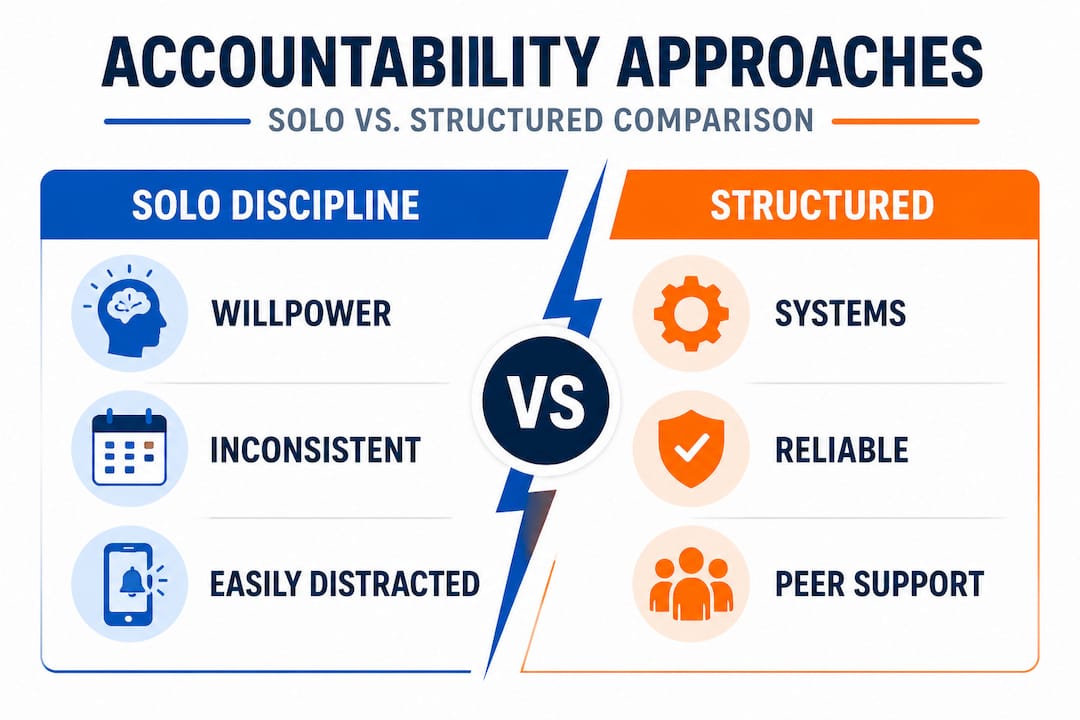
| Factor | Solo discipline | Structured accountability |
|---|---|---|
| Relies on | Willpower and motivation | Environment, rituals, and social commitment |
| Performance on hard days | Often collapses | Maintained through external anchors |
| Progress visibility | Mostly internal | Shared and trackable |
| Risk of rationalization | High | Reduced through reporting |
| Long-term follow-through | Inconsistent | Significantly more consistent |
| Best suited for | Short-term sprints | Sustained execution over weeks |
The research consistently favors structure over solo willpower. Emphasizing your role, adding external deadlines, creating a work ritual, visualizing progress, and partnering with an accountability contact form the five-part foundation that experienced advisors recommend for founders who want consistent daily output.
Pro Tip: Don’t try to implement all five elements at once. Pick one tool you’ll actually use (a shared Google Doc or a simple checklist app) and identify one person who can serve as your accountability partner. Simplicity at the start is what allows the system to stick.
The goal here is not to manufacture pressure. It’s to build a reliable container that makes showing up feel normal rather than heroic. When your environment expects output from you, discipline becomes far less of a daily battle.
Step-by-step daily accountability process for entrepreneurs
With your tools and foundation set, it’s time to put daily accountability into action by following these steps.
A process that works on paper but falls apart in practice solves nothing. The sequence below is designed to be realistic for founders with packed schedules while still generating the structure that drives results.
- Identify your single most important goal for the day. Before you open your inbox or check your phone, write down the one outcome that would make today a success. Not a list of ten items. One. This clarity protects your energy from being consumed by reactive tasks.
- Time-block a focused work session. Schedule a minimum of 60 to 90 minutes of uninterrupted work around your priority. Block it on your calendar, set a “do not disturb” mode, and protect it from meetings or social media.
- Record your commitment publicly or with your partner. Send a message to your accountability partner at the start of the session: “Today I’m working on [X]. I’ll check back in by [time].” This small act of public declaration shifts the goal from a private intention to a social expectation.
- Check progress at the midpoint. A brief five-minute pause halfway through your session to review whether you’re on track helps you self-correct without losing momentum. Think of it as a mini course-check rather than a full review.
- Do an end-of-day check-in with your partner. Report what you completed, what you didn’t, and what you’ll carry into tomorrow. Keep it brief. Two to three sentences is enough. The habit of reporting, even imperfectly, is what builds the muscle over time.
The data behind this approach is compelling. Success rates rise to 95% with a specific accountability appointment, compared to much lower rates when goals exist only in your head or on a private to-do list. The moment another person is expecting your update, completion becomes the path of least resistance.
| Approach | Daily goal completion rate | Weekly follow-through | Key driver |
|---|---|---|---|
| Ad hoc (no process) | ~35% | ~30% | Individual motivation |
| Personal to-do list | ~43% | ~40% | Written commitment |
| Partner + weekly reports | ~76% | ~72% | Social accountability |
| Partner + specific appointment | ~95% | ~90% | External expectation + structure |

For practical entrepreneur productivity hacks that complement this daily process, look at batching similar tasks within your time blocks and using transition rituals (a short walk, a glass of water) to signal your brain that focused work is beginning. These small touches make the system more sustainable over the long run.
Pro Tip: Add a recurring 15-minute calendar invite titled “Accountability check-in” at the same time every day, ideally at the end of your workday. This anchor appointment removes the mental overhead of deciding when to review your progress and makes the habit automatic.
The essential execution tips that experienced mentors consistently share all point to one truth: systems beat intentions. When your check-in is on your calendar and someone is waiting for your message, showing up stops being optional.
Common mistakes (and how to avoid them)
Even with the best intentions, some traps can derail your progress. Here’s what to watch for and how to course-correct.
Knowing the steps is useful. Knowing where founders typically fall apart is what actually keeps you on track. These are the most common mistakes early-stage entrepreneurs make with daily accountability processes:
- Skipping clear daily priorities. Trying to be accountable for a vague goal (“work on marketing”) produces vague outcomes. Fix this by naming a specific, measurable deliverable before your session begins.
- Relying only on willpower. Discipline matters, but it’s a limited resource. When energy dips, structure is what keeps the day from derailing. Remove the need for willpower by scheduling and committing in advance.
- Obsessing over daily metrics. Checking your revenue dashboard or website analytics every few hours creates anxiety without insight. Reviewing key metrics weekly or monthly is far more effective for most early-stage founders and avoids the trap of overreacting to normal fluctuations.
- Failing to report progress. Accountability without reporting is just a personal list. If your partner never hears from you, the social commitment disappears. Even a two-sentence message preserves the integrity of the system.
- Making the process too complex. A 12-step daily ritual with five apps and three check-ins sounds thorough. It’s also likely to be abandoned by day four. Complexity is the enemy of consistency.
“Daily metrics can mislead founders. The most investor-ready founders focus on process accountability and review key metrics weekly or monthly, avoiding the trap of overreacting to short-term data noise.” This is a principle that experienced investors emphasize when evaluating the habits of early-stage teams.
Using structured entrepreneurship frameworks alongside your daily process gives you a more complete operating system, one where the big-picture strategy and the day-to-day habits reinforce each other rather than competing for attention.
The fix for most of these mistakes is the same: simplify your commitments, write them down, and tell someone. That’s the core of what works.
How to measure progress and adapt your process
Accountability is only as effective as your ability to see real progress. Here’s how to tell if it’s working and adjust when it’s not.
Running a daily process without checking whether it’s producing results is like driving without looking at the road. Measurement doesn’t have to be complicated, but it does need to be intentional.
- Do a 5-minute daily closeout. At the end of each day, ask yourself one question: “Did I do what I said I would do today?” A yes builds confidence. A no reveals a pattern worth addressing. Document both in a running log, even just in a notes app.
- Review big-picture KPIs weekly. Protecting your energy and tracking key metrics weekly rather than daily allows you to spot genuine trends without the noise of daily fluctuations. Pick three to five metrics that directly reflect your business’s growth, such as leads generated, revenue collected, or user signups, and review them every Monday morning.
- Identify where your process is breaking down. If you’re consistently missing your daily priority, the problem might be the goal itself (too big), the time block (wrong time of day), or the partner (not the right fit). Adjust one variable at a time and observe the difference.
- Celebrate streaks, not perfection. Tracking consecutive days of check-ins builds momentum even when individual days fall short of the goal. Progress compounds, and recognizing streaks keeps motivation aligned with the process rather than with outcomes you can’t fully control.
Statistic callout: Solo goal-setting produces a success rate of roughly 43%. Adding an accountability partner with weekly progress reports jumps that rate to 76%, and a specific accountability appointment pushes it close to 95%. The numbers make a compelling case for social structure over solo effort.
Adapting your process is not a sign of failure. It’s a sign of maturity. The best founders treat their daily routine the way a product team treats a beta launch: launch, observe, and iterate. Your goal setting for success should evolve as your business does, and so should the accountability structures around it.
True verification means tracking your work habits as much as your outcomes. Did you show up for your time block? Did you send the check-in message? Did you complete the daily closeout? These behaviors are what outcomes are built on, and they’re fully within your control.
Why accountability is about your environment, not just self-discipline
Stepping back, let’s address what most founders get wrong and why the classic “just try harder” advice keeps failing new entrepreneurs.
There’s a persistent myth in startup culture that the founders who succeed are simply more disciplined, more driven, or more willing to grind through discomfort than everyone else. It’s a seductive story because it puts all the credit on the individual. It’s also, in large part, wrong.
The reality is that even the most successful founders rely heavily on environmental design and social structures to stay on track. External deadlines and an accountability partner reduce the founder’s ability to rationalize missed work and increase follow-through in ways that willpower alone simply cannot replicate. This isn’t a weakness. It’s how human motivation actually works.
When you commit to a goal privately, breaking it costs you nothing socially. When you commit publicly, to a partner, a peer group, or a structured program, breaking it carries a real (if small) social cost. That shift flips accountability from an internal intention to an external expectation. And expectations, it turns out, are far more powerful drivers of behavior than intentions.
This is why isolated founders often plateau while founders inside strong communities accelerate. It’s not that one group is more talented. It’s that one group has built an environment that makes following through the path of least resistance. The founder mindset and success literature consistently identifies environment design, not personal grit, as the differentiating factor in long-term execution.
The practical takeaway is this: don’t trust your willpower on hard days. Design your environment so that showing up is easier than not showing up. Choose your partner carefully, keep your process simple, and let the structure do the heavy lifting that motivation cannot sustain alone.
Take your accountability further with expert guidance
Now that you know how to build daily accountability into your routine, consider where expert guidance and community structure can help you go further, faster.
Building a daily process on your own is a strong start. But the founders who accelerate fastest are typically those who surround themselves with experienced mentors, structured frameworks, and a community of peers who are all moving in the same direction. That’s precisely what Nomad Excel’s programs are designed to deliver. Through the online entrepreneurship bootcamp, you gain live accountability, expert-led sessions, and real execution sprints in an environment purpose-built for founder growth. For those who want ongoing personal guidance, the mentorship process for entrepreneurs offers structured, one-on-one support that turns strategy into consistent daily action. Explore everything available on the Nomad Excel platform and take the next step toward building the business you’ve been planning.
Frequently asked questions
What is the most effective daily accountability method for entrepreneurs?
A daily process combining a clear goal, a structured time block, and progress reporting to an accountability partner yields the best results. Success rates reach 95% with a specific accountability appointment in place.
How often should entrepreneurs review their business metrics?
Weekly or monthly reviews are most effective for early-stage founders because they reveal true trends without the distortion of daily noise. Reviewing metrics weekly or monthly is the approach that experienced investors consistently recommend.
Does having an accountability partner really improve follow-through?
Yes, dramatically. Solo goal-setting success rises from 43% to roughly 76% when an accountability partner with weekly check-ins is added to the process.
Is willpower enough to stay accountable as a founder?
No. External deadlines and an accountability partner consistently outperform willpower alone by reducing rationalization and making follow-through a social expectation rather than a personal choice.
Can I use digital tools for daily accountability?
Yes. Shared documents, calendar reminders, habit-tracking apps, and even a simple daily message thread with a partner all make tracking and reporting significantly easier and more consistent.
Recommended
- How to Stay Accountable as Entrepreneur for Lasting Growth
- Step by Step Goal Setting for Entrepreneurs Success
- How to Build a Growth Mindset for Entrepreneurial Success
- 7 Essential Execution Tips for Entrepreneurs Worldwide
- Build Self-Awareness: Practical Steps for Personal Growth
- Essential Financial Metrics Every Business Owner Needs
Comments are closed.