
Why Business Communities Matter for Entrepreneurs
TL;DR:
- Building high-quality, relevant networks significantly predicts entrepreneurial success and business growth.
- Consistent involvement and genuine relationships within communities lead to more referrals, leads, and credibility.
Most aspiring entrepreneurs treat networking as an occasional activity, something you do at a conference, hand out cards, and forget about. That framing misses the point entirely. Understanding why business communities matter reveals a different reality: the people around you are not just contacts. They are the infrastructure through which growth actually happens. Research consistently shows that the strength and relevance of your professional network predicts revenue, profitability, and new business leads with more reliability than almost any other factor you can control.
Table of Contents
- Key Takeaways
- What business communities actually are
- How network quality predicts entrepreneurial success
- Concrete benefits that show up in the numbers
- Practical strategies to get the most from business communities
- Business communities vs. independent networking
- My honest take on what most entrepreneurs miss
- Build your network through Nomadexcel’s programs
- FAQ
Key Takeaways
| Point | Details |
|---|---|
| Network quality beats quantity | Startups with relevant, high-reach networks are 1.8x more likely to gain commercial traction within 24 months. |
| Credibility transfers through membership | Customers are 63% more likely to buy from businesses associated with a chamber of commerce. |
| Strong networks generate leads | 93% of SME founders say their professional network directly produced new business opportunities. |
| Engagement matters more than attendance | Showing up consistently and contributing actively builds the familiarity that converts connections into referrals and partnerships. |
| Communities amplify education and mentorship | Business communities work best alongside structured learning, accelerating the application of skills through real relationships and accountability. |
What business communities actually are
Before unpacking the value, it helps to understand what “business community” actually means in practice. The term covers a wide range of structures. Local chambers of commerce are the most established form, offering member directories, advocacy, and regular events. Industry associations group professionals by sector, creating specialized knowledge-sharing environments. Online communities, from private forums to mastermind groups, extend that reach globally and allow asynchronous connection.
Each type serves a distinct function, but most share the same core offerings:
- Networking access: Structured introductions, mixers, and referral programs that connect members with potential clients, partners, and mentors.
- Credibility signals: Association with a recognized organization tells potential customers and collaborators that you operate at a certain standard.
- Resource access: Chambers offer discounts on shipping, insurance, office supplies, and even financing options that independent businesses rarely find on their own.
- Advocacy: Larger bodies represent member interests in policy discussions, which can directly affect operating conditions for small businesses.
- Visibility: Member spotlights, newsletter features, and event speaking slots put your brand in front of audiences you haven’t yet reached.
Understanding the benefits of joining communities goes well beyond showing up to monthly lunches. The most successful members treat community involvement as a growth channel, one they manage with intention.
Pro Tip: Before joining any community, ask existing members what tangible outcomes they’ve experienced. If long-term members struggle to name a lead, referral, or collaboration the community produced, that tells you everything you need to know.
How network quality predicts entrepreneurial success
Here is where the conversation shifts from intuition to evidence. A large-scale study of over 5,500 startups found that network relevance and reach ranked among the top predictors of commercial traction out of 26 criteria evaluated. Startups scoring high on those two factors were 1.8 times more likely to gain real momentum within 24 months. That is not a marginal edge. It’s a structural advantage.
“Quality of network connections is a stronger predictor of startup success than the number of contacts alone.” — Insight from a study of 5,500 startups
What does network relevance actually mean? It means being connected to people who can actively open doors for you: potential customers, experienced operators who can vouch for your credibility, and partners whose work complements yours. A network full of people who cannot buy from you, refer you, or introduce you to someone who can is not an asset. It’s just a contact list.
This is why the importance of business networks cannot be measured in raw numbers. An entrepreneur with 50 highly relevant connections inside a tight-knit industry group will almost always outperform someone with 500 loosely connected LinkedIn contacts. The mechanism is trust. When a respected member of your community introduces you to a potential client, the trust they’ve built transfers to you instantly. Cold outreach cannot replicate that.

The ability to convince others also ranked as a significant growth criterion in the same research. This is not about persuasion tactics. It’s about the earned authority that comes from being known and respected within a community over time. That kind of authority is built slowly, through consistent presence and genuine contribution.
Concrete benefits that show up in the numbers
The evidence for business community advantages is not theoretical. Several well-documented studies attach specific numbers to membership benefits, and those numbers are worth knowing before you decide how seriously to invest in this area.
| Benefit | Data point | Source |
|---|---|---|
| Revenue growth | 86% of networked SME owners were profitable vs. 66% with weaker networks | American Express Research |
| New business leads | 93% of SME founders attribute new leads directly to their professional network | American Express Research |
| Customer purchase likelihood | Customers are 63% more likely to buy from chamber-affiliated businesses | US Chamber of Commerce |
| Brand visibility | Chamber directories and newsletters amplify member exposure beyond their own marketing reach | US Chamber of Commerce |
The gap between 86% and 66% profitability is striking. That 20-percentage-point difference represents the measurable impact of networking on business outcomes at the SME level. And the lead generation figure, 93%, tells you that professional networks are not supplementary. For most small business owners, they are the primary source of new opportunities.
The chamber membership statistic deserves special attention. When 64% of adults familiar with a local chamber say they are more likely to purchase from member businesses, that is a credibility signal with direct revenue implications. Your membership functions as a third-party endorsement, reducing the skepticism that every new customer carries into a purchase decision.
- Choose communities with active referral programs, not just social events.
- Track every lead and collaboration that comes through community involvement so you can measure actual ROI.
- Prioritize communities whose members match your ideal customer or partner profile.
Pro Tip: Don’t wait for leads to come to you. After each community event, follow up with two or three people you connected with and offer something genuinely useful before asking for anything in return. That one habit compounds dramatically over 12 months.
Practical strategies to get the most from business communities
Knowing why business communities matter is one thing. Knowing how to extract real value from them is another. Most entrepreneurs join, attend a few events, and wonder why nothing happened. The difference between passive members and those who see measurable results comes down to strategy and consistency.
- Choose communities tied to your actual goals. If you need customers, join groups where your customers gather. If you need mentors, seek out communities built around experienced operators. Joining the closest or cheapest option rarely produces results.
- Show up regularly before you need anything. Familiarity is the foundation of trust. Attend consistently for at least three to six months before expecting meaningful referrals or introductions. People refer those they know and trust, and that status takes time to earn.
- Volunteer for visibility. Take seats on committees, speak at events, or sponsor a meetup. These roles accelerate the familiarity-building process because they put you in front of the room rather than in it.
- Build genuine relationships, not transactional ones. Authentic involvement enhances your ability to persuade and your reach simultaneously. Ask about people’s challenges. Introduce members to each other. Add value before you extract it.
- Track what the community produces for you. Keep a simple log of leads, referrals, and collaborations that trace back to each community. This tells you where to invest more time and where to pull back.
Building powerful connections requires treating networking as a learnable skill rather than a personality trait. Research confirms that networking capability improves venture growth outcomes when entrepreneurs invest in developing it deliberately. You don’t have to be the most charismatic person in the room. You have to be the most consistent.
Pro Tip: Set a specific monthly goal for your community involvement, such as making two meaningful introductions or attending one event. Specificity turns vague intention into a trackable habit.
Business communities vs. independent networking
A common question among aspiring entrepreneurs is whether formal community membership offers anything that general, ad hoc networking doesn’t. The honest answer is yes, and the difference is structural.
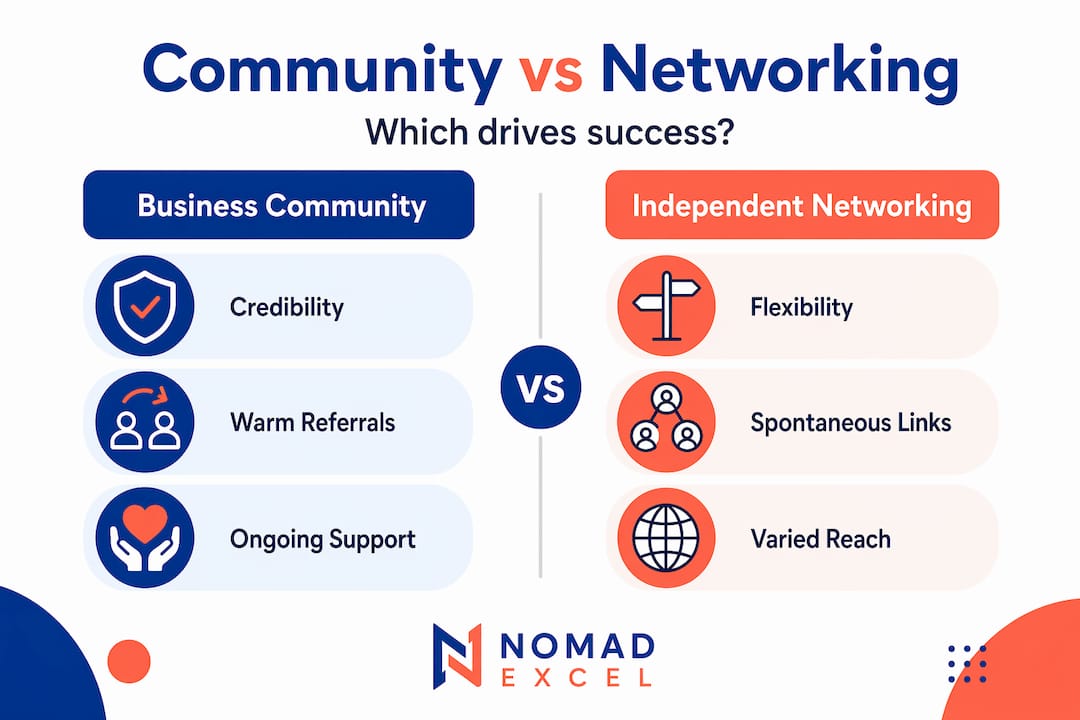
| Factor | Formal business community | Independent networking |
|---|---|---|
| Credibility | Third-party endorsement from recognized organization | Dependent entirely on personal reputation |
| Consistency | Recurring events and structured touchpoints | Irregular, requires personal initiative |
| Resource access | Discounts, advocacy, directories, financing info | None built in |
| Referral culture | Explicit norms around member support | Informal, unpredictable |
| Visibility channels | Newsletters, websites, member spotlights | Limited to personal outreach |
Independent networking is not without value. Spontaneous connections at industry conferences or through mutual introductions can be powerful. But they lack the recurring structure that builds deep familiarity over time. Formal communities create the conditions for relationships to develop naturally without requiring heroic personal effort every time.
Communities also amplify the benefits of other growth strategies. If you are investing in business education or working with a mentor, a strong community gives you a live environment to test and apply what you’re learning. The value of professional communities lies partly in this multiplication effect: skills sharpen faster when you practice them among peers who are on a similar path and willing to give honest feedback.
My honest take on what most entrepreneurs miss
I’ve spent years working alongside early-stage entrepreneurs, and the pattern I keep seeing is this: people treat community membership as a marketing tactic rather than a long-term relationship investment. They show up, distribute cards, wait two months, and then declare that networking doesn’t work. What they actually experienced is the natural outcome of transactional behavior inside a relational system.
What transformed my own perspective was noticing that the most-connected people in any room were rarely the loudest or the most aggressive about promoting themselves. They were the ones who asked genuine questions, remembered details about others, and followed through on small promises. Their networks weren’t large. They were relevant and warm, and that combination opened doors that no amount of paid advertising ever could for me.
The uncomfortable truth is that most of the best opportunities I’ve encountered, from partnerships to introductions to funding conversations, came through people who knew me before I needed anything from them. That kind of relationship cannot be manufactured on demand. It has to be built in advance, patiently, through consistent presence and real contribution.
My advice to any aspiring entrepreneur reading this: join one community that genuinely connects you to relevant people, and commit to showing up for a full year before evaluating its worth. Presence over time is the variable that makes the difference. Everything else is secondary.
— Amichai
Build your network through Nomadexcel’s programs
The insights in this article point toward one clear conclusion: business growth accelerates when you are surrounded by the right people. Nomadexcel’s Online Entrepreneurship Bootcamp is built around exactly that principle. Every program brings together a curated group of driven founders for hands-on learning, mentorship from experienced operators, and a peer community that continues to support your growth long after the program ends. If you want to understand why joining a bootcamp can accelerate your business, the answer starts with the people you meet there. Explore Nomadexcel’s programs and take the step from knowing why community matters to actually experiencing what it produces.
You can also explore community-driven bootcamp benefits to understand how structured peer environments consistently outperform solo learning when it comes to real entrepreneurial progress.
FAQ
Why do business communities matter for entrepreneurs?
Business communities provide credibility, warm referrals, and consistent access to relevant relationships that independent networking cannot replicate. Research shows that network relevance ranks among the top predictors of startup commercial success.
How do business networks help generate leads?
Strong professional networks produce warm introductions that reduce trust friction. According to American Express research, 93% of SME founders attribute new business leads directly to their professional network.
What is the benefit of joining a chamber of commerce?
Chamber membership signals credibility to potential customers. Consumers are 63% more likely to purchase from a business affiliated with their local chamber, making membership a direct influence on buying decisions.
How long does it take to see results from a business community?
Most experienced members recommend committing to consistent attendance for at least six months before expecting referrals or leads. Familiarity and trust, the two factors that drive referrals, build gradually through repeated, genuine interaction.
Is quality or quantity more important in business networking?
Quality wins decisively. A study of 5,500 startups found that network relevance and reach outperformed raw contact volume as predictors of commercial traction, confirming that who you know matters far more than how many people you know.
Comments are closed.