
Global Entrepreneurship: Accelerating Business Growth Worldwide
Starting a business can feel overwhelming when traditional barriers still exist in many economies. Aspiring founders worldwide now benefit from a systematic movement across 180+ economies where structured mentorship, peer accountability, and vibrant communities are changing the path from idea to growth. Modern entrepreneurship means real-time collaboration, accessible tools, and proven bootcamp experiences—giving you opportunities to connect, learn, and accelerate your next venture like never before.
Table of Contents
- What Defines Global Entrepreneurship Today
- Types of Global Entrepreneurial Programs
- Core Frameworks for Business Building and Scaling
- Mentorship, Execution, and Community Impact
- Critical Pitfalls, Costs, and Founder Responsibilities
Key Takeaways
| Point | Details |
|---|---|
| Modern Entrepreneurs Embrace Community | Entrepreneurs today engage with peers and mentors, enhancing their growth through collaborative networks. |
| Rapid Execution is Essential | Successful founders prioritize quick testing and iteration of ideas based on real market feedback. |
| Diverse Entrepreneurship Paths | There are now multiple frameworks and support systems tailored to various types of entrepreneurship, from tech startups to service businesses. |
| Program Selection Matters | Choose entrepreneurship programs that align with your stage and focus on real execution rather than just theoretical learning. |
What Defines Global Entrepreneurship Today
Global entrepreneurship has shifted from a niche pursuit to a central economic force. What started as individual founder stories has become a systematic movement across 180+ economies, with structured frameworks, mentorship networks, and measurable outcomes replacing trial-and-error approaches.
Today’s entrepreneurship looks fundamentally different than it did a decade ago. Modern entrepreneurs aren’t building in isolation—they’re plugging into communities, accessing real-time mentorship, and collaborating with peers across continents. The shift is real, and it changes how you approach building your business.
The Core Elements Defining Modern Entrepreneurship
Three characteristics now define global entrepreneurship:
Accessibility over gatekeeping. Founders from any background can access tools, mentorship, and networks that were once locked behind connections or geography.
Action over planning. Successful entrepreneurs today move fast, test assumptions weekly, and iterate based on real market feedback rather than perfecting plans before launch.
Community over solo building. Peer collaboration driving entrepreneur success has become the accelerator—the support network directly impacts survival rates and revenue growth.
Modern entrepreneurship thrives on transparency, execution speed, and the mutual support of founders working toward similar goals.
The data backs this up. Entrepreneurial activity across formal economies shows that while rates vary by country, the infrastructure supporting entrepreneurs has expanded dramatically. High-income nations lead in startup density, but middle and low-income economies are catching up rapidly as bootcamps, mentorship programs, and funding networks proliferate.
What’s Actually Changed
Five years ago, entrepreneurship meant bootstrapping alone or finding one angel investor. Today’s founders operate differently:
Mentorship is expected, not optional. Access to experienced operators who’ve scaled businesses before reduces guesswork and accelerates learning curves from years to months.
Networks compound results. A single bootcamp connects you with 15-50 founders facing similar challenges, creating accountability and collaboration opportunities that extend years beyond the program.
Validation happens live, not in a spreadsheet. You test business ideas with real customers in days, not months. Failure becomes data, not disaster.
Geographic location matters far less. Remote collaboration means your co-founder, mentor, or first customer could be anywhere. Time zones are managed, not barriers.
Multiple entrepreneurship paths exist. Whether you’re building a scalable tech startup, running a service business, or designing lifestyle flexibility, different types of entrepreneurship now have defined frameworks and support ecosystems.
The entrepreneurs winning today aren’t necessarily the smartest. They’re the ones embedded in active communities, receiving real feedback weekly, and willing to pivot based on what customers actually want.

Why This Matters for You
If you’re building a business right now, understand this: global entrepreneurship today means you have options your predecessors didn’t. You can surround yourself with accountability partners, access experienced mentorship, validate ideas quickly, and build in public.
The overhead of launching has dropped. The access to guidance has expanded. But the stakes for execution have risen—everyone can move fast now, so staying ahead requires consistent action and community support.
Pro tip: Look for immersive experiences where you can spend focused time with mentors and peers building real traction, not just learning theory. Thirty days of daily execution in a supported environment compounds faster than six months of solo work.
Types of Global Entrepreneurial Programs
Entrepreneurship programs aren’t one-size-fits-all. Globally, they span from classroom-based education to intensive bootcamps, each designed for different audiences and outcomes. Understanding which type matches your stage and goals is critical to getting real value from your investment of time and money.
The landscape has expanded dramatically. Entrepreneurship education and training programs vary widely by target audience, with some aimed at students building foundational mindsets and others targeting active entrepreneurs scaling existing businesses. The right program depends on where you are in your entrepreneurial journey.
Program Types by Structure
Global entrepreneurial programs fall into distinct categories:
Here’s a concise comparison of global entrepreneurial program types to help you select the right fit:
| Program Type | Audience Focus | Key Advantages | Typical Limitations |
|---|---|---|---|
| University-based | Students, early-stage | Foundations, mentorship | Limited real-world execution |
| Bootcamps | Active founders | Community, rapid traction | Intense, short duration |
| Accelerators | Startups with MVP | Funding, scaling support | Competitive entry, equity loss |
| Online Courses | Broad, flexible | Self-paced, accessible | Low accountability, less support |
| Government/Nonprofit | Underrepresented groups | Free, targeted resources | Varies in quality, limited scale |
University-based programs. Typically 8-12 week courses embedded in higher education curricula, focusing on business fundamentals, business plan development, and entrepreneurial skill-building. These build mindset early but often lack real-world execution pressure.
Intensive bootcamps. 2-12 week immersive experiences with daily execution, real mentorship, and peer accountability. Participants work on live businesses, not hypotheticals. Results compound fast because of the focused environment and community support.
Accelerators and incubators. Programs that pair funding (sometimes) with mentorship, typically 3-6 months long. Better for founders who already have a product or validated idea and need help scaling distribution and raising capital.
Online courses and certifications. Self-paced learning platforms teaching entrepreneurship theory, marketing, and operations. Flexible but lack accountability and community, making completion rates lower.
Government and nonprofit training. Programs designed to support underrepresented entrepreneurs or build economic development in specific regions. Often free or low-cost but variable in quality.
Most research shows that entrepreneurship programs influence skill development, yet actual business launch intentions depend more on family background and socioeconomic factors than education alone—suggesting programs work best when combined with real execution opportunities.
What Separates High-Impact Programs
Not all programs deliver the same results. High-impact programs share core elements:
Real mentorship from experienced operators. Mentors who’ve scaled businesses themselves, not just business school professors. Types of mentorship programs vary, but the best pair structured guidance with accountability.
Built-in community and peer collaboration. You’re surrounded by founders solving similar problems, creating natural accountability and partnership opportunities.
Execution over theory. Time spent building, testing, and launching beats classroom hours every time. Programs that measure progress by revenue generated, customers acquired, or validated assumptions beat those measuring completion certificates.
Clear outcomes and support beyond. The best programs don’t end when you leave—they maintain alumni networks, continued mentorship, and ongoing collaboration.
The reality is simple: programs that force you into action with peers and mentors accelerate growth far beyond what solo study or traditional education can deliver.
Choosing the Right Program for Your Stage
Your stage determines the best fit. If you’re exploring entrepreneurship or building foundational skills, university-based or online programs work. If you’re ready to launch or scale with focused intensity, immersive bootcamps with real mentorship and peer collaboration deliver faster results.
The founders who move fastest aren’t the ones with perfect plans. They’re the ones embedded in communities with daily accountability, receiving real feedback, and iterating weekly.
Pro tip: Look for programs that measure success by traction you build (revenue, customers, validated assumptions), not by completion. Spend time with founders one or two steps ahead of you—they’ll accelerate your learning curve faster than any curriculum can.
Core Frameworks for Business Building and Scaling
Frameworks aren’t optional luxuries for entrepreneurs—they’re the difference between moving in circles and moving forward with purpose. A solid framework gives you the decision-making rules, the metrics that matter, and the processes that let you scale without losing control.
Most founders spend months building before they realize they need structure. The ones who win define their framework first, then execute within it. This clarity compounds daily, turning effort into measurable progress.
The Essential Building Blocks
Essential frameworks for business building address four core areas that every founder must nail:
This table summarizes the main building blocks of a business framework for founders:
| Area | Business Purpose | How It Enables Growth |
|---|---|---|
| Market Validation | Tests actual customer demand | Reduces costly missteps |
| Value Proposition | Defines unique market value | Attracts targeted customers |
| Revenue Model | Simplifies income generation | Focuses business strategy |
| Operations | Creates scalable processes | Supports sustainable scaling |
Market validation. Test your assumptions with real customers before scaling. Move fast, gather feedback weekly, and iterate based on what the market actually wants, not what you think they want.
Value proposition clarity. Define exactly what problem you solve, for whom, and why it matters. A vague value proposition kills traction. Specificity attracts customers; generality repels them.
Revenue model simplicity. Know how you make money. Avoid multi-layered business models early—one clear path to revenue beats three confusing ones. Revenue focuses strategy and forces clarity.
Operational systems. As you grow, repeatable processes replace heroic effort. Document what works, train your team, and scale systematically.
Entrepreneurial ecosystems require assessing human capital, managerial capabilities, and market structures to identify gaps and align programs with growth potential. Your personal framework should reflect similar diagnostic thinking.
Scaling Without Losing Control
Scaling kills more businesses than staying small ever will. Growing requires deliberate frameworks that prevent chaos. Here’s what separates sustainable growth from reckless expansion:
Timing is critical. Scale only when you’ve validated your core model and have repeatable processes. Premature scaling—pushing for growth before the foundation is solid—breaks everything.
Team structure must evolve. Your first five hires operate differently than your next fifteen. Define roles, decision-making authority, and communication systems before chaos emerges.
Metrics drive decisions. Track leading indicators (customer acquisition cost, retention rate, revenue per customer) not just vanity metrics. Metrics tell you if your framework is working.
Flexibility within structure. A rigid framework becomes a prison. Build in regular reviews—quarterly at minimum—to test assumptions and adjust course.
Most founders skip this step. They assume that execution energy alone carries them. It doesn’t. Proper frameworks create leverage, turning one person’s effort into team results.
Building Your Personal Framework
Your framework should answer these questions clearly: Who do we serve? What problem do we solve? How do we reach them? How do we make money? What metrics prove success? If you can’t answer these in two sentences, your framework isn’t clear enough.
Write it down. Share it with advisors and cofounders. Test it weekly against reality. Refine monthly. A framework lives—it evolves as you learn.
Pro tip: Pick one revenue metric and one customer metric to monitor obsessively for ninety days. Everything else is noise. Once those two metrics trend up consistently, expand your framework to include team health and operational efficiency.
Mentorship, Execution, and Community Impact
Mentorship isn’t advice from a distance—it’s a sustained relationship with someone who’s built what you’re building. The difference between founders who accelerate and those who plateau often comes down to one thing: access to real mentors embedded in their journey.
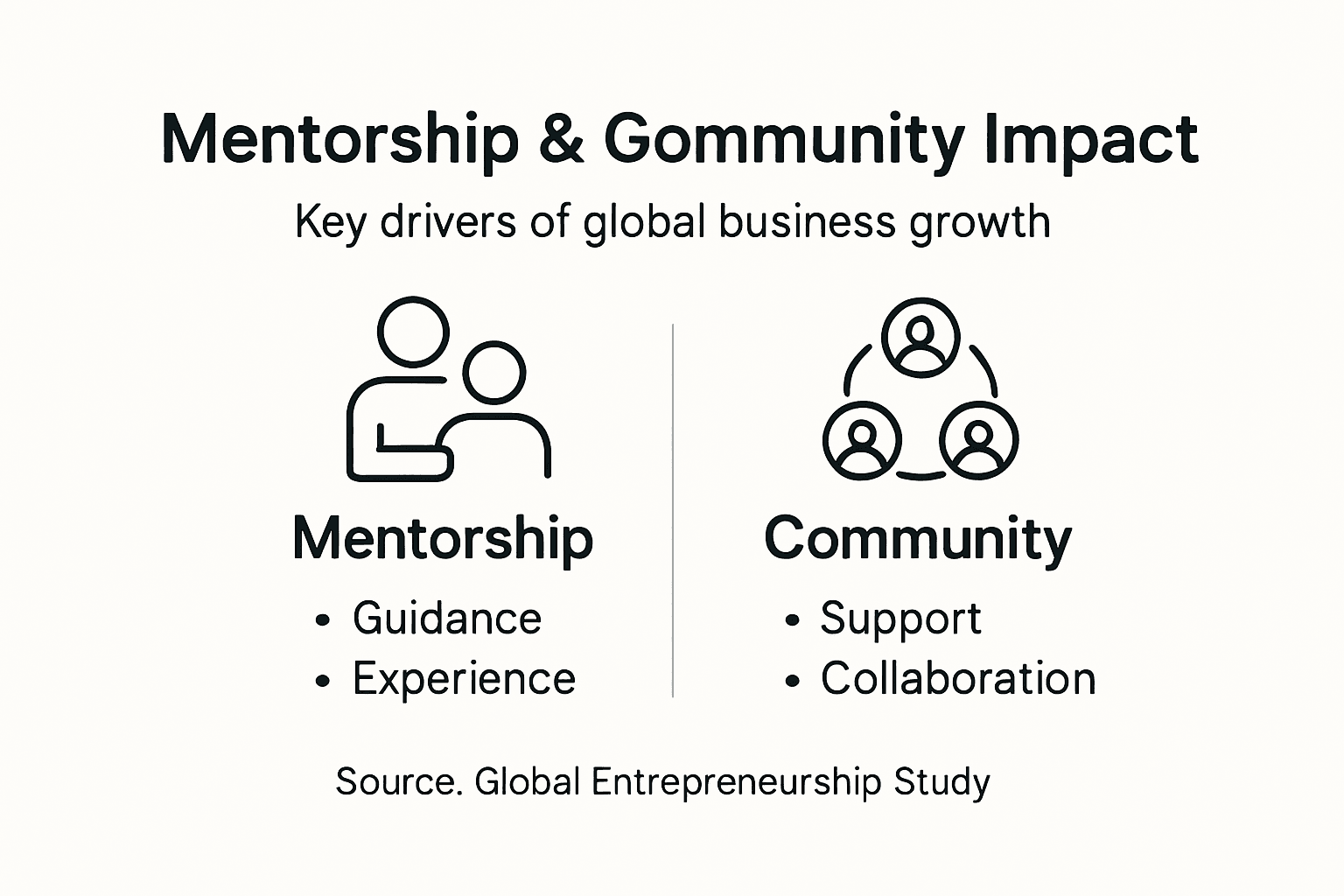
Execution without mentorship is slow. Community without execution is empty talk. Mentorship plus execution plus community creates compounding growth that no solo founder can match.
Why Mentorship Changes the Timeline
Think of mentorship as borrowing someone else’s experience. A mentor who’s scaled a business before knows the landmines you’ll hit. They’ve solved the problems you’re about to face. This compressed learning—skipping mistakes that would cost you months—is invaluable.
Mentorship programs significantly impact entrepreneurial success, with studies tracking founders over three years showing higher revenue growth, faster market expansion, and greater venture sustainability. Active mentor engagement correlates directly with measurable business outcomes.
What makes this work? Mentors provide:
Strategic clarity. They help you see what matters versus what’s noise, cutting through founder overwhelm.
Industry insights. They know the competitive landscape, pricing dynamics, and customer behavior patterns in your space.
Accountability. They ask tough questions and expect results, preventing you from spinning on low-impact work.
Connections. A mentor’s network becomes accessible to you—potential customers, investors, partners, and other founders.
Mentorship works best when paired with consistent execution and community. A mentor alone guides; add peer community, and the founder gains both individual support and collective momentum.
Execution: Where Ideas Become Traction
Mentorship means nothing without execution. The best mentors in the world can’t build your business—you have to. But mentorship accelerates your execution by clarifying priorities and removing friction.
Execution in a supported community creates velocity. Here’s the difference: a solo founder works alone, gets stuck, and loses momentum. A founder in a bootcamp with peers and mentors works daily, shares blockers with the group, gets unstuck within hours, and compounds progress.
The timeline shifts dramatically:
Clarity on what to build. Mentor feedback eliminates months of building the wrong thing.
Weekly progress sprints. Community accountability forces consistent action, not sporadic effort.
Fast iteration cycles. Mentor guidance reduces the feedback loop from months to weeks.
Measurable traction. Revenue, customers, or validated assumptions—mentorship keeps you focused on metrics that matter.
Founders who move fastest aren’t working harder. They’re working with better information, clearer priorities, and stronger accountability.
Community: The Multiplier Effect
You’ll build your business. Your peers are building theirs. Together, you create something larger: a network that accelerates everyone’s growth. Mentorship fosters business resilience through strategic guidance and community networks, with research showing mentored founders expand customer engagement faster and build more sustainable ventures.
Community creates opportunities that mentorship alone can’t:
Partnership potential. You might find a cofounder, a business partner, or a strategic ally in your cohort.
Customer referrals. Peers understand your business and refer customers naturally.
Shared learning. What one founder learns, all benefit from. Knowledge compounds across the group.
Long-term support. The best bootcamps maintain alumni networks for years. Your cohort becomes your board of advisors.
The founders thriving post-bootcamp aren’t the ones who left and went solo. They’re the ones who maintained their community, kept meeting with peers, and leveraged those relationships for years.
Pro tip: Choose mentors who’ve built in your market or solved your specific problem, not generic “entrepreneur mentors.” Specificity matters—a mentor who scaled a SaaS from zero to one million in revenue beats a mentor who reads business books.
Critical Pitfalls, Costs, and Founder Responsibilities
Building a business looks glamorous from the outside. The reality is messier: capital constraints, team conflicts, market rejection, and personal sacrifice. Understanding what you’re actually signing up for separates founders who persist from those who quit.
The stakes are real. Your time, your money, your relationships, and your mental health are all on the line. Being honest about these costs upfront helps you prepare mentally and financially.
The Fear That Stops Founders
Rising global fear of failure affects entrepreneurship decisions, with nearly half of potential entrepreneurs hesitant to start businesses due to risk concerns. This isn’t irrational fear—it’s grounded in real costs. The challenge is distinguishing between manageable risks and risks that’ll destroy you.
Common fears and their reality:
Financial risk. You might lose your savings. Startups burn capital fast. The cost isn’t just money—it’s opportunity cost (the income you’d make at a job).
Time burden. Early-stage founders work 60-80 hour weeks, not the Instagram-friendly “follow your passion” narrative. This disrupts relationships and exhausts your physical health.
Market rejection. Your idea might not work. You’ll hear “no” hundreds of times before you hear “yes.” Psychological resilience matters more than business acumen here.
Equity dilution. If you raise capital, you’ll give up ownership. The trade-off is growth speed, but it means less wealth if you succeed.
Founders who succeed aren’t fearless—they’re prepared. They know the costs, build support systems, and take calculated risks rather than blind leaps.
Founder Responsibilities You Can’t Delegate
As a founder, you’re responsible for decisions with real consequences. The founder’s dilemma involves balancing control retention with attracting talent and capital necessary for sustainable growth. This tension never disappears—you just learn to navigate it.
Core responsibilities include:
Capital management. You must know your burn rate (monthly cash spend), runway (months until cash runs out), and path to profitability or the next funding round. Miscalculating this kills companies.
Hiring and team building. Early hires make or break companies. You’re responsible for recruiting, evaluating culture fit, and sometimes firing people who don’t work out. This is harder than it sounds.
Strategic clarity. You set direction. If your strategy is unclear, your team wastes effort. This is your core job, not delegation.
Accountability for results. No one else is responsible for your business’s success or failure. You can’t blame the market, your team, or bad luck—you have to own it.
Stakeholder communication. Investors, employees, customers, and advisors all need transparency. Hiding problems compounds them; transparency builds trust.
Most founders underestimate these responsibilities. The ones who thrive treat them seriously from day one.
Common Pitfalls to Avoid
Building in a supported environment prevents many avoidable mistakes. Isolation amplifies poor decisions. Here’s what kills founders most often:
Building without validation. You spend months on a product no one wants. Test ideas with customers first, then build.
Waiting for perfection. Launching late with a perfect product loses to launching early with a good product and iterating.
Wrong metrics focus. Tracking vanity metrics (website visitors, followers) instead of business metrics (revenue, retention, customer acquisition cost) masks real problems.
Poor communication with cofounders. Silent resentment kills partnerships. Uncomfortable conversations early prevent expensive breakups later.
The founders who avoid these pitfalls aren’t smarter—they’re humble enough to seek mentorship and embedded in communities that provide reality checks.
Pro tip: Before you quit your job, spend three months building nights and weekends. If you can’t sustain effort around your current commitments, full-time commitment won’t magically create motivation. Test your conviction before betting everything.
Accelerate Your Entrepreneurial Journey With Mentorship and Community
The article highlights the challenges every modern entrepreneur faces today: moving swiftly from idea to execution, validating business models with real customers, and building supportive communities that fuel growth. You might be struggling with turning visions into traction or feeling isolated without the right mentorship and accountability to keep you moving forward. Concepts like focusing on daily execution, gaining real feedback, and embedding yourself in a peer network are essential but hard to achieve solo.
At Nomad Excel, we understand these pain points deeply. Our entrepreneurship bootcamps are specifically designed to give you structured frameworks, direct mentorship from seasoned operators, and a thriving community of founders who push each other toward measurable outcomes. By joining immersive programs built around action, collaboration, and clarity, you can rapidly reduce guesswork, cut through uncertainty, and build real momentum. Whether you are launching or scaling, our bootcamps and company retreats create the environment where your business growth accelerates.
Why wait while others transform their ideas into thriving businesses today? Explore how Nomad Excel’s unique blend of mentorship, execution focus, and community support can fast-track your success. Take the first step and discover more about our offerings at Nomad Excel to turn your entrepreneurial ambitions into reality.
Frequently Asked Questions
What are the key characteristics of modern global entrepreneurship?
Modern global entrepreneurship is defined by three main characteristics: accessibility over gatekeeping, action over planning, and community over solo building. This means founders can access resources easily, test and iterate quickly, and benefit from collaborative networks.
How has the role of mentorship changed in today’s entrepreneurship landscape?
Mentorship has become a critical and expected component of entrepreneurship today. Founders are increasingly relying on experienced mentors to accelerate their learning and reduce the trial-and-error phase, making the path to success faster and smoother.
What types of global entrepreneurial programs are available for aspiring founders?
Global entrepreneurial programs vary widely, including university-based courses, intensive bootcamps, accelerators, online courses, and government/nonprofit initiatives. Each program targets different audiences and serves specific purposes, from foundational skills to advanced scaling techniques.
How can a solid business framework support an entrepreneur’s growth?
A solid business framework helps entrepreneurs define their market validation, value proposition, revenue model, and operations. This structure enables systematic scaling, reduces chaos, and ensures that the business’s efforts translate into measurable progress.
Recommended
- Entrepreneurial Leadership Guide for Accelerated Growth
- Nomad Excel – Your Entrepreneurial Adventure Starts Here
- What Is Business Acceleration: Unlocking Startup Growth
- Execution Focused Entrepreneurship Guide for Fast Growth
- Partnerships – FullyOps
- Internal Business Development Executive – Oprema Cardiff
Comments are closed.