
What Is a Learning Mindset: A Practical Guide
A learning mindset is the sustained behavioral orientation to continuously acquire, unlearn, and apply knowledge — not just a belief about intelligence, but a set of observable habits you practice daily. To start right now: (1) ask one colleague for specific feedback on something you finished this week, (2) write three sentences in a journal about what you’d do differently next time, and (3) identify one assumption in your current work that might be outdated. The key distinction worth noting early: a growth mindset is a belief (“I can improve”), while a learning mindset is the operational layer beneath it — the actual behaviors that make improvement happen.
Key Takeaways
A learning mindset is a set of observable, trainable behaviors — not just a belief — and the fastest way to build it is through daily practice, structured feedback, and deliberate reflection.
| Point | Details |
|---|---|
| Learning mindset defined | A sustained behavioral orientation to acquire, unlearn, and apply knowledge — distinct from growth mindset belief. |
| Core practices to start today | Ask for specific feedback, reflect in three sentences daily, and keep a stop-doing list for outdated habits. |
| Research-backed evidence | The National Study of Learning Mindsets found measurable effects on motivation and outcomes, with results varying by context and environment. |
| Track progress with mixed signals | Combine behavioral counts (feedback requests, experiments run) with qualitative signals (comfort with discomfort, feedback quality). |
| Nomadexcel accelerates the process | Nomadexcel’s bootcamps provide daily practice, mentorship, and peer accountability — the conditions that make learning behaviors stick fastest. |
Table of Contents
- What does a learning mindset mean in practice?
- How does a learning mindset compare to growth and fixed mindsets?
- Why does a learning mindset matter for your career and life?
- What are the core elements of a learning mindset?
- What does a learning mindset look like in real life?
- How do you develop a learning mindset? A practical six-week plan
- What obstacles will you face — and how do you get past them?
- How do you track whether your learning mindset is actually growing?
- What does the research actually show — and where are the limits?
- One experiment worth trying this week
- Immersive programs can accelerate your learning mindset faster than solo practice
- Sources
What does a learning mindset mean in practice?
A learning mindset is more than optimism about your own potential. It is a sustained orientation to acquire, apply, and refine knowledge across every context — a hobby, a new role, a leadership challenge. According to eLearning Industry, a learning mindset is the willingness and ability to continuously acquire, unlearn, and reapply knowledge, and in workplace settings it is increasingly used to assess what organizations call “learning agility.” That framing shifts the focus from performance outcomes to process orientation: how you engage with difficulty, not just whether you succeed.
In day-to-day terms, the mindset shows up as a cluster of observable behaviors:
- Seeking feedback actively rather than waiting for a performance review
- Practicing deliberately by targeting specific weaknesses, not just repeating what you already do well
- Reflecting regularly on what worked, what did not, and why
- Tolerating productive struggle without interpreting confusion as failure
- Unlearning consciously by letting go of habits and mental models that no longer serve you
- Treating knowledge as provisional — open to revision when better evidence arrives
The scope is wide. A student who rewrites notes in their own words after class is practicing it. A manager who asks their team “what should I stop doing?” is practicing it. A hobbyist guitarist who records themselves to catch timing errors is practicing it. The common thread is not the domain — it is the deliberate, reflective engagement with the learning process itself.
How does a learning mindset compare to growth and fixed mindsets?
The terms “learning mindset” and “growth mindset” are often used interchangeably, but they operate at different levels. Understanding the distinction helps you choose the right intervention for yourself or your team.
Carol Dweck’s research established that a growth mindset is the belief that abilities can be developed through effort and good strategy. A fixed mindset is the opposing belief that talent is innate and static. Dweck also warned that simplified or misapplied growth messaging — praising effort without connecting it to strategy — can reduce effectiveness rather than build it.
A learning mindset sits at the behavioral level. It is what you actually do when you hold a growth belief. Think of it as the growth-focused mindset translated into daily practice.
| Dimension | Fixed Mindset | Growth Mindset | Learning Mindset |
|---|---|---|---|
| Core belief | Abilities are fixed | Abilities can grow | Growth requires deliberate practice |
| Response to challenge | Avoidance or defensiveness | Acceptance and effort | Active seeking of difficulty |
| Response to feedback | Threat or dismissal | Generally welcome | Treated as data to act on |
| Primary focus | Proving competence | Believing in potential | Building observable habits |
| Useful intervention | Belief reframing | Motivational messaging | Behavioral practice + reflection |
A brief vignette for each:
Fixed mindset in action: A sales rep avoids a new CRM tool because they feel they “aren’t tech-savvy.” They stick to familiar methods even as results decline.
Growth mindset in action: The same rep hears that skills can be built and feels motivated to try the new tool. They put in effort but don’t have a structured practice plan, so progress is slow.
Learning mindset in action: The rep asks a colleague to walk them through one feature per day, tracks their own errors, and adjusts their approach based on what the data shows. Progress is faster and more durable.
When to emphasize which: use belief-level messaging (growth mindset) when someone is stuck in avoidance or self-doubt. Shift to behavior-level practice (learning mindset) once motivation is present but progress has stalled.
Why does a learning mindset matter for your career and life?
The practical benefits compound over time. People who operate with a learning orientation tend to recover from setbacks faster, because they interpret difficulty as information rather than evidence of inadequacy. They refresh skills more efficiently, because they seek feedback before problems become visible to others. They transfer learning across contexts more readily, because reflection builds the mental models that make new knowledge stick.
Research syntheses confirm that learning mindsets shape how students interpret challenges, and that environment-level messages — from teachers, managers, and institutional policies — can help people adopt more adaptive beliefs. The implication for adults: your workplace culture either reinforces or undermines the behaviors you are trying to build.
Research callout: The National Study of Learning Mindsets delivered brief, well-designed mindset interventions to 9th graders and reported measurable effects on motivation and academic outcomes in some settings — demonstrating that even short, structured exercises can shift behavior when the environment supports them.
In professional terms, organizations now assess “learning agility” as a hiring and promotion criterion precisely because the half-life of specific skills is shrinking. The ability to learn, unlearn, and relearn is increasingly the durable skill beneath all other skills.
What are the core elements of a learning mindset?
Mindset Online describes a learning mindset as an operational layer beneath growth-mindset beliefs — durable habits and reflexes that convert practice into real gains. Six elements make up that layer, and each one is trainable.
Curiosity. The drive to ask “why” and “what if” before accepting the obvious answer.
Practice: Before any meeting or task, write one question you genuinely don’t know the answer to. Spend two minutes on it afterward.Feedback orientation. Treating feedback as data, not judgment.
Practice: After completing a project, send a two-sentence message to one stakeholder: “What worked well? What would you change?” Log the response.Tolerance for productive struggle. Staying with difficulty long enough for learning to occur.
Practice: Set a “confusion timer” — give yourself 10 minutes to work through a hard problem before seeking help. Notice what you figure out on your own.Reflection. Extracting lessons from experience rather than just accumulating experience.
Practice: End each workday with three sentences: what you learned, what surprised you, and what you’d do differently.Deliberate unlearning. Actively retiring outdated habits and mental models. eLearning Industry identifies unlearning as a core workplace skill, especially as AI-driven workflow changes make prior methods obsolete.
Practice: Keep a “stop-doing list” alongside your to-do list. Review it weekly and run one replacement experiment per month.Learner identity. Seeing yourself as someone who grows through effort, not someone who either “gets it” or doesn’t.
Practice: Reframe one self-description this week: replace “I’m not good at X” with “I haven’t practiced X enough yet.”
Pro Tip: You don’t need to work on all six at once. Pick the element that feels most foreign to you right now — that gap is usually where the biggest return is. Build one habit for three weeks before adding another.
What does a learning mindset look like in real life?
Abstract definitions only go so far. These short vignettes show the mindset operating across different contexts.
The student who gets a low grade on an essay doesn’t just feel bad and move on. She reads the instructor’s comments line by line, identifies the two weakest arguments, and rewrites those sections even though the grade is already recorded. The rewrite is for her, not the grade.
The manager whose team missed a quarterly target schedules a 30-minute retrospective. He asks what the team would do differently, writes down every answer without defending the original plan, and builds one change into the next sprint. His team notices he doesn’t get defensive — and they start bringing problems to him earlier.
The individual contributor learning a new data tool doesn’t wait for a formal training session. She finds a short tutorial, applies it to a real project the same day, and notes where the tutorial didn’t match reality. That gap becomes her next question for the team’s Slack channel.
The hobbyist training for a half-marathon tracks not just miles but perceived effort, sleep quality, and how his legs feel on day two after a long run. He adjusts his training plan based on patterns, not just a fixed schedule.

The entrepreneur attending an immersive bootcamp-style program doesn’t just absorb frameworks. She applies each concept to her own business the same day it’s introduced, asks her cohort for honest reactions, and revises her pitch three times in one week. The speed of iteration — not the quality of any single version — is what builds her skill.
How do you develop a learning mindset? A practical six-week plan
Building this mindset is less about motivation and more about structure. Here is a realistic starter plan you can follow without overhauling your schedule.
Weeks 1–2: Establish baseline habits
- Start a learning journal — three sentences per day (what you learned, what surprised you, what you’d change).
- Make one feedback request per week using this script: “I’m working on [skill/project]. What’s one thing I’m doing well and one thing I could improve?”
- Identify one belief or habit you want to unlearn. Write it down. Don’t act on it yet — just name it.
Weeks 3–4: Add deliberate practice
- Choose one skill to practice deliberately for 20 minutes per day. Target a specific weakness, not general use.
- Run your first “replacement experiment”: try one new approach to replace the habit you named in week 1.
- After each deliberate practice session, write one sentence: “The hardest part was ___.” This builds tolerance for productive struggle.
Weeks 5–6: Build reflection and accountability
- Do a weekly review every Friday (15 minutes): What did you learn? What did you avoid? What’s one experiment for next week?
- Share your learning goal with one person who will ask you about it. Accountability accelerates behavior change.
- Review your stop-doing list. Drop one item that is clearly obsolete.
Daily schedule (15–20 minutes total):
- Morning (2 min): Write one learning question for the day.
- During work: Apply the deliberate practice block (20 min).
- Evening (3 min): Three-sentence journal entry.
Weekly reflection prompts:
- What assumption did I test this week?
- Where did I feel most uncomfortable — and what did I learn there?
- What feedback did I receive, and what will I do with it?
Unlearning checklist:
- What habit am I still using that no longer fits my current role or context?
- What would I do differently if I were starting fresh?
- What am I holding onto because it worked before, not because it works now?
What obstacles will you face — and how do you get past them?
Knowing the common pitfalls in advance makes them easier to navigate when they appear.
Fear of judgment. Asking for feedback feels risky when the culture rewards looking competent. Tactic: Start with low-stakes requests — ask a peer, not your manager, for the first few rounds. Build the habit before raising the stakes.
Performance pressure. When your job is evaluated on outcomes, process-focused learning feels like a luxury. Tactic: Reframe it as risk management. A 15-minute weekly review that catches a flawed assumption early saves hours of rework later.
Time scarcity. “I don’t have time to reflect” is the most common reason people give for not building this mindset. Tactic: Attach reflection to an existing habit — end-of-day notes written while your computer shuts down, or a voice memo on your commute. Habit stacking requires no extra time.
Confirmation bias. Seeking feedback from people who already agree with you. Tactic: Deliberately ask someone who has a different perspective or who has pushed back on your ideas before. Uncomfortable feedback is usually the most useful.
Misplaced persistence. Staying with an approach long past the point where it’s producing learning. Red flag: If you’ve run the same experiment three times with the same result and no new insight, that’s not productive struggle — that’s repetition. Pivot the method, not the goal.
Burnout from over-optimization. Trying to build all six elements simultaneously. Tactic: One element at a time, three weeks minimum per habit. Depth beats breadth here.
How do you track whether your learning mindset is actually growing?
Behavior change is hard to see from the inside. A simple measurement system makes progress visible and keeps you honest.
Monthly self-assessment (score 1–5 for each)
- How often did I ask for specific feedback this month?
- How often did I stay with a hard problem before seeking help?
- How often did I reflect on what I learned after a significant task?
- How often did I try a new approach rather than defaulting to a familiar one?
- How often did I update a belief or method based on new evidence?
- How often did I identify something I needed to unlearn?
- How often did I share what I learned with someone else?
A score of 28–35 suggests the behaviors are becoming habitual. A score below 20 points to a specific element that needs more attention — look at which questions scored lowest.
What to track weekly
| Signal | What to record | Action threshold |
|---|---|---|
| Feedback requests | Number sent per week | Below 1/week: add a calendar prompt |
| Reflection entries | Days with journal entries | Below 3/week: shorten the format |
| Experiments run | New approaches tried | Zero in two weeks: schedule one |
| Discomfort moments | Times you stayed with struggle | Zero: lower the difficulty bar |
| Unlearning actions | Habits retired or replaced | Zero per month: revisit stop-doing list |
Qualitative signals matter as much as the numbers. Notice whether the quality of feedback you receive is improving — more specific, more candid. Notice whether you feel less threatened by criticism than you did three months ago. Notice whether colleagues start bringing you problems earlier, because they’ve seen you respond to difficulty without defensiveness. These shifts are slower to appear but more durable than any single metric.
The Learner Variability Project emphasizes that measuring mindset change benefits from mixed metrics: short behavioral indicators alongside mid-term performance signals and qualitative reflection notes. No single number tells the whole story.
What does the research actually show — and where are the limits?
The evidence base for mindset interventions is real but nuanced. Getting the nuance right matters, because oversimplified messaging can backfire.
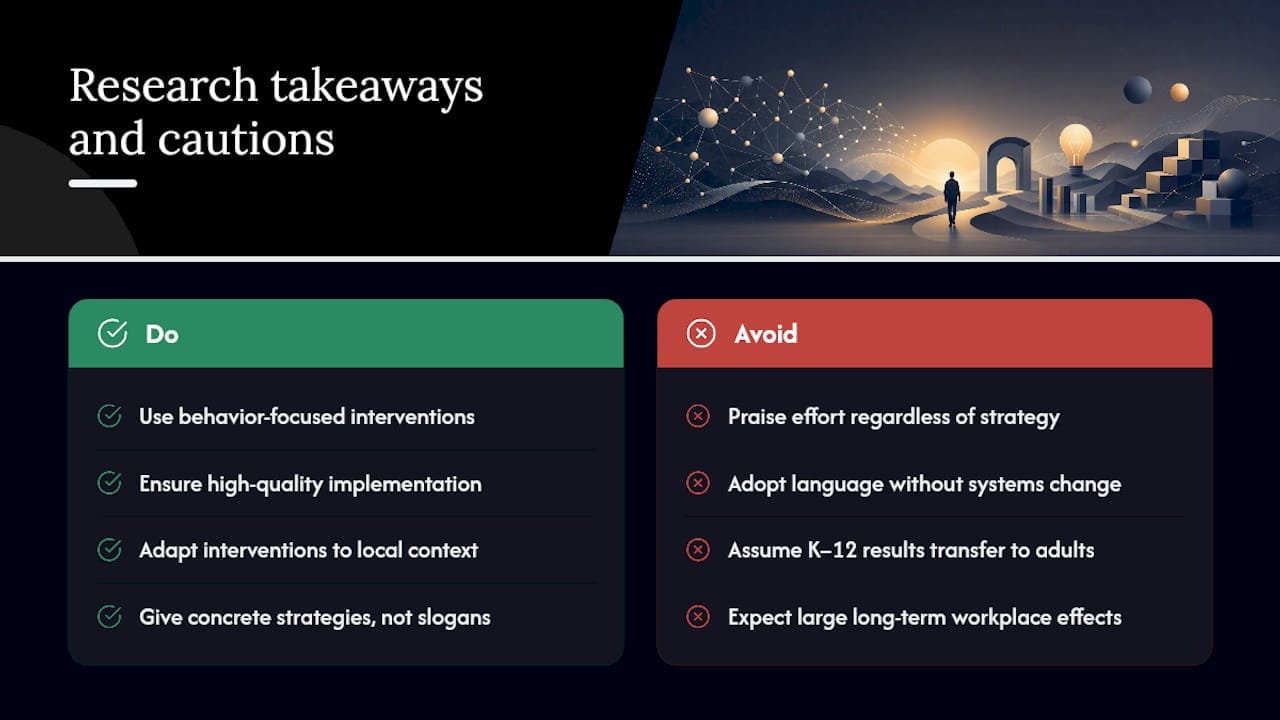
The National Study of Learning Mindsets is among the most rigorous field experiments in this area. It delivered brief, structured interventions to 9th graders across the United States and found measurable effects on motivation and academic outcomes in some settings. The key phrase is “in some settings” — effects varied by school context, prior achievement level, and how well the intervention was implemented.
Carol Dweck herself has cautioned against the “false growth mindset” — praising effort regardless of strategy, or using growth-mindset language as a motivational veneer without changing the underlying systems. When organizations adopt the language without the practice, the message loses credibility fast.
The practical implication: behavior-focused interventions (the learning mindset approach) tend to be more durable for adults than belief-focused messaging alone, because they give people something concrete to do. Verywell Mind’s synthesis of growth-mindset characteristics — welcoming challenges, valuing effort, “failing forward” — aligns with this: the characteristics that predict better outcomes are behavioral, not just attitudinal.
Where the research is still open: long-term effects of mindset interventions in adult workplace settings are less studied than K–12 contexts. Effect sizes in meta-analyses are often moderate. And the innovation mindset literature suggests that context specificity matters — what works in a classroom may need significant adaptation for a high-pressure sales team or a startup founder.
One experiment worth trying this week
The most common mistake people make when they first encounter learning-mindset ideas is treating them as a philosophy rather than a practice. Reading about feedback orientation does not build it. Thinking about reflection does not build it. Only doing it builds it.
Here is a single, bounded experiment to run over the next seven days. Each morning, write one question you genuinely cannot answer about something you are working on. At the end of the day, write one sentence about what you learned — even if the answer is “I still don’t know, but now I know why I don’t know.” On day seven, read all seven entries. Look for patterns: which questions led to the most useful learning? Which days did you skip, and why?
That seven-day record is more informative than any self-assessment score. It shows you exactly where your curiosity is active, where your reflection is shallow, and which conditions make learning easier or harder for you. The growth mindset in business literature consistently shows that teams who build structured reflection into their weekly rhythm outperform those who rely on motivation alone. The same principle applies to individuals.
One more thing worth saying plainly: the people who build this mindset fastest are rarely the ones who read the most about it. They are the ones who put themselves in environments where the behaviors are expected, modeled, and reinforced daily.
Immersive programs can accelerate your learning mindset faster than solo practice
Reading a framework and applying it alone is a starting point, but the research is clear: daily practice, structured feedback loops, and accountability to a cohort compress the timeline significantly. Nomadexcel’s online entrepreneurship bootcamp is built around exactly these conditions — daily sprints, direct mentorship from experienced operators, and a peer community that challenges your assumptions in real time rather than once a quarter.
Before joining any immersive program, ask three questions: Does it build in daily practice rather than passive instruction? Does it include structured feedback from mentors and peers, not just lectures? Does it measure outcomes — skills applied, experiments run, revenue generated — rather than just hours attended? Nomadexcel’s program structure is designed to answer yes to all three. If you are ready to move from reading about a learning mindset to living one, check availability and see which cohort fits your schedule.
Sources
These sources provide the strongest research evidence and practical guidance behind the ideas in this article.
- Learning Mindset: How To Build It In The Age Of AI – eLearning Industry
- PMC article on mindset interventions (National Study of Learning Mindsets excerpt)
- What We Know About Learning Mindsets from Scientific Research
- What having a growth mindset actually means – Harvard Business Review
- Growth mindset: Characteristics, benefits, and how to cultivate it – Verywell Mind
- What is a Learning Mindset? Explained + Quiz – Mindset Online
Comments are closed.