
Refine your business offers for real startup growth
TL;DR:
- Most startups fail to grow because their offers focus on features instead of the outcomes customers want to achieve. Clarifying and emphasizing specific results builds credibility, reduces skepticism, and differentiates a business in competitive markets. Continuous, genuine customer research and iterative positioning refinement are essential for sustainable growth and alignment between messaging and service delivery.
Most startups hit a frustrating wall not because their product is bad, but because their offer is built around the wrong thing entirely. They list features, describe processes, and explain how their service works, while potential customers are quietly asking one question: “What does this actually do for me?” That gap between feature-led and outcome-led offers is where growth stalls, deals fall through, and marketing budgets disappear without results. This guide walks you through a practical, proven process for refining your offer so it speaks directly to what your customers value most, backed by expert research and real entrepreneurial experience.
Table of Contents
- Why clarifying your offer outcomes matters
- Prepare for refinement: Understand customer needs deeply
- Refining your positioning and messaging: Step-by-step process
- Common pitfalls and troubleshooting tips
- Our take: Why real refinement outpaces talk
- Take the next step: Accelerate your growth with Nomad Excel
- Frequently asked questions
Key Takeaways
| Point | Details |
|---|---|
| Lead with outcomes | Successful business offers focus on clear customer outcomes rather than just features. |
| Interview for insights | Customer interviews consistently deliver actionable information for offer refinement. |
| Align positioning and proof | Effective offers require messaging credibly supported by actual delivery and results. |
| Avoid common pitfalls | Troubleshooting is essential if refinements stall due to mismatched promise and capability. |
| Continuous improvement | Top entrepreneurs iterate offers based on real-world feedback and ongoing learning. |
Why clarifying your offer outcomes matters
Features describe what your product does. Outcomes describe what your customer gains. It sounds like a small distinction, but it changes everything about how your offer lands in the market.
Consider two ways to position the same coaching service. Version one says: “We provide six weekly sessions, a workbook, and a private community.” Version two says: “You’ll have a validated business model and your first paying customer within 60 days.” The second version speaks to a result that a real customer cares about. It creates urgency, reduces skepticism, and makes your offer easier to say yes to.
Outcome-led offer refinement can enhance your positioning by leading with business outcomes and making your approach uniquely yours. When your messaging centers on what clients actually achieve, rather than the steps you take to get there, you instantly differentiate yourself from competitors who are still talking about features.
Why outcome clarity is a competitive advantage:
- Customers make decisions based on desired future states, not product specifications
- Outcome-led messaging reduces the mental work a prospect has to do to see the value
- Specificity in outcomes builds credibility and trust in a way that vague feature lists never can
- Clear outcomes make it easier to attract referrals, because clients know exactly what to tell others
- Aligning team objectives around outcomes also keeps your internal team focused on what matters
There is also a deeply practical business reason to prioritize outcome clarity. When your entire team understands the outcome they are delivering, every decision from product development to customer service becomes easier and more consistent. Investing in business education that emphasizes outcome thinking gives entrepreneurs a serious edge because most of their competitors are still operating in feature mode.
The businesses that grow fastest are not always the ones with the best features. They are the ones who can most clearly articulate why those features matter to the person paying for them.
Prepare for refinement: Understand customer needs deeply
Now that you understand the need for outcome focus, it’s time to prepare for effective refinement by digging into customer conversations. No amount of strategic thinking replaces what you learn from real customers talking openly about their problems, goals, and frustrations.
Real customer conversations consistently outperform surveys and landing page tests for generating insights before testing your messaging. A survey gives you numerical responses to the questions you thought to ask. An interview gives you the language, emotions, and context behind the real problems your customers are trying to solve.
Comparing customer research methods:
| Method | Insight depth | Time required | Best use case |
|---|---|---|---|
| 1-on-1 interviews | High | 30-60 min per session | Uncovering root problems and language |
| Surveys | Low to medium | 10-15 min per response | Validating patterns at scale |
| Landing page tests | Medium | Days to weeks | Testing message resonance |
| Observational research | High | Variable | Understanding behavior in context |
Ten well-conducted interviews with the right customers will reshape your entire offer more effectively than 200 survey responses. The reason is simple: surveys confirm what you already think, while interviews reveal what you haven’t considered.
How to maximize value from customer interviews:
- Recruit customers who have already experienced the problem your offer solves, not just people who might have it
- Ask open-ended questions like “Walk me through the last time you dealt with this” rather than “Would you use a product that does X?”
- Listen for the specific words and phrases customers use to describe their pain points, because those exact words belong in your positioning
- Pay close attention to emotional signals, hesitation, and frustration, which often reveal the real motivation behind a purchase decision
- Validate market demand by identifying how many people share the same core problem before finalizing any messaging changes
- Approach each interview with genuine curiosity rather than a desire to confirm your existing hypothesis
Pro Tip: Record your interviews (with permission) and transcribe them. Look for phrases that appear across multiple conversations. Those recurring phrases are your offer’s most powerful language, because they reflect how customers already think about the problem you solve.
The preparation phase is not glamorous, but it is where the real refinement begins. Experiential education for entrepreneurs consistently reinforces this lesson: the founders who invest time in genuine discovery conversations build offers that convert, scale, and retain customers far more reliably than those who skip straight to messaging. Building solid team accountability strategies around customer research also keeps your team honest about whether your assumptions are grounded in reality.
Refining your positioning and messaging: Step-by-step process
Armed with insights from customer interviews, let’s walk through the actionable steps for refining your offer messaging. This is where discovery becomes direction.
“When your positioning and offer aren’t credibly aligned, prospects treat you as a vendor rather than a partner. The difference in how they engage, negotiate, and refer you is enormous.” This reflects the core of HubSpot’s positioning guidance, which explicitly links effective positioning to explaining differentiation and proof.
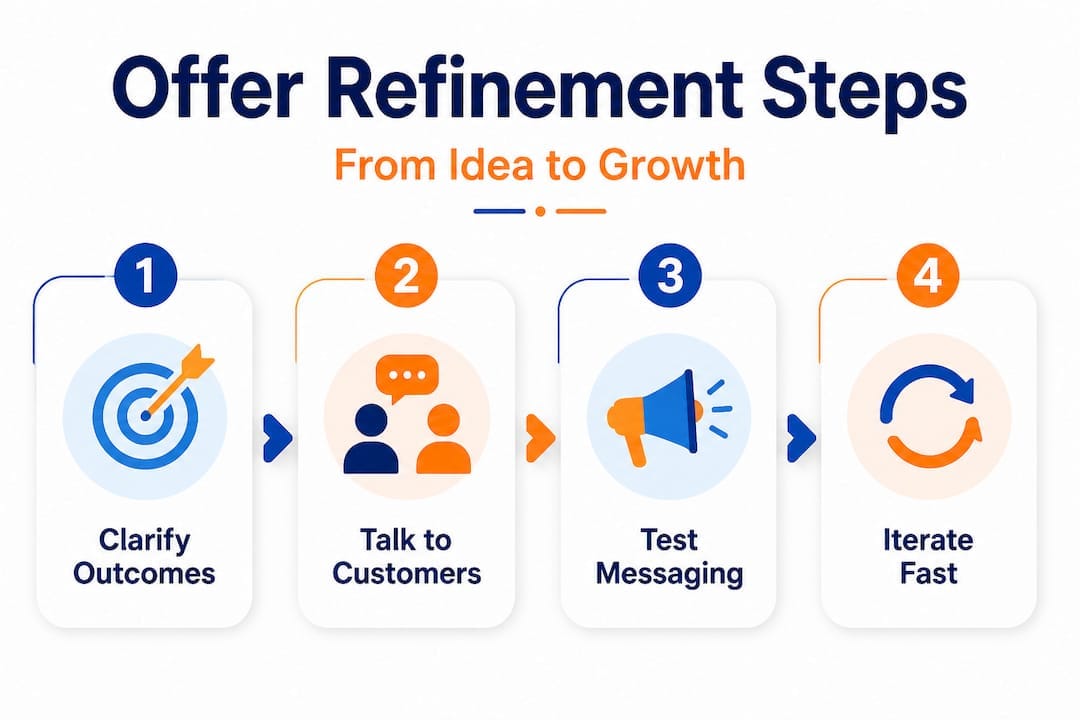
Here is a clear, repeatable process you can use to refine your offer positioning:
Identify the single most important outcome your customers want. Not the five things your service does, but the one result that makes someone say yes. Use your interview notes to find it.
Write your outcome statement in plain language. Avoid industry jargon. If your ideal customer wouldn’t use that word in a conversation, don’t use it in your positioning. Aim for something specific enough to be believable and compelling enough to create desire.
Add proof to your positioning. Proof can be a case study, a testimonial, a specific data point, or a before-and-after narrative. Hands-on entrepreneurship teaches you that showing someone what’s possible through real evidence closes more deals than any perfectly worded sales pitch.
Clarify what makes your approach uniquely yours. This is not about listing your features again. It’s about naming the specific method, perspective, or philosophy that sets your delivery apart. Are you faster? More personalized? Rooted in a particular framework? Name it explicitly.
Test the message in real conversations before going wide. Share your refined positioning in one-on-one conversations, outreach emails, or brief discovery calls. Measure whether prospects respond with more curiosity, less objection, and stronger engagement than before.
Iterate based on real response data. Refinement is not a one-time exercise. Each time you share your new positioning, note what generates interest and what creates confusion. Adjust accordingly.
Positioning elements and their roles:
| Element | Purpose | Example |
|---|---|---|
| Outcome statement | Describes the result clients achieve | “Build your first scalable revenue stream in 90 days” |
| Proof point | Builds credibility and reduces skepticism | Client testimonial with specific numbers |
| Differentiator | Explains why your approach works | “Live mentorship, not pre-recorded content” |
| Ideal client clarity | Signals who the offer is for | “For founders generating under $10k/month” |
Pro Tip: Run your refined positioning through this quick test. Ask someone unfamiliar with your business to read your messaging and tell you in their own words what you do and who it’s for. If their answer matches what you intended, your positioning is working. If it doesn’t, keep simplifying.
Accelerating growth hands-on through structured environments also reinforces these positioning skills faster than working alone, because you get real-time feedback from peers and mentors who can spot weak messaging that you might be too close to see. Understanding the role of educational tools and programs that sharpen these skills can also significantly compress your learning curve.

Common pitfalls and troubleshooting tips
Even with a refined offer, obstacles can arise. Here’s how to diagnose and fix common refinement issues.
The most damaging problem entrepreneurs face after refining their messaging is a mismatch between promise and delivery. You can write compelling positioning that attracts new customers, but if your actual service doesn’t deliver the outcome you promised, growth stalls immediately. Messaging improvements stall when the underlying offer cannot deliver the promised outcomes, which means positioning and product capability must evolve together.
Warning signs that your refinement isn’t working:
- Prospects respond with interest but hesitate to commit, often citing doubt about whether results are achievable
- Customers churn quickly after purchase, suggesting the experience doesn’t match the expectation you set
- Your marketing generates clicks but those clicks don’t convert to conversations or sales
- Existing customers struggle to describe your offer clearly when referring others, meaning the outcome isn’t clear enough
- You receive consistent objections around price that disappear when you focus conversations on specific results rather than service components
Tips for getting your offer back on track:
- Return to your customer interviews and check whether the outcome you’re promising is the outcome they most urgently want
- Audit your actual delivery process to identify where the gap between promise and experience might exist
- Add interim milestones to your offer so customers experience progress before the final outcome is achieved
- Use testimonials from clients who have achieved the promised result to address skepticism before it becomes an objection
- Consider offering a smaller, lower-risk version of your offer that lets new customers experience your delivery quality before committing fully
Community-driven bootcamps are particularly valuable during troubleshooting phases because they expose you to founders working through similar challenges. Hearing how others have diagnosed and resolved their own offer misalignments often provides insights that hours of solo reflection cannot match.
Pro Tip: When growth stalls, resist the urge to immediately change your messaging. First, check whether the problem is in your positioning or in your actual delivery. Fixing the wrong layer wastes time and erodes confidence.
Our take: Why real refinement outpaces talk
Most startup guides treat offer refinement as a one-time exercise. Write your positioning, test it, ship it. But what we see consistently at Nomad Excel, across bootcamps with founders at every stage, is that the entrepreneurs who grow fastest treat refinement as an ongoing practice, not a project they complete and move on from.
Conventional wisdom underestimates how much the market changes around you even when you haven’t changed. Customer language evolves. Competitors copy your differentiators. The outcomes your audience prioritizes shift with economic conditions and industry trends. An offer that was well-positioned 12 months ago can quietly become generic if you stop paying attention.
What accelerates this learning dramatically is close, consistent interaction. Founders who participate in structured mentorship and peer communities refine their offers in weeks rather than months. This isn’t because mentors hand them the answers. It’s because the feedback loop is compressed. You share your positioning, someone who has seen it work or fail challenges your assumptions in real time, and you adjust before investing heavily in the wrong direction.
The education benefits for entrepreneurs that matter most aren’t about acquiring more information. They’re about gaining access to experienced perspectives that shorten the distance between your current offer and one that consistently converts. That’s exactly what a strong entrepreneur mentorship guide provides: a structured way to compress years of trial and error into a focused period of guided iteration.
Our honest perspective is this. The entrepreneurs who struggle longest are those who refine in isolation. They polish their messaging without showing it to real customers, or they receive feedback from friends and colleagues who are too polite to tell them what isn’t working. Real refinement requires real exposure, to customers, to mentors, and to peers who will challenge your thinking with care but without hesitation.
Take the next step: Accelerate your growth with Nomad Excel
Refining your business offer is one of the most high-leverage investments you can make as a founder, and you don’t have to figure it out alone. Nomad Excel’s online entrepreneurship bootcamp is built around exactly the kind of structured, hands-on refinement process described in this article. You’ll work through customer discovery, positioning frameworks, and messaging tests with experienced mentors and a community of driven founders who are doing the same work in real time. If you’re weighing whether this kind of program is right for you, the entrepreneurship bootcamp guide walks through what to expect and who benefits most. You can also explore our program to see the full range of options designed to help you move from idea to traction faster than you would working alone.
Frequently asked questions
How often should I refine my business offer?
Review and refine your offer every time you receive meaningful customer feedback or notice a shift in how the market responds to your messaging. Treating refinement as a recurring practice rather than a one-time event keeps your positioning sharp as customer needs and competitive conditions evolve.
What’s the best way to test a refined business offer?
Direct customer interviews consistently generate richer, more actionable insights than surveys or landing page experiments. Customer conversations outperform these methods for generating real insights before testing messaging broadly, because they reveal motivations and language that structured tests can’t capture.
How do I know if my offer is outcome-led or just feature-led?
Outcome-led offers clearly state the specific result clients will achieve, while feature-led offers describe product activities or technical components. If your positioning answers “what will my life or business look like after using this?” rather than “what does this product include?”, it is outcome-led.
What if my refined offer isn’t delivering promised results?
If clients aren’t achieving the outcomes you’ve positioned, the gap usually lies in the delivery process rather than the messaging alone. Messaging improvements stall when the underlying offer cannot actually deliver on what was promised, which means realigning your service delivery and rebuilding proof through small, successful client engagements before scaling outreach again.
Recommended
- 7 Smart Growth Strategies for Startups: Practical Steps
- Business Alignment: Driving Startup Growth Globally
- Blog – Nomad Excel – Your Entrepreneurial Adventure Starts Here
- 7 Essential Growth Strategies for Startup Success
- How business cards elevate startup branding in 2026 – BcardsCreation
- Go-To-Market Strategy for Startups: A Blueprint for Rapid Growth – Reddog Consulting Group
Comments are closed.