
How to build a startup community that drives real growth
TL;DR:
- Many startup communities fail to create meaningful business impact despite impressive surface activity.
- Building engagement around clear goals related to collaboration, learning, or pipeline ensures genuine value and growth.
- Prioritizing depth over breadth and measuring real outcomes help communities endure and deliver measurable success.
Many founders build communities that look impressive from the outside, but quietly fail to generate anything meaningful for their business. Slack channels fill with announcements. Events draw a crowd. Yet pipeline stays flat, partnerships never materialize, and the whole effort starts to feel like a time drain. The truth is that surface-level activity and genuine community value are completely different things. This guide walks you through a proven, step-by-step approach to designing, growing, and measuring a startup community that creates real connections, unlocks growth opportunities, and delivers outcomes you can actually trace back to your bottom line.
Table of Contents
- Understand your ‘why’: Set the right goals for your community
- Prepare the building blocks: People, platforms, and processes
- Activate engagement: Steps to spark real connection and value
- Measure what matters: Scorecards and outcomes for sustainable growth
- Troubleshooting and common mistakes: How to course-correct
- The untold truth: Why deeper networks outlast flashy communities
- Next steps: Accelerate your entrepreneurial network with expert support
- Frequently asked questions
Key Takeaways
| Point | Details |
|---|---|
| Purpose-driven strategy | Communities that link participation to business results grow faster and last longer. |
| Build the right foundation | Assemble dedicated core team members, choose smart tools, and set strong processes early. |
| Engagement over events | Focus on rituals and meaningful interactions instead of only social gatherings or online noise. |
| Measure real impact | Track both engagement and concrete outcomes—like new deals, hires, or retention improvements. |
| Adapt and iterate | Continually refine your approach based on feedback and measurable results to ensure sustainable growth. |
Understand your ‘why’: Set the right goals for your community
Before you send a single invite or choose a platform, you need to get honest about what you actually want your community to accomplish. Too many founders treat community building as a brand exercise, a way to look connected and credible without tying the effort to anything measurable. That approach burns time and goodwill fast.
A strong startup community is built around concrete business goals. Think about what specific outcomes would justify the time investment. The most durable communities tend to center on one or more of the following:
- Collaboration: Founders co-creating products, sharing resources, or tackling shared challenges together
- Learning and skill transfer: Structured knowledge exchange between operators at different growth stages
- Business development: Referrals, warm introductions, and deals that flow naturally from trusted relationships
- Talent recruiting: Access to vetted candidates who already share your values and vision
- Customer pipeline: Converting community members into paying customers or advocates
The key is linking community participation to your startup’s actual KPIs. If retention is your core challenge, your community should be designed to reinforce customer success and product feedback loops. If early pipeline is the goal, the community should consistently generate warm leads and referrals. Understanding network depth and outcomes reveals that physical spaces and surface activity signals rarely drive real community value on their own.
“A common mistake is focusing on surface activity; a scorecard approach should connect participation indicators to business outcomes like pipeline and retention impact.”
Learning how to build business community with intention means starting with clarity about what success actually looks like for your specific stage and sector. Write it down. Share it with your founding team. Make it visible to early members so expectations are aligned from day one.
With the purpose clear, the next step is to assess what you need to get started.
Prepare the building blocks: People, platforms, and processes
A community without structure is just a group chat. Real communities require three foundational assets: a committed core team, the right platform, and clear operating processes that keep things moving even when the founder is busy.
Your core team should include at least one dedicated community lead who owns engagement, content, and moderation. This doesn’t have to be a full-time hire early on. It can be a cofounder, a passionate early customer, or even a part-time contractor. What matters is accountability. Someone must own it.

Platform selection is one of the most common early stumbling blocks. Here’s a practical comparison to help you choose:
| Platform | Best for | Key features | Avoid if |
|---|---|---|---|
| Slack | Real-time async discussion | Channels, integrations, search | You need rich content or events |
| Circle | Content and community combined | Courses, events, forums, DMs | You need deep integrations |
| Discord | Younger, high-engagement audiences | Voice, threads, bots | Audience isn’t tech-comfortable |
| In-person meetups | Trust-building and deal-making | Human energy, spontaneity | You lack consistent local audience |
| LinkedIn Groups | Professional lead gen | Visibility, professional context | You need active daily engagement |
Processes matter just as much as platform. You need systems for onboarding new members, moderating discussions, and celebrating wins. A solid onboarding flow sets expectations, introduces new members to key people, and gives them an immediate first action to take. Without it, most new members go silent within days.
The Community Health Scorecard for Startups offers concrete targets to orient your early benchmarks, including participation rates of 35 to 45% monthly active contributors, contribution quality around 55 to 60%, pipeline influence between 15 and 20%, and retention signals tracked through cohort lift. These numbers give you a realistic picture of what healthy looks like.
Pro Tip: Start with 20 to 30 highly curated members rather than blasting an open invite. A small, engaged founding cohort sets the cultural tone for every member who joins after them.
For detailed frameworks on structure and early activation, the step-by-step community guide and real-world startup community examples offer practical blueprints worth studying.
With your foundational assets assembled, it’s time to bring people together and get them meaningfully involved.
Activate engagement: Steps to spark real connection and value
Getting people to show up is one challenge. Getting them to genuinely participate is another. Shallow engagement, likes, one-word replies, passive event attendance, feels productive but rarely translates into business outcomes. Authentic engagement requires intentional design.
Here are the core activation steps every founder should follow:
- Craft a compelling welcome sequence. When someone joins, send a personal message within 24 hours. Introduce them to two or three specific members they should meet. Give them a clear first action like answering an intro prompt or joining a live call.
- Engineer early wins. Make it easy for new members to contribute and receive value in their first week. A simple win, like getting a useful answer to a business question, builds the habit of participation.
- Run curated introductions. Manually connect members who have complementary needs or skills. This is time-intensive but produces a disproportionate amount of the trust that makes communities sticky.
- Establish regular rituals. Weekly threads, monthly live sessions, or quarterly founder showcases create rhythm and give members reasons to keep showing up.
- Recognize contributions publicly. Celebrate members who give great advice, make introductions, or share wins. Recognition is a powerful and free engagement lever.
The contrast between shallow events and sustained network-building is worth understanding clearly:
| Approach | Short-term result | Long-term outcome |
|---|---|---|
| One-off networking events | High attendance, low follow-through | Weak ties, low retention |
| Recurring structured sessions | Moderate attendance, higher engagement | Stronger relationships, more referrals |
| Peer-led working groups | Lower initial uptake | Deep trust, collaboration, and pipeline |
| Curated 1:1 introductions | Time-intensive to manage | Highest conversion to business outcomes |
As the research consistently shows, community support and growth are accelerated when members feel genuinely seen and supported, not just included in a broadcast channel. And community-driven growth happens when those connections have clear, business-relevant context.
It’s also critical to avoid optimizing for vanity activity. Participation should directly drive business impacts, not just generate surface-level metrics that look good in a monthly report.
Pro Tip: Peer-led sessions where members teach each other create far deeper engagement than founder-led content alone. Rotate facilitation early and often.
For more on integrating community into your broader business development approach, explore this networking for founders workflow guide.
Once engagement takes root, you need to ensure it delivers measurable value and doesn’t just look good on the surface.
Measure what matters: Scorecards and outcomes for sustainable growth
Most founders track community metrics that feel reassuring but tell them very little about real impact. Member count, post volume, and event attendance are leading indicators at best, vanity metrics at worst. What you actually need is a community health scorecard that pairs leading engagement inputs with lagging commercial outcomes.
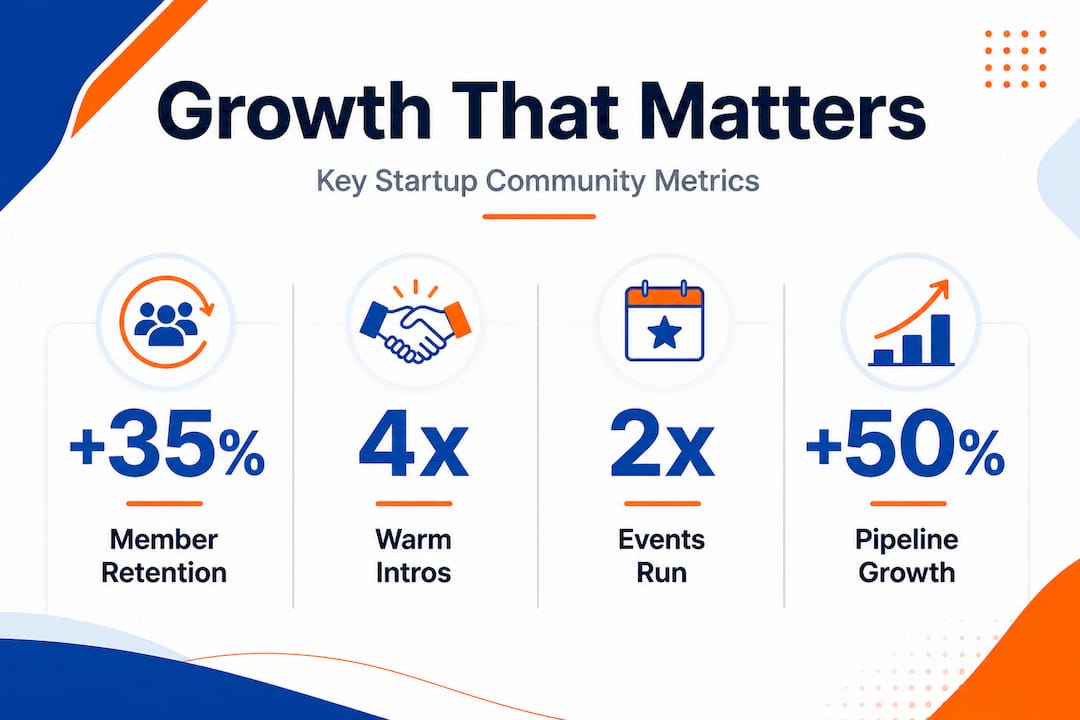
Here’s a practical scorecard framework:
| Metric | Target range | How to measure |
|---|---|---|
| Monthly active contributors | 35 to 45% of total members | Active posts or replies divided by total members |
| Contribution quality score | 55 to 60% rated helpful | Member upvotes, moderator rating, or survey data |
| Pipeline influence rate | 15 to 20% of new leads from community | CRM tracking with lead source tagging |
| Retention cohort lift | 10 to 15% higher than non-members | Compare churn rates between community and non-community customers |
Spotting false positives is just as important as tracking the right metrics. Here’s what to watch for:
- High post volume, low response rates. Lots of content being published but little conversation happening around it suggests members are broadcasting, not connecting.
- Event attendance without follow-up action. If your post-event surveys show no new connections formed or deals discussed, the event generated noise but not value.
- Engagement concentrated in a small group. If 80% of your posts come from 10% of your members, you have a core contributor problem that will stall growth.
Connecting your community data to your growth strategies creates a feedback loop where community efforts directly inform business decisions. You can also find structured frameworks inside an entrepreneurship bootcamp environment that help you apply these metrics in real time with accountability built in.
Sustained community health requires regular check-ins on personal growth action plans at the individual level too. When members grow, the community grows with them.
Measuring outcomes sets the stage for continual improvement and real impact. But what makes some communities thrive while others stall?
Troubleshooting and common mistakes: How to course-correct
Even well-intentioned communities drift. Here are the most common failure patterns founders encounter, and the fastest way to fix each one.
- Inconsistent leadership. When founders disappear for weeks at a time, engagement drops sharply. Communities need a consistent, visible leader. Fix: Block protected community time in your calendar each week, treat it like a client call.
- Unclear expectations. When members don’t know what the community is for or how to participate, they default to silence. Fix: Create a pinned “start here” resource that explains the purpose, norms, and first actions.
- Lack of network diversity. Communities that attract only one type of founder or operator quickly feel repetitive. Fix: Actively recruit members from adjacent industries, different growth stages, and diverse backgrounds.
- Burnout in core contributors. The same handful of people cannot carry engagement indefinitely. Fix: Identify and develop a second tier of community leaders early, before burnout sets in.
- Shallow engagement spirals. Once a community gets a reputation for surface-level content, it’s hard to reverse. Fix: Seed the community yourself with high-value, vulnerable, specific posts that model the culture you want.
“Warns to avoid optimizing ‘for vanity activity.’ Depth and outcomes matter far more than showy surface metrics.”
For founders looking to apply proven growth strategies for startups to their community building efforts, the core principle applies equally here. What gets measured and intentionally designed gets improved.
Now that you’ve seen how to check your progress and fix errors, let’s reflect on what really separates transformative startup communities from generic busy groups.
The untold truth: Why deeper networks outlast flashy communities
Here’s something most startup community guides won’t tell you. A crowded room is not the same as a powerful network. Hundreds of members posting daily is not the same as twenty founders who genuinely trust each other and make introductions without being asked. The obsession with growth metrics, member counts, engagement rates, post volumes, can actually undermine the thing that makes communities valuable in the first place.
The research is clear on this. Network depth, institutional coordination, and outcomes, not simply activity signals or physical spaces, drive real community value. Innovation hubs that focused on headcount and buzz have struggled. The ones that created genuine trust infrastructure, shared accountability, and measurable commercial outcomes have endured.
What most guides miss is that trust is not a byproduct of time or frequency. It’s a byproduct of intentional design. You have to create environments where vulnerability is safe, where failure is discussable, and where helping someone else is recognized and rewarded. That doesn’t happen automatically in a Slack channel. It has to be architected.
The founders we’ve seen build genuinely transformative communities share one trait. They prioritize depth over breadth, every single time. They say no to rapid scaling until the core culture is solid. They invest in fewer, richer interactions rather than more frequent, shallow ones. And they measure success by business outcomes, not activity volume.
Community-driven bootcamps work precisely because they compress trust-building and accountability into an intentional environment where every element is designed to create depth, not just presence. That model transfers directly to how the best startup communities are built outside of bootcamp settings too.
Next steps: Accelerate your entrepreneurial network with expert support
Building a community with real business impact takes more than good intentions. It takes structure, mentorship, and the right environment to accelerate your learning and relationships simultaneously. At Nomad Excel, our immersive programs are specifically designed to help founders build exactly this kind of deep, results-driven network. Through our Online Entrepreneurship Bootcamp, you’ll work through proven frameworks for community-led growth alongside a curated cohort of driven peers. If you’re ready to surround yourself with founders who push you forward, explore joining entrepreneurship bootcamps and see how an intentional, structured environment transforms how fast you grow.
Frequently asked questions
What are the essential first steps for building a startup community?
Define your goals, assemble a core team, select the right platform, and create clear onboarding processes. Healthy communities target participation rates of 35 to 45% monthly active contributors right from the early stages.
How can I measure if my startup community is successful?
Track business outcomes like new customer pipeline and retention, not just engagement stats. A scorecard approach connects participation indicators directly to commercial results like pipeline and retention impact.
What types of activities drive deeper engagement?
Peer-led sessions, curated introductions, and regular collaborative projects foster stronger engagement than one-off events because they create repeated, high-trust interactions between members over time.
What’s the most common mistake founders make with startup communities?
Optimizing for surface activity instead of linking participation to real business outcomes. As the research warns against vanity activity, the focus should always be on meaningful, measurable impact.
How often should I reassess my community structure or goals?
Quarterly reviews are ideal for tracking progress and making strategic adjustments, giving you enough time to see trends while staying agile enough to course-correct before problems compound.
Recommended
- Step-by-step guide to building a successful startup community
- 7 startup community examples every entrepreneur should study
- Why community-driven bootcamps accelerate business growth
- Team Building for Startups: Driving Growth Together
- Go-To-Market Strategy for Startups: A Blueprint for Rapid Growth – Reddog Consulting Group
Comments are closed.