
What Is a Business Sprint? A Practical Guide
TL;DR:
- A business sprint is a short, structured work cycle focused on specific goals to achieve rapid progress. It replaces long-term plans with time-bound execution, improving productivity, alignment, and feedback. Different formats suit various objectives, with each promoting clear priorities and continuous adaptation.
A business sprint is defined as a focused, time-boxed period in which a team concentrates its effort on completing specific business objectives to drive rapid, measurable progress. The term comes from agile software development but now applies across product launches, marketing campaigns, and entrepreneurial planning. 97% of groups using agile methods report better results than those using traditional planning. That number tells you something important: structured, iterative work cycles outperform long-range plans that sit untouched for months. Nomadexcel builds sprint frameworks directly into its entrepreneurship bootcamps, giving founders a repeatable system for turning goals into results.
What is a business sprint and how does it work?
A business sprint is a short, structured work cycle with a defined start, a clear goal, and a fixed end date. The sprint forces a team to prioritize ruthlessly, commit to a small set of objectives, and review progress before moving forward. This is the core mechanic behind the business sprint methodology: replace open-ended planning with time-bound execution.
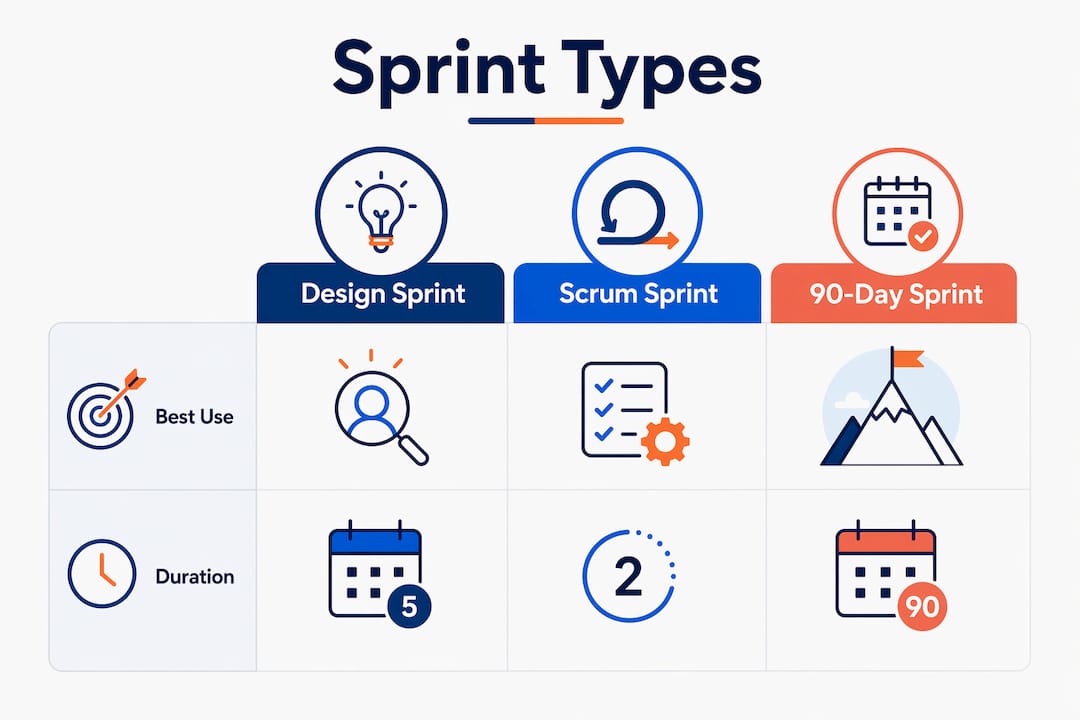
Three sprint formats dominate business practice today. Each serves a different purpose and timeframe.
Design sprints compress months of problem-solving into one week. Originally developed by Jake Knapp at Google Ventures, the design sprint runs through five phases: understand, sketch, decide, prototype, and validate. Teams use it to test a product idea or solve a specific user problem before committing to full development.
Scrum sprints run for 1–4 weeks and focus on iterative delivery. A team selects a set of tasks from a backlog, works through them during the sprint, and then reviews outcomes before planning the next cycle. Scrum sprints work well for software teams and product-focused businesses.
90-day sprints apply sprint thinking to quarterly business goals. The 90-day sprint divides into three 30-day phases: activation, iteration, and amplification. Activation sets the foundation, iteration tests and adjusts, and amplification scales what works.
| Sprint type | Duration | Best use case |
|---|---|---|
| Design sprint | 5 days | Rapid problem-solving and prototyping |
| Scrum sprint | 1–4 weeks | Iterative product or project delivery |
| 90-day sprint | 90 days | Quarterly business goal execution |
Pro Tip: Pick your sprint format based on the scope of the goal. Use a design sprint for a single question, a Scrum sprint for a defined deliverable, and a 90-day sprint for a full business objective.
How do business sprints enhance productivity and project execution?
Business sprints improve productivity by replacing vague ambition with specific, time-bound commitments. When a team knows a sprint ends on Friday, every day carries weight. That urgency is not artificial pressure. It is a design feature.

Scrum business planning transforms static plans into living documents by working in short cycles with frequent reviews and adaptations based on real feedback. A traditional annual plan becomes obsolete the moment the market shifts. A sprint-based plan adjusts every two weeks.
The benefits of business sprints show up in four consistent areas:
- Clearer priorities. Sprints force teams to choose 3–5 objectives and ignore everything else. That constraint removes the paralysis of too many competing demands.
- Faster feedback loops. Sprint reviews surface what is working before a team wastes weeks on the wrong path.
- Reduced burnout. Short cycles with defined endpoints give teams permission to rest and reset. The work has a rhythm.
- Stronger alignment. Daily stand-ups keep every team member aware of blockers and progress without requiring long status meetings.
Regular, time-boxed sprints create a predictable rhythm for teams, improving focus and reducing overwhelm through clear, limited objectives. Predictability matters more than most teams realize. When people know what to expect, they spend less mental energy on coordination and more on execution. Investing in leadership training best practices alongside sprint adoption accelerates team alignment even further.
Pro Tip: Track one metric per sprint objective. A single number tells you faster whether the sprint is working than a full dashboard of indicators.
What are the key phases of running a successful business sprint?
A well-run sprint follows a four-phase cycle: planning, execution, review, and retrospective. Each phase has a specific job, and skipping any one of them weakens the whole system.
Sprint planning
Sprint planning is where the team selects objectives from the backlog and commits to what they will complete. Sprint planning sessions typically last 1–2 hours. The output is a sprint backlog: a short, prioritized list of tasks the team owns for the duration of the sprint. Good planning means the team leaves the room with no ambiguity about who does what.
Daily execution and stand-ups
During the sprint, teams run daily stand-ups. Each person answers three questions: What did I complete yesterday? What will I complete today? What is blocking me? Stand-ups take 15 minutes or less. Their purpose is to surface blockers early, not to report progress to a manager.
Sprint review
At the end of the sprint, the team reviews what was completed and gathers feedback. For a design sprint, this means testing a prototype with real users. For a Scrum sprint, it means demonstrating a working product increment. The review is not a celebration. It is a data-gathering session.
Sprint retrospective
The retrospective asks: What went well? What did not? What will we change next sprint? This is where the team improves its own process. Sustaining sprint momentum requires disciplined weekly measurement and adjustment, with scorecards tracking key outcomes to enable transparent accountability and continuous improvement.
For a design sprint specifically, the five phases run in sequence across a single week:
- Understand the problem and map the challenge
- Sketch competing solutions individually
- Decide on the strongest solution as a group
- Prototype a realistic but low-cost version
- Validate with real users and capture feedback
Pro Tip: Keep your sprint retrospective to 30 minutes. Use a simple format: three things that worked, two things to fix, one experiment to try next sprint.
How can entrepreneurs and teams apply business sprints for faster results?
Entrepreneurs benefit most from sprint thinking when they apply it to quarterly business objectives. The 90-day sprint structure gives a solo founder or small team a framework that matches the natural rhythm of business planning without requiring a large organization to support it.
The most common mistake entrepreneurs make is choosing too many objectives. Limit each sprint to 3–5 key goals. More than that and focus collapses. Each goal needs a clear success metric so the sprint review has something concrete to evaluate.
Here is how sprint thinking applies across common entrepreneurial contexts:
- Product development. Use a design sprint to test a new feature or offer before building it. Five days of structured work can replace three months of guesswork.
- Marketing campaigns. Run a two-week Scrum sprint to launch, measure, and adjust a campaign before committing to a full budget.
- Team alignment. Use a 90-day sprint to align a distributed team around shared quarterly priorities, with weekly check-ins replacing quarterly all-hands meetings.
- Revenue goals. Break an annual revenue target into four 90-day sprints. Each sprint has its own activation, iteration, and amplification phase.
Solopreneurs and small teams should dedicate approximately 10 hours per major goal weekly in a 90-day sprint to avoid burnout and maintain progress. That is a concrete, manageable commitment. It also makes the sprint feel real rather than aspirational.
Traditional annual goals often lose momentum. The 90-day sprint creates accountability and urgency through weekly tracking, scorecards, and regular reviews. A weekly rhythm of Monday kickoff, midweek check-in, and Friday review keeps the sprint alive between planning sessions. You can read a detailed breakdown of this approach in Nomadexcel’s guide to running business sprints for faster results.
Pro Tip: Schedule your Friday sprint review before the week starts. Teams that treat the review as optional skip it when things get busy. Treat it like a client meeting.
Key Takeaways
Business sprints work because they replace open-ended planning with time-bound cycles, clear objectives, and structured reviews that force teams to learn and adapt faster than traditional planning allows.
| Point | Details |
|---|---|
| Sprint formats vary by scope | Choose design (5 days), Scrum (1–4 weeks), or 90-day sprints based on the size of your goal. |
| Limit objectives per sprint | Focus on 3–5 key goals per sprint to maintain clarity and avoid losing momentum. |
| Four phases drive every sprint | Planning, execution, review, and retrospective form the repeatable cycle behind sprint success. |
| Weekly rhythms sustain progress | Monday kickoffs, midweek check-ins, and Friday reviews keep accountability high between sprint boundaries. |
| Sprints replace static plans | Agile sprint cycles adapt to real feedback, making them more reliable than annual plans that go stale. |
Why I stopped trusting annual plans and started running sprints
The shift from annual planning to sprint cycles felt uncomfortable at first. I had spent years building detailed 12-month roadmaps, color-coded and cross-referenced, only to watch them become irrelevant by March. The market moved. A campaign flopped. A competitor changed the rules. The plan stayed the same.
What I found with sprints is that the constraint is the point. When you commit to a 90-day window with five objectives and a weekly review cadence, you stop pretending you can predict the future. You start building the skill of adapting quickly instead. That is a more durable competitive advantage than any annual plan.
The most common pitfall I see is teams treating the retrospective as optional. They run the sprint, skip the review, and wonder why the next sprint feels just as chaotic. The retrospective is where the learning happens. Without it, you are just repeating the same sprint over and over with different tasks.
Start smaller than you think you need to. One 90-day sprint with three objectives teaches you more about your team’s capacity than six months of traditional planning. Once you have one sprint under your belt, the next one runs faster and cleaner. Incremental progress compounds. That is not a motivational phrase. It is what the data from sprint retrospectives actually shows you, quarter after quarter.
Pair sprint discipline with strong execution habits for founders and the results accelerate further. The sprint gives you the structure. The habits give you the consistency to show up for it every week.
— Amichai
Nomadexcel’s sprint-based approach to entrepreneurial growth
Nomadexcel’s Online Entrepreneurship Bootcamp is built around the same sprint principles covered in this article. Participants work through structured sprint cycles with daily accountability, expert mentorship, and a community of founders who challenge and support each other throughout the program. The bootcamp translates sprint methodology from theory into real business outcomes, whether you are validating a new offer, building a revenue system, or aligning a team around a quarterly goal. If you want to apply sprint thinking to your own business with guidance and a proven framework, Nomadexcel’s program gives you the structure, the community, and the expert support to make it work.
FAQ
What is a business sprint in simple terms?
A business sprint is a short, focused work period where a team commits to completing specific goals within a set timeframe, typically ranging from 5 days to 90 days.
How long does a typical business sprint last?
Sprint length depends on the format. Design sprints last 5 days, Scrum sprints run 1–4 weeks, and 90-day sprints cover a full quarter divided into three 30-day phases.
What are the main benefits of business sprints?
Business sprints create clearer priorities, faster feedback, stronger team alignment, and reduced burnout by replacing open-ended planning with structured, time-bound execution cycles.
How many objectives should a sprint include?
A sprint should focus on 3–5 key objectives. More than that splits team attention and reduces the urgency that makes sprint cycles effective.
Can solo entrepreneurs use business sprint methodology?
Yes. Solo founders benefit from 90-day sprints by dedicating approximately 10 hours per major goal weekly, using scorecards and weekly reviews to maintain accountability without a full team.
Comments are closed.