
How to Run Business Sprints for Faster Results
TL;DR:
- Running effective business sprints involves disciplined planning, clear goal setting, and continuous process improvement. Most teams fail when they ignore fixed backlogs, limit goals, and undervalue retrospectives, hindering measurable progress. Adopting a fixed sprint goal and regular retrospectives transforms entrepreneurial execution with greater clarity and results.
A business sprint is a time-boxed work cycle where a team commits to a defined set of goals and delivers measurable output within a fixed period, typically one to four weeks. Knowing how to run business sprints effectively separates teams that execute consistently from those that stay stuck in planning mode. 97% of high-performing groups use agile methods to handle shifting priorities, and the sprint model is the engine behind that agility. Rooted in the Scrum methodology, business sprints give entrepreneurs and team leaders a repeatable rhythm for shipping work, gathering feedback, and adjusting course without waiting for an annual review cycle.
What tools and setup do you need to run business sprints?
Before your first sprint begins, you need the right infrastructure. Trying to run sprints without defined roles, a prioritized backlog, and a shared tracking system is like running a relay race without lanes. The setup takes less time than most teams expect, and it pays back immediately in reduced confusion.
Essential tools for sprint management
Three categories of tools cover most sprint needs: task tracking, communication, and scheduling. Trello works well for visual kanban-style backlogs, while Jira offers deeper sprint reporting and velocity tracking suited to larger teams. Slack handles async communication between standups, and Google Calendar locks in recurring sprint ceremonies so they never get skipped. For solo founders or very small teams, a well-structured Google Sheets sprint tracker can replace dedicated software entirely.
| Tool | Best for | Key feature |
|---|---|---|
| Trello | Small teams, visual thinkers | Drag-and-drop kanban boards |
| Jira | Engineering and product teams | Sprint velocity and burndown charts |
| Notion | Founders managing docs and tasks | Combined wiki and task database |
| Google Sheets | Solo founders or lean teams | Fully customizable, zero cost |
| Slack | All team sizes | Async updates between standups |
Roles that make sprints work
The Scrum framework defines three core roles, and each one matters even in non-software businesses. The Product Owner owns the backlog and decides what gets prioritized. The Scrum Master protects the team from distractions and facilitates ceremonies. The Development Team (or execution team in a business context) commits to and delivers the sprint work. In a startup with two people, one person often holds two roles. That is fine, as long as the responsibilities are consciously assigned rather than left ambiguous.
Pro Tip: Before sprint one, spend 30 minutes aligning on team goals and writing them down with measurable outcomes. Vague goals are the single biggest cause of sprint failure.
How do you plan and execute business sprints step-by-step?
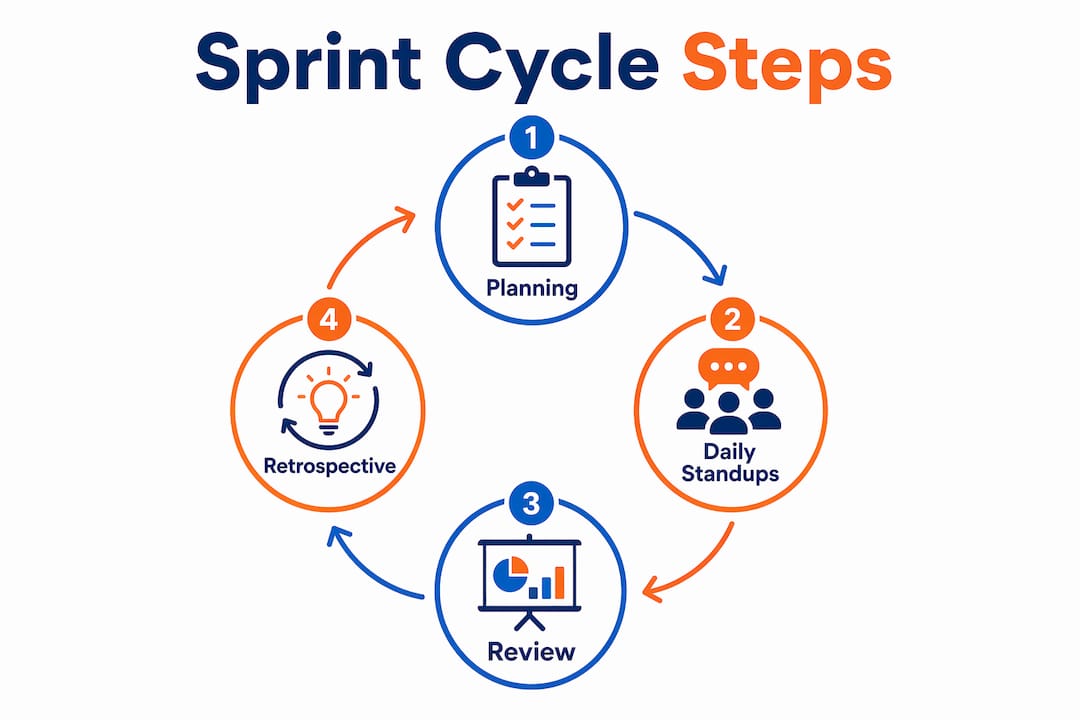
The Scrum sprint cycle consists of four stages: planning, daily standups, sprint review, and retrospective. Each stage has a specific purpose, and skipping any one of them creates a gap that compounds over time. Here is how each stage works in practice.
Step 1: Sprint planning

Sprint planning is a focused meeting where the team selects items from the product backlog and commits to completing them within the sprint window. The sprint backlog is fixed once planning ends, while the product backlog continues to evolve. This distinction matters because it protects the team from mid-sprint scope changes. During planning, each task should be estimated in effort (using story points or time blocks) and broken down until every item is independently completable within the sprint.
Step 2: Daily standups
The daily standup is a 10 to 15 minute check-in focused exclusively on blockers. Each team member answers three questions: What did I complete yesterday? What am I working on today? What is blocking me? Standups capped at 15 minutes and focused on blockers keep the team aligned without consuming the workday. Any discussion that goes beyond a blocker gets parked for a separate conversation.
Step 3: Sprint review
At the end of the sprint, the team demonstrates completed work to stakeholders or the Product Owner. The review is not a status update. It is a live demonstration of shippable output, which generates real feedback rather than assumptions. This feedback feeds directly into the next sprint’s backlog prioritization.
Step 4: Sprint retrospective
The retrospective is where the team examines its process, not its output. Blameless retrospectives that focus on systemic friction rather than individual mistakes produce the most useful improvements. The key discipline here is limiting the team to one primary improvement action per sprint. Trying to fix five things at once fixes nothing.
| Sprint phase | Primary activity | Goal |
|---|---|---|
| Planning | Backlog selection and estimation | Commit to a focused sprint goal |
| Daily standup | Blocker identification | Maintain momentum and alignment |
| Sprint review | Demonstrate completed work | Gather real stakeholder feedback |
| Retrospective | Process reflection | Identify one improvement to implement |
Pro Tip: Any story that cannot be completed within the sprint window must be broken into smaller, independently shippable pieces before it enters the sprint backlog. This single habit eliminates most scope creep.
What does a 90-day sprint look like for business growth?
The 90-day sprint model is the most widely adopted format for business-level goal execution, and it maps cleanly onto quarterly planning cycles. A 90-day sprint breaks into a one-week planning phase, eleven weeks of execution, and a one-week review and reset. This structure gives teams enough runway to accomplish meaningful goals while keeping the feedback loop tight enough to course-correct before a full quarter is lost.
Setting goals that actually drive focus
The first week of a 90-day sprint is dedicated entirely to selecting 3 to 5 number-backed goals rather than brainstorming a long list of possibilities. Goal dilution is the most common sprint failure mode. When a team chases eight goals simultaneously, each one receives roughly one-eighth of the available energy. Limiting goals to three to five forces the team to make real prioritization decisions before the sprint begins, not during it.
A useful technique from the 3-5-1 quarterly sprint method is defining a single “Rallying Cry” that unifies the sprint’s focus. This one-sentence statement helps teams resist the pull of shiny new opportunities that emerge mid-sprint and have nothing to do with the committed goals.
Weekly rhythms and sprint scorecards
The weekly cadence inside a 90-day sprint follows a consistent pattern: Monday kickoff to set the week’s priorities, a midweek check-in to surface blockers early, and a Friday review to assess progress against the sprint scorecard. The scorecard tracks each goal with a traffic light indicator: green for on pace, yellow for at risk, and red for off track. This system makes problems visible before they become crises.
Common pitfalls to avoid in 90-day sprints:
- Goal inflation. Adding goals after the sprint starts undermines the entire prioritization process.
- Skipping the retrospective. Teams that skip retrospectives repeat the same mistakes across every sprint.
- Treating the review week as downtime. The most successful teams use zero gap between sprints. The review week doubles as the next sprint’s planning week, using real operational data rather than assumptions.
- Ignoring post-mortems. Post-mortems kept in a repository across sprints reveal recurring issues like client emergencies that disrupt progress, and analyzing them leads to more realistic sprint planning over time.
How do you troubleshoot and improve sprints over time?
Even well-designed sprints break down. The good news is that the problems are predictable, and the fixes are straightforward once you know what to look for.
Scope creep is the most common issue. It happens when new tasks get added to an active sprint without removing existing ones. The fix is a firm rule: the sprint backlog is locked at planning. New requests go into the product backlog and get evaluated at the next planning session.
Goal dilution shows up when teams try to accomplish too much. Fewer sprint goals produce deeper work and better outcomes. If your team consistently misses sprint goals, the first question to ask is whether you committed to too many of them.
Team burnout is a signal that sprint length or workload needs adjustment. Startup-style growth sprints of 7 to 14 days work well for high-intensity phases, with 10 days considered the sweet spot for maintaining intensity without exhausting the team. Longer sprints of three to four weeks suit steadier execution phases.
Best practices for continuous sprint improvement:
- Assign clear ownership to every task before the sprint begins. Shared ownership means no ownership.
- Keep the sprint backlog to a size the team can realistically complete, not a wishlist.
- Use the retrospective to select exactly one process improvement per cycle, then measure whether it worked.
- Adjust sprint length based on team feedback after every third sprint, not just when something goes wrong.
- Accelerate business growth by connecting sprint outputs directly to revenue or customer metrics, not just task completion.
Pro Tip: Treating your business plan as a living product updated through sprint cycles, as outlined in agile business planning, prevents the planning paralysis that kills annual strategies. Sprints make the plan real.
Key takeaways
Running effective business sprints requires disciplined planning, consistent ceremonies, and a commitment to learning from each cycle rather than just completing tasks.
| Point | Details |
|---|---|
| Fix the sprint backlog at planning | Locking committed work prevents scope creep and protects team focus throughout the sprint. |
| Limit goals to 3 to 5 per sprint | Fewer goals produce deeper execution and measurably better outcomes than long goal lists. |
| Run blameless retrospectives | Focus on systemic friction and select one improvement action per cycle to drive real change. |
| Use weekly scorecards in 90-day sprints | Traffic light tracking makes problems visible before they derail the full quarter. |
| Adjust sprint length deliberately | Match sprint duration to project complexity and team feedback, not to a fixed default. |
Why I think most teams are running sprints wrong
Most teams adopt sprint language without adopting sprint discipline. They call their to-do list a backlog, rename their weekly meeting a standup, and wonder why nothing changes. The shift that actually moves the needle is not the terminology. It is the commitment to a fixed sprint goal that the team will not abandon mid-cycle, no matter what else comes up.
I have watched early-stage founders at Nomadexcel bootcamps transform their execution speed not by working more hours, but by compressing their planning horizon. Annual goals feel abstract. A 90-day sprint with three concrete, number-backed goals feels urgent. That urgency is not stress. It is clarity, and clarity is what most entrepreneurial teams are missing.
The other thing I see consistently undervalued is the retrospective. Teams treat it as optional, especially when the sprint went well. That is exactly backwards. A sprint that went well still contains process improvements you have not found yet. The teams that compound their performance over time are the ones that treat every retrospective as a strategic asset, not a formality.
If you are just starting out, do not wait until your process is perfect to run your first sprint. Run a two-week sprint with three goals, hold a 15-minute standup three times a week, and do a 30-minute retrospective at the end. That is enough to feel the rhythm. You can refine the lean startup approach and sprint structure from there.
— Amichai
Take your sprint execution further with Nomadexcel
Understanding the framework is one thing. Executing it consistently under real business pressure is another. Nomadexcel’s online entrepreneurship bootcamp is built around exactly this challenge. The program teaches sprint planning, goal-setting, and execution within a structured environment supported by experienced mentors and a community of driven founders. You leave with a working sprint system, not just a theory. For teams looking to align around goals and build sprint habits together, Nomadexcel’s company retreats offer the same execution focus in an immersive group setting. Both programs are designed for people who are ready to move from planning to results.
FAQ
What is a business sprint?
A business sprint is a time-boxed work cycle, typically one to four weeks, where a team commits to a defined set of goals and delivers measurable output by the end of the period.
How long should a business sprint be?
Most sprints run for two weeks, though startup-style growth sprints of 7 to 14 days work well for high-intensity phases, with 10 days considered optimal for maintaining focus without burnout.
How many goals should a sprint have?
Limit sprint goals to three to five per cycle. Fewer goals produce deeper work and better results, while too many dilute effort and lead to mediocre outcomes across the board.
What is a sprint retrospective and why does it matter?
A sprint retrospective is a structured team review of process rather than output, held at the end of each sprint. Blameless retrospectives that identify one key improvement per cycle are the primary driver of long-term sprint performance gains.
How do you prevent scope creep in a sprint?
Lock the sprint backlog at the end of planning and route all new requests to the product backlog for future prioritization. Any task too large to complete within the sprint must be broken into smaller, independently shippable pieces before it is committed.
Comments are closed.