
Innovation Workshop Step by Step: A Practical Guide
TL;DR:
- An innovation workshop is a deliberate, structured session that transforms scattered ideas into focused solutions, driving business results. Success depends on thorough preparation, clear challenge definition, diverse cross-functional participation, and disciplined follow-up within 48 hours to assign ownership and maintain momentum. Using frameworks like Design Thinking, TRIZ, or Business Model Canvas aligned with specific challenges enhances creativity and strategic impact.
An innovation workshop is a structured, interactive session designed to unlock creative solutions and align teams around ideas that drive real business results. Unlike a standard meeting, it follows a deliberate sequence of activities, from challenge definition through prototyping, that transforms scattered thinking into focused output. Whether you are a team leader, entrepreneur, or facilitator, running an innovation workshop step by step is the most reliable way to move from “we need better ideas” to “here is what we are building next.” Tools like Design Thinking, TRIZ, and platforms like Miro and Qmarkets make this process repeatable and measurable.
What are the prerequisites for a successful innovation workshop?
Preparation determines whether your workshop produces breakthroughs or just fills a whiteboard. The most common mistake teams make is treating setup as an afterthought. Planning large B2B workshops should begin 3 to 4 months in advance to secure the right stakeholders and finalize your methodology. That timeline gives you room to conduct pre-work interviews, align on goals, and prepare participants mentally.
Participant selection
The right room makes everything easier. Aim for 6 to 12 participants drawn from cross-functional roles, meaning product, marketing, operations, customer success, and leadership should all have a seat. Smaller groups move faster; larger groups dilute accountability. Diversity of perspective is the raw material of good ideation, so resist the temptation to fill the room with people who already agree with each other.
Timeline and venue
Optimal workshop duration is one to two full days. Half-day sessions consistently produce superficial outcomes because time pressure forces teams to skip the reflection phases where real clarity emerges. For in-person sessions, choose a space with natural light, movable furniture, and wall space for canvases. For virtual sessions, set up a shared workspace in Miro or a similar online collaboration platform before the session begins.
Pre-work and tools
Effective pre-work involves interviewing frontline employees or customers rather than relying on executive assumptions alone. This grounds the workshop in real pain points rather than internal opinions. Gather your facilitation materials in advance:
- Printed or digital canvases (empathy maps, journey maps, Business Model Canvas)
- Voting dots or digital polling tools for prioritization
- Timer for time-boxed activities
- Collaboration platform such as Miro or Qmarkets for real-time capture
- A clear agenda shared with participants at least 48 hours before the session
Pro Tip: Send participants a one-page brief before the workshop that includes the challenge statement, two or three customer quotes, and one data point about the problem. Participants who arrive informed contribute at a higher level from the first hour.
| Preparation element | Why it matters |
|---|---|
| Cross-functional participants (6-12) | Brings diverse perspectives that fuel better ideation |
| 1-2 day duration | Allows both divergent and convergent thinking without fatigue |
| Pre-work interviews | Grounds ideas in real customer or employee needs |
| Collaboration tools (Miro, Qmarkets) | Enables real-time capture and structured follow-up |
| Shared agenda sent in advance | Reduces friction and sets clear expectations |
How to execute each step of the innovation workshop
Running the session well requires a clear sequence. Each stage builds on the last, and skipping steps is the fastest route to a workshop that feels energizing but produces nothing. Here is the step-by-step process used in high-output sessions.
Step 1: Define the challenge. Open the workshop by writing a single, specific challenge statement on the wall. “How might we reduce customer churn in the first 30 days?” is a good challenge statement. “How do we grow the business?” is not. Specificity focuses energy and prevents the group from generating ideas that solve the wrong problem. Spend 20 to 30 minutes on this step and get explicit agreement before moving forward.

Step 2: Frame insights and identify opportunities. Share the pre-work findings, customer quotes, and relevant data with the group. Then ask participants to identify patterns and opportunity areas. This is where empathy maps and journey maps earn their place. The goal is to move from “here is what we know” to “here is where the real opportunity lies.” Guided by user needs rather than internal assumptions, this step prevents teams from building solutions nobody wants.
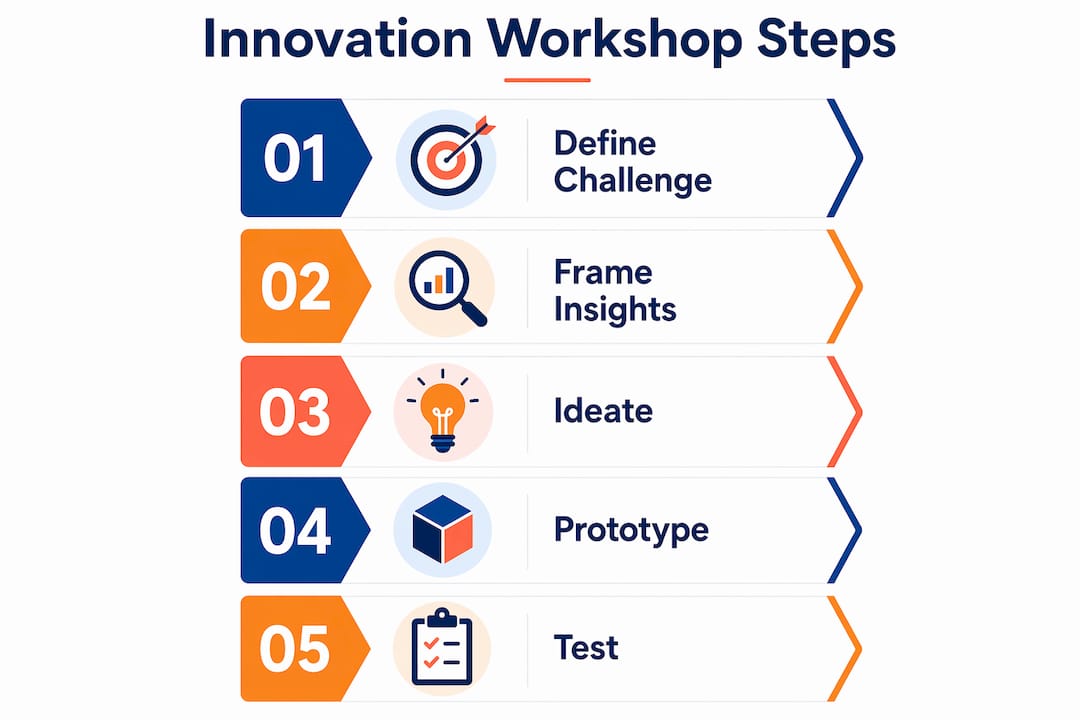
Step 3: Ideation using divergent thinking. This is the phase most people picture when they think of a workshop, but it works best when structured. Use time-boxed brainstorming: give individuals five minutes to generate ideas silently, then share and build in pairs, then open to the full group. Alternating individual and group work prevents the loudest voice in the room from dominating and produces a wider range of ideas. Aim for quantity over quality at this stage. You can explore innovation exercises for teams that keep energy high and thinking fresh throughout this phase.
Step 4: Synthesize and prioritize. Once you have a wall full of ideas, the group needs a structured way to narrow them down. Dot voting is the simplest method: each participant gets five votes and places them on the ideas they find most promising. More rigorous teams use a scoring matrix that weighs ideas against criteria like feasibility, impact, and alignment with strategic goals. The output of this step is a shortlist of two to four ideas worth developing further.
Step 5: Prototype and test. A prototype does not need to be a finished product. It can be a hand-drawn mockup, a role-play scenario, a one-page concept brief, or a simple landing page. The point is to make the idea tangible enough to get real feedback. Assign small teams of two to three people to each shortlisted idea and give them 60 to 90 minutes to build a rough prototype. Then present back to the group and gather reactions. This step transforms abstract ideas into something you can actually evaluate.
Pro Tip: At the end of Step 5, ask each prototype team to write one sentence: “We believe [this idea] will solve [this problem] for [this user], and we will know it works when [this measurable outcome] happens.” That sentence becomes the brief for the next phase of development.
What are the best practices to ensure workshops drive real impact?
The gap between a workshop that feels great and one that actually ships results comes down to facilitation quality and follow-through discipline. Innovation workshops fail when ideas stall after the session ends, not because the ideas were bad, but because no one owned them.
An experienced facilitator does three things well: they protect time boundaries so activities do not bleed into each other, they balance collaborative energy with quiet reflection phases, and they read the room to know when a group needs a break versus a push. Alternating between collaborative and quiet phases sharpens idea quality because it gives introverts and analytical thinkers space to process before speaking.
The most critical best practices for sustained impact are:
- Assign clear ownership of each idea before participants leave the room. One person owns each idea, not a committee.
- Schedule a follow-up session within 48 hours to review specific next steps, owners, and deadlines. Momentum fades fast.
- Use idea management software like Qmarkets to capture, prioritize, and track ideas in real time. Documentation alone is not enough; you need workflow assignment and progress visibility.
- Vary activities throughout the day to sustain energy. Alternate between individual writing, pair work, group discussion, and physical movement.
- Avoid vague challenge statements, insufficient pre-work, and rooms filled with people who lack decision-making authority.
“Documentation alone is insufficient; clear accountability and small teams increase execution likelihood.” — Product Mastery Now
Pro Tip: Run a 60 to 90 minute “momentum loop” within 30 days of the workshop. Pick one idea, assign a small team, and set a single measurable target. This short sprint proves the workshop produced real output and builds confidence for the next session.
For a deeper look at how workshops connect to long-term team development, the role of innovation workshops in building creative capacity is worth exploring.
How do popular innovation frameworks compare?
Choosing the right framework shapes everything from the activities you run to the type of output you produce. Three frameworks dominate most innovation workshop guides: Design Thinking, TRIZ, and Business Model Canvas. Each serves a different purpose.
| Framework | Core focus | Best for | Key strength |
|---|---|---|---|
| Design Thinking | Human-centered empathy and rapid prototyping | Product and service innovation | Grounds solutions in real user needs |
| TRIZ | Systematic resolution of technical contradictions | Engineering and process challenges | Eliminates trial-and-error with proven principles |
| Business Model Canvas | Visualizing and redesigning value creation | Strategic and business model innovation | Aligns cross-functional teams on revenue and value |
Design Thinking emphasizes empathy, ideation, and rapid prototyping to ground solutions in real user needs. It works best when the core problem is poorly understood and the team needs to build empathy before generating solutions. TRIZ resolves system contradictions using proven innovation principles instead of open-ended brainstorming. It is the right choice when the challenge is technical and the team needs a structured path through a specific contradiction. Business Model Canvas helps teams visualize and redesign value creation elements, making it ideal for exploring new revenue streams or aligning on strategic priorities.
The selection rule is straightforward. If your challenge is about understanding users, use Design Thinking. If it is about solving a technical or process contradiction, use TRIZ. If it is about rethinking how your business creates and captures value, use Business Model Canvas. Many high-performing workshops blend elements from two frameworks, using Design Thinking for the empathy and ideation phases and Business Model Canvas for the strategic synthesis at the end. You can find innovation workshop examples that show how these frameworks play out in practice across different industries.
Key takeaways
A well-executed innovation workshop requires deliberate preparation, a structured five-step process, disciplined facilitation, and clear ownership of ideas within 48 hours of the session.
| Point | Details |
|---|---|
| Preparation is non-negotiable | Select 6-12 cross-functional participants and begin planning 3-4 months out for large workshops. |
| Follow a five-step sequence | Move from challenge definition through insight framing, ideation, prioritization, and prototyping in order. |
| Alternate individual and group work | Quiet reflection phases improve idea quality and give every participant a voice. |
| Assign ownership before leaving the room | Clear accountability prevents ideas from stalling after the session ends. |
| Match the framework to the challenge | Use Design Thinking for user problems, TRIZ for technical contradictions, and Business Model Canvas for strategy. |
Why follow-through is the real test of any innovation workshop
I have facilitated and participated in dozens of these sessions across industries, and the pattern is consistent: the workshops that produce real results are not the ones with the best activities or the most creative participants. They are the ones where someone walked out of the room with their name next to an idea and a deadline.
The hardest part of running an innovation workshop is not the ideation phase. Most teams can generate ideas. The hard part is creating the conditions where those ideas survive contact with Monday morning. That means psychological safety during the session so people share their real thinking, not their safe thinking. It means a facilitator who is willing to cut a conversation short when the group is circling rather than progressing. And it means treating the follow-up sprint as part of the workshop itself, not an optional add-on.
The teams I have seen get the most from these sessions treat the workshop as the beginning of a process, not the end of one. They use the session to build alignment and generate raw material, then they use the weeks that follow to test, refine, and ship. That mindset shift, from “we ran a workshop” to “we started a sprint,” is what separates organizations that talk about innovation from the ones that actually do it.
— Amichai
Take your innovation skills further with Nomadexcel
The principles behind a great innovation workshop, structured thinking, real-world execution, and a community that pushes you forward, are exactly what Nomadexcel builds into every program. The Online Entrepreneurship Bootcamp gives entrepreneurs and teams a hands-on environment to apply frameworks like Design Thinking and Business Model Canvas to their actual business challenges, with mentorship and accountability built in. If you want to move from running workshops to building a culture of execution, the bootcamp step-by-step guide shows exactly how the program is structured to get you there.
FAQ
What is an innovation workshop?
An innovation workshop is a structured session where teams use facilitated activities to generate, evaluate, and prioritize creative solutions to a specific business challenge. It differs from a standard meeting by following a deliberate sequence of divergent and convergent thinking phases.
How long should an innovation workshop last?
One to two full days is the most effective duration. Half-day sessions often produce superficial outcomes because they do not allow enough time for both ideation and prioritization.
How many people should attend an innovation workshop?
The optimal group size is 6 to 12 participants drawn from cross-functional roles. Groups smaller than six lack perspective diversity; groups larger than twelve make facilitation and accountability difficult.
What should happen after an innovation workshop?
Assign specific next steps, owners, and deadlines within 48 hours of the session. Running a focused 30-day sprint on one idea immediately after the workshop is the most reliable way to maintain momentum.
Which framework works best for an innovation workshop?
The right framework depends on your challenge. Design Thinking suits user-centered problems, TRIZ addresses technical contradictions, and Business Model Canvas works best for strategic and business model questions.
Comments are closed.