32 Team Building Events That Actually Work for Every Team Size
If your goal is quick rapport, run a 30 to 60 minute icebreaker with a short debrief; if you need real behavior change, run a half-day facilitated workshop with a 30-day follow-up plan. That single decision, matching the format to the actual goal, is where most planning goes wrong before it even starts. Too many leaders pick an event because it looks fun on a vendor site, not because it serves what the team actually needs right now.
Here’s a fast way to shortcut the guesswork. Three go-to picks, sorted by objective:
- Building rapport on a new or merged team: a 45 minute virtual or in-person icebreaker series with structured small-group rotations.
- Developing a specific skill (communication, decision-making): a half-day workshop with a facilitated exercise and a documented debrief.
- Creating shared purpose or giving back: a CSR-based project, like a local volunteer build, that scales to large groups.
Bring in a professional facilitator anytime the stakes are high, like navigating team conflict, launching a merger, or running a leadership offsite where an internal manager leading the room would create an awkward power dynamic.
Pro Tip: Before booking anything, write down the one behavior you want different in 90 days. If you can’t name it, you’re planning a party, not a team building event.
Key Takeaways
Team building events succeed when the format matches the goal, facilitation includes a structured debrief, and a 30-day follow-up locks in behavior change.
| Point | Details |
|---|---|
| Match format to goal | Use icebreakers for rapport, workshops for skill change, retreats for deep alignment. |
| Facilitation matters | Bring in a professional for conflict, leadership offsites, or safety-sensitive activities. |
| Debrief is not optional | Run a structured 15 to 20 minute debrief connecting the activity to real work behavior. |
| Measure with a cadence | Use baseline and pulse surveys plus a 30/60/90 day follow-up to prove impact. |
| Consider a done-for-you retreat | Nomad Excel designs and facilitates custom company retreats end-to-end, including debrief and follow-up structure. |
Table of Contents
- What Team Building Events Are Actually Meant to Achieve
- Matching Activity Categories to Your Team’s Actual Constraints
- 32 Ready-to-Run Team Building Events by Setting and Time
- Planning Your Team Building Event Step by Step
- Running the Debrief and Proving the Event Worked
- Copy-and-Adapt Agendas for Any Time Budget
- What Team Building Events Actually Cost to Run
- Why Nomad Excel’s Approach to Team Programs Holds Up
- The Real Gap in Most Team Building Advice
- When It’s Time to Bring in a Team That Runs This for a Living
- Sources
What Team Building Events Are Actually Meant to Achieve
A team building event is a single-session activity designed to build rapport, trust, or specific skills among coworkers. A workshop goes deeper: it’s a facilitated, structured session built around a defined outcome, usually with pre-work, an exercise, and a debrief. A retreat combines both across multiple days, often blending strategic work with informal connection time. Confusing these three is the most common planning mistake, because each demands a different level of facilitation and follow-up to actually work.
The realistic outcomes break down by format:
- One-off social events (happy hours, quick icebreakers): short-term morale boost, faster introductions, lower barrier to conversation. Don’t expect lasting behavior change from these alone.
- Structured workshops with debriefs: measurable shifts in communication patterns and collaboration, especially when repeated quarterly.
- Multi-day retreats: deeper trust, aligned strategic direction, and renewed energy, but only if the schedule balances structured work with genuine downtime.
Research summarized in peer-reviewed psychology journals links structured team interventions to measurable improvements in collaboration and trust, but the operative word is structured. Workshop providers who study this consistently find that facilitated debriefs with a follow-up cadence create durable change, while unstructured bonding activities alone tend to fade within weeks.
None of this works without one precondition: psychological safety. If people don’t feel safe speaking honestly in front of their manager, even the best-designed workshop produces surface-level participation and nothing more. That’s not a soft add-on. It’s the filter every other decision runs through, from which icebreaker you pick to how you frame the debrief questions.
Matching Activity Categories to Your Team’s Actual Constraints
Every team building idea falls into one of six broad categories, and each one solves a different problem. Icebreakers exist to lower social barriers fast, usually at the start of a meeting or event. Problem-solving challenges build collaborative muscle under mild pressure. CSR activities create shared purpose outside the walls of the office. Wellness sessions address burnout and stress directly. Training-style workshops target a specific skill gap. Virtual and hybrid formats exist to close distance when your team isn’t in one room.
The category you choose should follow directly from three constraints: how much time you have, how big the group is, and whether everyone’s accessibility needs are accounted for, including time zones, mobility, and sensory sensitivities. A 200-person all-hands can’t run the same intimate trust exercise that works for a 6-person pod.
| Category | Best team size | Time budget | Accessibility notes |
|---|---|---|---|
| Icebreakers | Any size | 5 to 20 minutes | Offer opt-out or alternate prompts for introverts |
| Problem-solving challenges | 4 to 12 per group | 30 to 90 minutes | Provide written and verbal instructions |
| CSR / community projects | Scales to hundreds | Half-day to full-day | Confirm physical demands and offer non-physical roles |
| Wellness sessions | Small to mid-size | 20 to 60 minutes | Screen for physical limitations in advance |
| Training workshops | 8 to 30 per session | 3 to 7 hours | Provide materials in advance for processing time |
| Virtual / hybrid formats | Any size, distributed | 15 to 90 minutes | Confirm time zones and internet reliability |
Hybrid adaptations matter more than most planners realize. A problem-solving challenge designed for a shared table doesn’t translate to a screen without redesigning the mechanics, not just moving it online. Virtual team-building activities work best when they lean on breakout rooms, reliable video conferencing, and a facilitator who’s comfortable managing energy through a camera instead of a room. Skip the games that were clearly built for a conference table and never redesigned for a grid of faces.
32 Ready-to-Run Team Building Events by Setting and Time
This is the working menu. Pick by constraint first, not by what looks impressive on a slide.
Quick icebreakers (5 to 20 minutes)
1. Two Truths and a Lie, Team Edition
Requirements: none. Duration: 10 to 15 minutes. Best for: new teams, meeting openers. Outcome: faster name and face recall, lighter opening energy. Works equally well in person or on video.
2. Desert Island Object
Each person names one object they’d bring to a desert island and why. Requirements: none. Duration: 5 to 10 minutes. Best for: any size group as a rotating icebreaker. Outcome: light personal disclosure without oversharing pressure.
3. Four Facts and a Fib
A virtual-friendly variant on the classic, built specifically for remote teams according to MindTools. Duration: 15 minutes. Best for: distributed teams needing a low-lift connector. Accessibility tip: provide the prompt in the chat for anyone who processes better in writing.
4. This or That Rapid Fire
A quickfire preference game (coffee or tea, mountains or beach). Requirements: a slide deck or verbal prompts. Duration: 5 to 10 minutes. Best for: large groups, works well as a meeting warm-up.
5. One Word Check-In
Each person shares a single word describing their week. Requirements: none. Duration: 5 minutes. Best for: teams building emotional check-in habits before deeper work. Accessibility tip: allow “pass” as a valid answer.
Problem-solving and collaboration challenges (30 to 90 minutes)
6. Escape Room Challenge (In-Person)
Small groups solve puzzles under a time limit. Duration: 60 to 90 minutes. Best for: groups of 4 to 8, tests communication under mild pressure. Outcome: reveals who naturally leads and who defers, which is worth discussing in the debrief.
7. Virtual Escape Room
A remote-adapted version using shared digital puzzles and breakout rooms. Duration: 45 to 60 minutes. Best for: distributed teams. Vendor platforms recommend pairing this format with live polls to keep energy up between puzzle stages.
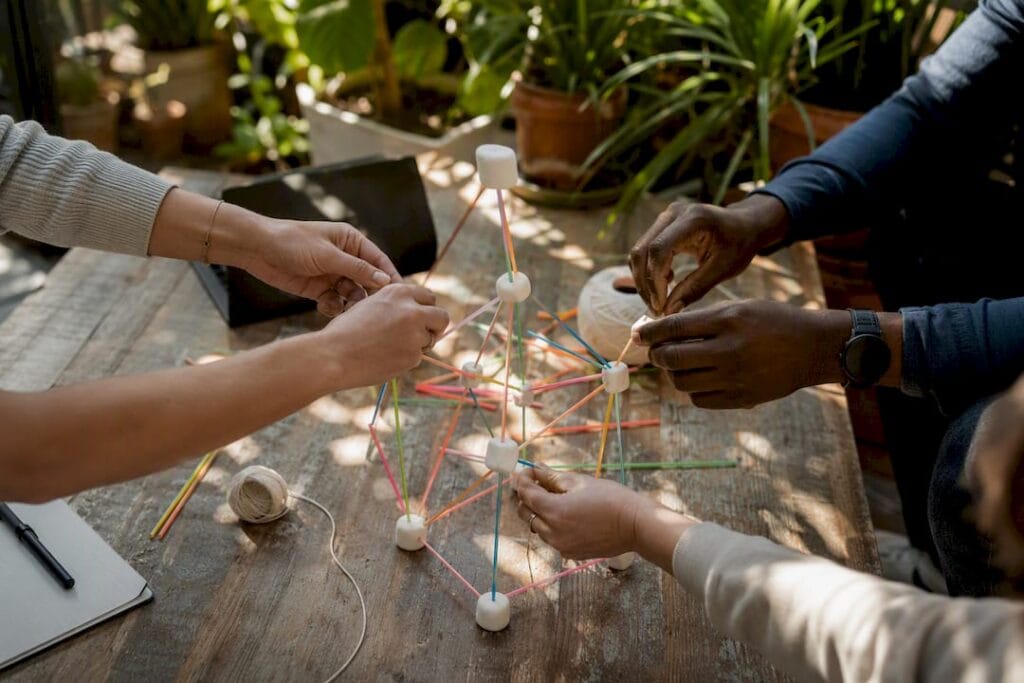
8. Build Challenge (Marshmallow Tower or Equivalent)
Teams build the tallest freestanding structure from limited materials in a set time. Duration: 30 to 45 minutes. Best for: groups of 4 to 6 per table, works for large all-hands with parallel tables. Outcome: exposes planning versus execution tendencies fast.
9. Cross-Functional Case Study Sprint
Mixed-department teams solve a real (anonymized) business problem in 60 minutes and pitch a solution. Best for: teams that rarely interact across functions. Outcome: builds appreciation for how other departments think, often surfaces ideas worth pursuing afterward. For teams looking to push this into genuine creative territory, a structured approach to sparking team innovation can extend the exercise into an ongoing practice.
10. Reverse Engineering Challenge
Teams are shown a finished product or outcome and must map backward to figure out the process. Duration: 45 minutes. Best for: product and engineering teams especially.
Virtual-friendly activities and async options
11. Virtual Trivia Tournament
Custom trivia covering company history, industry facts, or pop culture. Duration: 30 to 45 minutes. Best for: any distributed team size using breakout room brackets.
12. Async Photo Challenge
Over one week, team members post photos answering a daily prompt in a shared channel. Requirements: a messaging platform. Duration: ongoing, 5 minutes daily. Best for: teams spread across time zones who can’t sync live. Outcome: consistent low-effort touchpoints that don’t demand calendar coordination.
13. Five-Minute Meeting Add-On
A single quick question or poll tacked onto the start of an existing recurring meeting. This mirrors advice that short, frequent touchpoints beat rare big events for sustaining connection over time. Best for: any remote team, zero extra calendar time required.
14. Virtual Coffee Roulette
An automated tool randomly pairs coworkers for a 15 minute informal video chat each week. Best for: large distributed teams where cross-team friendships don’t form naturally.
15. Collaborative Playlist or Recipe Swap
Team members contribute to a shared music playlist or recipe collection. Requirements: a shared doc or app. Duration: ongoing. Best for: light, low-pressure connection building with zero scheduling.
Outdoor, adventure, and CSR options that scale
16. Volunteer Build Day
Teams partner with a local nonprofit for a hands-on project like a community garden or housing build. Duration: half-day to full-day. Best for: scales from 10 to several hundred people across parallel sites. Charitable events like this tend to create deeper engagement than standard bonding activities because they give the group a shared purpose beyond company metrics.

17. Outdoor Scavenger Hunt
Teams navigate a city or campus solving location-based clues. Duration: 90 minutes to half-day. Best for: groups of 20 to 100, easily split into competing teams. Accessibility tip: offer a route with minimal walking as an alternative.
18. Ropes Course or Low-Element Challenge
A facilitated outdoor course with trust-building physical challenges. Duration: half-day. Best for: teams working through trust or conflict issues, typically groups of 10 to 40. Requires a professional facilitator for safety and framing.
19. Company Field Day
A structured outdoor day of relay races, team sports, and light competition. Duration: half-day to full-day. Best for: large all-company events, scales well past 200 people.
20. Sustainability Project
Teams work on a local environmental initiative, like a park cleanup or tree planting. Duration: half-day. Best for: any size, particularly resonant with younger workforces prioritizing purpose-driven work.
21. Cooking Class or Team Meal Prep
A hands-on shared cooking session, either at a venue or catered in-office. Duration: 2 to 3 hours. Best for: groups of 15 to 40, works well as a lower-intensity add-on to a larger event.
Full-day and multi-day program ideas
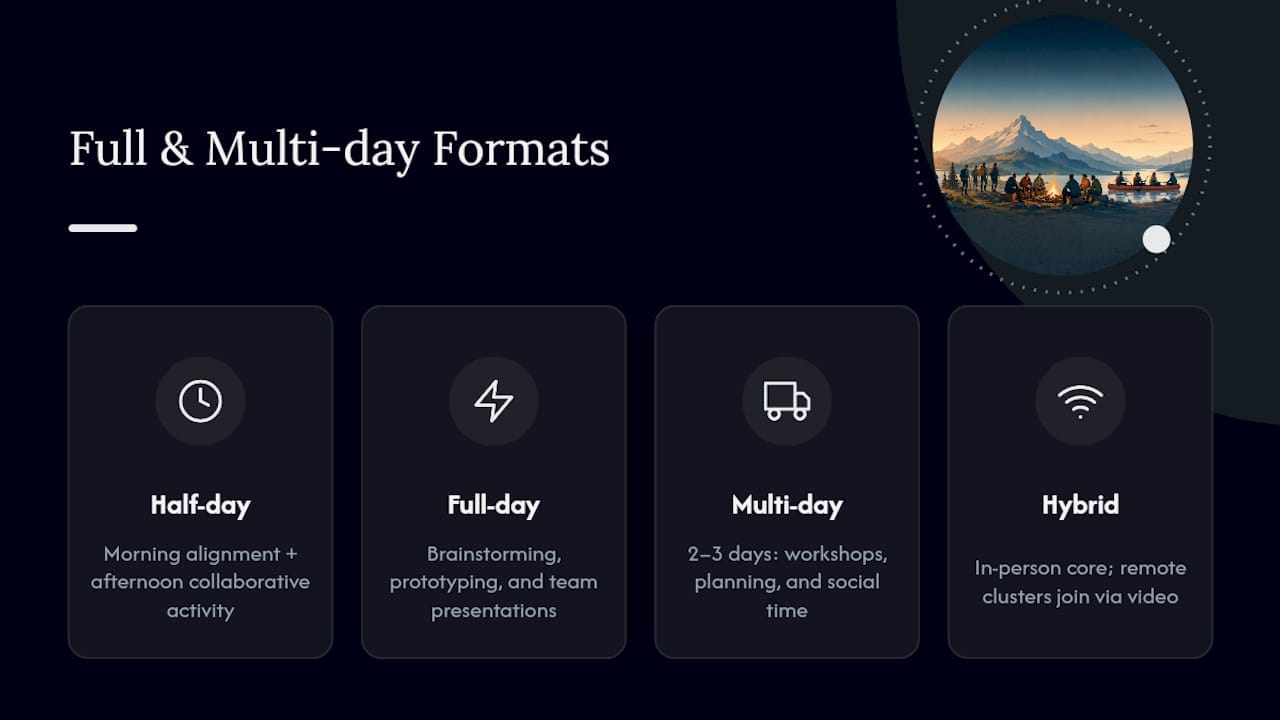
22. Half-Day Strategy and Connection Workshop
Morning strategic alignment session, afternoon collaborative activity, closing debrief. Best for: leadership teams needing both planning time and rapport building in one sitting.
23. Full-Day Innovation Sprint
A structured day mixing brainstorming, prototyping, and team presentations. Best for: product and cross-functional teams looking to generate new ideas while building working relationships.
24. Multi-Day Offsite Retreat
Combines workshops, strategic planning, and unstructured social time across two or three days, often at a location away from the office. Best for: leadership teams and distributed teams that rarely meet in person. This format works particularly well for remote-first companies trying to rebuild in-person rapport, and retreat formats designed specifically for remote teams tend to outperform generic offsites because the agenda accounts for people who don’t already know each other well.
25. Leadership Alignment Retreat
A focused 2-day retreat for senior leaders centered on strategic decisions, facilitated difficult conversations, and relationship repair where needed. Best for: leadership teams navigating change, growth, or conflict.
26. New Hire Immersion Bootcamp
A multi-day onboarding experience combining company training with team bonding for a cohort of new employees. Best for: companies hiring in batches or building a new team from scratch.
27. Cross-Team Innovation Retreat
Multi-day event mixing structured ideation workshops with informal exploration time in a new location. Best for: teams that need both a creative reset and deeper cross-functional relationships.
28. Quarterly Skills Workshop Series
A recurring half-day session, run quarterly, each focused on one skill (feedback, conflict resolution, delegation). Best for: teams committed to compounding development over a year rather than a single event.
29. Wellness and Resilience Retreat
A multi-day format blending stress management sessions, physical activity, and reflective group work. Best for: teams recovering from burnout periods or high-pressure project cycles.
30. Customer Immersion Day
Teams spend a day directly observing or interacting with customers, followed by a group debrief on insights. Best for: product and support teams that benefit from shared external perspective.
31. Hybrid Retreat with Remote Satellite Groups
An in-person core group runs the main agenda while remote clusters join key sessions via video, with separate local bonding activities. Best for: companies with regional hubs that can’t all travel to one site.
32. Annual Vision and Culture Summit
A full-day or multi-day event centered on revisiting company values, celebrating wins, and setting the year’s direction together. Best for: whole-company gatherings once a year.
Planning Your Team Building Event Step by Step
Skipping straight to picking an activity is how most events end up feeling like filler. Work through these steps in order instead.
- Define your objective and how you’ll measure it. Write the specific behavior or outcome you want, and decide upfront what “success” looks like, whether that’s a survey score, a retention signal, or fewer escalations in a particular process.
- Audit your audience. Map roles, group size, time zones, and any accessibility needs, including mobility limitations, sensory sensitivities, and neurodivergent participants who may need alternate task formats or clearer written instructions.
- Set a budget range before you shop vendors. Decide whether you’re doing this internally with existing staff or hiring outside facilitation, since that single decision changes your cost structure entirely.
- Choose vendor versus DIY. Internal facilitation works for lower-stakes rapport building; bring in a professional for conflict-heavy sessions, leadership retreats, or anything requiring specialized safety knowledge.
- Build your timeline. A half-day workshop needs 1 to 2 weeks of lead time for logistics and communications. A multi-day offsite needs 6 to 8 weeks to lock venue, travel, and facilitation.
- Confirm tech and materials for virtual or hybrid pieces. Test video conferencing, breakout room assignments, and any shared digital tools at least 48 hours ahead, not the morning of.
- Brief your facilitator on psychological safety norms. Make clear that participation should never be mandatory to the point of forcing disclosure, and that opt-out paths exist for every activity.
A quick logistics checklist for virtual and hybrid events:
- Confirm reliable video conferencing with breakout room capacity for your group size.
- Test screen sharing and any interactive tools (polls, shared docs) in advance.
- Send materials or pre-work at least 48 hours ahead for async participants.
- Assign a co-facilitator to monitor chat and troubleshoot tech issues in real time.
Pro Tip: If you’re planning your first offsite for a distributed team, build in more unstructured time than feels comfortable. Teams that never see each other in person need buffer time to actually talk, not just another packed agenda.
For teams weighing whether to run this internally or bring in outside logistics support, a structured approach to corporate team building can save the planning headaches that come with juggling venues, catering, and facilitation on top of your regular job.
Running the Debrief and Proving the Event Worked
The debrief is where most of the actual value gets locked in, and it’s the step teams skip most often because everyone wants to head home. A structured debrief usually runs 15 to 20 minutes and follows a simple arc: what happened, what it revealed, and what changes going forward.
A workable debrief template:
- What did you notice? (5 minutes, open floor) Let people describe observations without judgment first.
- What patterns showed up that mirror how we work day to day? (5 to 7 minutes) This is where the real insight lives, connecting the activity to actual workplace behavior.
- What’s one thing you’ll do differently next week? (5 minutes) Each person commits to a specific, small action, said out loud or written down.
Measuring impact means you need a baseline. A short pre-event pulse survey (three to five questions on trust, communication clarity, and engagement) gives you something to compare against a post-event version sent within 48 hours. Track shifts in self-reported engagement, a simple team NPS-style question, and any observable behavior change, like faster response times in shared channels or fewer repeated miscommunications.
The real work happens in the follow-up cadence:
- Day 30: Send a short pulse check asking whether the committed actions from the debrief actually happened.
- Day 60: Revisit the original objective in a team meeting; ask what’s stuck and what’s faded.
- Day 90: Compare against your baseline survey and decide whether to repeat, adjust, or escalate the format for next time.
Workshop providers consistently find that pairing a facilitated debrief with a follow-up cadence is what separates a one-off feel-good afternoon from an event that actually shifts how people work together. Skip the follow-up and you’re left with a nice memory and nothing measurable.
Copy-and-Adapt Agendas for Any Time Budget
30 to 60 minute meeting add-on
Open with a 5 minute icebreaker, run the core activity for 20 to 40 minutes, then close with one debrief prompt: “What’s one thing from today you’d want to see more of in how we work?” This format fits directly into an existing recurring meeting without needing a separate calendar block.
Half-day workshop (approximately 3 hours)
- Warm-up icebreaker (15 minutes)
- Core collaborative activity or skills exercise (90 minutes)
- Facilitated debrief (30 minutes)
- Action planning and commitments (30 minutes)
- Informal close, like a shared lunch (30 to 45 minutes)
This structure lines up with what workshop providers commonly publish as the standard half-day time budget, roughly three hours from open to close.
Full-day agenda (6 to 7 hours)
Morning blocks should run high-energy: a longer problem-solving challenge or outdoor activity. Afternoon blocks should shift toward reflection: strategic discussion, a facilitated debrief, and action planning. Build in at least one true break block with no agenda item attached, since a fully packed full day burns people out faster than it builds trust.
Multi-day retreat scaffold
- Day one: arrival, light connection activities, and a kickoff dinner with no formal agenda.
- Day two: the core workshop or strategic work block, split between morning structure and afternoon free time or optional activities.
- Day three (if applicable): closing reflection, commitments, and departure.
Larger groups may need parallel workshop tracks running simultaneously rather than forcing everyone through one session, which keeps energy from dragging in a room too big for genuine discussion.
What Team Building Events Actually Cost to Run
Costs break into five recurring line items: facilitator fees, venue rental, catering, materials, and travel if the event isn’t local. A short in-office icebreaker session costs close to nothing beyond staff time, while a multi-day offsite with professional facilitation and travel can run into the tens of thousands depending on group size and location.
Vendors generally operate in three tiers:
- Catalog packages: pre-built activities you book off a menu, lowest cost and least customization.
- Turnkey events: a vendor handles logistics, facilitation, and materials end-to-end for a set format.
- Custom program-managed retreats: fully bespoke design, facilitation, and follow-up built around your specific objectives, typically the highest cost but the most aligned to your actual goals.
Booking through certain venues can meaningfully lower per-person costs. Some entertainment and dining venues bundle activities, food, and space rental into a single package price, which tends to run cheaper than assembling the same pieces separately.
A few practical ways to cut cost without cutting impact: run facilitation internally for lower-stakes rapport events, lean into hybrid formats to eliminate travel spend for distributed teams, and consider local CSR projects, which often carry minimal fees beyond materials and transportation.
Why Nomad Excel’s Approach to Team Programs Holds Up
Amichai’s perspective on this article draws on Nomad Excel’s work designing and facilitating custom company retreats, where the through line across successful programs is consistent: structure and follow-up matter more than the activity itself.
Nomad Excel’s B2B work centers on:
- Designing custom retreats end-to-end, from workshop content to logistics and local experiences.
- Facilitating sessions focused on alignment, trust, and entrepreneurial thinking within existing teams.
- Building in structured debriefs, not just activities, so insights translate into workplace behavior.
- Supporting teams through follow-up touchpoints that keep momentum after the group returns home.
A team retreat that ends without a documented action plan and a follow-up date is a nice trip, not a development program. The gap between the two is entirely in what happens after everyone flies home.
The Real Gap in Most Team Building Advice
Most guides on this topic hand you fifty activity ideas and stop there, as if the activity itself is the point. It isn’t. The research is fairly consistent that structured facilitation and a real debrief drive more durable change than the exercise you pick, yet planners keep spending their energy shopping for the “coolest” idea instead of building in the fifteen minutes of reflection that actually makes it stick.
The conventional advice also underrates follow-up almost entirely. A single great offsite with no 30-day check-in fades from memory faster than most leaders expect, usually within a few weeks, back to whatever patterns existed before.
If you take one thing from this, prioritize the debrief structure and the follow-up cadence before you finalize the activity. Pick something simple that fits your group and constraints, then spend your real planning energy on what happens in the room afterward and in the weeks that follow.
— Amichai
When It’s Time to Bring in a Team That Runs This for a Living
Everything above works as a self-managed plan, but self-managed planning eats real hours: venue research, facilitator vetting, debrief design, and follow-up tracking all land on whoever owns the calendar invite. Nomad Excel removes that entire burden by designing and running the whole program for you, from workshop content and facilitation through logistics and local experiences, so your team shows up and your planning team gets their week back.
This fits leaders who want the outcomes covered in this piece (trust, alignment, measurable follow-through) without becoming a part-time event planner to get there. Nomad Excel’s retreats are built specifically to strengthen communication, develop entrepreneurial thinking, and give teams a real reset, with structure baked in from day one through the post-event follow-up.
If your team is due for something more substantial than another half-day workshop, look at Nomad Excel’s business retreat programs and check available dates for your group size and timeline.
Sources
- PMC article on team interventions (systematic review)
- Virtual team-building exercises — MindTools
- Cvent — Virtual team-building activities
- Team building at Dave & Buster’s — event booking