
9 Small Scale Business Tips to Start and Run Yours Right
Do these nine things first, and you skip the mistakes that sink most new ventures. The Bureau of Labor Statistics reports that a significant portion of private-sector small businesses do not survive their first year, and many close before their fifth year. That is not a reason to hesitate. It is a reason to work from a checklist instead of instinct, the same way SBA counselors and programs like Nomadexcel’s bootcamps train founders to operate.
- Validate demand with a pre-sell or landing page before building anything
- Write a one-page business plan with real numbers
- Estimate startup costs honestly, then add a cash buffer
- Choose your legal structure and register the business
- Open a dedicated business bank account
- Set a price floor based on true costs, not guesswork
- Pick one acquisition channel and one retention tactic
- Set up weekly bookkeeping before month one ends
- Decide your first hire-vs-outsource call in writing
Your next 24 hours: draft the one-page plan (Section 3 gives the template) and send five customer-interview requests today.
Key Takeaways
Small business survival depends less on the idea itself and more on disciplined validation, honest cash-flow planning, and one tested acquisition channel run consistently for 90 days.
| Point | Details |
|---|---|
| Validate before building | Use a pre-sell or landing page test before spending on production or inventory. |
| Plan on one page | A one-page plan with CAC, LTV, and break-even numbers beats a lengthy document nobody reads. |
| Budget for the unexpected | Add a cash buffer to startup cost estimates; undercapitalization sinks otherwise solid ideas. |
| Focus marketing spend | Pick one acquisition channel and one retention channel, then test for 90 days before adding more. |
| Get guided structure | Nomadexcel’s bootcamps offer hands-on frameworks and mentorship for founders who want faster execution. |
Table of Contents
- Small Scale Business Tips for Validating Your Idea Fast
- What Goes in a One-Page Business Plan?
- How Much Money Do You Need to Start and Keep Running?
- Legal Steps You Cannot Skip Before Opening
- Simple Systems That Keep Small Operations Running
- Which Marketing Channel Should You Start With?
- How Do You Keep Customers Coming Back?
- Should You Hire or Outsource First?
- When Is It Actually Time to Scale?
- What Timeline and Costs Should You Realistically Expect?
- Templates and Tools Worth Using This Week
- A Founder’s Note on What Actually Moves the Needle
- A Guided Option If You Want Structure Built In
- Sources
Small Scale Business Tips for Validating Your Idea Fast
The single best early test is a pre-sell: ask people to pay before you build. If ten strangers hand over money for something that does not exist yet, you have real signal. If they will not, you just saved months of wasted effort.
Three low-cost validation moves work for almost any idea:
- Run five customer interviews using a short script: What’s the last time you tried to solve this problem? What did you use? What frustrated you about it? What would you pay for a better version? Would you buy it today?
- Build a one-page landing page with a “reserve yours” button and track click-to-signup rate.
- Post a limited listing on a marketplace or run a $50 ad test to see if strangers, not just friends, will bite.
Pro Tip: Weight what people do over what they say. A “yes, I’d definitely buy that” in an interview means little; a completed preorder means everything.
Shopify’s launch guidance backs this sequence: validate first, build second.
What Goes in a One-Page Business Plan?
A one-page plan is the most useful planning tool a small-scale founder has, because it forces you to answer hard questions before spending money you cannot get back.
Your one-pager needs six sections:
- The problem you’re solving and for whom
- Your ideal customer, described specifically
- Your offer and how it’s different
- How you make money (one-time sale, subscription, retainer)
- Your realistic costs, fixed and variable
- Three measurable goals for the first year
Track four numbers from day one:
- Customer acquisition cost (CAC)
- Lifetime value (LTV)
- Break-even point in units or dollars
- Cash runway in months
Nomadexcel’s guide on essential components of a business plan walks through a full example. Revisit the page monthly for the first year, then quarterly once revenue stabilizes.
How Much Money Do You Need to Start and Keep Running?
Cash flow, not the quality of your idea, decides whether your business survives its first year. Plenty of good ideas die because the owner ran out of cash three months before revenue caught up.
Build two projections before you spend a dollar: a first-month budget covering every startup cost you can list, and a 12-month cash-flow sheet showing money in and money out by week. Add a contingency margin on top of your estimate, since nearly every startup cost guide, including QZ’s rundown of pre-launch lessons, flags underestimating expenses as the most common early mistake.
Your cash-flow checklist should cover:
- Every fixed cost (rent, software, insurance) listed monthly
- Variable costs tied to sales volume
- A separate business bank account, never mixed with personal funds
- A minimum cash reserve equal to at least one slow month
- A weekly five-minute check of what’s actually in the account versus what you projected
Roughly half of small businesses don’t make it past five years, according to BLS data, and undercapitalization is a recurring theme among those that close early.
Funding options worth considering, roughly in order of risk: bootstrapping from savings or early revenue, a small business loan through a local bank or credit union, a business line of credit for seasonal gaps, and crowdfunding if your product has visual or story appeal. Match the funding type to how predictable your revenue actually is, not how much you’d like to raise.
Legal Steps You Cannot Skip Before Opening
Handle four things before you take your first customer payment: pick a legal entity, register the business name, get your tax ID, and open a business bank account. The SBA’s 10-step checklist covers this sequence in order and is worth reading end to end.
After launch, plan for ongoing obligations that don’t disappear once you’re registered:
- Quarterly or annual tax filings, depending on your structure and location
- Payroll setup the moment you hire anyone, even part-time
- Industry-specific licenses and permits, renewed on schedule
- General liability insurance, and professional liability if you offer services
Free counseling through SCORE or your local SBA-affiliated Small Business Development Center covers most of this at no cost.
Pro Tip: DIY the registration and tax ID. Bring in a professional the moment you’re hiring employees or handling contracts worth real money, since that’s where mistakes get expensive.
Simple Systems That Keep Small Operations Running
Weekly bookkeeping plus a monthly close is the single highest-return habit you can build, according to Salesforce’s small business research. Everything else in operations exists to support that one discipline.
Set these systems up in your first month:
- Accounting software that reconciles automatically with your bank feed
- Invoicing software with automatic payment reminders
- A basic scheduling or inventory tool suited to your business type
- One-page standard operating procedures (SOPs) for your three most repeated tasks
A simple checklist: invoice within 24 hours of delivery, reconcile the books every Friday, and review margins monthly, not annually. Delegate the repetitive parts first. Nomadexcel’s list of productivity tools for entrepreneurs is a solid starting point for picking software that fits a one-person or two-person team.
Which Marketing Channel Should You Start With?
Pick one primary acquisition channel and one retention channel, then run a 90-day test before adding anything else. Spreading thin across five channels at once is how small marketing budgets disappear without producing data.
Rank your channel options by effort and cost:
- Google Business Profile and local SEO, if you serve a physical area
- Email marketing, which stays one of the highest-return channels for retention and repeat sales
- Referral programs, since existing customers convert new ones cheaply
- Short-form video on one platform, chosen based on where your customers actually spend time
- Marketplace listings, if your product fits an existing platform’s audience
Structure your 90-day test with a hypothesis (“this channel will produce X leads at Y cost”), a fixed spend cap, and three metrics you check weekly: cost per lead, conversion rate, and customer acquisition cost. Shopify’s 2026 small business tips emphasize narrowing focus to a niche before expanding channels, and Nomadexcel’s marketing strategies guide breaks down channel selection by business type.
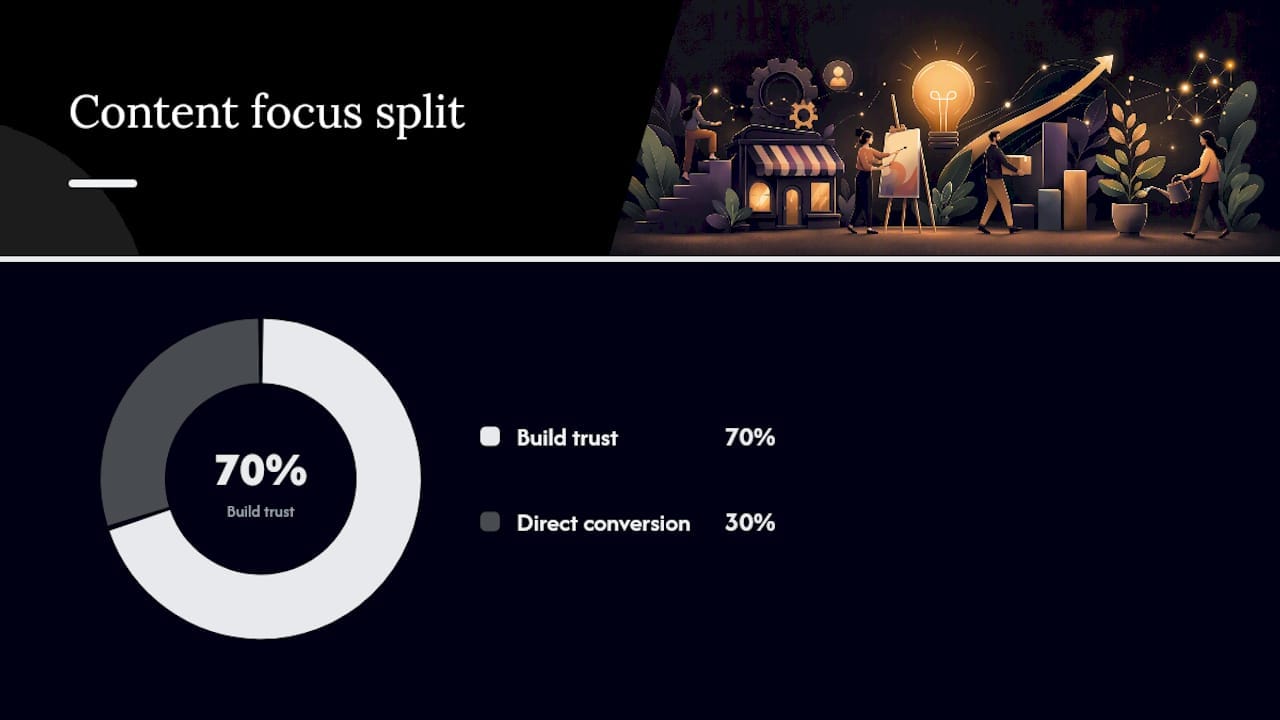
Pro Tip: Split your content roughly 70/30 between building trust (how-to posts, behind-the-scenes) and direct conversion asks (offers, discounts). All-conversion content burns out your audience fast.
How Do You Keep Customers Coming Back?
Systematic follow-up paired with a simple loyalty offer beats almost any acquisition tactic for return on effort, because keeping a customer costs far less than finding a new one.
Build these four pieces:
- A short onboarding sequence, even if it’s three emails, so new customers know what to expect
- A feedback loop, like a two-question survey sent one week after purchase
- A basic loyalty offer, such as a discount after the third purchase
- A follow-up email template you reuse for every customer who goes quiet for 60 days
Check retention rate and repeat-purchase rate monthly. Salesforce frames customer experience as a core operational priority, not an add-on, and it shows up directly in retention numbers.
Should You Hire or Outsource First?
Outsource anything non-core and unpredictable in volume; hire for roles that are strategic or need to grow with the business long-term.
Run this decision checklist before every hire:
- Is the task recurring enough to justify a fixed cost?
- Could a contractor from a platform like Upwork or Fiverr handle it just as well?
- Does the role touch your core product or customer relationship directly?
- Would the cost of a mistake here be high enough to justify paying more for reliability?
Once you bring on help, a short onboarding checklist, access to shared docs, one clear point of contact, and a first-week check-in, cuts early errors significantly.
When Is It Actually Time to Scale?
Scale only once you have three straight months of positive gross margin at your current volume and a customer acquisition cost meaningfully below lifetime value. Scaling on hope instead of data is how profitable small businesses turn into unprofitable bigger ones.
Watch for these three triggers before committing more capital:
- Consistent margin for a minimum of three months, not one good month
- CAC comfortably under LTV, with room to absorb rising ad costs
- Cash runway that survives a slower quarter after the scale-up
Before doubling spend anywhere, run a small experiment first: increase one variable (ad spend, inventory, staffing hours) by a fixed, capped amount for 30 days and measure the return before going further. Nomadexcel’s piece on proven growth strategies covers this staged approach in more detail.
What Timeline and Costs Should You Realistically Expect?
A notable share of small businesses close within the first year, per BLS data, which makes the first 90 days the highest-risk stretch for any new venture. Service businesses often reach their first paying customer faster than product businesses, which face manufacturing and inventory lead times.
Rough milestones to plan around:
- Day 30: idea validated, one-page plan finished, entity registered
- Day 90: first paying customers, bookkeeping system running weekly
- Day 365: consistent revenue pattern, enough data to know whether to scale
Build your contingency capital assuming the first 90 days take longer and cost more than your plan says. It almost always does.
Templates and Tools Worth Using This Week
Three templates matter more than any others right now: the one-page business plan, a 12-month cash-flow sheet, and a 90-day marketing test tracker. Get those three built before anything else.

| Tool Category | What It Handles |
|---|---|
| Accounting | Bookkeeping, bank reconciliation, monthly close |
| Invoicing | Payment requests, automatic reminders |
| Email/CRM | Customer follow-up, retention sequences |
| Scheduling | Appointments, bookings, simple automation |
Nomadexcel’s business accountability workflow gives a monthly review cadence you can pair with these tools, and SCORE’s free template library covers business plan and financial worksheet formats if you want a second reference point.
A Founder’s Note on What Actually Moves the Needle
The lesson that took me too long to learn: clarity beats cleverness. A founder with an average idea and a working weekly system will outlast a founder with a brilliant idea and no structure around it. If you take one step this week, make it the one-page plan. Programs like Nomadexcel’s entrepreneurship bootcamps exist for founders who want that structure built alongside a community that holds them to it, not for those who want another course to sit through.
A Guided Option If You Want Structure Built In
The checklist above works if you execute it consistently, which is exactly where most solo founders stall out, not on knowledge but on follow-through. Nomadexcel’s entrepreneurship bootcamps give aspiring and early-stage founders one to four weeks of hands-on frameworks, direct mentorship, and daily accountability instead of one more static course to work through alone. It complements everything covered here: the one-page plan, the validation scripts, the 90-day test structure, all get built with mentor feedback in real time rather than guesswork. Bootcamps are entirely optional, not a requirement for using this checklist, but if guided execution and a founder community would move you faster, check current program dates and see if a cohort fits your timeline.
Sources
- U.S. Bureau of Labor Statistics
- U.S. Small Business Administration — Business Guide
- SCORE | Free Business Mentoring, Workshops & Resources
- How to Start a Business: 13 Steps to Launch (2026) – Shopify
- 21 Small Business Tips to Succeed – Salesforce
This article is general information, not a substitute for advice from a qualified financial advisor. Consult a qualified financial professional about your own circumstances before acting on anything here.
Comments are closed.