
E Commerce Business to Consumer: How Founders Choose a Bootcamp
In this article, “e commerce business to consumer” refers to cohort-based B2C entrepreneurship bootcamps sold directly to individual founders, not online retail. It is a specific format of hands-on education: a curated cohort, a fixed timeline, and mentorship built for people launching or scaling a business that sells to everyday customers. The verdict: join now if you’re pre-revenue or early-revenue and want structured momentum; wait if you lack a testable idea. Founders with strong pre-entry knowledge who joined an accelerator grew revenue by roughly 188% in a year, and cohort-based courses with active facilitation see 70 to 90% completion rates, evidence that structure works when matched to the right founder. Nomadexcel builds its bootcamps around exactly this fit.
Key Takeaways
Structured, cohort-based B2C bootcamps work best when program design matches a founder’s pre-entry knowledge, and proximity to experienced founders drives outcomes that remote-only formats rarely replicate.
| Point | Details |
|---|---|
| Match structure to experience | Novices benefit most from structured, generalist tracks; experienced founders need flexible, specialized ones. |
| Completion rates signal design quality | Active, facilitated cohorts see 70 to 90% completion, versus far lower rates for self-paced courses. |
| Proximity density drives skill transfer | In-person time with experienced founders passes on judgment and timing that’s hard to teach remotely. |
| No program guarantees survival | Bootcamps improve skills and networks but never replace funding or a defensible business model. |
| Nomadexcel fits early and mid-stage founders | Its structured cohorts and specialized tracks map directly to the selection checklist above. |
Table of Contents
- Who Should Sign Up for a B2C Entrepreneurship Bootcamp?
- What a B2C Bootcamp Curriculum Actually Covers
- How to Choose the Right Bootcamp for Your Stage
- Timeline and Cost: What to Budget For
- When a Bootcamp Isn’t the Right Move
- How to Prepare Before Your Cohort Starts
- What Nomad Excel Emphasizes and What We Won’t Promise
- Ready to Join a Structured B2C Founder Cohort?
- Sources
Who Should Sign Up for a B2C Entrepreneurship Bootcamp?
Three founder profiles get the most out of these programs. Match yourself to one before you pay for a seat.
- Novice founders with an untested idea who need frameworks, deadlines, and a peer group to force execution.
- Solo freelancers launching a product or service business who want structured go-to-market help instead of trial and error.
- Experienced founders seeking specialized peer feedback on a specific growth problem, like pricing or paid acquisition.
If your goals include rapid go-to-market, validating product/market fit, generating early revenue, or plugging into a founder network, a bootcamp fits. Founders with little pre-entry knowledge do better in structured, generalist tracks; those with prior startup experience get more from flexible, specialized programs, a distinction the Wharton research on accelerator outcomes backs up directly.
What a B2C Bootcamp Curriculum Actually Covers
Most programs move through a similar arc, even when the pacing differs.
- Idea validation and customer research
- B2C marketing fundamentals (positioning, channels, messaging)
- Pricing and unit economics
- A product launch playbook
- Structured peer feedback sessions
- Mentorship office hours with operators who have built similar businesses
A typical week blends live workshops, peer critique circles, and open mentor office hours, with light asynchronous work between sessions so you’re not glued to a screen all day. Pro tip: ask any program for its weekly schedule before enrolling. If it’s all self-paced video with no live touchpoint, you’re buying a course, not a cohort.
Ask admissions what outcome metrics past cohorts hit: revenue growth, hiring or contractor milestones, or funding introductions. The pre-entry knowledge gap matters here too. Founders with deep prior experience showed employment growth many times higher than low-human-capital entrants after an accelerator, so ask how a program adjusts its curriculum for founders at different starting points rather than teaching everyone the same material.

How to Choose the Right Bootcamp for Your Stage
Start with a simple decision flow, not a spreadsheet of features. If you’re a novice founder without a validated idea, look for a structured, generalist program that walks you through validation, offer design, and launch in a fixed sequence. If you’ve already built or sold something and want sharper execution on a specific problem, a flexible, specialized track with less hand-holding and more targeted mentorship will serve you better. This split isn’t a stylistic preference. It reflects documented outcome differences by pre-entry knowledge, where the wrong structure for your experience level wastes both time and tuition.
Once you know which lane you’re in, run every candidate program through this checklist:
- Ideal participant fit — does the program’s stated audience match your actual stage, or are you the least experienced person in a room built for scaling founders?
- Program structure — is it a fixed curriculum or a flexible, choose-your-track model?
- Cohort size and proximity density — smaller, in-person cohorts create more face time with founders who’ve already built similar businesses, a factor Harvard Business School’s research on proximity ties directly to skill transfer that’s hard to replicate remotely.
- Mentorship intensity and alumni access — how many hours of 1:1 time, and does the network stay open after graduation?
- Measurable outcomes — what do past cohorts report on revenue, hiring, or funding?
- Cost transparency — is tuition all-in, or are travel, housing, and materials extra?
- Graduation support — is there a defined alumni community, or does contact end at demo day?
When you get on a call with admissions, ask direct questions: How many hours of mentor access does each participant get? What percentage of the last cohort hit their stated revenue goal? How is the cohort composed by stage and industry? What does support look like 90 days after the program ends? A vague answer to any of these is itself an answer. For more on evaluating mentorship depth specifically, this comparison of startup mentorship programs breaks down what strong mentor access actually looks like.
Timeline and Cost: What to Budget For
Bootcamp formats vary widely, and the right length depends on how much friction you can absorb.
- Weekend intensives: one to three days, minimal ongoing time commitment, best for testing an idea quickly.
- Short bootcamps: four to twelve weeks, typically 10 to 15 hours weekly between live sessions and execution work.
- Part-time cohorts: three to six months, lighter weekly load but longer overall commitment, suited to founders balancing a day job.
Cost bands generally track what’s included rather than program length alone. Entry-level programs usually cover group workshops and light mentorship. Mid-range programs add more 1:1 mentor hours and structured peer accountability. Premium, in-person immersions add proximity intensity and capital or investor introductions, the kind of dense founder access that a short, high-touch format can deliver efficiently, an approach some industry observers describe as a concentrated “espresso shot” of exposure rather than a long, diluted commitment. Higher tuition usually buys more room time with experienced founders, not just more slides.
When a Bootcamp Isn’t the Right Move
A bootcamp isn’t the only path, and it isn’t always the right one.
- Accelerators focus on scale and funding, best once you already have traction and want capital.
- Incubators offer longer handholding, often over a year, for very early ideas that need sustained support.
- Self-directed learning works if you already have discipline and just need information, not accountability.
- Short mentorship engagements suit founders with one specific problem to solve, not a full relaunch.
A simple rule: join a bootcamp when you need structured cohort momentum and peer accountability. Choose an accelerator or incubator when you need funding or extended incubation instead. Either way, no program guarantees survival. Cohort models combining coursework, advising, and alumni networks report stronger short-term outcomes than one-off training, but they raise your odds, not your certainty.
How to Prepare Before Your Cohort Starts
Do this work before day one, not during week one.
- Write a one-page problem statement: who you serve, what you solve, why now.
- Gather whatever customer research you already have, even five conversations count.
- List your existing assets: website, prototype, social channels, waitlist.
- Pick 2 to 3 growth experiments you want to test during the program.
- Set a single priority metric: a revenue target, a user acquisition number, or one hypothesis to validate.
Beyond the paperwork, prepare mentally for active peer feedback. Structured onboarding, buddy systems, and scheduled feedback loops are what make cohort programs stick, so show up ready to both give and take critique, not just absorb lectures. A pre-bootcamp validation exercise can sharpen your problem statement before the clock starts.
What Nomad Excel Emphasizes and What We Won’t Promise
We built Nomadexcel around execution, community, and proximity density, because founders learn faster in a room with people who’ve already built the thing they’re trying to build. We’ll be direct about the limits: a bootcamp sharpens your skills and your network, but it does not guarantee funding, a specific revenue number, or long-term survival. Anyone who tells you otherwise is selling something else.
Ready to Join a Structured B2C Founder Cohort?
Compared to a generic online course or a slow-moving incubator, Nomadexcel gives you a fixed timeline, a curated cohort, and direct mentor access without the year-long commitment accelerators often require. Our entrepreneurship bootcamp is built for exactly the profiles covered above: structured tracks for novice founders working through validation and launch, and more flexible, specialized sessions for founders who already have traction and need sharper execution. Every cohort combines hands-on workshops, daily accountability, and an alumni network that keeps working after the program ends.
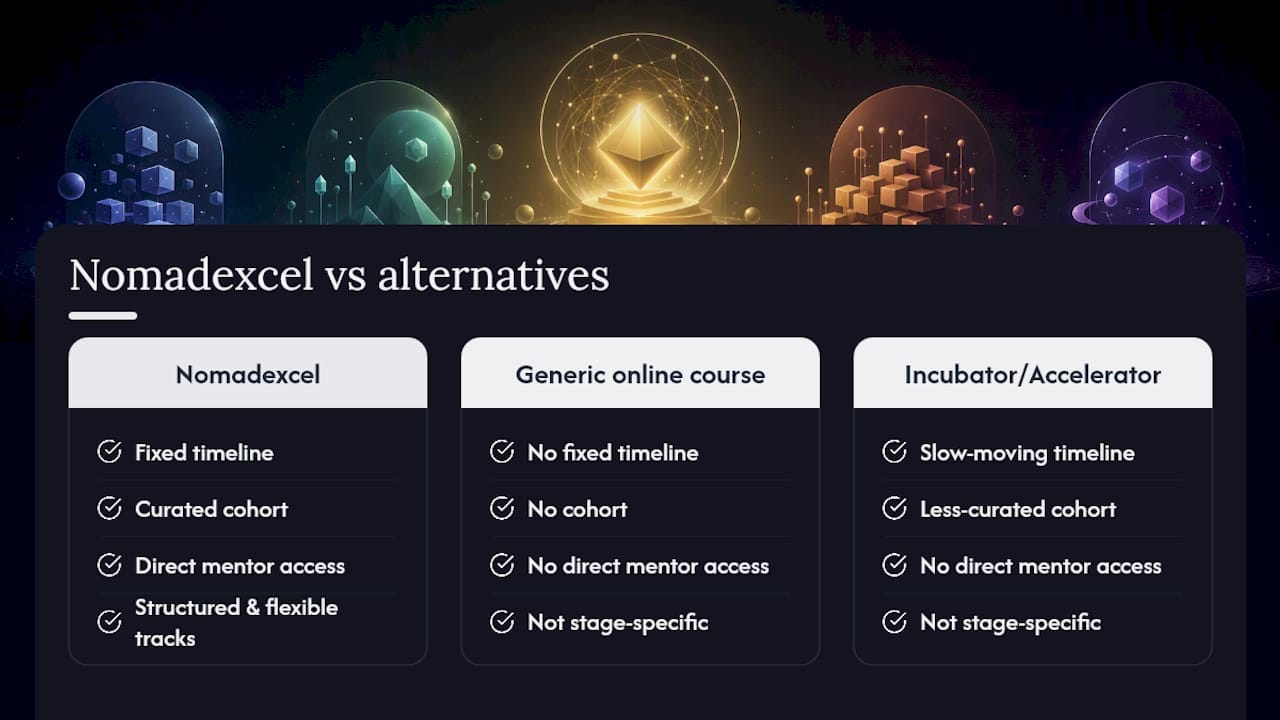
If you match the checklist in this piece, the next step is simple. Apply for a seat or book an info call to see which track fits your stage before the next cohort fills.
Sources
- Why Some Founders in Startup Accelerators Do Better Than Others – Knowledge at Wharton
- The Science of Cohort-Based Learning | MoreBetterLabs
- How much does proximity influence startup innovation? – Harvard Business School working knowledge
- Goldman Sachs 10KSB and the Power of Cohort-Based Growth | Observer
Comments are closed.