
20 Business Startup Examples You Can Validate in 2 Weeks
The strongest business start up examples right now share four traits: they turn a service into a product, they sell digital goods with no inventory, they occupy a tight e-commerce niche, or they automate repetitive work with AI. This guide walks through 20 concrete examples, a validation test for each, how they map to proven business models, and a two-week sprint we run with founders to get from idea to first sale faster. Expect most of these to need modest upfront spend and a real shot at revenue within 30 to 90 days.
TL;DR:
- Most startup ideas can begin generating revenue within 30 to 90 days with modest upfront costs, especially if validated through customer conversations.
- Focus on creating a clear, simple offer and pre-sell to at least five customers to test demand and refine your product rapidly.
- Service-to-product models, like freelancing or consulting, often require the lowest initial investment and provide immediate cash flow proof.
- Testing ideas through direct outreach, such as pre-selling or launching small, targeted campaigns, significantly accelerates early sales.
- Building trust signals and a narrow niche improves acquisition success and sets the foundation for scaling later.
Table of Contents
- 1. Twenty Startup Business Examples Worth Testing
- 2. How do you pick the right idea for you?
- 3. Startup business models and how they fit these ideas
- 4. Low-cost side hustles that reach revenue fastest
- 5. What can you learn from successful startup archetypes?
- 6. The Nomad Excel two-week sprint to validate your idea
- 7. What actually predicts early success for new founders?
- How Nomad Excel speeds up your first sale
- FAQ
- Sources
1. Twenty Startup Business Examples Worth Testing
The businesses gaining traction in 2026 tend to start small, test fast, and scale only once demand is proven, according to a curated list of viable 2026 business types. That pattern holds across every category below, from consulting to niche retail.
- Fractional operations consultant. You handle finance, HR, or ops part-time for multiple small companies. Ideal customer: founders with 5 to 20 employees who need senior judgment without a full salary. Startup cost: low, mostly your laptop and a LinkedIn presence. First steps: list three past employers as case studies and message ten founders in your network. Time to first sale: 2 to 4 weeks.
- Niche micro-agency. Pick one channel (say, Pinterest ads for home decor brands) and go deep instead of wide. Ideal customer: small e-commerce brands already spending on ads. Startup cost: low. First step: run one free audit for a prospect in exchange for a testimonial. Time to first sale: 3 to 6 weeks.
- Content services for a specific industry. Write case studies, newsletters, or technical documentation for one vertical, like legal tech or veterinary clinics. Startup cost: low. First step: pitch five companies with a sample piece written for their audience. Time to first sale: 2 to 5 weeks.
- Cohort-based course. Teach a skill you already use professionally, delivered live to a small group over several weeks. These succeed when the program is built around a clear transformation and real accountability rather than a pile of video lessons, per the same 2026 business opportunity breakdown. Startup cost: medium, mainly your time to design the curriculum. First step: pre-sell five seats using a simple outline. Time to first sale: 4 to 8 weeks.
- Digital templates and toolkits. Sell Notion templates, spreadsheet models, or design kits for a specific job, like freelance invoicing or wedding planning. Startup cost: low. First step: build one template, list it on a marketplace, and share it in a relevant online community. Time to first sale: 1 to 3 weeks.
- Print-on-demand apparel or home goods. You design, a supplier fulfills, and you never touch inventory. Margins depend heavily on finding a specific aesthetic or audience rather than general appeal. Startup cost: low. First step: launch ten designs around one theme and run a small paid test. Time to first sale: 2 to 4 weeks.
- Niche e-commerce store. Carry a tightly defined product range (left-handed tools, plus-size activewear) instead of competing broadly. Startup cost: medium, for initial stock or a dropship setup. First step: build a one-page store and drive 100 visitors through organic social posts. Time to first sale: 3 to 6 weeks.
- AI workflow automation service. Build simple automations that save small businesses hours each week, like auto-sorting leads or generating invoice reminders. The practical opening in AI for solo founders is automating repetitive tasks for small businesses rather than building new models, a distinction worth keeping in mind as you scope offers, based on ecosystem analysis of AI adoption patterns. A detailed workflow automation guide for small businesses outlines common use cases worth borrowing from. Startup cost: low. First step: automate one process for a friend’s business for free, then ask for a referral. Time to first sale: 2 to 5 weeks.
- Cybersecurity and compliance support for small businesses. Offer basic security audits and policy templates for companies too small to hire a full-time specialist. Startup cost: low to medium, depending on certifications. First step: offer a free vulnerability scan to three local businesses. Time to first sale: 4 to 8 weeks.
- Bookkeeping and finance ops. Small businesses consistently need someone to manage books, run payroll, and close the month. Consulting and bookkeeping remain reliable entry points because of low startup costs and near-immediate cash flow, according to the same 2026 business ideas roundup. Startup cost: low. First step: offer a flat-fee monthly package to five referrals. Time to first sale: 2 to 4 weeks.
- Online tutoring or coaching. Teach a subject, skill, or exam prep one-on-one or in small groups over video. Startup cost: low. First step: list availability on a tutoring platform and message past students. Time to first sale: 1 to 3 weeks.
- Subscription box for a micro-niche. Curate monthly boxes around a narrow interest, like specialty coffee from one region or board game accessories. Startup cost: medium. First step: pre-sell 20 boxes before sourcing inventory. Time to first sale: 4 to 8 weeks.
- Local cleaning or lawn care service. Clear demand, repeat customers, and margins that improve fast once you hire help. Startup cost: low. First step: post in three neighborhood groups and complete five jobs at a discount for reviews. Time to first sale: 1 to 2 weeks.
- Food truck or ghost kitchen concept. Test a menu without the overhead of a full restaurant lease. Startup cost: high relative to others here, though still far below a storefront. First step: run a single pop-up weekend to gauge demand. Time to first sale: 1 to 2 weeks.
- Resale and curation store. Source secondhand or vintage goods in one category and resell online. Startup cost: low. First step: list 20 items on a resale marketplace and track which categories move fastest. Time to first sale: 1 to 2 weeks.
- Event or workshop business. Run in-person or virtual workshops around a skill, hobby, or professional topic. Startup cost: low to medium. First step: host one free workshop to build an email list, then charge for the next one. Time to first sale: 2 to 4 weeks.
- Photography workshops. Combine a creative skill with teaching to reach two revenue streams at once: client shoots and paid workshops. Startup cost: medium, mostly equipment you may already own. First step: offer a discounted session to five clients in exchange for referrals. Time to first sale: 2 to 4 weeks.
- Pet services. Dog walking, pet sitting, or mobile grooming have steady local demand and low entry barriers. Startup cost: low. First step: list on a pet services app and complete your first five bookings at a promotional rate. Time to first sale: 1 to 2 weeks.
- Mobile or field services. Mobile car detailing, appliance repair, or window cleaning fill gaps that larger companies ignore. Startup cost: low to medium, depending on equipment. First step: canvass one neighborhood with flyers and a simple booking link. Time to first sale: 1 to 3 weeks.
- Starter digital product. A single paid ebook, mini-course, or checklist that solves one specific problem, sold through a landing page and social content. Startup cost: low. First step: write the first draft in a weekend and pre-sell it to your existing audience or a relevant online group. Time to first sale: 1 to 3 weeks.
2. How do you pick the right idea for you?
Not every idea on that list fits every founder, so narrowing down matters more than picking the “best” one in the abstract. Three criteria do most of the work: skill fit, demand fit, and monetization fit.
Skill fit asks whether you already have the knowledge, network, or craft to deliver this well without a steep learning curve. Demand fit asks whether real people are actively paying for a solution to this problem right now, not whether it sounds interesting. Monetization fit asks whether the numbers work: can you charge enough, often enough, to cover your time and costs within a reasonable window.
Score each criterion from 1 to 5 for any idea you’re considering, then add them up.
- Rate skill fit. Ask yourself honestly whether you could deliver this today, or whether you’d need months of training first.
- Rate demand fit. Search for people complaining about this problem in forums, reviews, or social posts, and count how often it comes up.
- Rate monetization fit. Estimate your price point and how many customers you’d need per month to hit a modest income target.
- Add the three scores. A total of 12 or higher suggests the idea deserves a real test; below 8 usually means it needs rethinking or more research.
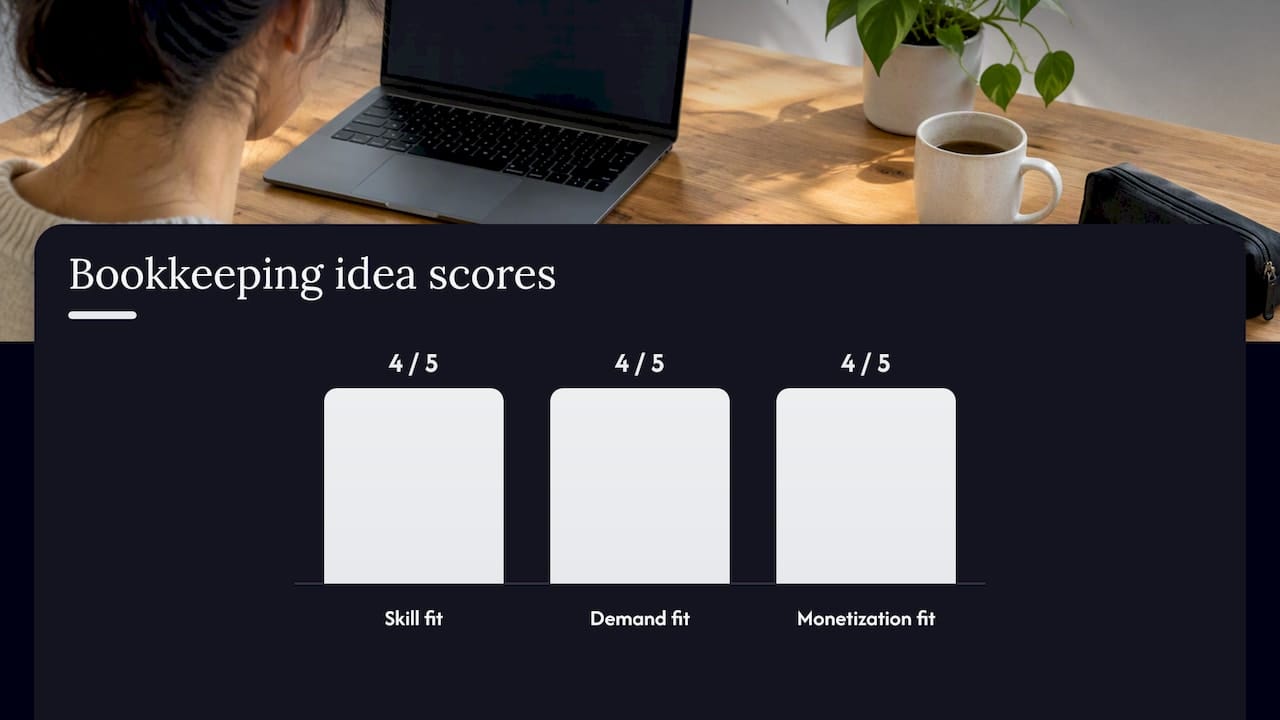
Here’s a worked example using the bookkeeping idea from the shortlist above. Say you’ve managed finances for two small companies before: skill fit scores a 4. A search of local business forums turns up frequent complaints about late invoicing and tax confusion: demand fit scores a 4. At $400 a month per client, five clients would cover a modest income: monetization fit scores a 4. Total: 12, a strong signal to move to a validation test.
Watch for red flags that should slow you down regardless of your score: businesses that require licenses you don’t have time to obtain, as outlined in official guidance on business licenses and permits, or models where your cost per unit exceeds what customers will pay. On the other side, quick wins show up as a clearly painful customer problem paired with a cheap way to reach that customer, whether that’s a Facebook group, a niche subreddit, or a short list of referrals.
Pro Tip: Before writing a single line of marketing copy, find ten people with the problem you’re solving and ask how they currently handle it; their answer tells you more than any survey.
For a longer walk-through of this scoring process, our guide to business validation for early-stage founders covers additional edge cases worth checking before you commit.
3. Startup business models and how they fit these ideas
Every idea above eventually needs a revenue mechanism, and most fall into one of five well-tested models: marketplace, SaaS or subscription, e-commerce or retail, freemium, and service-to-product. Common startup models include marketplaces, subscription software, e-commerce, and freemium, with revenue mechanics that differ sharply between them, according to the Global Startup Ecosystem Report 2025.
- Marketplace. You connect buyers and sellers and take a cut of each transaction, often called a rake or commission. A resale and curation store or a tutoring listing both lean on this mechanic when you sell through an existing platform.
- SaaS or subscription software. Revenue comes from a recurring fee, measured by average revenue per user and how long customers stick around before churning. A niche vertical software product, like the kind built for dance studio scheduling by platforms such as StudioFlare, illustrates how a single operational pain point can anchor a subscription business.
- E-commerce or retail. You buy or produce goods and sell them at a markup. Print-on-demand apparel, niche e-commerce stores, and subscription boxes all run on margin: the gap between what you pay and what you charge.
- Freemium. A free tier draws users in, and a smaller percentage upgrades to a paid tier for more features. Digital templates and toolkits sometimes use this shape, offering one free template to build an audience before selling a paid bundle.
- Service-to-product. You start by delivering a service personally, then package the repeatable parts into a product others can buy without your direct time. Fractional consulting, bookkeeping, and content services for a specific industry are the clearest candidates, since each has a repeatable deliverable that could eventually become a template, course, or tool.
Matching your idea to the right model early saves you from building pricing or features that don’t match how the business actually makes money.
4. Low-cost side hustles that reach revenue fastest
If capital is tight or you want to test an idea part-time before committing fully, a handful of options from the shortlist above consistently reach a first sale within days rather than months.
- Freelance writing or editing. Spend: under $50 for a portfolio site. Reach five potential clients through direct outreach on LinkedIn. First sale typically lands within 1 to 2 weeks at $50 to $150 per piece.
- Social media management for one local business. Spend: under $100 for scheduling tools. Pitch three local shops directly. Expect a first contract within 2 weeks at $300 to $600 per month.
- Pet sitting or dog walking. Spend: under $50 for flyers and a booking app listing. Post in two neighborhood groups. First booking often comes within days at $20 to $30 per visit.
- Resale arbitrage. Spend: $100 to $300 for initial inventory. List 20 items on one marketplace. First sale within a week, priced at a 30 to 50% markup over cost.
- Digital template or checklist. Spend: under $50 for a landing page tool. Share in one relevant online community. First sale within 1 to 2 weeks at $10 to $30 per download.
- Tutoring one subject. Spend: under $30 for a profile on a tutoring platform. Message five past students or classmates. First session often booked within a week at $25 to $50 per hour.
- Mobile car detailing. Spend: $100 to $200 for basic supplies. Post a before-and-after photo in a local group. First booking within 1 to 2 weeks at $40 to $80 per job.
- Micro-consulting calls. Spend: $0, using your existing expertise. Offer five 30-minute paid calls to your network. First booking often happens within days at $50 to $100 per call.
- Print-on-demand single design drop. Spend: under $50 for setup. Post the design in one niche community and run a small boosted post. First sale typically within 2 weeks at your chosen retail markup.
- Event ticket for a one-time workshop. Spend: under $100 for a venue or video tool. Announce to your existing contacts. First ticket sold within 1 to 2 weeks, priced to cover costs plus a modest margin.
For outreach that doesn’t rely on a big ad budget, our practical guide to social media for entrepreneurs breaks down low-cost ways to find that first wave of customers.
5. What can you learn from successful startup archetypes?
Rather than studying one specific company’s history, it helps to study the shape of success: the pattern a certain kind of startup tends to follow, and what you can copy from it.
- The marketplace that grew by solving a trust problem first. Early marketplaces typically win not by having the most listings but by making the first transaction feel safe, through reviews, guarantees, or manual vetting. Lesson: if you’re testing the resale or tutoring marketplace idea, invest your first effort in trust signals, not volume.
- The niche product brand that out-positioned bigger competitors. Small product brands regularly beat larger retailers in a narrow category by speaking directly to one audience’s specific need instead of a general one. Lesson: for print-on-demand or subscription box ideas, write copy for one specific customer, not “everyone who might like this.”
- The cohort-based education business that scaled past its first course. Education businesses that expand successfully usually do it by turning satisfied cohort graduates into case studies, then into referral sources, then into a second product like consulting or a template library. Lesson: if you’re testing a cohort course, plan your second offer before you’ve finished teaching the first one.
- The AI-enabled consultancy built on one repeatable automation. The sharpest wins in small-business AI work tend to come from mastering one specific automation deeply, like lead routing or invoice follow-ups, rather than offering broad “AI consulting.” Lesson: for the AI workflow automation idea, pick one workflow, build it well, and let referrals carry you to the next client.
Across all four patterns, pricing tends to rise only after demand is proven, and scaling triggers (hiring, paid ads, new product lines) show up after a founder has repeatable evidence that the core offer converts, not before.
6. The Nomad Excel two-week sprint to validate your idea
Once you’ve scored an idea and matched it to a model, the fastest way to find out if it works is a short, structured sprint rather than months of planning. Here’s the seven-step version we walk founders through.
- Days 1 to 2: Define the customer and the problem. Write one sentence naming who you’re serving and the specific pain they feel.
- Days 3 to 4: Find ten real conversations. Talk to potential customers directly, in person or over video, and ask how they solve this problem today.
- Days 5 to 6: Draft your offer. Write a simple description of what you’ll deliver, for how much, and by when.
- Days 7 to 8: Build a minimum deliverable. Create the smallest version of your product or service that someone could actually buy.
- Days 9 to 10: Pre-sell to five people. Ask for a real payment or a deposit, not just interest, from people in your existing network or a relevant community.
- Days 11 to 12: Deliver and collect feedback. Fulfill your first orders and ask directly what worked and what felt confusing.
- Days 13 to 14: Decide: continue, adjust, or stop. Measure traction by counting actual paying customers, not likes or signups.
Throughout the sprint, having a mentor or peer group to report progress to each day keeps momentum higher than working alone, which is the backbone of how our bootcamp cohorts operate. Our startup idea validation checklist walks through common pitfalls to watch for at each stage.
Pro Tip: In every customer conversation, ask what they tried before and why it didn’t work; that answer usually reveals the real price they’d pay for a better fix.
7. What actually predicts early success for new founders?
After watching founders test dozens of ideas, the single behavior that predicts early traction isn’t a clever idea or a big budget. It’s speed from idea to first paying customer. Founders who productize a service or ship a simple digital product with clear unit economics, then test it with real money within two weeks, consistently outpace those who spend months refining a plan nobody has paid for yet.
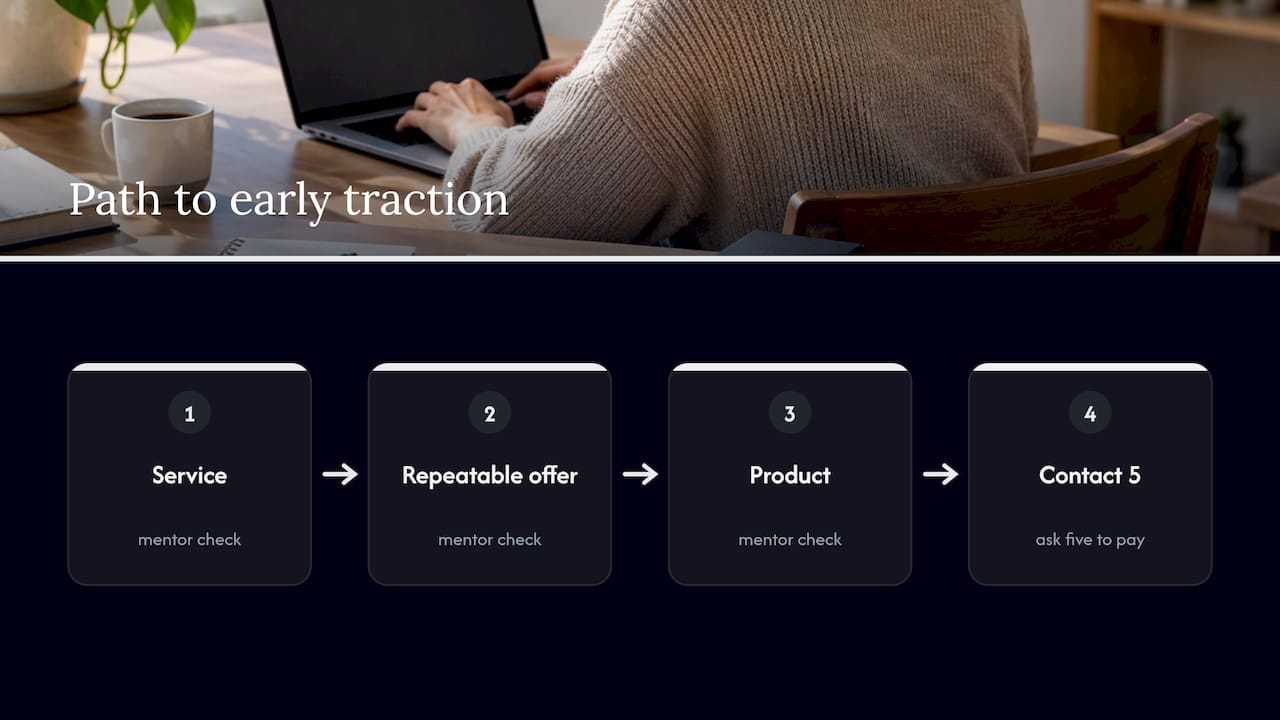
The fastest path tends to run from service, to repeatable offer, to product, with a community or mentor checking your progress at each step so you don’t quietly stall. If you take one action today, make it this: contact five potential customers before the week ends and ask them to pay for something small.
How Nomad Excel speeds up your first sale
Testing an idea alone, on your own timeline, often stretches a two-week sprint into two months of second-guessing. We built our bootcamps to close that gap: daily accountability, direct mentorship from working entrepreneurs, and a cohort of founders testing their own ideas alongside you, so the awkward early conversations and pricing decisions get unstuck faster than they would solo.
Our Online Entrepreneurship Bootcamp is built for exactly the validation work covered in this article: narrowing your shortlist, running real customer conversations, and getting to a first sale with structured feedback rather than guesswork. If you’re weighing whether guided support is worth it, our breakdown of why founders join an entrepreneurship bootcamp covers the outcomes past cohorts have worked toward, from sharper offers to active peer networks that outlast the program itself.
If you’re ready to turn one of these 20 examples into a tested business, visit Nomad Excel to see current bootcamp dates and find a cohort that fits your timeline.
FAQ
What is the cheapest business to start in 2026?
Service-based options like freelance writing, bookkeeping, or social media management typically cost under $100 to start since they rely on your existing skills rather than inventory or equipment. Digital products, such as templates or checklists, carry similarly low costs because there’s nothing to manufacture or ship.
How long does it take a new business to make its first sale?
Many of the low-cost examples above, including tutoring, pet sitting, and digital templates, can generate a first sale within one to two weeks of launch if you reach out directly to a warm audience. Businesses requiring licensing, inventory, or a longer sales cycle, like cybersecurity support or subscription boxes, more commonly take four to eight weeks.
What startup business model makes the most sense for a beginner?
Service-to-product is often the easiest starting point because you can earn income immediately from the service while gradually packaging the repeatable parts into a product. It also requires the lowest upfront investment compared to marketplace or SaaS models, which typically need more development time before the first dollar comes in.
Do I need a formal business plan to start?
A full formal business plan usually isn’t necessary unless you’re applying for a specific loan or grant that requires one. Most early-stage founders validate faster using quick customer conversations and a simple one-page outline instead.
What legal steps should I take before launching?
Requirements vary by location and industry, so checking official guidance for your jurisdiction early is worth the time; the U.S. Small Business Administration’s licensing guidance outlines the kind of permits and licenses many new businesses need before operating. Confirming these requirements before you take your first payment helps you avoid costly corrections later.
Sources
- Top 10 most successful businesses to start in 2026 (e-Resident)
- Apply for licenses and permits (U.S. Small Business Administration)
Comments are closed.