
Seed 20–50 Posts to Grow Your Online Community in 90 Days for Builders
The fastest path to a thriving online community follows one sequence: define your purpose and audience, design how members will participate, pre-seed the space before anyone arrives, run signature programming on a schedule people can set their clocks to, then measure and adjust. Start by assembling 20 to 50 seeded posts, recruiting 5 to 10 ambassadors, and scheduling your first flagship event. Success in the early months looks like a rising share of members contributing, steady attendance at recurring events, and at least one business metric, whether that is leads, retention, or referrals, moving in the right direction.
TL;DR:
- Community success depends on defining a clear purpose and target audience, with specific success metrics like onboarding completion and contribution rate.
- Seeding the space with 20 to 50 posts and recruiting early ambassadors before launch significantly boosts engagement and signals activity to newcomers.
- Focusing on one main goal, such as support or acquisition, during the first 90 days improves programming effectiveness and measurement clarity.
- Member contribution patterns follow a 1-9-90 distribution, so programs should prioritize active contributors while providing easy ways for passive members to engage.
- Choosing the right platform should be based on community size, ownership, searchability, and support for both real-time and asynchronous discussion, progressing from Slack to dedicated tools as needed.
Table of Contents
- Clarify Purpose and Target Audience Before Anything Else
- Design the Community Using the 5 Ps and SPACES Framework
- Pre-Launch Checklist: Seeding the Space and Removing Friction
- Launch and the First 90 Days: Turning Lurkers Into Contributors
- Growth Channels and Promotion: Sustainable Ways to Increase Membership
- Engagement and Retention Using the 1-9-90 Model
- Platform and Tooling: Choosing the Right Community Home
- Measure What Matters: KPIs, Reporting, and Experiments
- Sample Programming Calendar and Content Prompts
- Lessons From Cohort-Based Bootcamps and Retreats
- An Option for Builders Who Prefer a Guided, High-Touch Route
- FAQ
- Sources
Clarify Purpose and Target Audience Before Anything Else
Every design decision that follows depends on answering one question honestly: why does this community need to exist, and for whom? A community built to gather product feedback looks different from one built for peer accountability among founders or one built to share job referrals between members. Skipping this step is why so many promising groups go quiet within weeks.
Start by translating your organization’s goals into a clear value proposition for members. A startup accelerator might promise peer accountability and warm introductions. A software company might promise early access and a direct line to the product team. Whatever the promise, it has to be specific enough that a prospective member can say “yes, that’s for me” in one sentence.
Then narrow the membership criteria. Vague communities attract vague engagement. A tightly defined identity, say, “early-stage SaaS founders raising their first round,” gives people something to belong to and something to recommend to a friend who fits the same description.
Set a few success metrics tied directly to that purpose:
- Onboarding completion rate: the share of new members who finish your welcome sequence.
- Referral rate: how many new members arrive because an existing member invited them.
- Contribution rate: the percentage of members who post, reply, or react within their first 30 days.
These numbers tell you whether your purpose statement is actually landing with the people you recruited, or whether it needs sharper language and a narrower target.
Design the Community Using the 5 Ps and SPACES Framework
Once purpose and audience are settled, design follows a known structure. The 5 Ps framework for community design breaks the work into five decisions, and the order matters: People and Purpose come first, Platform comes last. Starting with a platform choice before knowing who you are serving is one of the most common reasons communities stall.
- People: who exactly are the members, and what do you expect them to contribute?
- Purpose: what outcome does membership deliver, stated in one sentence?
- Participation: what does an active member actually do each week?
- Programming: what recurring activities create that participation?
- Platform: which tool supports the above without adding friction?
Alongside the 5 Ps, the SPACES framework ties your community’s daily work to business outcomes across pillars like Support, Product, Acquisition, and Content. This matters more than it sounds: Only a minority of community professionals report being able to confidently quantify their community’s ROI, with common objectives including support, success, and acquisition. Map one or two measurable KPIs to each pillar you choose to pursue, rather than trying to serve all of them at once.
At launch stage, prioritize People and Purpose decisions and keep Programming simple. As the community grows, Platform and Participation design become more important to manage a larger, more diverse member base.
Pro Tip: Pick one SPACES pillar as your primary objective for the first 90 days. Trying to optimize for support, acquisition, and product feedback simultaneously dilutes your programming and your metrics.
Pre-Launch Checklist: Seeding the Space and Removing Friction
A new community with zero activity reads as abandoned, not fresh. Before you invite anyone publicly, populate the space so the first visitors find a living conversation rather than an empty room.
- Seed the space with 20 to 50 posts and replies, written in different voices, covering introductions, a few genuine questions, and one or two resource shares.
- Write short, specific invitation copy that states what the community does and what a new member gets in one or two lines.
- Build a simple FAQ that answers “what is this,” “is it free,” and “how do I leave” before anyone has to ask.
- Use a QR code or single-click join link wherever you promote the community, in person or online.
- Recruit 5 to 10 early ambassadors and brief them on what good participation looks like.
- Design a 7-day onboarding sequence with a welcome message, an introduction prompt, and a check-in near day 5.
Redesigned invitation materials, including shorter copy, clear FAQs, and QR codes, measurably increased agreement to participate and boosted online completion rates in a mixed-methods recruitment study. That is a strong argument for treating your invitation and onboarding copy as a design problem, not an afterthought.
Launch and the First 90 Days: Turning Lurkers Into Contributors
The first 12 weeks set the habits your community will keep for the next two years. Think of this stretch as a repeatable cadence rather than a single launch event.
- Weeks 1 to 2: run onboarding for your seeded ambassadors and first wave of invited members.
- Weeks 3 to 6: hold your first flagship event, something recurring like a weekly office hours call or a monthly AMA, and repeat it on a fixed schedule.
- Weeks 7 to 10: layer in a micro-program, such as a four-week accountability sprint or a themed discussion series.
- Weeks 11 to 12: review participation data and decide what to keep, cut, or double down on.
For our step-by-step startup community guide, we outline templates for kickoff events, including a moderator checklist that covers who welcomes new members, who seeds discussion questions, and who tracks attendance.
Watch two early metrics closely: the share of invited members who show up to the first flagship event, and the percentage who post or reply within their first two weeks. If attendance or contribution stays flat after the second iteration of your flagship event, that is your signal to change the format, the timing, or the topic before investing further.
Growth Channels and Promotion: Sustainable Ways to Increase Membership
Word of mouth remains the most durable growth channel any community has, because it carries built-in trust that advertising cannot replicate. Build a simple referral program around it rather than leaving it to chance.
- Offer a light incentive for referrals: early access to a new program, a shoutout, or a small discount works better than nothing at all.
- Equip ambassadors with shareable content: a one-line description and a single link remove the friction that kills most referrals.
- Repurpose member discussions into content: a great thread becomes a blog post, a social clip, or an SEO asset that brings in new members searching for the exact problem your community already solved.
Our guide on turning community content into social and SEO assets covers how to repackage member Q&A into material that keeps working long after the original conversation ends. Content marketing guidance from Design Wellness offers additional detail on repurposing owned content for acquisition.
Paid promotion and co-marketing have their place, but only after organic growth proves the concept. Run a small paid test, a few hundred dollars across one channel, once you know your flagship event reliably converts invitees into attendees. Partnerships with adjacent communities or creators, like the kind detailed by creator economy operator Naomi Lennon, can expand reach faster than paid ads, especially when the partner’s audience overlaps closely with your defined member profile.
Pro Tip: Before spending on paid acquisition, confirm your onboarding sequence converts at least half of new joiners into one visible action, a post, a reply, or an event RSVP. Paid traffic into a broken funnel just burns budget faster.

Engagement and Retention Using the 1-9-90 Model
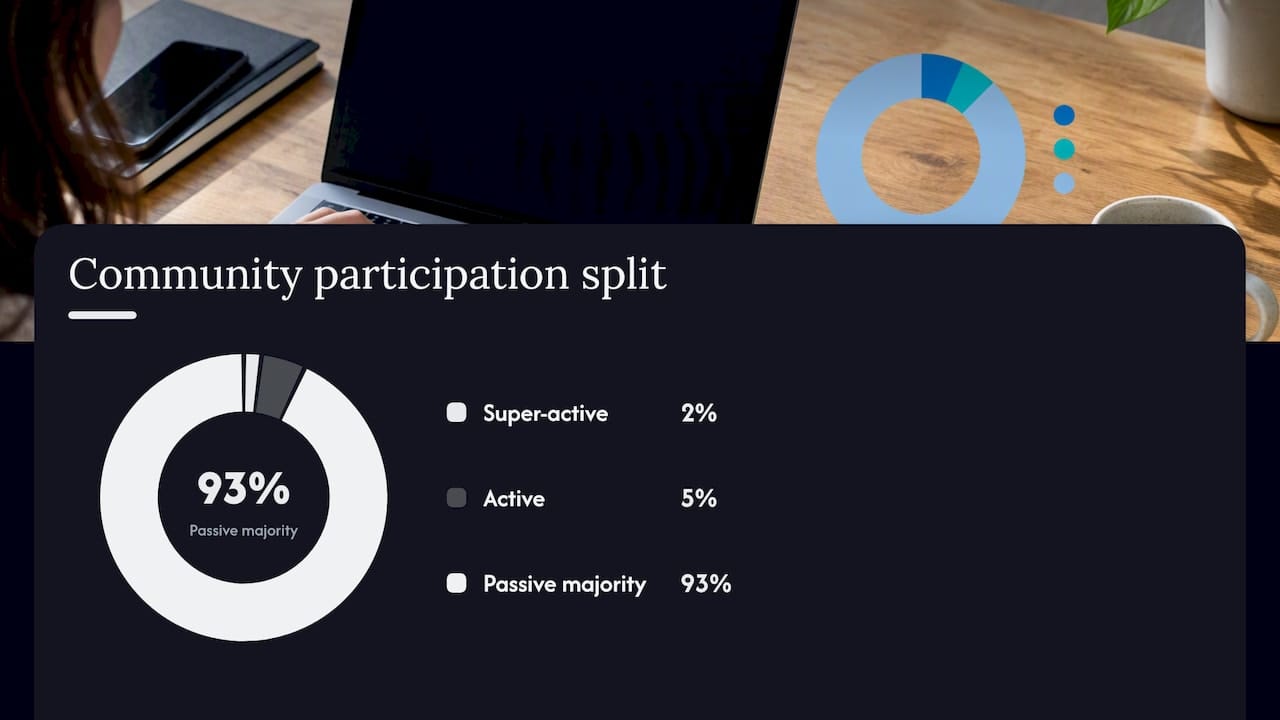
Most communities, no matter how well designed, settle into an uneven participation pattern. The 1-9-90 theory of engagement describes this directly: roughly 2% of members become super-active contributors, another 5% participate actively, and the remaining 93% stay largely passive. That is not a failure state. It is the realistic baseline you should plan around rather than fight.
The practical implication is to concentrate programming energy on the active 7% while still giving the passive majority easy, low-effort ways to engage.
- Create micro-commitments: a one-click reaction, a poll vote, or a one-word reply lowers the bar for the passive majority.
- Build recognition rituals: a weekly member spotlight or a shoutout for a helpful answer moves people along the commitment curve.
- Document a clear path from new member to contributor: the CMX Community Engagement Cycle offers a tested model for deepening engagement in stages rather than expecting instant participation.
Retention then depends on three levers: a finished onboarding sequence, visible milestone recognition at 30 and 90 days, and contribution paths that take less than a minute. Members who complete onboarding and make one small contribution in their first two weeks are far more likely to stick around for the second and third month.
Platform and Tooling: Choosing the Right Community Home
Platform choice comes after People, Purpose, and Participation are settled, never before. Evaluate any tool against a short checklist: can members find past conversations through search, do moderation controls match your community’s size, do you own your member data, and does the platform support both real-time chat and asynchronous discussion.
- Starter stage: Slack or Discord paired with a shared Google Sheet for tracking members and attendance.
- Growth stage: a dedicated membership platform with built-in analytics once manual tracking becomes unmanageable.
- Scale stage: a CRM connected to automation tools once onboarding, reminders, and recognition need to run without manual effort.
Keep content portable from day one. Export-friendly formats and clear tagging let you repurpose member discussions into blog posts or resource roundups later, which matters directly for the SEO and acquisition tactics covered earlier. Productized platform features aimed at retention, like those outlined by Kukoo Creative, are worth reviewing once you are weighing paid membership models.
Measure What Matters: KPIs, Reporting, and Experiments
A useful measurement plan tracks three levels at once: the member, the community, and the business.
- Member level: onboarding completion, daily and weekly active users, first-contribution rate.
- Community level: reply rate per post, event attendance, ratio of active to passive members.
- Business level: referral rate, conversion to leads, retention or renewal rate tied to community participation.
Report on a monthly cadence at minimum, with a lighter weekly check on attendance and new-member activity. Run small experiments on the pieces most likely to move the needle: test two versions of your welcome message, try different event times to see which draws more attendance, and compare onboarding sequences that ask for one action versus three.
When presenting results to stakeholders, a short dashboard beats a long report: show the three-level metrics above alongside one business outcome tied directly to community activity, since confidence in community ROI remains low across the industry and concrete numbers build trust faster than narrative updates.
Sample Programming Calendar and Content Prompts
A monthly template built around four weekly pillars removes the guesswork from programming: one week for education, one for support, one for networking, and one for open discussion. Repeating this structure gives members a predictable rhythm without making every week feel identical.
Six prompts cover most of what a young community needs:
- Welcome thread: new members introduce themselves using three guided questions.
- Member spotlight: a short feature on one member’s project or milestone.
- Project demo: a member walks through something they built or launched.
- Micro-challenge: a one-week task tied to the community’s core purpose.
- AMA: an expert or veteran member answers open questions for an hour.
- Resource roundup: members submit links, tools, or lessons from the past month.
As the community matures, hand these formats to members themselves. Document the AMA and demo templates, then rotate facilitation among trusted contributors to reduce the load on your core team while keeping the formats consistent. Our community building strategies guide walks through this handoff in more detail.
Lessons From Cohort-Based Bootcamps and Retreats
We offer immersive entrepreneurship bootcamps and company retreats designed to support individuals and teams in accelerating growth through clarity, execution, and community. That experience shapes a specific view: shared outcomes build trust faster than asynchronous interaction alone.
When a group of founders works through the same sprint, under the same deadline, in the same room, the bonds that form are sturdier than the ones built through scattered online replies over months. Cohort intensity compresses the commitment curve. People who might take a year to become active community contributors online often reach that same trust level within a week of shared, high-stakes work.
That does not replace the online tactics above. It reinforces why the best digital communities borrow structure from in-person ones: fixed schedules, small groups, and visible shared progress.
— Amichai
An Option for Builders Who Prefer a Guided, High-Touch Route
Everything above works, but it takes months of consistent effort to execute alone. For early-stage founders and teams who want the network effects of community without building the infrastructure from scratch, a cohort-based program compresses that timeline into days rather than months.
Our Online Entrepreneurship Bootcamp brings together a curated group of founders for structured sprints, direct mentorship, and the kind of peer network that normally takes a year of community building to earn. Teams looking for the same alignment and trust-building benefits can explore our company retreats, designed to strengthen communication and shared direction over a focused, multi-day experience.
If you are weighing whether a guided cohort fits your stage better than a self-built community, our guide to joining an entrepreneurship bootcamp walks through what to expect and who benefits most. Reach out through Nomadexcel to check program fit and dates.
FAQ
What Are the 5 C’s of Community?
Definitions of the “5 C’s” vary across sources and are not a single standardized framework the way the 5 Ps or SPACES models are. Builders looking for a structured approach are better served by the 5 Ps (People, Purpose, Participation, Programming, Platform) covered earlier in this guide, which is a widely referenced community design model.
How Do You Promote an Online Community?
Promotion works best through a referral program with a simple incentive, repurposed member content turned into social and SEO assets, and partnerships with adjacent creators or communities whose audience overlaps with yours. Paid promotion should come after your onboarding funnel proves it can convert invitees into contributors, not before.
What Are the 7 Elements of Community?
Like the “5 C’s,” a “7 elements” framework is not a standardized model with consistent industry agreement. The design frameworks with stronger backing, the 5 Ps and SPACES, cover the same underlying decisions: who your members are, why they join, how they participate, what programming you run, and which platform supports it.
How Many Members Actually Contribute to a Community?
Most healthy communities follow a 1-9-90 distribution: about 2% become super-active contributors, 5% participate actively, and the remaining 93% stay largely passive.
Should a New Community Start With Many Channels or Few?
Starting with 3 to 5 focused spaces, such as introductions, a core topic channel, and general chat, works better than launching with a dozen channels that spread early activity too thin. Add more spaces only once existing ones show consistent weekly activity.
Sources
- SPACES framework in action: match your community work to business goals
- Enhancing participant recruitment through redesigned invitation materials in a probability-based online panel: a mixed-methods approach
Comments are closed.