
Step-by-step guide to building a successful startup community
TL;DR:
- Building a startup community with a clear purpose and targeted personas fosters engagement and growth.
- Choosing the right platform and personal recruitment of founding members set a strong foundation.
- Genuine, value-driven interactions create lasting trust and competitive moats beyond hype.
Building a startup can feel isolating. You’re making high-stakes decisions without trusted feedback, pushing through uncertainty without accountability, and watching progress stall because no one around you truly understands the journey. The good news? A well-built startup community changes all of that. Community-driven companies grow 5x faster, and 92% of people trust peer recommendations over advertising. This guide gives you a practical, proven playbook to build a startup community from scratch, covering purpose, platform selection, content strategy, and sustainable growth so you can stop building alone and start building together.
Table of Contents
- Define your community’s purpose and personas
- Choose the right platform and recruit founding members
- Seed content, set guidelines, and launch softly
- Sustain, measure, and scale genuine engagement
- A fresh take: Why real startup communities thrive where hype fails
- Ready to fast-track your entrepreneurial growth?
- Frequently asked questions
Key Takeaways
| Point | Details |
|---|---|
| Purpose and persona clarity | A well-defined mission and specific member personas ensure your startup community stays focused and valuable. |
| Start small and recruit personally | Begin with 10–20 engaged members and grow through genuine connections, not open signups. |
| Seed value before scaling | Provide high-value content and guidelines early, prioritizing engagement over member counts. |
| Track real engagement | Measure meaningful participation and relationships, not just signups or vanity metrics. |
| Communities as growth moats | A supportive startup community is hard to copy and accelerates both personal and company growth. |
Define your community’s purpose and personas
Most communities fail before they ever launch. Not because of bad tools or low budgets, but because they start vague. “A community for startup founders” is not a purpose. It’s a category. Without a clear mission, members have no reason to stay, contribute, or care.
The most effective communities are built around a specific outcome. Think: helping SaaS founders reach their first $10K in monthly recurring revenue, or supporting bootstrapped indie makers who are building without outside funding. When the purpose is that specific, the right people immediately recognize themselves in it, and they show up with energy.
To define a clear purpose for your community, ask yourself: What transformation does membership create? What would members miss if this community disappeared tomorrow? Those answers become your north star.
Once the purpose is locked in, you need to identify specific community personas by role and stage. A solo founder at the idea stage has completely different needs than a two-person team with early traction. Mapping these personas before you recruit a single member saves enormous time and prevents the common mistake of trying to serve everyone at once.
Here’s a sample persona table to get you started:
| Persona | Role | Stage | Primary need |
|---|---|---|---|
| The Validator | Solo founder | Pre-launch | Honest feedback on ideas |
| The Grower | Startup marketer | Early traction | Acquisition strategies |
| The Builder | Technical co-founder | Product development | Peer problem-solving |
| The Scaler | Bootstrapped operator | Revenue stage | Systems and delegation |
Understanding what each persona needs helps you design content, events, and conversations that feel personally relevant rather than generic. For a deeper look at how different entrepreneurial communities are structured, this entrepreneurial community breakdown offers useful context.
Key questions to answer when defining your community:
- What specific outcome does membership deliver?
- Who is the ideal member, and what stage are they at?
- What does success look like for a member after 90 days?
- What topics or conversations are in scope, and what’s off limits?
Pro Tip: Bring two or three potential “champion” members into the purpose design process before you finalize anything. Their language, frustrations, and goals will sharpen your mission statement more than any solo brainstorming session ever could.
Choose the right platform and recruit founding members
With your purpose and personas defined, the next step is to strategically select tools and assemble a core group. Platform choice shapes culture more than most founders realize. The wrong environment creates friction that quietly kills engagement over time.
Here’s a quick comparison of the most common platforms for startup communities:
| Platform | Best for | Engagement style | Moderation ease |
|---|---|---|---|
| Slack | Professional, async discussion | Threaded channels | Moderate |
| Discord | Technical or younger audiences | Real-time chat, voice | Moderate to high |
| Facebook Groups | Broad reach, less tech-savvy | Feed-based posts | Easy |
| Circle | Dedicated community builders | Structured spaces | High |
Choose platforms like Slack, Discord, or Facebook based on where your audience already spends time, not where you’re most comfortable. If your personas are technical founders, Discord’s real-time energy fits. If they’re service-based entrepreneurs, a Slack group or Circle community may feel more professional.

Start small. The goal is not to have hundreds of members on day one. Recruit members personally and co-create with early adopters to establish the culture you want before it scales beyond your control.
Here’s a step-by-step approach to recruiting your founding 10 to 20 members:
- List 30 to 50 people you already know who match your core persona.
- Write a personalized message to each one explaining the specific community purpose.
- Be honest that it’s early stage and their input will shape the experience.
- Invite them to a short 1:1 call or beta event before the community formally opens.
- Ask each founding member to suggest one other person who belongs.
Personalized invitations dramatically outperform mass outreach. People join communities because they feel seen, not because they received a bulk email. Understanding why community matters for entrepreneurs can help you articulate the value proposition in those early conversations.
Founders who invest in peer collaboration early consistently report faster decision-making and stronger accountability. That dynamic starts with your founding cohort.
Pro Tip: Use direct messages and 1:1 calls with your first 10 members to learn what they actually want from the community. Their answers will tell you exactly what content to create and what events to run in the first 60 days.
Seed content, set guidelines, and launch softly
Once your founding group gathers, it’s time to foster the first sparks of value and trust. A common mistake is opening the doors and waiting for members to generate the energy. It doesn’t work that way. You have to model the behavior you want to see.
Seed with high-value content, establish clear guidelines around helpfulness and no self-promotion, and run a soft launch with your founding members before opening publicly. This phase is where culture gets set, and culture is nearly impossible to reset once it drifts.
High-value, low-promotion post types that spark genuine interaction:
- “What’s the one thing you wish you knew before launching?”
- Weekly wins thread where members share small but real progress
- AMA (Ask Me Anything) sessions with a relevant founder or operator
- Curated resource lists on topics your personas care about most
- Honest failure posts that normalize struggle and build psychological safety
Guidelines should be pinned, visible, and brief. Long rule lists intimidate new members. Instead, write three to five principles that reflect the community’s values. Something like: Be generous before you ask. Share what you’ve learned, not just what you’re selling. Treat every question as worth answering.
The soft launch phase is critical for gathering honest feedback before scale introduces complexity. Run it for two to four weeks with your founding cohort, then iterate based on what’s working.
“Commit to a ‘give first’ phase, providing genuine value for 12 to 18 months before asking for promotion or monetization. Communities built on generosity compound over time in ways that promotional groups never do.”
The role of community support in entrepreneurship is well documented, and it consistently points to one truth: the communities that last are the ones where members feel they receive more than they give, at least in the early stages.
Numbered steps for a successful soft launch:
- Set a two to four week window with your founding cohort only.
- Post three to five pieces of high-value content before inviting anyone to contribute.
- Host one live event or AMA to create a shared experience.
- Collect structured feedback from founding members at the end of the window.
- Adjust guidelines, content cadence, and platform settings before public opening.
Sustain, measure, and scale genuine engagement
After your soft launch, the priority shifts to keeping engagement genuine while preparing to scale impact. This is where many communities plateau. The founding energy fades, posts slow down, and the community quietly becomes a ghost town.
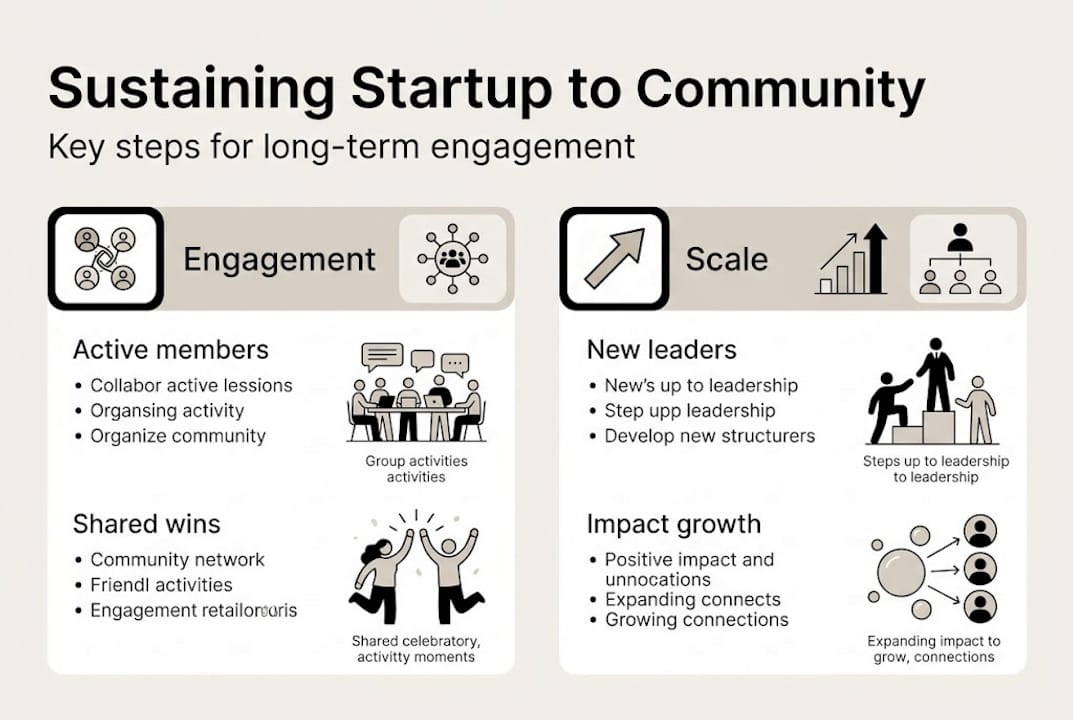
The solution is to track the right metrics and avoid the vanity traps that distort your understanding of community health.
Engagement metrics that actually matter:
- Participation rate: What percentage of members post or comment each week?
- Topics per member: Are conversations distributed, or do three people carry everything?
- Return visit rate: How often do members come back without a prompt?
- Member-generated content: What share of posts comes from non-founders?
- Response time: How quickly do questions get answered by peers?
Total member count is the most seductive and least useful metric. A community of 200 highly active founders creates more value than a group of 2,000 lurkers. Track engagement, not just member count, because community-driven companies grow 5x faster and 92% of people trust peer recommendations, outcomes that only come from genuine interaction.
Research confirms that entrepreneurial networks positively impact SME performance, with social connections improving customer relationships and overall business outcomes. This is not a soft benefit. It’s a measurable growth driver.
Common pitfalls to avoid as your community grows:
- Opening publicly before the culture is established
- Failing to moderate off-topic or promotional content early
- Letting engagement drop without a re-engagement campaign
- Not evolving the content mix as member needs change
When you’re ready to scale, recruit two or three moderators from your most active founding members. They already understand the culture. Promote them publicly, give them clear responsibilities, and treat them as co-owners of the community’s success. For a fuller picture of how community supports entrepreneurial growth, the evidence is consistent: sustained engagement is the engine, and business community benefits compound significantly over time.
A fresh take: Why real startup communities thrive where hype fails
Here’s something most community-building guides won’t say directly: the majority of startup communities that launch with excitement are dead within six months. Not because the founders lacked effort, but because they built around hype instead of relationships.
Hype-based communities attract members with big promises and flashy launches. But hype has a half-life. Once the novelty fades, members leave unless they’re receiving consistent, genuine value from other people, not just from the organizer.
The communities that endure are built on a simple, almost counterintuitive principle: communities create moats that products alone cannot. A competitor can copy your features, your pricing, even your marketing. They cannot copy the trust, inside jokes, shared wins, and mutual accountability that develop inside a well-tended community.
In the current AI era, where products are being replicated faster than ever, this moat matters more than it ever has. Founders who invest in business education and community-building are building something genuinely defensible. The “give first” mentality is not just good ethics. It’s a long-term competitive strategy that compounds in ways a product roadmap simply cannot.
Ready to fast-track your entrepreneurial growth?
Building a startup community from scratch takes clarity, patience, and the right environment to grow. If you’re looking for a structured way to accelerate that journey, Nomad Excel’s online entrepreneurship bootcamp brings together driven founders for hands-on learning, expert mentorship, and a community that stays active long after the program ends. Explore why joining entrepreneurship bootcamps gives founders a measurable edge, and see how a strong mentorship program can compress years of trial and error into focused, accountable growth. Your community starts with the right room.
Frequently asked questions
How do I keep members engaged in a startup community?
Focus on member success stories, regular events, and exclusive content to encourage ongoing participation. A soft launch phase that seeds high-value content before opening publicly sets the tone for sustained engagement.
What are the biggest mistakes to avoid when launching a startup community?
Avoid chasing vanity metrics, building without a clear purpose, and neglecting relationship-building with members. The most durable communities give first for a year or more before shifting toward promotion or monetization.
Do I need a huge audience to start a successful community?
No. Most thriving startup communities began with just 10 to 20 founding members who were personally recruited and deeply engaged before any public launch.
How can joining a community help my startup’s growth?
Startup communities increase trust, provide access to peer recommendations, and help companies grow 5x faster than those building without a network of engaged peers.
Comments are closed.