
Guide to Business Validation for Early-Stage Founders
TL;DR:
- Business validation involves collecting concrete evidence that customers face a genuine problem and are willing to pay for a solution.
- It is essential to use structured tests, including customer interviews, MVPs, and behavioral commitments, to accurately assess market demand before investing heavily.
Business validation is the process of collecting evidence that your target customers have a real problem and will pay for your solution. Without that evidence, you are building on assumptions, and assumptions are expensive. The industry term for this process is market validation, though founders and investors use both terms interchangeably. This guide to business validation walks you through every critical step: mapping your riskiest assumptions, running customer discovery interviews, testing willingness to pay, and designing a structured validation plan that protects your runway and sharpens your decisions before you spend serious money.
What is the business validation process?
Business validation, or market validation, is defined as the systematic gathering of evidence that confirms a real market exists for your idea. Market validation involves interviewing customers, conducting surveys, and running focus groups to prove your business idea has genuine demand. That definition matters because it draws a clear line between gut feeling and proof.
The core insight every founder needs early is this: most failed startups did not fail because they built a bad product. They failed because they built the right product for a problem nobody cared enough to pay to solve. Validation exists to catch that mistake before it costs you everything.
Three tools anchor the business validation process:
- Customer discovery interviews to map real pain points
- Minimum viable products (MVPs) to test solution fit
- Behavioral commitments like pre-orders or deposits to confirm willingness to pay
Each tool answers a different question. Interviews tell you what the problem is. MVPs test whether your solution fits. Pre-orders prove that customers will actually pay. You need all three signals before you can call an idea validated.
How do you identify and prioritize core assumptions?

Every business idea rests on a stack of assumptions. The business validation process starts by naming them and ranking them by risk. A core assumption is any belief your model requires to be true, such as “customers experience this problem weekly,” “they currently spend money solving it,” or “our price point fits their budget.”
The most dangerous assumptions are the ones with the highest impact and the least evidence. Rank yours on two axes: how likely is this assumption to be wrong, and how badly does it break your model if it is? The assumptions that score high on both axes get tested first.
- Customer problem: Do real people experience this pain, and how often?
- Solution fit: Does your proposed fix actually address the root cause?
- Pricing: Will customers pay your target price, or a meaningfully lower one?
- Market segment: Are you targeting the right buyer, or a proxy who will never purchase?
Setting stop/go criteria before you run any test is non-negotiable. A sequenced validation plan is designed to decide whether to keep building, pivot, or stop entirely. Without predefined criteria, you will rationalize weak results and keep spending runway on a flawed idea.
Pro Tip: Write your stop criteria in one sentence before each test. “If fewer than 8 of 15 interviewees confirm this problem is a top-three priority, we pivot the customer segment.” That sentence protects you from sunk-cost thinking.
How do customer discovery interviews confirm real problems?
Customer discovery interviews are the highest-value activity per hour in early-stage validation. Discovery interviews should reach at least 15 target customers before you draw conclusions about consistent problem themes. Fifteen is the threshold because patterns become statistically meaningful and outliers stop distorting your read.
Structuring these conversations well is what separates useful data from noise. Follow this sequence:
- Open with context questions. Ask about their current workflow, not your solution. “Walk me through the last time you dealt with this situation” yields far more than “Would you use a tool that does X?”
- Listen and probe without pitching. Diagnostic questions around urgency and differentiation reveal why customers would buy, when, and from whom. Your job is to understand, not to sell.
- Map the problem space before testing solutions. Discovery interviews map the problem space first, while validation interviews test proposed solution fit. Running them in the wrong order creates premature confidence.
- Capture exact language. The words customers use to describe their pain become your marketing copy. Write them down verbatim.
- End with a referral ask. “Who else do you know who deals with this?” expands your interview pool and signals social proof of the problem’s prevalence.
Discovery interviews and validation interviews serve different purposes. Discovery asks “Is there a real problem here?” Validation asks “Does my solution solve it well enough to pay for?” Confusing the two is one of the most common and costly mistakes early founders make.
Pro Tip: Record every interview with permission and review it twice. The second listen always surfaces signals you missed while talking. Tools like Otter.ai make transcription fast and searchable.
What methods actually prove willingness to pay?
Willingness to pay is the most critical and most commonly faked signal in early validation. Behavioral evidence like money commitments is a stronger signal than verbal interest or hypothetical agreement. Someone saying “I would definitely buy that” costs them nothing. A $50 deposit costs them something real.
The table below shows the difference between warm signals and genuine commitment:
| Signal Type | Example | Strength of Evidence |
|---|---|---|
| Warm (low commitment) | Free email signup | Weak: curiosity, not intent |
| Warm (low commitment) | Social media follow | Weak: interest, not demand |
| Behavioral (real commitment) | Refundable deposit | Strong: financial skin in the game |
| Behavioral (real commitment) | Pre-order with payment | Strong: confirmed purchase intent |
| Behavioral (real commitment) | Signed letter of intent | Strong: documented business commitment |
| Behavioral (real commitment) | Paid pilot or trial | Strongest: real revenue, real feedback |
Landing pages collecting free emails function mainly as warm-up signals rather than proof of willingness to pay. That distinction matters enormously. A waitlist of 500 email addresses feels exciting but proves nothing about price tolerance or actual purchase behavior.
The most effective paid validation methods are:
- Pre-orders with a real payment processor like Stripe or Gumroad
- Refundable deposits that require a credit card on file
- Letters of intent signed by business buyers committing to purchase upon launch
- Paid pilots where early customers pay a reduced rate for early access
Pricing research must be validated with real purchase behavior because initial price sensitivity ranges are hypotheses until tested with actual payment. Run a pricing test alongside your commitment test. Offer two price points to different segments and measure conversion, not just stated preference.
How do you build a structured validation plan?
A structured validation plan sequences your tests from riskiest assumption to least risky, with time and budget constraints that force decisions. Fast, low-cost validation is achievable within a 2–4 week framework and under $200, producing clear scored results across multiple ideas. That timeline is tight by design. Urgency prevents overthinking.
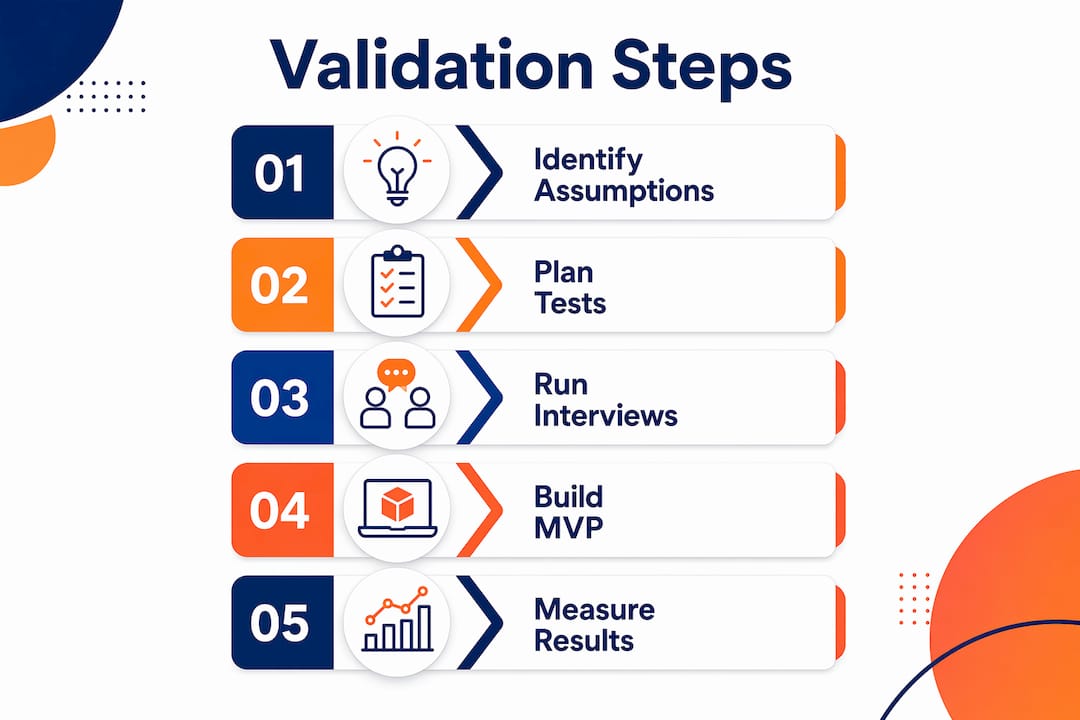
Here is a practical framework for a four-week validation sprint:
| Week | Activity | Goal | Decision Trigger |
|---|---|---|---|
| Week 1 | 15 customer discovery interviews | Confirm problem exists and is painful | 8+ of 15 confirm top-three pain point |
| Week 2 | Landing page with pre-order or deposit | Test willingness to pay at target price | 5%+ conversion on paid commitment |
| Week 3 | 5 validation interviews with solution concept | Test solution fit and pricing tolerance | 3+ express strong purchase intent |
| Week 4 | Paid pilot offer to 3 warm leads | Confirm real revenue is possible | At least 1 paying customer secured |
The Build, Measure, Learn cycle from lean startup methodology underpins this structure. Build a minimal test, measure real outcomes, then decide to pivot or continue. Each week produces a binary decision: the evidence either supports moving forward or it triggers a pivot.
Integrate your startup idea validation checklist into this plan so nothing gets skipped under time pressure. The checklist keeps your process honest when excitement starts overriding evidence.
What are the most common validation mistakes?
Validation mistakes fall into predictable patterns. Knowing them in advance is the fastest way to avoid wasting weeks of effort and thousands of dollars.
- Testing the product before confirming the market. Entrepreneurs often waste runway by testing solutions before validating the actual market problem and customer segment. Build nothing until interviews confirm the problem is real and painful.
- Treating engagement as commitment. Likes, shares, and email signups feel like momentum. They are not evidence of willingness to pay. Only money moves the needle.
- Running validation interviews before discovery. Pitching your solution to customers who have not yet confirmed the problem exists creates false positives. They respond to your framing, not their actual experience.
- Skipping stop/go criteria. Without predefined thresholds, every weak result gets rationalized. You keep building, the runway shrinks, and the pivot comes too late.
- Relying on vanity metrics. Page views, follower counts, and app downloads tell you about reach, not demand. Track conversion rates, payment completions, and repeat engagement instead.
The pattern underneath all these mistakes is the same: founders fall in love with their solution and stop listening to the market. Effective business validation strategies require you to stay genuinely curious and willing to be wrong.
Key takeaways
Disciplined business validation requires behavioral evidence, sequenced tests, and predefined stop criteria to protect your runway and confirm real market demand.
| Point | Details |
|---|---|
| Map riskiest assumptions first | Rank assumptions by impact and evidence gap before designing any test. |
| Run at least 15 discovery interviews | Consistent problem themes only emerge reliably after 15 target customer conversations. |
| Require behavioral commitment | Pre-orders, deposits, and paid pilots prove demand; free signups do not. |
| Sequence discovery before validation | Confirm the problem exists before testing whether your solution fits. |
| Set stop criteria before every test | Predefined thresholds prevent sunk-cost rationalization and protect limited runway. |
Why validation taught me to love being wrong
I used to think the goal of validation was to confirm a great idea. After working with hundreds of early-stage founders, I know the real goal is to disprove a bad one as fast and cheaply as possible. That shift in mindset changes everything.
The founders I have seen succeed fastest are not the ones with the best ideas at the start. They are the ones who treated their first idea as a hypothesis and genuinely wanted the market to challenge it. They ran their idea validation steps with rigor, not theater. They set real stop criteria and honored them even when it hurt.
The uncomfortable truth about validation is that compliments are not data. Customers are polite. They will tell you your idea sounds interesting because they do not want to disappoint you. Only a payment, a signed letter, or a repeat conversation initiated by them tells you something real. Chase those signals relentlessly and ignore everything else.
— Amichai
How Nomadexcel helps you validate faster
Knowing the steps is one thing. Executing them under real pressure, with real accountability, is another. Nomadexcel’s Online Entrepreneurship Bootcamp gives early-stage founders a structured environment to work through every stage of the business validation process with expert mentors and a community of driven peers. You get proven frameworks for customer discovery, willingness-to-pay testing, and MVP design, alongside daily accountability that keeps you moving. If you are ready to stop theorizing and start gathering real evidence, explore upcoming bootcamp dates and take the first concrete step toward a validated, fundable business.
FAQ
What is business validation in simple terms?
Business validation is the process of gathering real evidence that customers have a problem and will pay for your solution. It replaces assumptions with data before you invest significant time or money.
How many customer interviews do i need to validate an idea?
Conduct at least 15 discovery interviews with your target customer segment. That threshold is where consistent problem themes become reliable enough to act on.
What is the difference between discovery and validation interviews?
Discovery interviews map the problem space and confirm pain points exist. Validation interviews test whether your specific solution fits that problem well enough for customers to pay.
Are free email signups enough to validate demand?
No. Free email signups are warm-up signals, not proof of willingness to pay. Pre-orders, refundable deposits, and paid pilots provide the behavioral evidence that real demand exists.
How long should a business validation plan take?
A focused validation sprint can run in 2–4 weeks for under $200. The goal is to test your riskiest assumptions quickly and make a clear go, pivot, or stop decision based on real evidence.
Comments are closed.