
What Is a Leadership Development Program, and Who Needs One?
A leadership development program is a structured, multi-month initiative that prepares current and future leaders for higher-responsibility roles by combining experiential practice, coaching, and measurable outcomes. Most run six to twelve months, sometimes stretching to two years, and they’re built for three overlapping groups: leaders already in the role who need sharper execution, high-potential employees being groomed for what’s next, and organizations trying to build a leadership bench instead of relying on external hires.
Unlike a single workshop, a leadership development program (LDP) unfolds over a sustained stretch of time, typically in one of these formats:
- Cohort-based: a group of participants moves through the same curriculum together, building peer accountability along the way.
- Rotational: participants cycle through different functions or business units to build broad exposure.
- Coaching or mentoring-led: development centers on one-on-one guidance rather than group instruction.
- Blended: combines classroom learning, digital modules, and in-person immersion.
The format matters less than the structure behind it. A real program has goals, assessment, and a way to measure whether it worked.
Key Takeaways
A leadership development program works because it pairs sustained, real-world practice with coaching and clear evaluation checkpoints, not because it delivers information alone.
| Point | Details |
|---|---|
| Structure over duration | An LDP runs 6-24 months and combines training, coaching, mentoring, and stretch assignments, not a single event. |
| Align before you build | Tie the program to a named business priority and secure executive sponsorship before designing curriculum. |
| Practice beats lectures | Coaching frameworks like Assessment-Challenge-Support show experiential practice drives deeper skill retention than instruction alone. |
| Measure at checkpoints | Track 360 feedback and business KPIs at the midpoint and program close, not just at the very end. |
| Match format to the goal | Rotational programs suit broad exposure; cohort and coaching formats suit deeper, targeted development. |
Table of Contents
- What Is Leadership Training Compared to a Full Development Program?
- Why Leadership Development Programs Matter to Organizations
- How to Design a Leadership Program: The Core Components
- Types of Leadership Programs and When Each One Fits
- Who Should Attend, and How to Select Them
- The Core Leadership Skills Every Program Should Teach
- What an Immersive, Execution-Focused Program Looks Like
- Where Most Leadership Programs Undersell Themselves
- Frequently Asked Questions
- Sources
What Is Leadership Training Compared to a Full Development Program?
Here’s where a lot of confusion sets in. “Leadership training” often refers to a single event: a workshop on giving feedback, a seminar on conflict resolution, a one-day session on time management. Useful, sure. But it rarely changes behavior long-term because it doesn’t include repetition, feedback loops, or real-world application.
A leadership development program is different by design. It stretches learning over months, layering formal instruction with lived experience, and it treats leadership as a skill built through practice rather than information absorbed in a single sitting. According to the Yale CDO’s overview of LDP structures, many corporate programs use rotational assignments and structured mentoring cycles precisely because one-time training doesn’t stick without ongoing reinforcement.
A well-built program typically includes:
- Formal training modules that introduce frameworks for communication, decision-making, and strategic thinking.
- Experiential assignments where participants apply what they’ve learned to real projects, not simulations.
- One-on-one coaching that helps individuals process feedback and adjust behavior in real time.
- Mentoring relationships with more senior leaders who model the behaviors being taught.
- Executive exposure, such as shadowing senior leadership or presenting to decision-makers.
There’s also a subtler distinction worth understanding: developing individual leaders versus building a leadership system. Some programs focus narrowly on making ten people better managers. Others aim to create a repeatable pipeline, a system that consistently produces capable leaders year after year, regardless of who’s in the cohort. The strongest organizations eventually need both, but conflating the two goals inside a single program is one of the more common design mistakes.
Why Leadership Development Programs Matter to Organizations
The business case comes down to risk. Every organization eventually loses a leader, whether through promotion, retirement, or resignation, and the question is whether someone internal is ready to step in.
BetterUp’s research on leadership pipelines points to a clear pattern: organizations that invest in leadership development reduce their dependence on external hires, which tend to carry higher costs and higher failure rates than internally promoted leaders who already understand the culture and the business.
That case rests on four pillars:
- Succession planning. Programs identify and prepare successors before a role opens up, not after.
- Retention. High-potential employees who see a clear development path are less likely to leave for a competitor.
- Capability building. Structured practice closes the gap between “good individual contributor” and “effective leader,” which are not the same skill set.
- Culture reinforcement. Programs that teach specific leadership behaviors help standardize how decisions get made across the organization, not just at the top.
Statistic Callout: External hires for leadership roles routinely carry more risk and higher cost than internal promotions groomed through a structured development program, largely because internal candidates already understand the business context an outsider takes months to learn.
None of this happens automatically. A program without clear goals or sponsorship tends to drift into a checkbox exercise, which is exactly why the next section matters.
How to Design a Leadership Program: The Core Components
Every effective program follows a similar backbone, whether it’s built for ten people or two hundred. Skip a step and you’ll likely feel it later, usually around month six when nobody can explain what the program actually changed.
Alignment and sponsorship. Before you build curriculum, connect the program to a specific business priority: closing a succession gap, reducing turnover in a certain role, preparing for expansion into a new market. Programs that lack a named executive sponsor tend to lose funding and attention the moment budgets tighten. According to Hyring’s breakdown of program design, many failed LDPs trace back to exactly this: no clear tie to business outcomes and no one senior enough invested in the result.
Setting measurable goals. Define what success looks like before you launch. That might mean a target percentage of internal promotions within eighteen months, a specific engagement score lift, or a reduction in time-to-fill for leadership vacancies.
Assessment and selection. This is where you decide who participates and how you’ll measure their starting point. Common tools include:
- 360-degree feedback, gathering input from peers, direct reports, and managers
- Personality and behavioral assessments to surface working styles and blind spots
- Manager nominations paired with self-application, to avoid missing quieter high performers
Development methods. This is the heart of the program, and it’s where the Assessment-Challenge-Support coaching framework proves useful: challenge participants with real stretch work, but pair it with enough support that they don’t just fail quietly. Cohort learning, one-on-one coaching, structured mentoring, and action learning projects all belong here, layered rather than chosen one at a time.
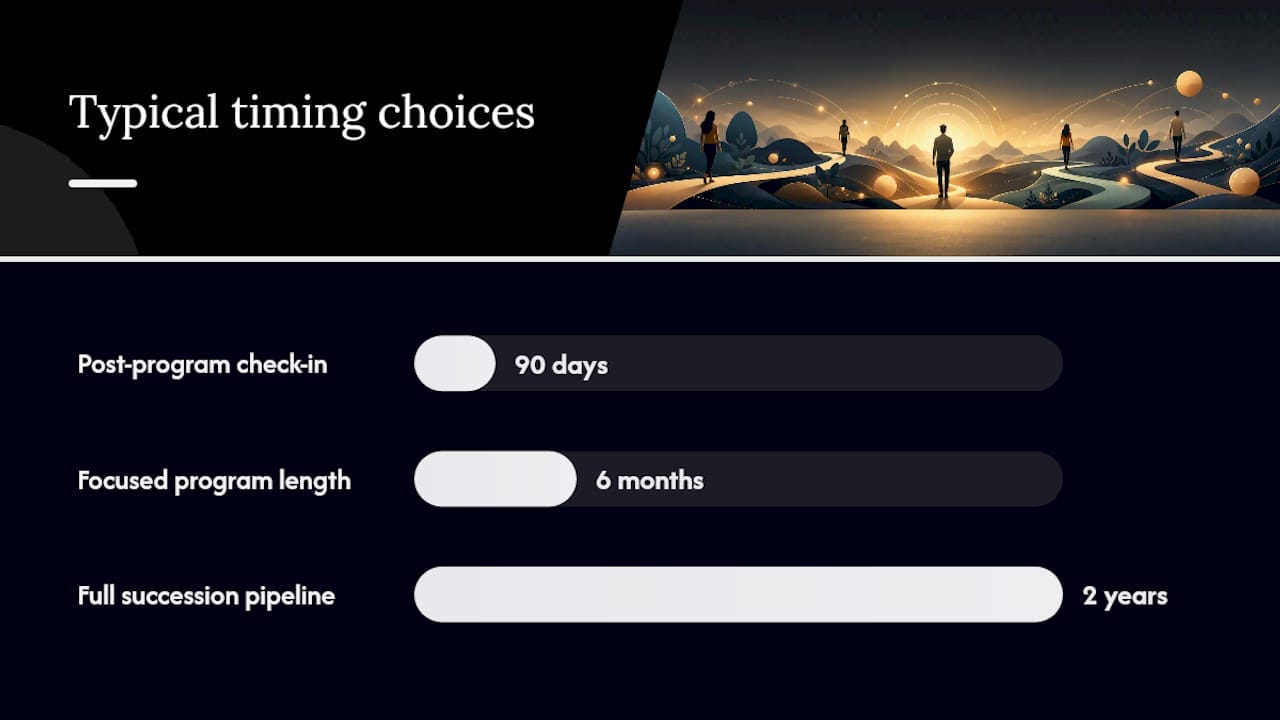
Implementation choices. Decide on timeline (six months for a focused skills push, up to two years for a full succession pipeline), cohort size (smaller groups allow deeper coaching; larger cohorts scale cost-efficiently), and delivery mix (in-person immersion versus blended digital modules).
Evaluation. Track both participant-level progress (skill assessments, 360 feedback retaken at the midpoint and end) and business-level KPIs (promotion rates, retention, engagement scores). Programs that skip formal evaluation often can’t justify renewed budget the following year, according to Deel’s glossary breakdown of LDP structure.
Pro Tip: Build your evaluation checkpoints into the calendar before the program starts, not after. A midpoint 360 review and a 90-day post-program check-in catch problems early enough to actually fix them, rather than surfacing issues only in a year-end report nobody acts on.
| Design Stage | What It Involves | When to Prioritize It |
|---|---|---|
| Alignment | Tie the program to a named business priority and secure a senior sponsor | Before any curriculum is built |
| Assessment | Use 360 feedback, behavioral assessments, and nominations to select participants | During intake, 4-6 weeks before launch |
| Development | Combine coaching, mentoring, cohort learning, and stretch assignments | Throughout the 6-24 month program |
| Evaluation | Track skill progress and business KPIs at defined checkpoints | Midpoint and program close |
You can outsource pieces of this, tools like ClickCoach’s accountability software help track coaching engagements and progress between sessions, but the design decisions above have to come from inside the organization.
Types of Leadership Programs and When Each One Fits
Not every organization needs the same shape of program. The right format depends on what problem you’re actually solving.
- Rotational programs move participants through multiple departments or business units over 12-24 months. Common in banking, manufacturing, and energy, these work best when you need leaders with broad cross-functional fluency, not just deep expertise in one area.
- Cohort-based programs group participants together for a shared curriculum over 6-12 months. They scale well and build peer networks, making them a strong fit for mid-sized companies developing multiple leaders at once.
- Coaching and mentoring-focused programs center on individualized one-on-one relationships rather than group instruction. These fit best when you’re developing a small number of senior leaders or addressing specific, personal skill gaps.
- Action learning programs assign participants to solve a real business problem over the program’s duration, often 3-9 months, learning leadership skills through the work itself rather than through separate instruction.
Most mature organizations eventually blend two or three of these rather than picking just one.
Who Should Attend, and How to Select Them
Deciding who gets a seat is as important as designing the curriculum itself. Broad leadership upskilling, open to any manager who wants it, builds baseline capability across the organization. Targeted high-potential programs concentrate resources on a smaller group being groomed for specific senior roles. Both have a place, and many organizations run both simultaneously at different levels.
Good selection criteria tend to include:
- Demonstrated performance in the current role, not just tenure
- Genuine aspiration for more responsibility, not just willingness
- Coachability, meaning openness to feedback rather than defensiveness
- Mobility, both geographic and functional, if the role requires it
Watch selection processes closely for equity gaps. Manager-only nomination systems tend to favor people who are already visible, often missing strong candidates in quieter roles. Pairing manager nominations with open self-application tends to surface a more representative pool.
The Core Leadership Skills Every Program Should Teach
Most competent programs converge on a similar core, even when the delivery format differs wildly.
The Center for Creative Leadership frames it as the “Fundamental 4”: self-awareness, communication, influence, and learning agility. These aren’t advanced skills reserved for executives. They’re baseline capabilities worth building at every career stage, from first-time manager to senior vice president.
Beyond that foundation, strong programs also prioritize:
- Strategic thinking, connecting daily decisions to longer-term business direction
- Coaching others, since most leaders are eventually responsible for developing their own teams
- Change leadership, guiding people through ambiguity rather than just managing steady-state operations
Statistic Callout: Programs built around the Fundamental 4 framework treat self-awareness, communication, influence, and learning agility as skills to revisit at every promotion, not milestones you check off once.
How do programs actually build these skills instead of just naming them? Through repeated feedback cycles, role-play scenarios that simulate difficult conversations, and stretch assignments that force participants to apply a skill under real pressure, with a coach or mentor helping them process what happened afterward.

What an Immersive, Execution-Focused Program Looks Like
Classroom theory only goes so far. At Nomadexcel, leadership development happens through immersive bootcamps and company retreats that combine hands-on workshops, direct mentorship, and daily accountability rather than lecture-based instruction.
The gap between knowing a leadership concept and applying it under real pressure is where most training fails. Immersive formats close that gap by putting people inside live business problems, with mentors and peers present for the messy middle, not just the polished takeaway.
Participants in this kind of format typically walk away with:
- Sharper strategic clarity on the specific challenge they came in with
- Practiced execution skills built through daily sprints, not one-time exercises
- An active peer network that continues supporting their growth after the program ends
… The format works because it treats leadership as something built through repeated, structured action, similar to how structured mentorship accelerates growth in one-on-one settings, just compressed into an intensive, shared experience.
Where Most Leadership Programs Undersell Themselves
The conventional advice on leadership development leans heavily on curriculum: pick the right competency model, sequence the right modules, hire the right facilitator. That’s not wrong, but it’s incomplete. The research is fairly consistent on one point that gets underweighted: reflection and lived practice outperform lecture-based instruction almost every time. A program can have a flawless syllabus and still produce nothing if participants never apply what they learn under real stakes.
The bigger failure point isn’t curriculum design. It’s the absence of sustained, on-the-job practice paired with honest feedback. Organizations love the assessment phase, it feels rigorous and data-driven, but they underinvest in the messy middle: the stretch assignment that might fail, the coaching conversation that requires real vulnerability. That’s exactly where intensive, execution-focused formats earn their keep, because they force practice instead of just describing it.
If you’re building or evaluating a program, prioritize the practicum over the syllabus. Ask what participants will actually do differently in week three, not just what they’ll learn in week one. The skill sticks when it’s tested, not when it’s explained.
Frequently Asked Questions
What is a leadership development program in simple terms?
It’s a structured, multi-month initiative that builds leadership capability through a mix of training, coaching, mentoring, and real-world assignments, rather than a single workshop or seminar.
How long does a typical leadership training program last?
Most run six to twelve months, though rotational and succession-focused programs can extend to 24 months depending on the scope of roles being developed.
What are the main benefits of leadership programs for a company?
The core benefits are succession readiness, stronger retention among high-potential employees, improved execution of strategy, and reduced reliance on costly external hires.
How do you measure the impact of a leadership development strategy?
Combine participant-level metrics, like 360 feedback retaken at set intervals, with business KPIs such as internal promotion rates, engagement scores, and retention among program graduates.
What’s the difference between leadership training and a full development program?
Training is usually a single event covering one skill. A development program stretches learning over months, layering formal instruction with coaching, mentoring, and applied projects so skills actually stick.
Ready to see what an immersive, execution-focused approach to leadership growth looks like in practice? Explore Nomadexcel’s entrepreneurship bootcamp to find a format built around real accountability instead of theory alone.
Sources
- The six principles of leadership coaching — CCL
- Leadership Development Programs (LDP) 101 — Yale CDO blog
- Leadership Development Program: What It Is and How to Build One
- What Is a Leadership Development Program and Why Do You Need One? — BetterUp
Comments are closed.