
Why Invest in Leadership Development: Impact on Growth
Every tech startup reaches a point where traditional ideas about leadership fall short. The belief that leaders are simply born or that a single workshop can transform a manager often leads to disappointment and wasted resources. In truth, leadership development is a dynamic process shaped by real-world challenges, feedback, and team culture. Unpacking these common myths and understanding what truly works will help your startup build resilient leaders who drive genuine alignment and measurable growth.
Table of Contents
- Defining Leadership Development And Common Myths
- Types Of Leadership Development Approaches
- Key Benefits For Teams And Organizations
- Quantifying ROI And Business Impact
- Pitfalls To Avoid And Best Practices
Key Takeaways
| Point | Details |
|---|---|
| Continuous Leadership Development | Effective leadership requires ongoing practice and feedback, not just one-time workshops. Engaging in real-world challenges fosters genuine improvement. |
| Myth of Born Leaders | Leadership can be developed in anyone with the right support and training. This belief expands the pool of potential leaders within an organization. |
| Distributing Leadership | Organizations should aim to distribute leadership across teams, enhancing resilience and collective decision-making capability. |
| Measuring Impact | It is essential to track metrics related to leadership development to assess its effectiveness and ensure a return on investment. |
Defining Leadership Development and Common Myths
Leadership development isn’t what most people think it is. When you hear the term, you might imagine a one-off training day where a consultant flies in, delivers an inspiring speech, and everyone leaves thinking they’ve been transformed. But that’s not how it works in real life. Leadership development is actually about a continuous process of enhancing your capabilities as a leader through feedback, real-world challenges, and intentional practice over time. It’s messy, context-specific, and deeply tied to your actual business environment.
The gap between perception and reality here matters enormously for your startup. According to leadership development research, the evidence shows that one-off training sessions don’t stick. Your team learns leadership through doing it, getting feedback, adjusting, and doing it again. This is where most tech startups get it wrong. They send their new managers to a weekend workshop, check the box, and wonder why nothing has changed back at the office. Real development happens in the ongoing conversations, the mistakes you recover from, and the patterns you build over months.
Another critical myth you’ll want to discard: the idea that leaders are simply born with special traits. You’ve probably heard someone say “he’s just a natural leader” or “some people just have it.” This misconception persists across most organizations, but it limits your thinking about who can develop into strong leaders. The truth is that leadership is a socially constructed, collective process shaped by your company culture, team dynamics, and how you develop your people. That quiet engineer who seems reserved might become your best technical leader when given the right development and support. The key insight here is that you’re not discovering born leaders. You’re building them.
The most dangerous myth, especially in startup environments, is the “big-hero” narrative where you believe one charismatic founder or executive carries all the leadership weight. This creates fragility in your organization. When one person holds all the decision-making power and leadership capability, your team becomes dependent rather than capable. Real leadership development distributes capability across your organization. It builds a team where multiple people can step into difficult situations, make decisions, and move things forward. This shift from lone heroes to distributed leadership is what actually scales companies.
Pro tip: Start by auditing which leadership myths are embedded in your current hiring and promotion decisions. Are you promoting people because they “seem like natural leaders,” or are you developing capabilities systematically and seeing who grows into leadership roles with support?
Here’s a summary of common myths versus the realities of leadership development:
| Myth | Reality | Impact on Startups |
|---|---|---|
| Leaders are born | Leadership is learned through practice | Enables all employees to develop as leaders |
| One-time training works | Ongoing development is required | Sustains growth and team improvement |
| Lone hero leadership | Leadership should be distributed | Builds resilience and decision-making capacity |
Types of Leadership Development Approaches
There’s no single pathway to developing strong leaders, and trying to use one-size-fits-all methods in your startup will backfire. Different approaches work for different people, different contexts, and different leadership challenges. The most effective organizations combine multiple methods rather than betting everything on one approach. Understanding your options helps you build a development strategy that actually fits how your team learns and grows.
The main categories you’ll encounter include formal training programs, which typically involve structured workshops, certifications, or leadership academies. These work best when they’re targeted and relevant to your immediate business challenges. You might run a workshop on difficult conversations when your managers are struggling with performance feedback, for example. Then there’s coaching and mentoring, which is one-on-one guidance from someone more experienced. In a startup context, this might look like pairing your new engineering lead with your CTO, or bringing in an external executive coach to help your founder navigate scaling decisions. The advantage here is personalization; coaching addresses your specific situation rather than generic material.
Experiential learning and action learning form another critical category. Different leadership development approaches vary significantly in their methodology and outcomes, but the ones that stick are those grounded in real work. This is where you learn by actually doing the thing, then reflecting on it. Running a product sprint, launching a new market, or reorganizing your team structure becomes a leadership development opportunity when you build in reflection time. Your team learns leadership by facing actual problems, making decisions, and discussing what worked and what didn’t. This is why Nomad Excel’s retreats focus on real business challenges and execution; learning happens through doing, not watching slides.
The research also highlights the power of hybrid models that blend formal and informal learning. Experiential components, reflection, and social interaction create lasting change in leadership capabilities. Your startup probably can’t afford to send everyone to expensive leadership academies, but you can create a culture where people learn from each other, where mistakes become teaching moments, and where you regularly step back to reflect on how you’re leading. Mix a quarterly offsite focused on team alignment with ongoing peer mentoring. Combine a workshop on delegation with monthly one-on-ones where managers practice what they learned. The combination is what creates real transformation.
Pro tip: Start with action learning by identifying your most pressing leadership challenge right now, then build development around solving that actual problem with reflection and feedback woven in. This is far more effective than generic training that never connects to your real work.
This table compares core leadership development approaches and their typical business outcomes:
| Approach | Best For | Unique Benefit | Business Impact |
|---|---|---|---|
| Formal Training | New managers | Structured skill-building | Faster ramp-up on basics |
| Coaching & Mentoring | Emerging leaders | Personalized guidance | Better problem-solving capacity |
| Experiential Learning | All levels | Real-world practice | Accelerated adaptation to change |
| Hybrid Model | Teams | Combines methods | Long-term capability growth |
Key Benefits for Teams and Organizations
Investing in leadership development isn’t an expense you absorb and hope for the best. It’s a strategic move that directly impacts your bottom line through measurable improvements across your entire organization. When your leaders develop their capabilities, the effects ripple through every part of your business, from how decisions get made to how your team responds to unexpected challenges.
The most obvious benefit is improved team performance. Better leaders create environments where people do their best work. They set clearer expectations, provide more useful feedback, and make decisions that actually move the business forward. Well-developed leaders foster better decision-making climates and boost innovation, which means your teams solve problems faster and adapt to market changes more quickly. In a startup context, this is everything. You can’t afford sluggish decision-making or teams stuck in analysis paralysis. Strong leadership creates momentum.

Then there’s employee engagement and retention, which directly affects your ability to scale. People don’t leave bad jobs because they’re bored. They leave because their leaders don’t develop them, don’t believe in them, or don’t create a sense of purpose around the work. Developed leaders build cultures where people feel invested in the mission, where they see a path forward, and where they know their growth matters. This reduces costly turnover and builds institutional knowledge. Your team members stay longer, perform better, and become stronger leaders themselves over time.
Organizational agility is another critical outcome, especially for tech startups operating in fast-moving markets. Leadership development leads to more adaptive teams and greater resilience that can handle the complexity and uncertainty you face daily. When multiple people on your team have developed leadership capabilities, you’re not dependent on one person to navigate crises or major pivots. You have a bench of people who can step up, make tough calls, and move things forward. This resilience compounds as your company grows and faces inevitable disruptions.
Beyond these direct benefits, leadership development creates cultures aligned with your values and goals. A well-developed leadership team doesn’t just execute your strategy; they live your values and make decisions that reinforce them. This builds trust internally and externally, attracts the right people, and creates competitive advantage through cultural coherence that’s hard to replicate.
Pro tip: Track three specific metrics before and after leadership development: team engagement scores, time to decision on key initiatives, and employee retention rates in your leadership pipeline. These concrete numbers will show you exactly where your investment is paying off and where you need to double down.
Quantifying ROI and Business Impact
Here’s the uncomfortable truth: most companies invest in leadership development without actually measuring whether it worked. They send managers to a retreat, feel good about it for a week, then wonder why nothing changed. You can’t manage what you don’t measure. If you’re going to invest time and resources into developing your leaders, you need a framework for tracking the impact, or you’re flying blind.
The challenge is that isolating leadership development effects isn’t straightforward. Your team’s improved performance comes from multiple factors: market conditions, product improvements, hiring better people, and yes, leadership development. But that doesn’t mean you throw up your hands and measure nothing. Sustained development correlates positively with improved financial performance, productivity, and employee retention, and you can capture these metrics directly. Start by establishing baseline measurements before any development work begins. Track team engagement scores through surveys, measure time to decision on key business initiatives, monitor employee turnover rates in your leadership pipeline, and record productivity metrics relevant to your business.
A practical approach uses multiple measurement layers. First, immediate learning outcomes: Did people actually absorb the content? Use 360-degree feedback, pre and post-program assessments, and direct observation of behavioral changes. Your managers might come back from a retreat talking about delegation differently, actually delegating more, and seeing their teams take on more ownership. That’s observable. Second, business outcome tracking: Link leadership development to concrete business results. If you ran a program on scaling communication, measure whether decision-making velocity improved or whether cross-team collaboration increased. If you focused on retention, track whether your leadership team members stay longer than before. Third, link leadership development activities to strategic organizational goals using data analytics to demonstrate meaningful ROI. This means connecting the dots between a specific development initiative and a measurable business outcome.
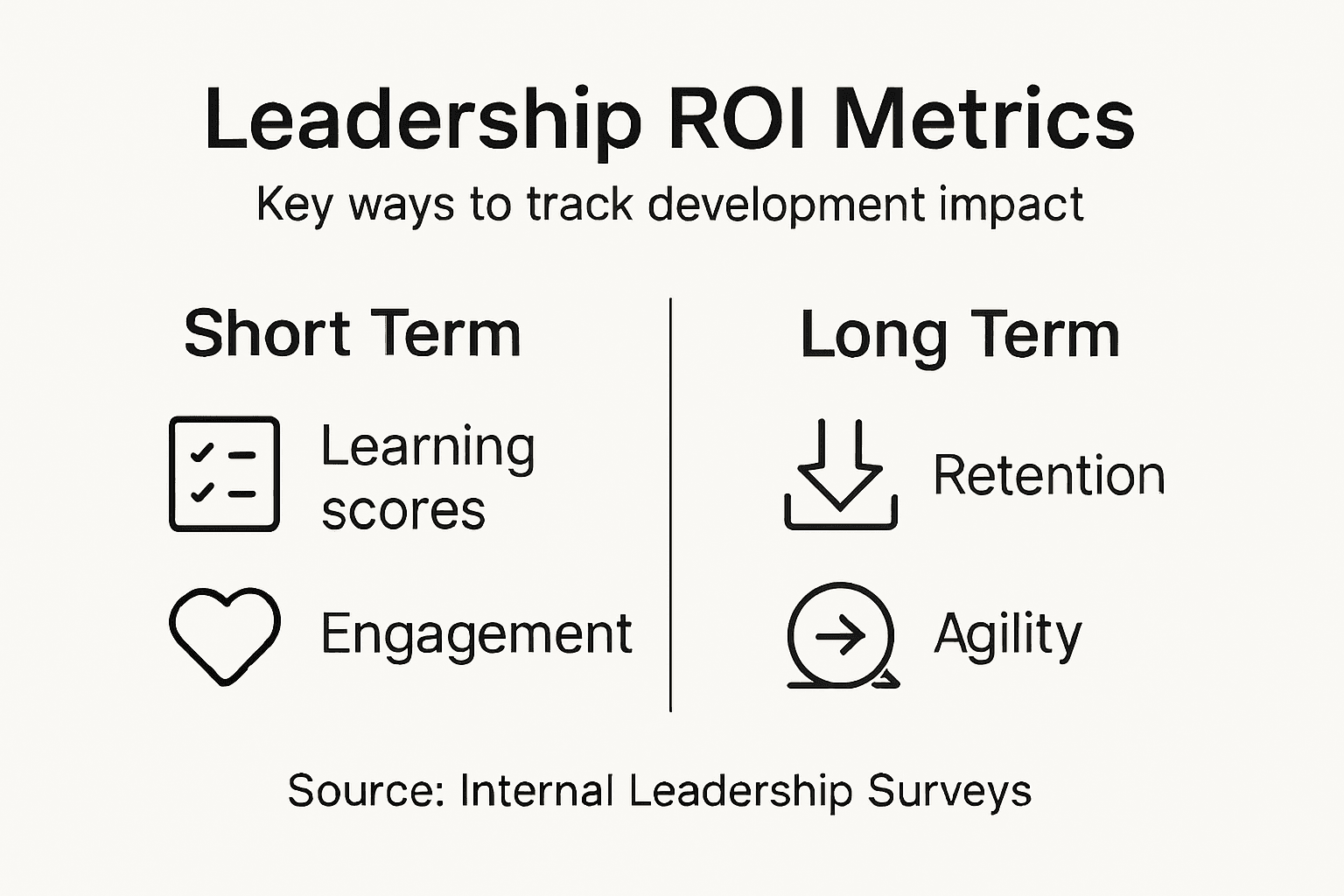
For your startup, think in terms of concrete numbers. If your engineering retention improved by 15 percent after your technical leads went through leadership development, calculate the cost savings from reduced hiring and onboarding. If decision-making speed improved and you launched a new market 4 weeks faster, what’s the revenue impact? If your sales team increased performance by 12 percent after your sales leader developed their coaching skills, what additional revenue did that generate? These calculations turn soft skills into hard business value. You don’t need perfect precision. You need directionally accurate numbers that show your investment is paying off. Track these metrics quarterly so you can adjust your approach based on what’s actually working.
Pro tip: Create a simple one-page dashboard tracking four metrics: engagement scores, retention of your leadership bench, time to critical decisions, and the specific business outcome your development program targets. Review it quarterly to see if development is moving the needle, and adjust your approach if it’s not.
Pitfalls to Avoid and Best Practices
Most leadership development fails not because the concept is flawed, but because organizations make predictable mistakes in execution. You can avoid these traps if you know what to watch for. The biggest mistake is treating leadership development like a checkbox exercise. You bring in a consultant, run a program, and assume the work is done. But leadership development is not an event. It’s a process. Without ongoing support, reinforcement, and accountability, people revert to their old patterns within weeks. The temporary enthusiasm fades, and you’re left with an expensive experience that changed nothing.
Another critical pitfall is the one-size-fits-all approach. Your senior engineering leader needs different development than your sales manager, who needs something different than your operations director. Generic programs miss the mark for everyone. What works is designing development that addresses the specific skills and contexts your leaders actually face. If your engineering team is struggling with delegation, that’s what you develop. If your sales leaders need better coaching skills for a distributed team, that’s what you build. Common pitfalls include lack of alignment with business strategy and inadequate ongoing support, so anchor everything to your actual business challenges.
The best practice here is embedding leadership development into your organizational culture rather than treating it as a separate initiative. This means your leaders see development as part of how you operate, not something that happens occasionally. It means you have leadership sponsorship from your founders or executive team who actively participate in and reinforce development. It means you create space for reflection and learning in your regular rhythm. When you run a company retreat or offsite, you’re not just solving immediate problems. You’re developing your leaders through real challenges, reflection, and feedback.
Another best practice that gets overlooked: integrate multiple learning methods and encourage reflective practice rather than relying only on formal programs. Some people learn through experience and reflection. Others learn through peer discussion. Still others need structured input first. The most effective development blends all of these. You might run a workshop on delegation, then have your managers practice it with their teams, then discuss what happened in peer groups, then reflect individually on what they learned. That multi-layered approach sticks.
Also don’t neglect the social and cultural dimensions of leadership. Leadership doesn’t exist in isolation. It’s deeply shaped by your team dynamics, your company culture, and how people actually interact day to day. Development that ignores this context will fail. Finally, ensure your evaluation mechanisms actually work. Track whether your development is creating the changes you aimed for, and adjust based on what you learn. If something isn’t moving the needle after six months, stop doing it and try something different.
Pro tip: Before launching any leadership development initiative, get your executive team aligned on what success looks like and what ongoing support they’ll provide after the program ends. Without executive commitment to reinforcement, even great programs fail to stick.
Unlock Leadership Growth with Real Impact and Lasting Change
If you’ve read about the myths and realities of leadership development you know that one-off workshops and vague training do not create lasting transformation. Your startup needs leadership growth embedded in real challenges with ongoing reflection and support. The toughest pain points often come from trying to develop leaders without a clear strategy or measurable impact. You want to build leadership capability that boosts team performance, employee engagement, and organizational resilience while ensuring leaders truly grow through experience.
Nomad Excel helps you move beyond generic programs by offering immersive opportunities to develop leadership in action. Explore our Program Archives to discover bootcamps and company retreats designed to focus on your exact business challenges and leadership goals. With a mix of mentorship, community, and execution-driven learning, your team will cultivate the skills needed to lead with confidence and agility.
Ready to transform leadership myths into real business growth? Visit Nomad Excel and start your journey with insights from our Entrepreneurship Archives. Don’t wait to build the leadership culture that your startup deserves. Take action now and unlock the lasting impact leadership development promises.
Frequently Asked Questions
What is leadership development?
Leadership development is a continuous process of enhancing leadership capabilities through feedback, real-world challenges, and intentional practice over time, rather than just one-off training sessions.
Why is ongoing leadership development essential for startups?
Ongoing leadership development helps cultivate capable leaders, creates a culture of growth, and enhances decision-making, which is crucial for the fast-paced environment of startups.
How can we effectively measure the impact of leadership development?
To measure impact, establish baseline metrics before development, track improvements in team engagement scores, time to decision on key initiatives, and employee retention rates within the leadership pipeline.
What common myths about leadership development should organizations avoid?
Organizations should avoid the belief that leaders are born, that one-time training is sufficient, and that lone hero leadership is effective. Instead, leadership development should focus on learning through practice and supporting a collaborative approach.
Comments are closed.