
Lean Startup: Unlocking Rapid, Validated Growth
Launching a new venture often feels like you are stepping into the unknown, but the lean startup methodology offers founders a proven way to cut through uncertainty. Instead of sinking time and resources into plans based on guesswork, lean startup centers on validated learning through rapid experimentation and real customer feedback. For entrepreneurs, this approach means quickly testing ideas, adjusting when needed, and scaling what works, creating a clear path toward meaningful growth in any market.
Table of Contents
- Lean Startup: Core Definition And Myths
- Build-Measure-Learn Loop Explained
- Types Of Pivots And Business Adaptation
- Minimum Viable Product (MVP) Process
- Risks, Common Missteps, And Alternatives
Key Takeaways
| Point | Details |
|---|---|
| Lean Startup Methodology | Focuses on rapid experimentation and validated learning to minimize risks and assumptions in building a new venture. |
| Build-Measure-Learn Loop | A continuous cycle that enables startups to quickly test hypotheses, gather customer feedback, and iterate products efficiently. |
| Pivots as Strategic Adjustments | Pivots are necessary course corrections based on data, not signs of failure, helping startups adapt their business models effectively. |
| Risks and Missteps | Understanding sector-specific challenges and maintaining rigorous experimentation practices are crucial for the successful application of lean startup principles. |
Lean startup: Core definition and myths
The lean startup methodology is a systematic approach designed to help founders navigate the uncertainty that comes with building a new venture. Rather than spending months planning in isolation, lean startup emphasizes rapid experimentation, validated learning, and customer feedback over assumptions. At its core, the method works by formulating hypotheses about your business model, releasing a minimum viable product (MVP) to test those hypotheses in the real world, and iterating based on what you learn from actual customers.
What makes lean startup different from traditional business development is its focus on speed and efficiency. Instead of investing massive amounts of capital before proving market demand, you release a stripped-down version of your product early. This could be a landing page with a signup form, a basic prototype, or even a manual service that later becomes automated. The goal is simple: validate your assumptions quickly and cheaply. By doing this, you reduce the risk of building something nobody wants and get to profitable operations faster. Research shows that validated learning through iterative experiments is central to the methodology’s effectiveness.
Here’s a summary comparing Lean Startup with Traditional Startup approaches:
| Aspect | Lean Startup Approach | Traditional Startup Approach |
|---|---|---|
| Planning Timeline | Short, iterative cycles | Long, upfront business plans |
| Product Development | Minimal viable product first | Complete solution before launch |
| Use of Feedback | Rapid, ongoing with users | Limited, often after launch |
| Risk Management | Tests early, adapts quickly | High upfront investment risk |
| Resource Allocation | Efficient, low initial spend | High capital commitment early |
| Focus | Validated learning | Assumption-based planning |
However, lean startup has been surrounded by misconceptions that often lead founders astray. The most damaging myth is that it’s a one-size-fits-all approach that works equally well for every startup, industry, and founder. Some founders treat it as a rigid formula, believing they must always build an MVP first or follow a strict process regardless of their context. Others assume lean startup means launching without a strategy or that perfectionism is forbidden. Reality is more nuanced. Lean startup provides a framework for reducing uncertainty, but how you apply it depends on your market, resources, team experience, and whether you’re in a regulated industry. A biotech startup building medical devices cannot operate the same way as a software startup. A bootstrapped founder faces different constraints than one with institutional funding. Your growth strategy needs to adapt lean principles to your specific context, not the other way around.
Another widespread misunderstanding is confusing lean startup with having no vision or direction. Lean startup is not about being directionless or changing your core mission every week based on user feedback. It’s about maintaining clear strategic goals while remaining flexible about how you reach them. You test your assumptions systematically, learn from the data, and adjust your tactics accordingly. The core vision stays intact; what changes is the path you take to get there.
Pro tip: When you begin, identify your three most critical assumptions about customers, market demand, and revenue potential, then design the cheapest, fastest experiments to test each one before committing significant resources.
Build-Measure-Learn loop explained
The Build-Measure-Learn loop is the engine that drives lean startup methodology. It’s a continuous cycle where you build a minimum viable product, measure how customers respond to it, and learn from that data to decide your next move. This isn’t a one-time process. You complete the cycle, then do it again with what you learned. And again. And again. Each rotation gets you closer to product-market fit while minimizing wasted time and resources.
Here’s how the loop actually works in practice. In the Build phase, you create the simplest version of your product that lets you test your core hypothesis. This isn’t about perfection. A landing page that describes your solution and captures email signups can be a valid MVP. A spreadsheet-based service that you manually operate counts too. The goal is to get something real in front of customers as fast as possible. Next comes the Measure phase. You release your MVP and track what happens. Are people signing up? Using the feature? Paying for it? Do they abandon after the first interaction? You’re collecting hard data on customer behavior, not opinions. Finally, in the Learn phase, you analyze what the data tells you. Did your hypothesis hold up? What surprised you? Based on these insights, you decide whether to pivot or persevere. Pivoting means changing your strategy fundamentally, perhaps targeting a different customer segment or solving a different problem. Persevering means you were right and you double down on what’s working.

What makes this loop powerful for early-stage founders is speed and cost efficiency. Traditional product development locks teams into months of planning and building before getting any real customer feedback. By then, you’ve spent significant resources on assumptions that might be completely wrong. The Build-Measure-Learn loop compresses this timeline dramatically. You test assumptions weekly or even daily instead of quarterly. This approach also prevents the feature bloat trap, where you build dozens of features thinking customers want them, when actually they want something simpler or entirely different. Each cycle focuses on learning one specific thing, so you stay disciplined and avoid building guesses into your product.
The loop works best when you embrace the concept of rapid iterative feedback and treat each cycle as a contained experiment. This means setting a clear hypothesis before you build, deciding upfront what success looks like in the measure phase, and committing to learning from the data even if it contradicts what you hoped would happen.
Pro tip: Set a time box for each loop (usually 1-2 weeks for early stage), measure one primary metric that matters most to your hypothesis, and always document what you learned before starting the next cycle.
Types of pivots and business adaptation
A pivot is not failure. It’s a structured course correction based on real data from your experiments. When your Build-Measure-Learn loops reveal that your current path isn’t working, pivoting lets you redirect toward a better business model without starting from zero. The key difference between pivoting and randomly changing direction is that pivots are deliberate, hypothesis-driven adjustments informed by what you’ve learned from customers.
There are ten recognized pivot types, each addressing different aspects of your business. A customer segment pivot means you keep your product the same but target a completely different group of users. You built project management software for freelancers, but data shows teams at small agencies actually love it more. You pivot to focus on agencies instead. A channel pivot changes how you reach customers. You’ve been trying to sell directly to customers but discovering that partnerships with consultants who recommend your solution works far better. A technology pivot switches your underlying technology while keeping your core solution the same. You built a web app, but users keep asking for mobile access, so you pivot to prioritize mobile development. Other common pivots include feature pivots (emphasizing different aspects of your product), pricing pivots (changing your monetization model), and growth pivots (using a different mechanism to acquire customers).
Here’s a quick reference on common Lean Startup pivot types and their purpose:
| Pivot Type | What Changes | When to Use |
|---|---|---|
| Customer Segment | Target audience is refocused | When new group shows higher demand |
| Channel | Distribution method is altered | When another path reaches users |
| Technology | Underlying tech is replaced | When user needs shift platform |
| Feature | Core feature emphasis changes | When some features show more value |
| Pricing | Monetization model is changed | When current pricing stalls growth |
| Growth | Acquisition strategy is revamped | When current growth flattens |
What triggers a pivot decision? Usually, your metrics plateau or decline despite your efforts. Conversion rates stall. Customer acquisition cost climbs beyond what customers pay you. Usage drops off after the first week. Pivot triggers emerge from the data, not from frustration or boredom. This is crucial for founders at bootcamps. You might feel emotionally attached to your original idea, but pivot decisions represent critical strategic changes based on unforeseen circumstances or learning from experiments. The best founders separate their ego from their business model and move quickly when the data suggests a different direction.
Pivoting efficiently requires discipline. Set clear metrics before you launch. Know upfront what numbers indicate you should pivot versus persevere. When data shows your hypothesis was wrong, pivot decisively and quickly. Don’t spend three months slowly shifting direction while bleeding cash. Rapid pivots keep you from wasting runway on ideas that won’t gain traction.
Pro tip: Before launching, define three metrics that would trigger a pivot decision within 4 weeks, then commit to making the pivot immediately if those metrics hit their thresholds.
Minimum viable product (MVP) process
Building an MVP is where lean startup theory meets reality. An MVP is the simplest version of your product that lets you test your core hypothesis with real customers. Not a fully polished product. Not a feature-complete solution. Just enough to validate whether your assumption about customers, market demand, or your solution actually holds water. The MVP process forces you to strip away everything nonessential and focus ruthlessly on what matters: learning.
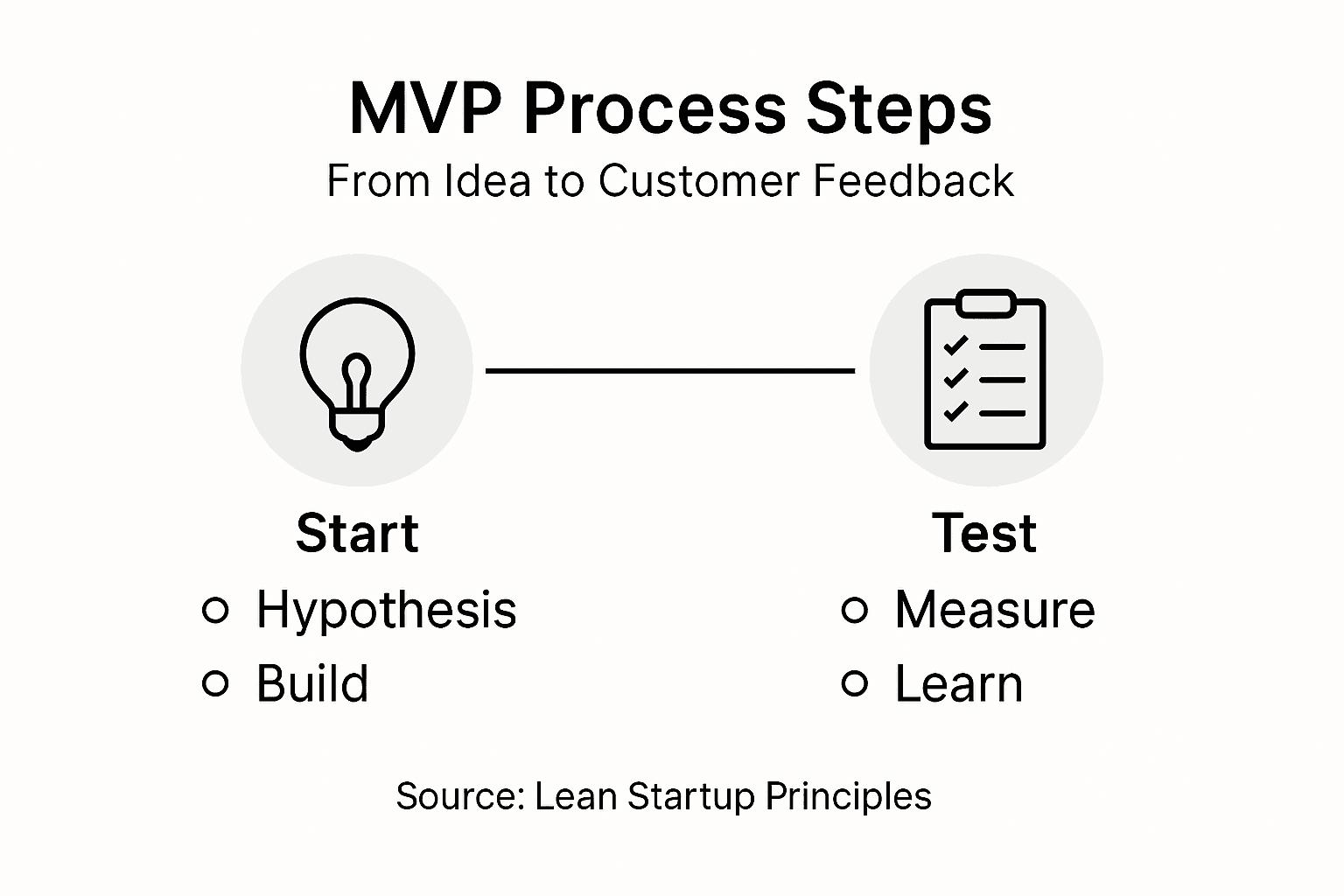
The MVP process starts with a clear hypothesis. You’re not just building something and hoping it works. You need to articulate exactly what you believe is true. For example: “Small business owners will pay $50 per month for a time tracking tool that integrates with their invoicing software.” That’s your hypothesis. Next, you identify the minimum set of features required to test it. For a time tracking tool, that might mean the ability to log hours and export a report. Nothing fancy. No mobile app yet. No team collaboration features. Just those core functions. An MVP framework emphasizes that core elements include minimal but functional features, effective distribution channels, and feedback mechanisms enabling entrepreneurs to test hypotheses efficiently with minimal resources.
What makes this process work is speed. You’re aiming to get your MVP in front of real customers in days or weeks, not months. Some of the most powerful MVPs aren’t even products yet. Airbnb’s initial MVP was photographs of real apartments posted on Craigslist. Dropbox’s MVP was a simple video showing how file syncing worked. Zappos’ MVP was photos of shoes from local stores posted online. These weren’t fully built solutions, but they answered the critical question: Do people actually want this? The distribution channel matters too. You can’t just build an MVP and assume customers will find it. You need a plan for how users will discover it. Will you reach out to potential customers directly? Post in relevant forums? Use your personal network? This is part of the MVP process from day one.
Once your MVP is live, you measure relentlessly. Track how many people sign up. How many return after the first week. How many pay. Collect qualitative feedback directly from users. Ask why they do or don’t use your product. This data tells you whether to iterate on your current direction or pivot. The MVP process isn’t about building something perfect. It’s about learning something true as quickly and cheaply as possible.
Pro tip: Define your core hypothesis in one sentence, identify exactly three features required to test it, and commit to launching your MVP within two weeks regardless of how unpolished it feels.
Risks, common missteps, and alternatives
Lean startup is powerful, but it’s not a cure-all. And yes, I learned this the hard way. The methodology works best for certain types of problems and fails spectacularly in others. Understanding where lean startup breaks down helps you avoid costly mistakes and choose the right approach for your specific situation. One major risk is sector misfit. Lean startup thrives in software and digital services where you can iterate quickly and cheaply. But if you’re building a hardware device, launching a pharmaceutical product, or operating in a regulated industry like finance or healthcare, rapid iteration becomes impossible. Regulatory approval timelines, manufacturing constraints, and safety requirements don’t bend to lean principles. You can’t pivot your way around FDA approval. This doesn’t mean lean startup is useless in these contexts, but it requires significant adaptation.
Common missteps emerge from misunderstanding lean startup’s core principles. Founders sometimes interpret “move fast” as “ignore customer feedback.” They launch an MVP, get feedback saying customers hate it, and then ignore the feedback because they’re committed to their original vision. That’s the opposite of lean startup. Other founders push toward scaling too early, spending heavily on customer acquisition before validating that customers actually want to pay for their solution. Still others confuse experimentation rigor with speed. They run sloppy experiments, collect unclear data, and make decisions based on intuition dressed up as validated learning. Common challenges include incomplete understanding of core principles, inadequate experimentation rigor, and difficulties adapting to sector-specific conditions. The solution is simple: deeply understand the methodology before implementing it, train your team rigorously, and stay honest about what your data actually shows.
Another critical misstep is ignoring risks beyond market uncertainty. Market validation answers one question: Do customers want this? But it doesn’t address technological risks. Can you actually build this at scale? Do the core technical assumptions hold? A marketplace startup might validate that buyers and sellers want the platform, then discover the payment processing infrastructure required is far more complex than anticipated. Technical risks, operational risks, and competitive risks all exist alongside market risk. You need to address all of them.
For founders working in regulated industries or hardware, hybrid approaches work better than pure lean startup. Combine lean principles with more structured innovation frameworks. Use lean startup for customer discovery and messaging validation, but apply traditional project management rigor to regulatory compliance and manufacturing. The methodology’s effectiveness depends on rigorous, consistent application and deep understanding by practitioners. Complement lean startup with complementary approaches suited to your specific challenges.
Pro tip: Before committing to lean startup, map your biggest risks (market, technology, regulatory, competitive), then design your experimentation strategy to address each one systematically rather than betting everything on market validation alone.
Accelerate Your Lean Startup Journey with Nomad Excel
Building a successful startup means navigating uncertainty with speed and validated learning. The lean startup approach highlights essential challenges like testing hypotheses quickly, managing risk through the Build-Measure-Learn loop, and knowing when to pivot thoughtfully. If you are struggling with translating these concepts into clear, actionable steps or need guidance on building your MVP efficiently while avoiding costly missteps, Nomad Excel offers the perfect solution.
Join our Entrepreneurship Archives for proven frameworks and hands-on mentorship tailored to help you master lean startup principles. Our immersive bootcamps provide expert-led support, community accountability, and real-world execution strategies so you can validate your ideas faster without wasting time or resources. Ready to transform your entrepreneurial vision into a validated growth engine? Visit Nomad Excel today and take the next step in accelerating your startup’s success.
Frequently Asked Questions
What is the lean startup methodology?
The lean startup methodology is a systematic approach designed to help entrepreneurs build new ventures efficiently by emphasizing rapid experimentation, validated learning, and customer feedback instead of long-term planning.
How does the Build-Measure-Learn loop work?
The Build-Measure-Learn loop involves creating a minimum viable product (MVP), measuring customer responses, and learning from the data to decide whether to pivot or persevere in your strategy. This cycle is repeated continuously to refine the product and approach.
What is a minimum viable product (MVP) and why is it important?
An MVP is the simplest version of your product that can effectively test your core hypothesis with real customers. It focuses on the essential features, allowing for rapid learning about customer preferences without investing heavily upfront.
What should I consider before implementing a lean startup approach?
Before adopting a lean startup approach, consider your biggest risks, including market, technology, regulatory, and competitive factors. Ensure you design your experimentation strategy to address each risk systematically, rather than solely relying on market validation.
Comments are closed.