
Why Connection Drives Business Growth and Opportunity
Most American business leaders agree meaningful connection drives real growth, yet over 80 percent of startups feel stuck in isolation. In every market, whether you are launching in the United States, Canada or Australia, building intentional connections can be the difference between slow progress and lasting momentum. This guide reveals proven strategies for turning isolated hustle into vibrant networks, so you can unlock sustainable growth and a supportive community grounded in trust.
Table of Contents
- Defining Connection In Business Growth
- Types Of Connection: Internal And External
- Connection’s Impact On Team Collaboration
- Customer Trust And Community Building Strategies
- Connection As A Catalyst For Innovation
- Common Barriers To Connection And Solutions
Key Takeaways
| Point | Details |
|---|---|
| Connection is Essential for Growth | Businesses should focus on creating strategic networks that foster collaboration, knowledge sharing, and innovative problem-solving. |
| Internal and External Connections are Vital | Organizations must cultivate both internal team dynamics and external partnerships to enhance performance and adaptability. |
| Trust Builds Customer Communities | Developing authentic relationships with customers transforms them into engaged community members, enhancing brand loyalty and feedback. |
| Address Barriers to Connection | Organizations should identify and dismantle psychological and structural barriers to communication to unlock collaboration potential. |
Defining Connection in Business Growth
Connection represents the critical infrastructure of business evolution, transforming isolated efforts into collaborative ecosystems of growth and opportunity. At its core, connection transcends simple networking—it is a strategic mechanism through which entrepreneurs and organizations create synergistic relationships that amplify individual capabilities and collective potential.
In today’s global marketplace, business connection operates as a dynamic network of human and technological interactions. The European University Association’s Innovation Agenda highlights how interconnected networks drive growth by facilitating knowledge exchange across diverse stakeholder groups. These connections are not random occurrences but intentional strategies designed to integrate diverse perspectives, skills, and resources.
Successful business connection involves multiple dimensions: interpersonal relationships, technological infrastructure, information sharing, and collaborative platforms. Entrepreneurs who master these interconnections can transform isolated ideas into scalable ventures. By understanding connection as a multifaceted phenomenon, business leaders can strategically design environments that encourage meaningful interactions, knowledge transfer, and collective problem solving.
Pro tip: Invest 30 minutes weekly in purposeful networking conversations that focus on mutual value creation rather than transactional exchanges.
Types of Connection: Internal and External
Business connections can be strategically divided into internal and external categories, each playing a critical role in organizational growth and resilience. Internal connections focus on relationships within an organization, while external connections extend beyond organizational boundaries to engage broader ecosystems of opportunity.
Research exploring organizational environments reveals the intricate dynamics between internal and external connection types, demonstrating how these interconnected networks drive business performance. Internal connections encompass team dynamics, cross-departmental communication, shared knowledge systems, and organizational culture. These connections create alignment, streamline operations, and foster a collaborative environment where innovation can flourish.
External connections represent the critical pathways through which businesses interface with the broader world—including customers, partners, investors, and market ecosystems. These connections enable organizations to gather market intelligence, develop strategic partnerships, access new resources, and adapt to changing business landscapes. By cultivating robust external networks, entrepreneurs can transform isolated ventures into interconnected, responsive enterprises that can quickly pivot and seize emerging opportunities.
Pro tip: Conduct a quarterly audit of both internal and external connection channels to identify potential communication gaps and strategic opportunities for enhanced collaboration.
Here’s a comparison of internal and external business connections and their key benefits:
| Type of Connection | Typical Stakeholders | Main Purpose | Business Benefit |
|---|---|---|---|
| Internal | Employees, teams, leaders | Foster collaboration, share knowledge | Greater innovation, smoother operations |
| External | Customers, partners, investors | Expand reach, access resources | Increased market intelligence, rapid adaptation |
Connection’s Impact on Team Collaboration
Team collaboration represents a sophisticated interplay of human dynamics, communication strategies, and shared objectives that transform individual potential into collective achievement. At its core, connection enables teams to transcend traditional working models, creating synergistic environments where creativity, problem solving, and mutual support become natural organizational outcomes.

Learning communities demonstrate how emotional connection and shared goals drive team performance, revealing that successful collaboration is not just about technical skills but about cultivating deep interpersonal understanding. Psychological safety emerges as a critical component, where team members feel empowered to share ideas, challenge assumptions, and contribute without fear of ridicule or professional retribution. This environment of trust amplifies collective intelligence, allowing teams to navigate complex challenges more effectively than any individual could alone.
Technological platforms and collaborative learning tools have revolutionized how teams connect and interact. Modern organizations recognize that connection goes beyond physical proximity, leveraging digital infrastructure to create seamless communication channels that bridge geographic and departmental boundaries. These systems enable real-time knowledge sharing, facilitate cross-functional collaboration, and provide transparent mechanisms for tracking project progress and individual contributions.
Pro tip: Implement monthly team connection workshops that rotate leadership and encourage vulnerability, allowing team members to share personal and professional challenges in a supportive environment.
Customer Trust and Community Building Strategies
Building customer trust represents a sophisticated, multidimensional approach that goes far beyond traditional transactional relationships. Modern businesses recognize that authentic connection transforms customers from passive consumers into active community members who are emotionally invested in an organization’s success and mission.
Platform Housing Group’s customer strategy demonstrates how transparent communication and responsive engagement create lasting customer relationships. Trust is cultivated through consistent, predictable interactions that demonstrate genuine commitment to customer needs. This involves creating multiple touchpoints where customers feel heard, valued, and empowered to provide feedback that directly influences product development and service improvements.
Successful community building strategies require a holistic approach that integrates digital and human interaction channels. Organizations must develop comprehensive ecosystems that allow customers to connect not just with the brand, but with each other, creating networks of shared experiences and mutual support. This approach transforms traditional customer service from a one-way communication model into a dynamic, collaborative relationship where customers become active participants in the brand’s evolution.
Pro tip: Design a quarterly customer feedback summit where top customers are invited to share insights, critique current offerings, and contribute directly to future product roadmaps.
Connection as a Catalyst for Innovation
Innovation emerges not from isolated brilliance, but from the complex web of human interactions and collaborative networks that transform raw ideas into transformative solutions. At its core, connection serves as the critical infrastructure that enables knowledge transfer, challenges existing paradigms, and creates fertile ground for breakthrough thinking.
McKinsey research reveals how organizational connections drive innovation by integrating diverse perspectives and fostering dynamic knowledge ecosystems. Successful innovation requires more than individual genius—it demands environments where ideas can collide, cross-pollinate, and evolve through meaningful interactions across different disciplines, departments, and domains of expertise. These connections create friction that generates creative sparks, challenging conventional wisdom and pushing boundaries of what seems possible.
The most powerful innovation strategies recognize connection as a deliberate, strategic mechanism for organizational growth. By creating intentional pathways for knowledge sharing, businesses can transform potential energy into kinetic progress. This involves designing communication infrastructures that break down traditional silos, encourage interdisciplinary collaboration, and provide psychological safety for team members to propose unconventional solutions without fear of ridicule or immediate rejection.
Pro tip: Implement a monthly cross-departmental innovation workshop where teams from different functional areas are randomly grouped to solve complex organizational challenges.
Common Barriers to Connection and Solutions
Connection in business is not a seamless process but a complex navigation through psychological and structural challenges that can significantly impede collaborative potential. Organizations frequently encounter invisible obstacles that fragment communication, undermine trust, and limit the transformative power of meaningful interactions.
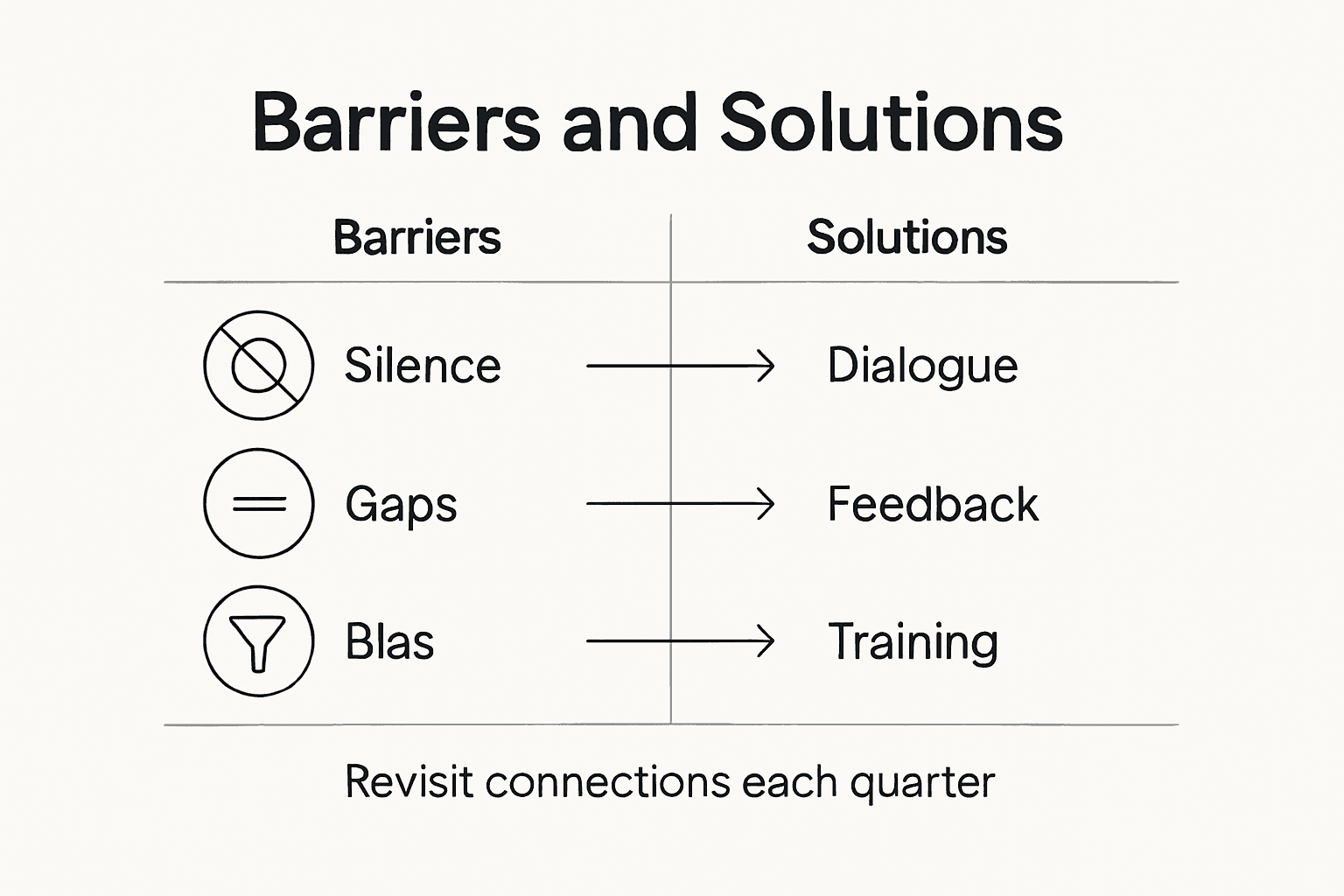
Systematic research reveals multiple barriers to effective connection, ranging from cultural differences to fundamental misalignments in organizational objectives. These barriers manifest through communication breakdowns, siloed departmental structures, divergent expectations, and a lack of shared understanding. Psychological safety emerges as a critical factor—when team members feel uncertain about vulnerability or fear potential criticism, they withdraw, creating invisible walls that block genuine connection and collaborative potential.
Addressing connection barriers requires a multifaceted approach that combines strategic intervention, cultural transformation, and intentional relationship building. Successful organizations develop comprehensive strategies that systematically dismantle traditional communication barriers by creating safe spaces for dialogue, establishing clear collaboration protocols, and cultivating a culture of mutual respect and curiosity. This involves designing communication infrastructures that prioritize transparency, encourage cross-functional interactions, and reward collaborative behaviors that transcend traditional departmental boundaries.
The table below summarizes common barriers to business connection and effective solutions:
| Barrier Type | Example Barrier | Strategic Solution |
|---|---|---|
| Psychological | Fear of criticism | Build psychological safety culture |
| Structural | Departmental silos | Foster cross-functional projects |
| Communication | Misaligned expectations | Use transparent processes |
Pro tip: Create a quarterly cross-departmental rotation program where team members spend one week working alongside colleagues from different functional areas to build empathy and break down organizational silos.
Unlock Business Growth Through Meaningful Connection
The article reveals the crucial challenge organizations face in building authentic connections that drive innovation, team collaboration, and customer trust. Key pain points include overcoming psychological and structural barriers and cultivating environments where internal and external connections flourish. Concepts like psychological safety, cross-functional collaboration, and community building are essential to transforming isolated efforts into powerful growth opportunities.
At Nomad Excel, we specialize in turning these challenges into strengths. Our immersive Entrepreneurship Bootcamps empower founders to build clarity, execute with focus, and develop networks that last well beyond the program. For established teams, our Company Retreats strengthen trust, align goals, and spark innovation through intentional connection. Both experiences are crafted to break down silos and foster psychological safety, exactly what the article highlights as key to sustained business success.
Looking to transform your business by harnessing the power of connection today Take the first step by exploring how our expert-led programs can amplify your growth. Join a community dedicated to action, mentorship, and collaboration now at Nomad Excel. Your next breakthrough starts with a single connection.
Frequently Asked Questions
What does connection mean in the context of business growth?
Connection refers to the strategic relationships and interactions among people and organizations that foster collaboration and innovation, transforming isolated efforts into a collective ecosystem of growth and opportunity.
How can internal and external connections benefit a business?
Internal connections enhance collaboration and innovation within an organization, while external connections allow businesses to access market intelligence and build strategic partnerships, both essential for resilience and adaptation in changing markets.
What role does psychological safety play in team collaboration?
Psychological safety creates an environment where team members feel safe to share ideas, challenge assumptions, and contribute without fear of criticism, leading to enhanced communication, creativity, and collective problem-solving.
What are common barriers to connection in business?
Common barriers include psychological challenges, like fear of criticism, and structural issues, such as siloed departments. These can hinder effective communication and collaboration, making it crucial for organizations to implement strategic solutions to overcome them.
Recommended
- Why Business Networking Matters for Growth and Success
- Why Join Entrepreneur Communities: Growth Through Connection
- Why Invest in Business Education for Entrepreneurs
- Role of Networking in Entrepreneurship: Essential Guide – Nomad Excel – Your Entrepreneurial Adventure Starts Here
- Why Support Hawaiian Businesses: Complete Guide | Flight Of Aloha
Comments are closed.