
Entrepreneurship vs Intrapreneurship: Choosing Your Path to Innovation
Most American founders discover that over 60 percent of major business innovations come from those willing to challenge traditional pathways. Understanding the difference between entrepreneurship and intrapreneurship is crucial for anyone aiming to create real impact, whether you want to build from scratch or thrive within established organizations. This guide uncovers what sets these two approaches apart, helping you decide how best to channel your passion, resources, and risk appetite for global business success.
Table of Contents
- Defining Entrepreneurship And Intrapreneurship
- Key Differences And Shared Skills
- Benefits And Limitations For Innovators
- Risks, Rewards, And Real-World Impacts
- Which Path Is Right For You?
Key Takeaways
| Point | Details |
|---|---|
| Distinction Between Paths | Entrepreneurship involves creating new ventures from scratch, while intrapreneurship focuses on innovation within existing organizations. |
| Shared Skills | Both paths require skills such as creative problem solving and strategic thinking to generate economic value. |
| Risk and Reward Analysis | Entrepreneurs face high financial risks and the potential for greater rewards, whereas intrapreneurs benefit from organizational resources with less personal financial exposure. |
| Self-Assessment is Key | Choosing between entrepreneurship and intrapreneurship requires a thorough understanding of personal risk tolerance, goals, and preferences. |
Defining Entrepreneurship and Intrapreneurship
Entrepreneurship represents the process of creating and developing innovative business ventures through personal initiative, risk taking, and strategic opportunity recognition. At its core, entrepreneurship involves transforming creative ideas into tangible economic value by launching new enterprises or introducing groundbreaking solutions to existing market challenges.
Intrapreneurship, by contrast, represents an internal innovation approach where employees act like entrepreneurs within their established organizational environments. Researchers have identified intrapreneurs as entrepreneurial employees who drive innovation from inside existing corporate structures, developing new ventures and seizing opportunities that generate economic value without leaving their current employment.
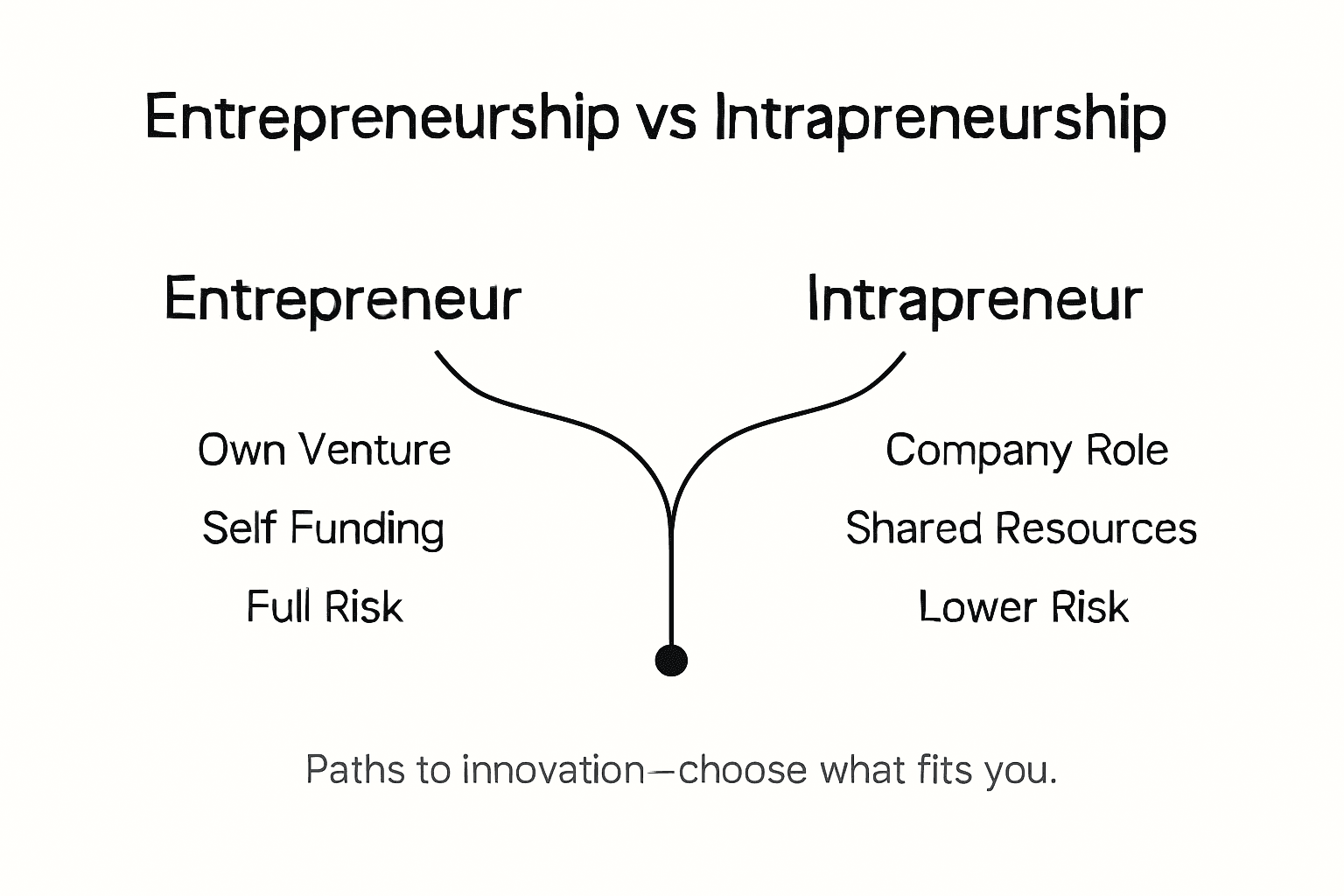
The key distinction between entrepreneurship and intrapreneurship lies in their operational context. Entrepreneurs typically start businesses from scratch, assuming full financial risk and operational responsibility, while intrapreneurs innovate within established organizational frameworks with institutional support and resources. Both approaches share fundamental characteristics: creative problem solving, strategic thinking, and a commitment to generating meaningful economic and organizational value.
The following table outlines how entrepreneurs and intrapreneurs transform their ideas into value:
| Pathway | Idea Generation Approach | Resource Acquisition | Impact Area |
|---|---|---|---|
| Entrepreneurship | Starts with personal innovation | Secures own funding and assets | Market and industry-wide |
| Intrapreneurship | Draws from organizational needs | Utilizes company resources | Internal and corporate growth |
Pro tip: Assess your personal risk tolerance and resource availability when choosing between entrepreneurial and intrapreneurial paths, understanding that each approach offers unique opportunities for professional growth and innovation.
Key Differences and Shared Skills
Both entrepreneurs and intrapreneurs share fundamental skills essential for driving innovation, yet they operate within distinctly different environments. Global research mapping behavioral differences highlights their core competencies in opportunity recognition and innovation, revealing a nuanced landscape of entrepreneurial thinking that transcends traditional organizational boundaries.
The primary distinctions emerge in operational context and risk management. Entrepreneurs independently launch and manage their own ventures, assuming complete financial and operational responsibility, while intrapreneurs innovate within existing organizational structures. This structural difference demands unique skill adaptations: entrepreneurs must build entire ecosystems from scratch, whereas intrapreneurs must navigate complex corporate hierarchies, align with institutional goals, and leverage internal resources.
Shared Skills Across Both Domains:
- Creative problem solving
- Strategic opportunity recognition
- Risk assessment and management
- Innovative thinking
- Adaptability and resilience
The comprehensive thesis research reveals that while their contexts differ, both entrepreneurs and intrapreneurs require similar foundational skills. The critical differentiator lies not in their capabilities, but in their operational environments and the mechanisms through which they transform innovative ideas into tangible value.
Pro tip: Develop a versatile skill set that combines creative thinking, strategic planning, and adaptability, enabling you to thrive whether you choose an entrepreneurial or intrapreneurial path.
Benefits and Limitations for Innovators
Entrepreneurs and intrapreneurs face distinct advantages and challenges in their respective innovation journeys. Research exploring intrapreneurship in academic and institutional settings reveals a complex landscape of opportunities and constraints, highlighting the nuanced trade-offs between organizational support and individual autonomy.
For entrepreneurs, the primary benefits include complete creative control, unlimited potential for financial rewards, and the ability to build entire business ecosystems from the ground up. However, these advantages come with significant limitations: high financial risk, total responsibility for business survival, and the challenge of securing initial funding and market validation. Intrapreneurs, by contrast, enjoy institutional resources, stable income, and established infrastructure, but must navigate more complex organizational dynamics.

Comparative Benefits and Limitations:
Entrepreneur Benefits:
- Total strategic autonomy
- Unlimited financial upside
- Direct impact on market innovation
- Personal brand building
Entrepreneur Limitations:
- Complete financial risk
- No guaranteed income
- Lack of institutional support
- Higher probability of failure
Intrapreneur Benefits:
- Organizational resources
- Stable compensation
- Reduced personal financial risk
- Established network access
Intrapreneur Limitations:
- Slower decision-making processes and restricted innovation autonomy within institutional frameworks
- Limited financial rewards
- Dependence on organizational strategy
- Potential bureaucratic obstacles
Pro tip: Regularly assess your personal risk tolerance, professional goals, and innovation capabilities to determine whether an entrepreneurial or intrapreneurial path aligns better with your long-term career objectives.
Risks, Rewards, and Real-World Impacts
Empirical studies reveal that intrapreneurial activities generate profound economic impacts across different organizational contexts, demonstrating how innovation emerges through calculated risk-taking and strategic organizational approaches. The real-world significance of entrepreneurial and intrapreneurial efforts extends far beyond individual success metrics, encompassing broader economic transformation and societal progress.
The risk landscape for innovators is fundamentally shaped by institutional frameworks and incentive structures. Comprehensive research analyzing intrapreneurship from firm and societal perspectives indicates that organizational rules critically determine the potential productivity and impact of innovative efforts. These risks manifest differently for entrepreneurs and intrapreneurs: entrepreneurs face direct financial vulnerability, while intrapreneurs navigate complex organizational political landscapes that can either amplify or constrain their innovative potential.
Key Risk and Reward Dimensions:
Entrepreneurial Risks:
- Complete personal financial exposure
- Market validation challenges
- Unpredictable revenue streams
- Full operational responsibility
Intrapreneurial Risks:
- Limited autonomy
- Potential organizational resistance
- Career progression constraints
- Innovation proposal rejection
Entrepreneurial Rewards:
- Unlimited scaling potential
- Direct financial returns
- Personal brand development
- Complete strategic control
Intrapreneurial Rewards:
- Institutional support
- Reduced personal financial risk
- Career development opportunities
- Organizational resources
Pro tip: Develop a comprehensive risk mitigation strategy that balances your innovative ambitions with realistic assessment of potential challenges and organizational dynamics.
Which Path Is Right for You?
Practical research on individual innovation pathways reveals that selecting between entrepreneurship and intrapreneurship requires deep self-reflection and strategic personal assessment. Your choice depends on multiple interconnected factors that extend beyond simple professional preferences, encompassing personal risk tolerance, resource access, and long-term career aspirations.
Decision Mapping Factors:
Choose Entrepreneurship If You:
- Thrive on complete independence
- Have high personal risk tolerance
- Want unlimited financial potential
- Prefer creating entire business ecosystems
- Are comfortable with financial uncertainty
- Want total strategic control
Choose Intrapreneurship If You:
- Prefer structured organizational environments
- Value stable income and benefits
- Want to innovate with institutional support
- Enjoy collaborative professional settings
- Have moderate risk tolerance
- Seek career advancement within existing structures
Comprehensive market research underscores that understanding personal motivations and organizational dynamics is crucial for selecting the most suitable innovation pathway. Your individual context matters more than generic recommendations, making self-awareness the most critical tool in making this pivotal career decision.
Pro tip: Conduct a personal innovation audit by honestly assessing your risk tolerance, financial needs, professional goals, and preferred working style before committing to either entrepreneurial or intrapreneurial paths.
Here’s a quick summary of typical career outcomes based on each innovation path:
| Innovation Path | Typical Career Progression | Long-Term Stability | Potential for Market Recognition |
|---|---|---|---|
| Entrepreneurship | Rapid growth or high volatility | Variable, risk dependent | Public and industry-wide impact |
| Intrapreneurship | Structured promotions, advancement | Generally predictable | Internal recognition, less public |
Accelerate Your Innovation Journey with Nomad Excel
Choosing between entrepreneurship and intrapreneurship means facing crucial decisions about risk, autonomy, and creative control. If you are navigating these paths and want to build the skills that turn innovative ideas into real-world impact, Nomad Excel offers powerful solutions designed precisely for these challenges. Whether you need to develop entrepreneurial skills for launching a new venture or cultivate intrapreneurial leadership within an existing organization, we provide immersive programs tailored to your goals.
Explore practical frameworks and get expert mentorship at our Entrepreneurship Archives. If you seek inspiration and community to keep pushing your personal and professional boundaries, check out our Inspiration Archives. Ready to commit to real growth? Visit Nomad Excel today to discover how our bootcamps and corporate retreats can help you overcome the risks and limitations highlighted in the article and unlock your full innovation potential. Take action now and turn your vision into measurable success.
Frequently Asked Questions
What is the main difference between entrepreneurship and intrapreneurship?
Entrepreneurship involves starting a business from scratch and taking on full financial risks, while intrapreneurship involves innovating within an existing organization using its resources and support.
What are some key skills shared by entrepreneurs and intrapreneurs?
Both entrepreneurs and intrapreneurs require skills such as creative problem-solving, strategic opportunity recognition, risk assessment, innovative thinking, and adaptability.
What are the benefits of choosing an entrepreneurial path?
Entrepreneurs have total strategic autonomy, unlimited financial upside, and the ability to directly impact market innovation, but they also face significant financial risks and responsibilities.
How do risks differ for entrepreneurs and intrapreneurs?
Entrepreneurs face complete personal financial exposure and market validation challenges, while intrapreneurs may encounter limited autonomy and potential organizational resistance to their innovative ideas.
Recommended
- The Essential Guide to Cultivating Entrepreneurial Independence
- Complete Guide to Entrepreneurial Thinking – Nomad Excel – Your Entrepreneurial Adventure Starts Here
- 7 Essential Types of Entrepreneurship for Modern Success – Nomad Excel – Your Entrepreneurial Adventure Starts Here
- The Essential Guide to Benefits of Entrepreneurial Mindset – Nomad Excel – Your Entrepreneurial Adventure Starts Here
Comments are closed.