
How to Set Business Goals for Entrepreneur Growth
Most American startup founders struggle to move from big ideas to tangible growth because their business goals lack clear focus. Building a startup, whether in New York, Berlin, or Singapore, can feel overwhelming without a method for setting and tracking results. When you clarify your business vision and break it into actionable steps, your path to accelerated growth becomes much clearer. This guide reveals proven strategies for defining, measuring, and refining your goals so you can move your company forward with confidence.
Table of Contents
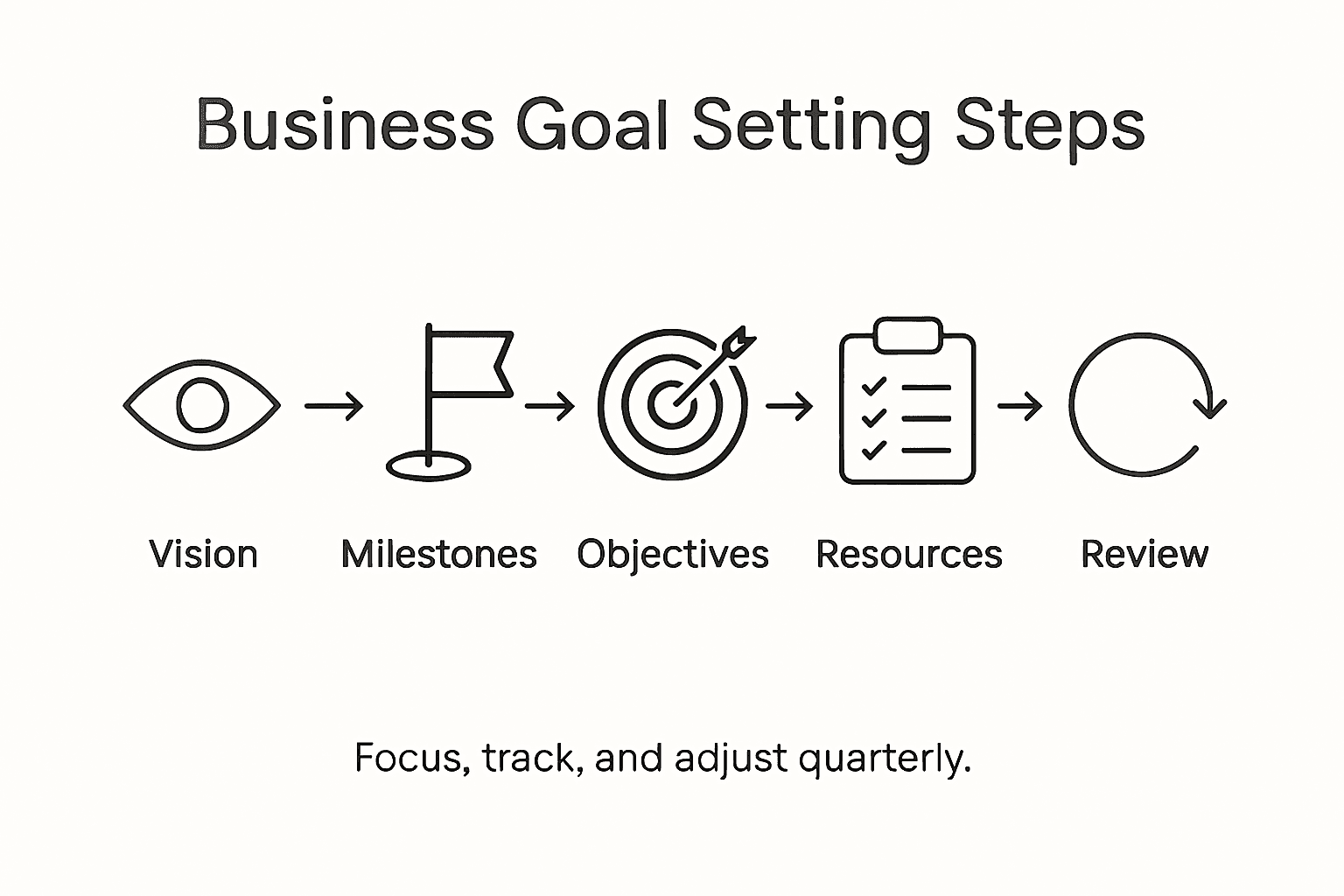
- Step 1: Define Your Core Business Vision
- Step 2: Identify Key Growth Milestones
- Step 3: Prioritize Measurable Objectives
- Step 4: Align Resources And Team Roles
- Step 5: Review And Adjust Goals Regularly
Quick Summary
| Key Point | Explanation |
|---|---|
| 1. Define a clear business vision | Articulate your core purpose and long-term aspirations to guide strategic decisions. |
| 2. Identify key growth milestones | Break down your vision into actionable steps to track significant achievements toward your goals. |
| 3. Prioritize measurable objectives | Set specific, quantifiable goals that align with your vision, ensuring focus on growth drivers. |
| 4. Align resources and team roles | Ensure all team members understand their responsibilities and have the tools necessary for success. |
| 5. Regularly review and adjust goals | Schedule assessments to evaluate progress, adapting your strategy to respond to changing conditions. |
Step 1: Define your core business vision
Defining your core business vision represents the essential first step in creating a strategic roadmap for entrepreneurial growth. This process involves crystallizing your fundamental purpose, long term aspirations, and the unique value you aim to deliver to your target market.
Starting your vision development requires deep introspection about why your business exists beyond simply making money. Developing a vision provides guidance about what to preserve and what to change, helping you balance continuity with progressive adaptation. Ask yourself critical questions: What problem are you truly solving? What impact do you want to create? What makes your approach distinctive?
To craft a compelling vision, focus on creating a clear statement that articulates your business’s core purpose and future direction. Business vision and mission statements critically shape strategic objectives, serving as a north star that guides decision making and inspires your team. Your vision should be ambitious yet realistic, specific yet flexible enough to accommodate future growth and market changes.
Pro tip: Write your initial vision statement in a single, powerful sentence that captures your ultimate business aspiration and can be easily communicated to others.
Step 2: Identify key growth milestones
Identifying key growth milestones is critical for transforming your entrepreneurial vision into a structured, actionable strategy. This process helps you map out the critical stages of your business development and track meaningful progress toward your ultimate goals.

The entrepreneurial process comprises phases that include moving from concept validation to company launch and shifting focus toward execution and scaling. Your growth milestones should represent significant achievements that demonstrate tangible business progression. These might include securing initial funding, launching your first product, reaching a specific revenue target, expanding into new markets, or hiring your first team members.
Consider creating a comprehensive milestone roadmap that breaks down your long term vision into measurable, time bound objectives. Strategic milestones can involve expanding through key acquisitions, diversifying your service platforms, and establishing strategic partnerships that propel your business forward. Each milestone should be specific, challenging yet achievable, and directly aligned with your core business vision.
Pro tip: Create a visual milestone tracker that allows you to celebrate achievements and quickly identify your next strategic focus areas.
Here’s a summary of entrepreneurial milestones and their strategic impact:
| Milestone | Strategic Outcome | Typical Timeframe |
|---|---|---|
| Securing initial funding | Enables product development | Early stage |
| Launching first product | Proves market viability | 6–12 months |
| Reaching revenue target | Demonstrates financial stability | 1–2 years |
| Expanding to new markets | Increases growth potential | 2+ years |
| Hiring first team members | Builds operational capability | Startup/Scale-up phase |
Step 3: Prioritize measurable objectives
Prioritizing measurable objectives transforms your entrepreneurial vision from abstract concept into concrete actionable strategy. This critical step ensures you focus your energy and resources on goals that directly drive meaningful business growth.
Developing SMART (Specific, Measurable, Attainable, Relevant, Time bound) goals is essential for setting clear objectives that guide organizational progress. Each objective should have quantifiable metrics that allow you to track progress precisely. For example, instead of setting a vague goal like “increase sales,” create a specific target such as “generate $50000 in monthly recurring revenue within six months” or “acquire 100 new customers by quarter end.”
Goals are aspirational statements reflecting an organization’s direction while objectives are specific, measurable steps to achieve those goals. When prioritizing, consider the potential impact of each objective on your overall business strategy. Focus on goals that provide the most significant return on investment, align closely with your core business vision, and can be realistically achieved with your current resources and capabilities.
Pro tip: Rank your objectives using a simple scoring system that weighs potential impact, required resources, and alignment with your long term vision.
Before setting objectives, consider these goal types and their benefits:
| Goal Type | Main Benefit | Example Metric |
|---|---|---|
| Aspirational | Long-term direction | Market share growth |
| Operational | Short-term performance | Monthly revenue target |
| Strategic | Competitive advantage | New product launched |
Step 4: Align resources and team roles
Aligning resources and team roles is fundamental to transforming your entrepreneurial strategy from concept to execution. This critical step ensures every team member understands their specific responsibilities and has the necessary tools to contribute effectively toward your business objectives.
Effective teams define their purpose, goals, roles, and responsibilities clearly using tools such as team charters and RACI matrices. Start by creating a comprehensive document that outlines each team member’s specific responsibilities, skills, and expected contributions. Assess individual strengths and match them with roles that maximize their potential and align with your business goals.
Managing teams requires establishing clear expectations, balancing skill sets, and assigning roles to utilize individual strengths effectively. Regularly review and adjust team roles as your business evolves, ensuring ongoing alignment between individual capabilities and organizational needs. Communication is key focus on creating transparent channels that allow team members to understand how their work connects to the broader business strategy.
Pro tip: Conduct quarterly skill mapping sessions to ensure your team’s capabilities continue to match your evolving business requirements.
Step 5: Review and adjust goals regularly
Regularly reviewing and adjusting your business goals is a critical practice that ensures your entrepreneurial strategy remains dynamic, responsive, and aligned with changing market conditions. This ongoing process helps you stay agile and maintain momentum toward your long term vision.
Regularly reviewing, resetting, and reflecting on business goals helps maintain organizational focus and motivation. Schedule quarterly goal assessment sessions where you critically evaluate your progress, identifying what is working well and what needs modification. During these reviews, analyze key performance indicators, market trends, and internal capabilities to determine whether your current objectives still serve your overall business strategy.
Effective management of business goals includes periodic review and adjustment to ensure alignment with changing internal and external conditions. Be prepared to pivot or recalibrate your goals based on new insights, unexpected challenges, or emerging opportunities. This flexibility does not mean abandoning your core vision but rather adapting your approach to navigate the complex entrepreneurial landscape more effectively.
Pro tip: Create a digital dashboard that tracks your key goals and metrics, allowing real time visibility and easier periodic review.
Accelerate Your Entrepreneurial Growth with Nomad Excel
Setting clear business goals is just the beginning of the journey toward sustained entrepreneurial success. If you find yourself struggling to prioritize measurable objectives, align your team roles, or regularly adjust your goals to stay on track you are not alone. Many entrepreneurs face the challenge of turning broad visions into actionable steps that drive real growth while maintaining focus and momentum.
At Nomad Excel we specialize in helping entrepreneurs and teams overcome these exact challenges through immersive bootcamps and company retreats designed to build clarity execution and community. Our Entrepreneurship Bootcamps provide step-by-step frameworks mentorship and daily accountability to sharpen your strategy and fuel real-world progress. For companies looking to unify their team and align around critical goals our custom Company Retreats create lasting impact by strengthening communication and entrepreneurial leadership.
Don’t let your business goals remain abstract or stalled — transform your vision into measurable growth by connecting with a community that accelerates every step of your journey. Visit Nomad Excel today to discover how our programs can help you define prioritize and execute your goals with confidence and speed.
Frequently Asked Questions
How can I define a core business vision for entrepreneurial growth?
Defining a core business vision involves identifying your fundamental purpose and long-term aspirations. Reflect on why your business exists beyond profit, and write a clear statement that captures your ultimate business aspiration in one powerful sentence.
What are key growth milestones I should set for my business?
Key growth milestones represent significant achievements in your business development. Establish milestones such as securing funding, launching your first product, or reaching specific revenue targets, and aim to create a comprehensive roadmap outlining these objectives with time frames.
How do I prioritize measurable objectives for my business goals?
To prioritize measurable objectives, focus on developing SMART goals—Specific, Measurable, Attainable, Relevant, and Time-bound. Rank your objectives using a scoring system, considering potential impact and alignment with your core vision to ensure you focus on what drives business growth.
What steps should I take to align team roles with business goals?
Aligning team roles involves clearly defining each member’s responsibilities and matching their strengths with business needs. Create a document outlining roles and regularly assess individual capabilities to ensure alignment with your evolving operational requirements.
How often should I review and adjust my business goals?
It is essential to review and adjust your business goals quarterly. Schedule assessment sessions to evaluate progress, analyze key performance indicators, and adjust objectives as necessary to maintain alignment with your overall business strategy and changing market conditions.
What tools can I use to track my business milestones and objectives?
You can use visual milestone trackers and digital dashboards to effectively monitor your business milestones and objectives. Set up a tracking system that allows for real-time visibility on progress, making it easier to celebrate achievements and identify next steps.
Comments are closed.