
Business Scalability: Why It Matters for Entrepreneurs
Most early-stage startups fail to scale because founders confuse quick growth with true business scalability. For american entrepreneurs at global bootcamps, understanding the difference is critical. Adaptable systems, not just more resources, drive sustainable expansion. You will discover how strategic frameworks separate resilient companies from the rest and why common myths can quietly sabotage your next move. Over 80 percent of startups struggle with some aspect of scalability—knowing what works will set your business apart.
Table of Contents
- Defining Business Scalability And Common Myths
- Core Types Of Business Scalability Models
- Key Elements Of A Scalable Startup
- Steps To Build And Measure Scalability
- Risks, Blockers, And What To Avoid
Key Takeaways
| Point | Details |
|---|---|
| Understanding Scalability | True scalability involves strategic design for sustainable growth rather than simply increasing resources or revenue. |
| Scalability Models | Entrepreneurs should choose the scalability model that aligns with their industry and organizational structure for optimal growth. |
| Building Scalable Startups | Focus on creating a robust business model and technological infrastructure to solve real market problems effectively. |
| Managing Risks | Continuous monitoring and proactive risk management are essential to navigate potential scalability blockers and ensure sustainable development. |
Defining Business Scalability And Common Myths
Business scalability represents a company’s strategic ability to expand operations efficiently without compromising performance or disproportionately increasing costs. Unlike simplistic growth models, scalability involves creating intelligent systems that enable sustainable expansion. Scalability fundamentally represents an organizational capability to increase value creation while maintaining operational efficiency.
Many entrepreneurs misunderstand scalability as merely adding more resources or growing revenue. However, true scalability demands strategic infrastructure that allows businesses to handle increased demand without exponentially rising expenses. Digital business models exemplify this principle particularly well, with technology enabling low incremental costs and rapid expansion. The most effective scalable models feature smart systems that can handle growth sustainably and profitably.
Scalability requires deliberate design across multiple dimensions. Successful entrepreneurs develop scalable processes by focusing on:
- Automated systems and workflows
- Technology that reduces manual intervention
- Standardized operational procedures
- Flexible organizational structures
- Repeatable revenue generation models
Beyond technical infrastructure, scalability demands a mindset of strategic adaptability. Entrepreneurs must continuously evaluate their business model, anticipate potential bottlenecks, and design solutions that can expand without breaking existing workflows.
Pro Tip: Conduct a quarterly scalability audit to identify potential constraints and redesign systems proactively before they become critical limitations.
Core Types Of Business Scalability Models
Business scalability models represent strategic approaches that enable organizations to grow efficiently and effectively. Researchers have identified multiple patterns of scalability that allow businesses to expand without proportional increases in complexity or cost.
Five fundamental scalability models emerge as critical strategies for entrepreneurs. These models include innovative approaches such as adding new distribution channels, freeing businesses from traditional capacity constraints, outsourcing capital investments, enabling customers and partners to assume multiple roles, and establishing platform-based structures.
Entrepreneurs can leverage different scalability models depending on their industry and organizational structure:
- Distribution Channel Scalability: Expanding reach through multiple sales platforms
- Technology Platform Scalability: Creating digital infrastructures that support rapid growth
- Process Automation Scalability: Implementing systems that reduce manual intervention
- Partner Ecosystem Scalability: Developing networks that extend organizational capabilities
- Financial Model Scalability: Designing revenue streams with minimal incremental costs
Successful scalability requires understanding which model best suits your specific business context. Each model offers unique advantages, and the most effective strategies often combine multiple approaches to create robust, adaptable business systems.
Here’s a comparison of core scalability models and their business impact:
| Scalability Model | Main Advantage | Typical Industry Example |
|---|---|---|
| Distribution Channel | Expands customer reach | Retail or Consumer Goods |
| Technology Platform | Enables rapid digital growth | Software as a Service (SaaS) |
| Process Automation | Reduces manual effort | Manufacturing & Logistics |
| Partner Ecosystem | Extends market capabilities | E-commerce Marketplaces |
| Financial Model | Minimizes extra expenses | Subscription-based Businesses |
Pro Tip: Conduct a comprehensive assessment of your current business model to identify which scalability strategies align most closely with your organizational goals and market potential.
Key Elements Of A Scalable Startup
Startup scalability goes far beyond simple business growth. Successful scalable startups fundamentally require a strategic approach that combines entrepreneurial team dynamics, technological infrastructure, and market-validated solutions.

Building a scalable startup begins with solving genuine market problems through rigorous demand validation and creating systems that can expand efficiently. This process demands more than just a promising idea; it requires developing a comprehensive framework that supports sustainable growth.
Key elements of a scalable startup include:
- Robust Business Model: Developing a replicable strategy with clear value proposition
- Technological Infrastructure: Creating scalable digital systems and automation
- Diverse and Adaptable Team: Building a team with complementary skills and growth mindset
- Customer-Centric Design: Ensuring products solve real, validated market needs
- Flexible Operational Processes: Designing systems that can efficiently manage increased complexity
Founders must recognize that scalability is not about rapid expansion but strategic, controlled growth. This means deliberately creating organizational structures that can absorb increased demand without sacrificing quality or operational efficiency.
Pro Tip: Regularly audit your startup’s scalability by mapping out potential bottlenecks and developing contingency systems that can flexibly adapt to changing market conditions.
Steps To Build And Measure Scalability
Scalability measurement requires a systematic and comprehensive approach to evaluating an organization’s potential for sustainable growth. The Intervention Scalability Assessment Tool provides a structured three-phase process that helps entrepreneurs critically assess their innovation’s readiness to scale responsibly.
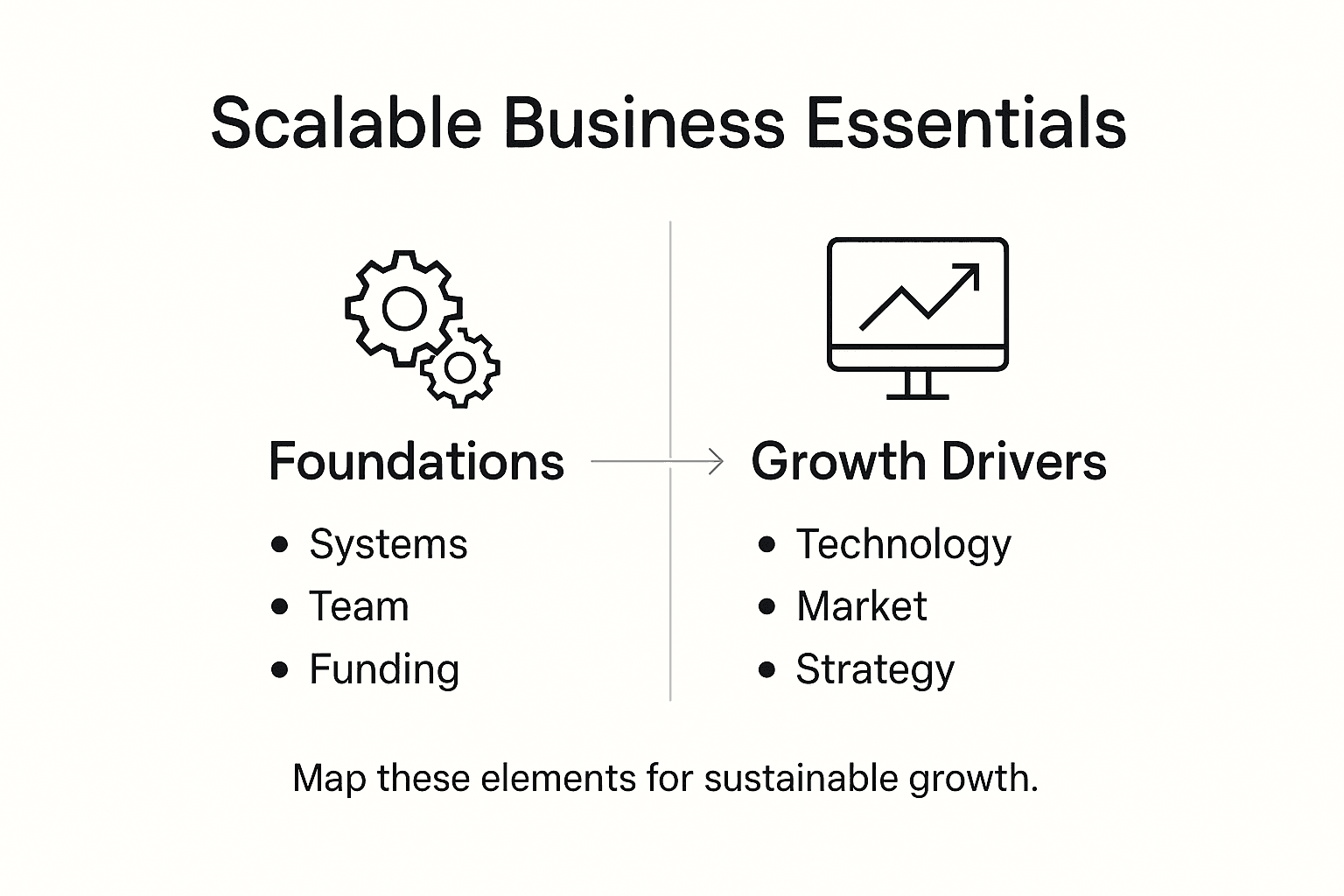
Entrepreneurs must develop a holistic strategy that examines internal capacity, external environment, and resource alignment to ensure sustainable growth implementation. This comprehensive evaluation goes beyond simple metrics and requires a nuanced understanding of organizational capabilities.
Key steps to build and measure scalability include:
- Preparation Phase
- Conduct comprehensive internal capability assessment
- Identify potential growth constraints
- Map current operational processes
- Stakeholder Engagement
- Involve diverse team members in scalability discussions
- Gather multidimensional perspectives on growth potential
- Validate assumptions with external experts
- Scalability Metrics Development
- Define clear, measurable growth indicators
- Create benchmarks for performance evaluation
- Establish flexible adaptation mechanisms
Successful scalability measurement demands continuous iteration and a willingness to adapt strategies based on emerging insights. Entrepreneurs must remain agile, regularly reassessing their scalability frameworks to maintain competitive advantage.
Pro Tip: Develop a quarterly scalability dashboard that tracks key performance indicators and provides real-time insights into your organization’s growth potential and systemic adaptability.
Risks, Blockers, And What To Avoid
Business scalability involves complex risk management that extends far beyond simple financial calculations. Successful entrepreneurs understand that scalability is fundamentally intertwined with anticipating and strategically navigating potential operational challenges.
Organizations face multiple potential blockers that can dramatically impede growth, including insufficient resource awareness, strategic limitations, and ineffective innovative approaches. Understanding these risks becomes crucial for sustainable business development.
Key scalability risks and blockers entrepreneurs must carefully manage include:
- Operational Risks
- Overextending financial resources
- Inadequate infrastructure for rapid growth
- Inefficient process management
- Strategic Risks
- Losing core business focus
- Premature market expansion
- Misaligned growth strategies
- Organizational Risks
- Poor team communication
- Lack of adaptable leadership
- Resistance to systemic changes
Successful risk management requires continuous monitoring, proactive planning, and maintaining organizational flexibility. Entrepreneurs must develop robust mechanisms to identify potential constraints before they become critical impediments to growth.
Below is a summary of major scalability risks and recommended mitigation strategies:
| Risk Category | Example Challenge | Mitigation Strategy |
|---|---|---|
| Operational | Outpaced by demand growth | Invest in scalable IT systems |
| Strategic | Weak market alignment | Validate market fit regularly |
| Organizational | Inflexible team structure | Foster adaptable leadership |
| Financial | Cashflow mismanagement | Monitor KPIs quarterly |
Pro Tip: Create a quarterly risk assessment framework that systematically evaluates potential scalability blockers and develops adaptive mitigation strategies.
Unlock Scalable Growth with Hands-On Support and Community
Scaling a business demands more than knowing the theory. It requires building scalable systems, adopting strategic adaptability, and overcoming common blockers such as process inefficiencies and organizational risks. The article highlights key challenges entrepreneurs face like operational bottlenecks and maintaining quality while growing. If you are ready to move beyond these hurdles and implement proven frameworks for sustainable expansion then connecting with like-minded entrepreneurs and expert mentors will accelerate your journey.
At Nomad Excel we specialize in helping founders build scalable startups through immersive bootcamps that deliver practical mentorship, structured accountability, and community support. Whether you are validating your business model, automating processes, or refining your growth strategy our programs offer step-by-step guidance tailored for early-stage entrepreneurs. Explore inspiring success stories and actionable strategies in our Inspiration Archives.
Don’t wait for growth challenges to slow your momentum. Visit Nomad Excel now and take part in our transformative bootcamps and retreats designed to equip you with the tools and network to scale smarter and faster. Start building the scalable future your business deserves today.
Frequently Asked Questions
What is business scalability?
Business scalability refers to a company’s ability to grow its operations efficiently without significantly increasing costs or compromising performance. It involves implementing strategies and infrastructure that support sustainable expansion.
Why is scalability important for entrepreneurs?
Scalability is crucial for entrepreneurs as it enables them to handle increased demand without disproportionately raising expenses. A scalable business model allows for greater market reach, improved profitability, and a competitive advantage over non-scalable models.
How can I determine if my business is scalable?
To determine if your business is scalable, assess your operational processes, identify potential growth constraints, and evaluate the efficiency of your current systems. Conducting a scalability audit can help pinpoint areas for improvement and growth potential.
What are some common scalability risks to consider?
Common scalability risks include operational challenges such as inadequate infrastructure for rapid growth, strategic issues like losing core business focus, and organizational limitations such as poor team communication. Identifying and managing these risks is essential for successful scaling.
Comments are closed.