
Managers: Which Team Building Types Work Every 2–4 Weeks
Communication exercises, problem-solving challenges, skills workshops, trust and personality activities, social bonding events, virtual formats, outdoor and physical challenges, and volunteering or value-based projects make up the core categories of team building. Each develops a distinct capability, from decision-making under pressure to plain old rapport. The real payoff comes from mixing quick, frequent sessions with a few deeper, facilitated experiences a year, rather than betting everything on one annual event.
TL;DR:
- Most successful team building combines quick, frequent sessions with a few in-depth experiences annually, to sustain engagement and skill development.
- Different activity types develop specific capabilities: communication enhances clarity, problem-solving improves decision-making, and trust exercises boost psychological safety.
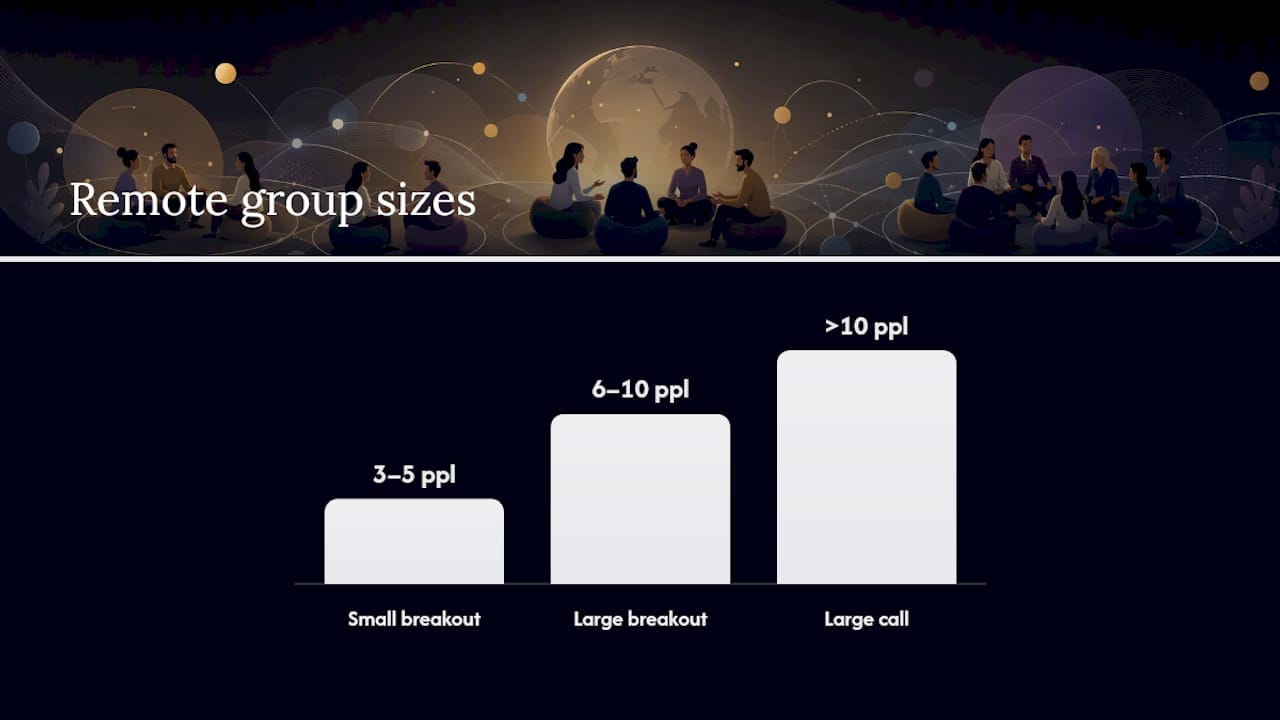
- Virtual formats work best with breakout groups of three to ten people, and activities must be adapted for remote or hybrid teams to maintain effectiveness.
- The effectiveness of team building depends heavily on proper logistics, skilled facilitation, and thorough debriefs to translate activities into real behavioral changes.
- Ongoing measurement through quick surveys and manager observations helps track impact, with broader wellbeing checks recommended every three months.
Table of Contents
- What Are the Main Types of Team Building Activities?
- What Does Each Type of Team Building Activity Actually Develop?
- How Do You Adapt Team Building for Remote and Hybrid Teams?
- How Do You Choose the Right Activity Type for Your Team?
- How Do You Design a Team Building Session That Actually Works?
- How Do You Measure Whether Team Building Actually Worked?
- What Multi-Day Retreats Get Right That a Single Session Can’t
- What Repeatedly Works With Real Teams
- How Nomad Excel Turns This Into a Program, Not a One-Off
- Sources
- FAQ
What Are the Main Types of Team Building Activities?
Before choosing a specific game or exercise, it helps to know what category you’re actually pulling from. Different taxonomies group these slightly differently. Some guides simplify to four broad buckets, others break things into six or more depending on whether the goal is a quick warm-up or a strategic offsite, as this breakdown of team building categories lays out. Here’s the working list managers actually need:
- Communication activities — build clarity and active listening; low to medium effort; works for groups of 4 to 20.
- Problem-solving challenges — sharpen collaborative decision-making under constraints; medium effort; best in teams of 4 to 12.
- Skills-based sessions — transfer a specific competency (facilitation, negotiation, presentation); medium to high effort; scales from pairs to full departments.
- Personality and trust exercises — surface working styles and build psychological safety; low effort, high emotional payoff; ideal for 6 to 15 people.
- Social and bonding events — reduce friction through informal connection; low effort; scales easily, from 5 to 100+.
- Virtual-specific formats — adapted for distributed teams using breakout rooms or async tools; low to medium effort; works from pairs up to 30 with the right structure.
- Physical and outdoor activities — build stamina, resilience, and shared memory; medium to high effort; typically 8 to 40 people.
- Volunteering and value-based projects — connect the team to a shared purpose; medium effort; scales from small teams to entire companies.
- Offsites and retreats — combine several of the above into a multi-day, facilitated program; high effort; usually 10 to 60 participants.
Keeping a variety of these in rotation matters more than most managers assume. A recurring mix of categories, not repetition of the same icebreaker, is what keeps engagement from flattening out, according to Achievers’ research on team building.
What Does Each Type of Team Building Activity Actually Develop?
Knowing the category is step one. Knowing what to run, for how long, and with whom, is what turns a list into a plan.
Communication activities
These sessions train people to listen fully before responding, and to translate ambiguous instructions into clear action.
- Examples: back-to-back drawing (one person describes a shape, the other draws it blind), “two truths and a lie,” structured active-listening pairs.
- Group size: 4 to 20, works best in pairs or small clusters.
- Time and effort: 15 to 30 minutes, low prep.
- When to use it: after a merger, a reorg, or any stretch where miscommunication has caused visible friction.
Problem-solving challenges
These build shared decision-making under time pressure and expose how a group actually behaves when there’s no clear leader assigned.
- Examples: the Marshmallow Challenge (build the tallest freestanding structure that holds a marshmallow, using spaghetti, tape, and string, in 18 minutes), escape-room-style puzzles, a scavenger hunt with clue dependencies.
- Group size: 4 to 12 per team.
- Time and effort: 30 to 90 minutes, medium prep for materials or a booked venue.
- When to use it: onboarding a new cross-functional team or resetting a group that’s stuck defaulting to hierarchy for every decision.
The Marshmallow Challenge deserves a closer look because it consistently surprises people. Adult teams often build worse structures than kindergartners do, largely because adults spend too long planning and negotiating status before ever testing a prototype, according to research on the exercise. The debrief question that matters most here isn’t “did you win,” it’s “when did you build your first prototype, and what would you do differently.” That single question, asked well, is where the actual learning shows up, and it’s widely used as a low-cost way to teach rapid iteration.
Skills-based sessions
These transfer a concrete, usable competency rather than just building rapport.
- Examples: a facilitation workshop where each team member runs a mini-meeting, a negotiation simulation, a “teach your craft” session where someone from marketing explains their workflow to engineering.
- Group size: scales from 2 to an entire department.
- Time and effort: 45 minutes to a full day, medium to high prep depending on whether you bring in outside expertise.
- When to use it: when a specific gap (public speaking, cross-department fluency, client handling) is holding the team back.
Personality and trust exercises
These are lower on physical effort and higher on emotional payoff. Done right, they change how comfortable people feel disagreeing with each other in a normal Tuesday meeting.
- Examples: personality-type mapping (Myers-Briggs, DISC, or similar frameworks) followed by a working-style discussion, a structured vulnerability round where each person shares one professional failure, “human bingo” for newer teams.
- Group size: 6 to 15 works best for the depth these require.
- Time and effort: 20 to 60 minutes, low logistical prep but high facilitation skill.
- When to use it: when a team is technically competent but avoids conflict, or when a new hire needs to integrate quickly.
Sharing short, structured personal stories before jumping into problem-focused work measurably improves both the creativity of what follows and how safe people feel speaking up, based on Harvard Business Review’s research on brainstorming. That’s a strong argument for opening any working session, not just a dedicated “team building day,” with two minutes of personal check-in.
Social and bonding activities
Low stakes, low prep, and easy to scale. These exist to reduce the everyday friction that comes from people simply not knowing each other well.
- Examples: team lunches with assigned conversation prompts, trivia nights, a rotating “coffee roulette” pairing.
- Group size: scales from 5 to well over 100.
- Time and effort: 30 minutes to a few hours, minimal prep.
- When to use it: as a steady baseline activity, especially after fast headcount growth or a wave of new hires.
Virtual-specific formats
Built from the ground up for distributed teams rather than adapted awkwardly from an in-person game.
- Examples: Team Spectrum-style opinion-mapping games, async “show and tell” Slack threads, a shipped physical kit opened simultaneously on a video call.
- Group size: works best at 3 to 10 people; larger groups need breakout rooms to keep everyone actually participating, a point confirmed by TeamRetro’s guidance on remote connection games.
- Time and effort: 15 to 45 minutes, low to medium prep.
- When to use it: for fully remote or hybrid teams that never share a physical room, especially newer hires who’ve never met in person.
Physical and outdoor activities
These build shared memory fast because shared discomfort or shared adrenaline creates a story people retell for months.
- Examples: a ropes course, a group hike with a mid-point challenge, a relay-style field day.
- Group size: 8 to 40.
- Time and effort: half a day to a full day, medium to high prep, and this is where safety planning matters most.
- When to use it: for annual or biannual resets, particularly with teams that spend most of the year at desks.
Indoor activities
Everything from board game tournaments to cooking classes falls here, and it’s the fallback category for weather, budget, or accessibility constraints.
- Examples: a cooking competition split into small teams, an escape room, a collaborative art project.
- Group size: 6 to 30.
- Time and effort: 1 to 3 hours, low to medium prep.
- When to use it: when outdoor logistics aren’t feasible, or when the group includes people with mobility limitations.
Volunteering and value-based projects
These connect the team to something bigger than the quarterly roadmap, and they tend to produce some of the most durable positive sentiment of any category.
- Examples: a group volunteer day at a local shelter, a fundraising challenge, a sustainability project like a neighborhood cleanup.
- Group size: scales from small teams to the whole company.
- Time and effort: half a day typically, medium prep for logistics and partner coordination.
- When to use it: for culture-building moments, especially when a team has been heads-down on internal work for a long stretch.
Offsites and retreats
These combine several categories above into one multi-day, facilitated program, which is exactly why they need more structure than a single afternoon activity.
- Examples: a two-day strategy retreat blending problem-solving workshops with informal evening bonding, a leadership offsite with skills training layered in.
- Group size: 10 to 60.
- Time and effort: multi-day, high prep, usually requiring outside facilitation.
- When to use it: annually, or after a major strategic pivot, when the team needs to align on direction, not just morale.
Problem-solving and creative exercises are the most flexible category here. They genuinely scale from a 6-person huddle to a 60-person offsite, and they translate to remote formats better than almost anything else on this list, a point echoed in BetterUp’s rundown of team-building exercises. For ready-to-run versions of most of the activities above, a library of team building activities can save you the setup time.
How Do You Adapt Team Building for Remote and Hybrid Teams?
Not every category above translates cleanly to a screen, but most can be rebuilt for remote or hybrid teams if you adjust the format instead of forcing the original.
- Communication and trust exercises move well to breakout rooms of 3 to 5 people, run in parallel, then reconvened for a shared debrief.
- Problem-solving challenges work best when split into async prep (everyone reviews the puzzle beforehand) followed by a live 30-minute working session, so the video call time is spent solving, not reading instructions.
- Social and bonding activities shift toward asynchronous formats: rotating photo threads, a shared music playlist, or a weekly non-work question dropped into a channel.
- Skills-based sessions translate almost unchanged, since most already assume a screen-share or a slide deck.
- Physical and outdoor activities are the hardest to replicate remotely; the closest substitute is a shipped kit opened simultaneously on a call, or a scheduled outdoor walk each person does solo while on a shared audio call.
Group size matters more online than in person. A live remote activity with more than 10 people tends to produce a handful of active talkers and a silent majority, which is why breakout rooms of 3 to 10 consistently outperform one large call for anything that requires actual participation, not just spectating.
Pro Tip: For remote problem-solving, assign one person per breakout room as the “reporter” before the room opens, not after. Without a pre-assigned reporter, groups spend the first five minutes negotiating who speaks first, and that’s five minutes you don’t get back on a 30-minute call.
Common pitfalls include running an activity built for a boardroom over a video call with no adjustments, skipping a tech run-through before a big session, and assuming a chat-based icebreaker lands the same as a spoken one. It usually doesn’t. For more remote-specific formats and sizing guidance, see this guide to remote collaboration ideas.
How Do You Choose the Right Activity Type for Your Team?
Start with a short diagnostic before picking any activity off a list.
- Has the team been through a recent change (new hires, reorg, leadership shift)? Lean toward communication and trust exercises.
- Is the team technically strong but slow to make decisions together? Run a problem-solving challenge.
- Is the team fully remote with people who’ve never met? Start with a virtual-specific format before anything physical.
- Has trust already eroded through unresolved conflict? Skip games entirely and bring in a skilled facilitator for a structured trust session.
- Is this a once-a-year budget line, or an ongoing monthly habit? That answer determines whether you need an offsite or a rotation of quick sessions.
Three scenarios show how this plays out in practice.
- A brand-new team, assembled in the last quarter, benefits most from a mix of communication exercises and light social bonding, run every two weeks for the first two months, then dropping to monthly. Startups in particular need this cadence early, since team building for growing startups tends to compound fastest in the first few months of a team’s existence.
- A distributed team spread across time zones should prioritize virtual-specific formats and async bonding, with one deeper facilitated session (in person if budget allows) once or twice a year to anchor the relationships that video calls alone struggle to build.
- A low-trust team, where past conflict has gone unaddressed, needs a skilled facilitator before any game-based activity. Trust exercises without proper facilitation can backfire, surfacing old wounds without a safe container to resolve them.
Budget and time trade-offs are real. A one-hour virtual icebreaker costs almost nothing but produces a shallow, short-lived bump. A multi-day retreat costs significantly more in both money and time away from work, but tends to produce change that actually sticks. The right answer for most teams is both, not one instead of the other.
How Do You Design a Team Building Session That Actually Works?
A good activity poorly run does more harm than no activity at all. Logistics and facilitation matter as much as the exercise itself.
Logistics checklist:
- Confirm the space fits the group size with room to spare, not exactly to capacity.
- Check accessibility needs in advance, including mobility, dietary, and sensory considerations, not as an afterthought.
- Prepare a backup plan for weather, tech failure, or a no-show facilitator.
- Assign one person as timekeeper and one as note-taker for the debrief, separate from whoever is leading the activity.
Facilitation works best when one person is dedicated to running the room and isn’t also trying to participate. That person keeps time visibly, redirects dominant voices, and makes sure quieter team members get a real turn, not just an offered one.
Psychological safety rules should be stated out loud before the activity starts: what’s shared in the room stays in the room, no one is forced to share more than they’re comfortable with, and there’s no punishment for a “wrong” answer in a brainstorm. This matters because poorly facilitated or physically risky activities have made headlines for the wrong reasons, and documented cases of team building gone wrong almost always trace back to skipped safety planning or a facilitator who wasn’t equipped for the group.
The debrief is where the actual learning happens, and it needs a template so it doesn’t get rushed or skipped entirely.
- What happened? (factual recap, no judgment yet)
- What did you notice about how the group worked? (behavior, not blame)
- What would you do differently next time? (forward-looking, specific)
- What’s one thing from today you’ll try back at your desk this week? (transfer to real work)
Pro Tip: Never skip step four. Without a concrete “back at your desk” commitment, even a great activity fades into a nice memory with zero behavior change.
How Do You Measure Whether Team Building Actually Worked?
Most teams either measure nothing or over-engineer a survey nobody finishes. The middle path works better.
- Immediately after: a 3-question pulse survey (energy level, one thing learned, one thing to try) takes under two minutes.
- 2 to 4 weeks later: a manager observation check, specifically watching whether the debrief’s “back at your desk” commitments actually showed up in meetings or workflows.
- 3 months later: a broader engagement or wellbeing check, ideally one your team already runs, so you’re not adding a new tool just for this.
Wellbeing is worth tracking alongside performance metrics, not instead of them. Happier employees measure roughly 13% more productive in controlled studies, which makes a case for treating morale data as a real business signal rather than a soft nice-to-have.
Connect qualitative feedback to outcomes by asking one specific question in your next 1:1 round: “did the last session change how you work with anyone on this team?” A pattern of “yes” answers across several people is a stronger signal than any single survey score. A minimal cadence that works for most teams: quick pulse after every session, manager check-in at the one-month mark, and a broader review twice a year.
What Multi-Day Retreats Get Right That a Single Session Can’t
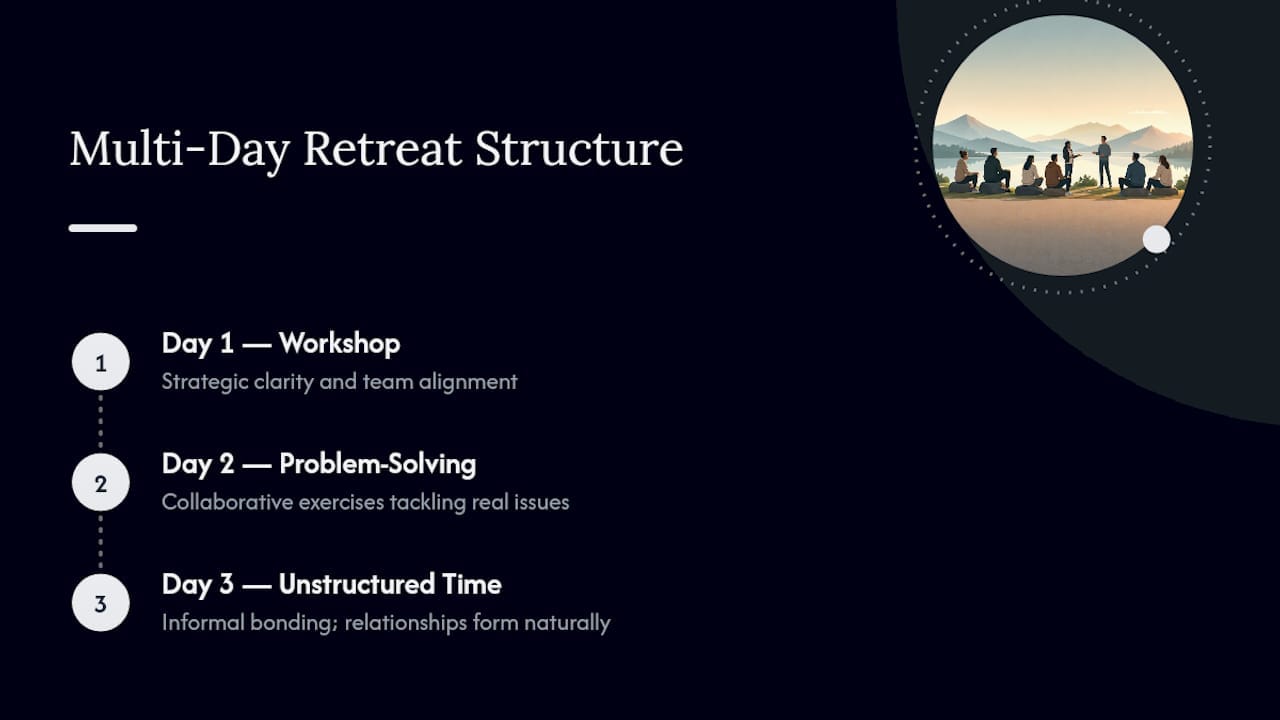
Running internal sessions builds real momentum over time, but there’s a ceiling to what a single afternoon, run by someone juggling their own job at the same time, can achieve. Custom company retreats can use a compressed, multi-day format to change the dynamic. A typical structure might open with a workshop day focused on alignment and strategic clarity, move into a day of collaborative problem-solving exercises, and close with informal, unstructured time that lets relationships form naturally, without an agenda pushing every minute.
The choice between hiring a facilitator and running something in-house usually comes down to two questions: does the team need to resolve something deeper than morale (unresolved conflict, a strategic pivot, a leadership transition), and does anyone on staff have the actual skill to hold that space safely? If the answer to either is no, bringing in outside facilitation stops being a luxury and becomes the safer bet. Programs like a tailored business retreat exist for exactly that gap, combining structured workshops with the kind of local experience that a conference room can’t replicate.
What Repeatedly Works With Real Teams
The biggest mistake I see teams make isn’t picking the wrong activity. It’s picking one activity, running it once a year, and expecting it to carry the team’s culture for the other 364 days. That’s not how any of this works. Trust and communication decay the same way skills do, quietly and steadily, if nobody practices them.
I’ve also watched a well-designed activity fall flat because nobody ran a real debrief afterward. A team once ran a sharp problem-solving challenge, then walked straight back to their desks with zero discussion. Three months later, nobody could name a single thing that had changed. The activity wasn’t the failure. The missing five minutes of “what did we actually learn” was.
Mix quick, cheap sessions with a few deeper ones each year, and treat measurement as a habit, not a one-time survey. Iterate based on what the data actually tells you, not on what felt fun in the room.
— Amichai
How Nomad Excel Turns This Into a Program, Not a One-Off
If your team needs more than another Friday icebreaker, that’s where a facilitated program earns its cost. Custom company retreats can be designed end-to-end from workshops to local logistics to reduce the need for amateur facilitation by team members.
Internal sessions work well for the steady, low-stakes cadence this article recommends: the biweekly communication exercise, the monthly social hour. A facilitated retreat makes more sense when the stakes are higher, a strategic reset, a leadership transition, or a team that’s grown too fast to still feel like one group.
Explore what a tailored company retreat looks like, or check the current retreat and bootcamp options to find the format that matches where your team is right now.
Sources
- Oxford University news: Happy workers are 13% more productive
- HBR: Research for better brainstorming: Tell an embarrassing story
- Achievers: Team building activities
FAQ
What Are the Main Types of Team Building Activities?
The main categories are communication exercises, problem-solving challenges, skills-based sessions, personality and trust activities, social bonding events, virtual-specific formats, physical and outdoor challenges, indoor activities, volunteering projects, and multi-day offsites. Each targets a different capability, so most effective programs mix several categories over the course of a year rather than repeating one.
How Often Should a Team Do Team Building Activities?
A steady rhythm works better than one big annual event. Short sessions every two to four weeks, paired with one or two deeper facilitated experiences per year, tend to produce lasting change rather than a short-lived morale spike.
What’s the Best Team Building Activity for a Remote Team?
Virtual-specific formats like structured opinion-mapping games or async show-and-tell threads work best, especially in breakout groups of 3 to 10 people rather than one large call, based on guidance from TeamRetro. Problem-solving challenges also adapt well to remote play when split into async prep and a shorter live session.
How Much Does Team Building Cost?
Costs range widely: an internal icebreaker can cost nothing beyond staff time, while a facilitated multi-day retreat involves venue, facilitation, and logistics fees. Nomad Excel’s tailored business retreats and multi-day programs don’t have a published flat rate since pricing depends on group size and format, so current details are available directly through Nomad Excel’s program page.
Why Does the Debrief Matter So Much in Team Building?
The debrief is where an activity turns into an actual behavior change instead of a fun memory. Skipping it, or rushing it, is one of the most common reasons teams run a great exercise and see zero lasting impact.
Comments are closed.