
$50,000–$5,000,000 Government Loans for U.S. Startups: Prep Steps
For most U.S. startups seeking debt financing, the answer is straightforward: start with SBA-guaranteed loans through participating lenders, not the SBA itself. Use the SBA 7(a) Loan Program for working capital, the SBA 504 Loan Program for real estate or heavy equipment, and the SBA Microloan Program if you need under $50,000 fast. If you’re building R&D-heavy technology, SBIR/STTR awards and your state’s SSBCI program deserve equal attention. Your first move: search SBA Lender Match today.
TL;DR:
- Most startups should begin with SBA-guaranteed loans, such as the 7(a), 504, or Microloan programs, depending on their asset needs and revenue stage.
- Eligibility requires a profitable operation, US-based business, industry-specific size standards, and credible repayment ability, with supporting documents like cash-flow forecasts and personal financial statements.
- Microloans move fastest and suit pre-revenue founders, while 7(a) loans are better for early revenue startups needing flexible financing, and 504 is ideal for asset-heavy purchases.
- Loan costs depend on interest rates, fee structures, and loan terms, with microloans capped at $50,000 and 7(a) loans up to $5 million, often requiring comprehensive documentation.
- Succesful applications hinge on complete cash-flow models, detailed use-of-funds, and early lender outreach; building a lender-ready package increases approval chances.
Table of Contents
- Which Government Loan Programs Fit Your Startup Stage?
- What Do Lenders Actually Require Before They Say Yes?
- How Long Does the SBA Loan Process Actually Take?
- What Will a Government-Backed Loan Actually Cost You?
- Are State Startup Loan Funds Easier to Access Than Federal Programs?
- How Do You Find the Right SBA Lender for Your Startup?
- What Separates a Funded Application From a Rejected One?
- Should You Even Take a Loan, or Look at Grants and Equity Instead?
- Build a Lender-Ready Application Before You Apply
- Where to Verify Program Details Before You Apply
- Sources
- FAQ
Which Government Loan Programs Fit Your Startup Stage?
Every federal program listed below shares one structural feature founders often miss: the government doesn’t hand you the money. A participating lender does, with the SBA covering part of the risk through its guarantee. That distinction shapes who underwrites your deal, how fast it moves, and what kind of relationship you’re actually building. SBIR/STTR, by contrast, isn’t a loan at all. It’s a competitive award, and Phase I grants typically run $50,000 to $275,000, with Phase II reaching $750,000 to $1.8 million for startups that prove technical merit. SSBCI works differently again, channeling state-administered capital rather than a single federal product.
| Program | Max amount | Best for | Allowed uses | Who underwrites | Timeline / terms |
|---|---|---|---|---|---|
| SBA 7(a) | $5 million | Startups with early revenue needing working capital or general financing | Working capital, equipment, real estate, refinancing | Participating lender, SBA-guaranteed | Moderate; term loans or the newer Working Capital Pilot for lines of credit |
| SBA 504 | Varies by project | Startups buying property or expensive equipment | Real estate, fixed assets, major equipment | Certified Development Company plus a private lender | Longer underwriting; long-term fixed rates |
| SBA Microloan | $50,000 | Very small startups needing fast, small-dollar capital | Working capital, inventory, supplies, some equipment | Nonprofit intermediary lenders | Fastest of the SBA tracks |
| SBA Export loans | Up to $5 million (7(a)-linked caps apply) | Startups with export sales or export plans | Export working capital, international transaction financing | Participating export lenders | Moderate, similar to 7(a) |
A few quick takeaways stand out once you line these up:
- Pre-revenue founders usually fit the microloan track best, since intermediary lenders are built to work with thinner financial histories.
- Startups with early revenue and a real repayment story should look at 7(a) first, given its flexibility and its $5 million ceiling.
- Asset-heavy founders buying a building or manufacturing line belong in the 504 program, where fixed rates protect long-term cash flow.
SBIR/STTR and SSBCI aren’t competitors to these loans. They’re complements: SBIR/STTR funds non-dilutive R&D, while SSBCI pushes state dollars into loan guarantees and direct lending that may be easier to access than a federal product.
What Do Lenders Actually Require Before They Say Yes?
Every SBA-backed program shares baseline eligibility rules: your business must operate for profit, be based in the United States, meet SBA size standards for your industry, and show a credible ability to repay. Lenders also apply a “credit elsewhere” test, meaning you generally need to show you couldn’t get comparable credit on reasonable terms from a conventional source.
Documents lenders typically want:
- A one-page business summary covering your model, market, and traction.
- Twelve-month, month-by-month cash-flow projections.
- Two to three years of business and personal tax returns (or projections if you’re pre-revenue).
- Personal financial statements from every owner with 20% or more equity.
- Collateral details, if you’re pledging equipment, property, or receivables.
Pro Tip: Build your cash-flow forecast conservatively, then pair it with a one-page use-of-funds memo that states exactly where every dollar goes. Lenders trust specific numbers far more than optimistic ranges.
How Long Does the SBA Loan Process Actually Take?
The path runs the same general direction for every program, but the clock moves at different speeds.
- Prequalify. Assess your revenue, credit, and collateral against the program’s baseline requirements.
- Find a lender. Use SBA Lender Match to get connected with participating banks or intermediary lenders suited to your loan size.
- Submit your application. Include the documents above plus any lender-specific forms.
- Underwriting. The lender reviews your numbers, may request additional documentation, and runs its own risk assessment alongside the SBA guarantee process.
- Closing and funding. Terms are finalized and funds are disbursed.
Microloans tend to move fastest, since intermediary nonprofit lenders are structured for quicker decisions. Standard 7(a) loans run on a moderate timeline that depends heavily on how complete your documentation is at submission. The 504 program takes longest, because it involves coordination between a Certified Development Company and a private lender on a structured capital project.
What Will a Government-Backed Loan Actually Cost You?
Costs break into three pieces: the SBA guarantee fee (charged to the lender and often passed through), any lender-specific origination fees, and your interest rate, which is typically pegged to a base rate plus a lender margin.
- A $50,000 loan on a longer, lower-rate structure produces a smaller monthly payment spread across more months.
- The same $50,000 borrowed on a short-term basis produces a noticeably higher monthly payment, since less time means less spreading of principal and interest.
- Exact figures depend on your lender’s rate and term, so treat any online calculator result as a planning estimate, not a quote.
Statistic Callout: SBA 7(a) loans can reach up to $5 million, while microloans cap out at $50,000, the widest range in the federal toolkit.
Are State Startup Loan Funds Easier to Access Than Federal Programs?
Often, yes. The State Small Business Credit Initiative puts nearly $10 billion into state-run programs, with a goal of generating up to $10 in private investment for every $1 of SSBCI funding. States use that money for loan guarantees, direct lending, and capital access programs tailored to local industries.
State-level funds often look different from SBA products:
- Smaller loan sizes, frequently in the microloan range, aimed at very early founders.
- Built-in technical assistance, since many programs are run through mission-driven community lenders.
- Faster relationship-building, because state and regional lenders tend to know local industries better than a national bank.
Search your state’s economic development or treasury website for “SSBCI” or “small business loan fund” to find your specific program.
How Do You Find the Right SBA Lender for Your Startup?
SBA Lender Match is the SBA’s own matching tool, and it’s the fastest way to get in front of lenders who actually work with your loan size and industry. Enter basic details about your business and funding need, and the tool routes your profile to participating lenders. Community Development Financial Institutions and other mission lenders are worth contacting directly too, especially if your startup serves an underserved market or community.
Before you commit to a lender, ask:
- How many startup loans has this lender closed in the past year?
- What’s the typical decision timeline from application to term sheet?
- What collateral or personal guarantee policy applies to a loan this size?
- Are there origination fees beyond the SBA guarantee fee?
Pro Tip: Keep a simple log of every lender you’ve contacted and their response. It becomes useful evidence if you need to demonstrate the “credit elsewhere” test wasn’t satisfied by conventional financing.
What Separates a Funded Application From a Rejected One?
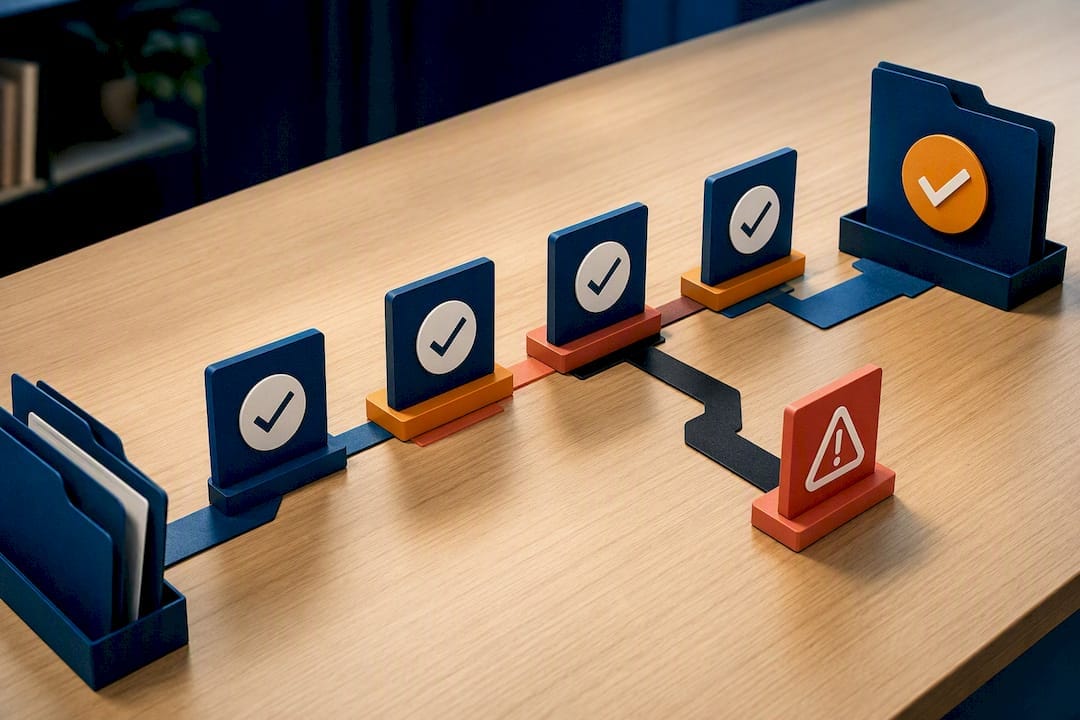
The most common failure points aren’t exotic. They’re incomplete cash-flow forecasts, vague use-of-funds statements, and founder documentation that doesn’t build credibility with an underwriter.
Fix each one directly:
- Replace vague projections with a real month-by-month cash-flow model covering a full year.
- Write a one-page use-of-funds memo that assigns a dollar figure to every major expense category.
- Assemble a founder background summary showing relevant experience, even if it’s outside your current industry.
Founders who tighten these three items in one to two weeks routinely shorten their underwriting back-and-forth. Nomad Excel’s guide on startup equipment financing walks through how to frame use-of-funds documentation for asset-heavy requests like 504 loans.
Should You Even Take a Loan, or Look at Grants and Equity Instead?
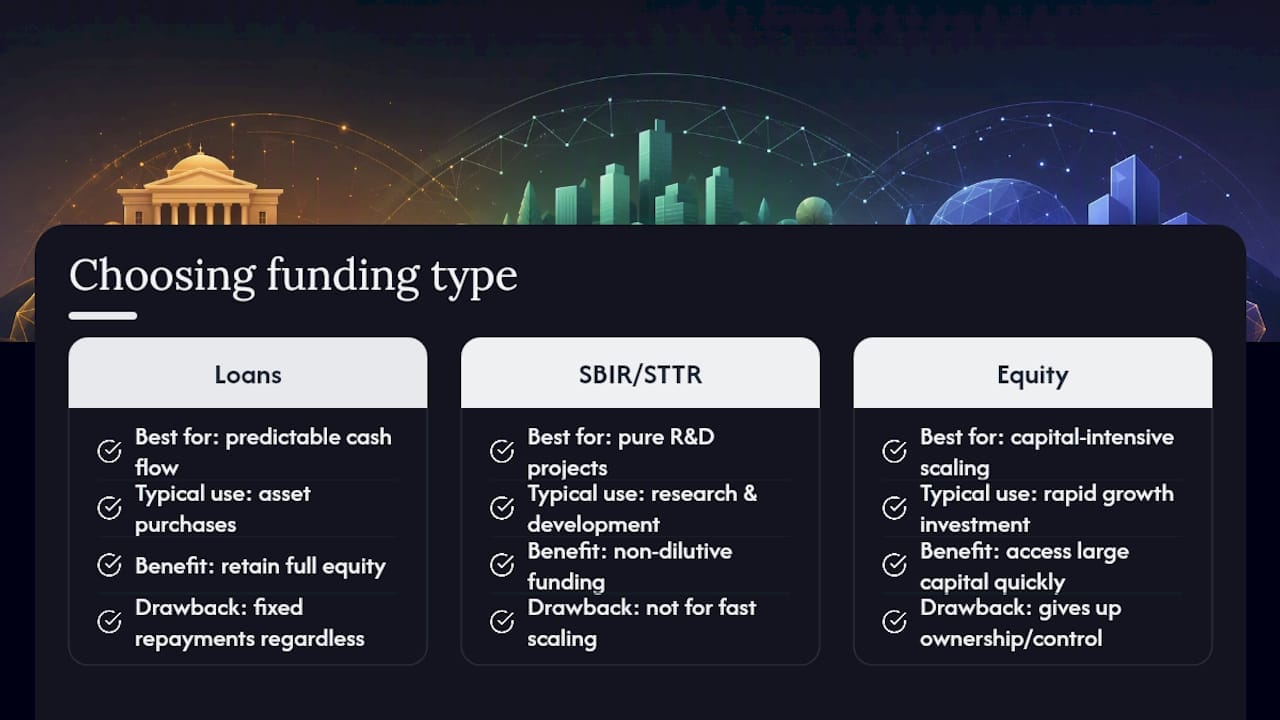
Loans suit predictable cash flow and asset purchases you can pay down over time. SBIR/STTR fits pure R&D, since it’s non-dilutive. Equity makes more sense for capital-intensive, high-growth scaling where speed matters more than keeping full ownership.
Debt keeps your equity intact but adds repayment pressure regardless of how revenue performs. That trade-off, control versus obligation, should drive the decision more than which option seems easiest to get approved for.
— Amichai
Build a Lender-Ready Application Before You Apply
SBA loans, SBIR/STTR, and SSBCI programs all reward founders who show up with clear numbers and a credible plan, not just an idea. That’s exactly the gap Nomad Excel’s Online Entrepreneurship Bootcamp is built to close. Over the course of the program, you work through cash-flow modeling, use-of-funds planning, and pitch materials with mentors who’ve built and funded companies themselves, the same documents lenders ask for during underwriting. Nomad Excel isn’t a lender and doesn’t issue loans or grants. It’s an educational program that prepares you to walk into a lender conversation with a package that holds up. If you’re weeks away from applying for a 7(a) or microloan and want your forecasts and founder story sharpened first, check the bootcamp’s current dates and pricing on the program page.
Where to Verify Program Details Before You Apply
- SBA loans overview and program-specific pages for 7(a), 504, and microloans
- Sbir for R&D award details and agency-specific solicitations
- Your state treasury or economic development site for SSBCI program contacts
This article is general information, not a substitute for advice from a qualified financial advisor. Consult a qualified financial professional about your own circumstances before acting on anything here.
Sources
- 7(a) loans | U.S. Small Business Administration
- SBIR/STTR application types (NSF/Triaged resource)
- State Small Business Credit Initiative (SSBCI) | U.S. Department of the Treasury
FAQ
Will the government give me money to start a business?
Not usually as a direct grant for general startup costs. The government backs loans through the SBA and funds R&D through SBIR/STTR awards, but most general startup funding still runs through private lenders using an SBA guarantee.
What is the government lender for startups?
There isn’t one. The SBA doesn’t lend directly for most programs. It guarantees loans made by participating banks, credit unions, and nonprofit intermediary lenders, which you find through SBA Lender Match.
How much is the payment on a $50,000 business loan?
It depends entirely on your term and rate. A longer, low-rate structure spreads the $50,000 across more months for a smaller payment, while a short-term loan concentrates repayment into a much higher monthly amount, so ask any lender for an amortization schedule before committing.
What’s the difference between SBA loans and SBIR/STTR grants?
SBA loans are debt you repay with interest, while SBIR/STTR provides non-dilutive awards for R&D, with Phase I typically running $50,000 to $275,000. Choose loans for predictable operating needs and SBIR/STTR when your startup is technology or research focused.
How can I improve my odds of getting an SBA-backed loan?
Build a complete, month-by-month cash-flow forecast, write a clear use-of-funds memo, and document your outreach to conventional lenders first. Programs like Nomad Excel’s entrepreneurship bootcamp help founders build exactly these materials before they approach a lender.
Comments are closed.