
Top Business Growth Accelerators 2025 for Early-Stage Founders
TL;DR:
- Early-stage founders should choose Nomadexcel’s bootcamp for practical, execution-focused business acceleration. The program offers daily sprints, mentor pairing, and a clear 30/60/90 action plan to ensure tangible progress. It is especially suitable for founders seeking validation, go-to-market strategy, and peer accountability within a short, intensive format.
For early-stage founders who want execution over theory, Nomadexcel’s immersive bootcamp is the strongest practical choice among business growth accelerators in 2025. The program pairs daily accountability sprints with direct mentor matching and closes with a concrete 30/60/90 action plan, so you leave with a real roadmap, not a certificate. Academic research confirms that accelerators act as innovation intermediaries, concentrating mentorship, rapid idea validation, and network access into a compressed window, which is exactly where immersive formats like Nomadexcel’s deliver the most.
Pro Tip: When screening any accelerator, check the mentor roster before the program’s brand name. A mentor who has built in your sector and stage will move your business faster than a prestigious logo on your pitch deck.
Table of Contents
- Who benefits most from immersive accelerators in 2026?
- What do immersive accelerators actually do?
- How do you choose the right accelerator in 2026?
- What outcomes should you realistically expect?
- Why Nomadexcel is a practical fit for early-stage founders
- How to apply and prepare for maximum impact
- Key Takeaways
- Immersion vs. longer accelerators: a candid take
- Nomadexcel’s bootcamp: what to do next
- Useful sources and further reading
Who benefits most from immersive accelerators in 2026?
Not every founder is at the right stage for an immersive program, and choosing the wrong format wastes both time and money. The clearest fits:
- Idea to pre-revenue founders who need structured validation frameworks and peer accountability to move from concept to first customer.
- Early-revenue founders ($0–$250K ARR) who have traction but lack a repeatable go-to-market system or a mentor network to pressure-test their strategy.
- Solo founders who benefit most from cohort community and external accountability, since they lack an internal team to challenge their thinking daily.
- Small co-founder teams (2–3 people) where one member can attend while the other maintains operations, then bring frameworks back to the team.
- Service-based and B2B SaaS founders whose growth depends on customer discovery and offer refinement, both of which immersive formats accelerate through structured interview sprints.
- Founders who can commit in-person for one to four weeks. If travel or visa logistics make that impossible, a hybrid or online cohort model is the practical alternative.
Sector matters too. Founders in regulated industries like healthcare or enterprise B2B often gain more from vertical or corporate-sponsored programs that provide domain-specific mentorship and procurement access, rather than generalist bootcamps.
What do immersive accelerators actually do?
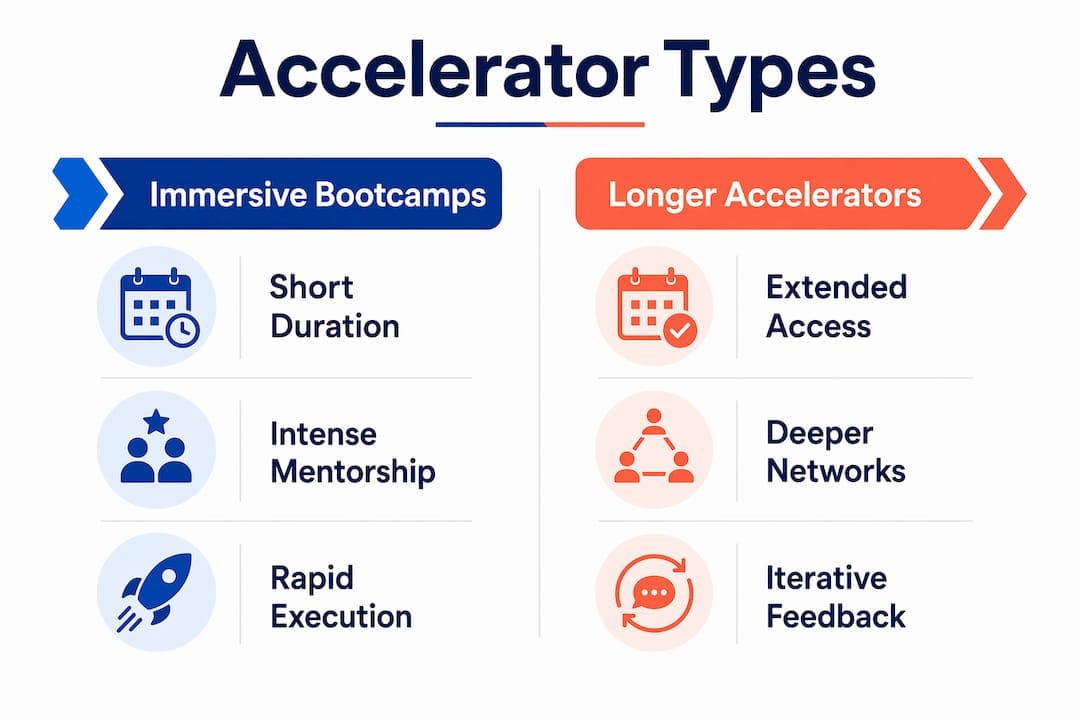
The format varies more than most founders expect. Understanding the structure before you apply saves you from committing to a program that does not match your current needs.
Common program formats:
- Short bootcamps (1–6 weeks): High-intensity, execution-focused. Daily sprints, mentor office hours, and a final pitch or demo day. Pennovation’s six-week Summer 2025 accelerator at the University of Pennsylvania is a strong example, pairing pre-seed to seed-stage founders with mentors through weekly education sessions and a closing Pitch Day.
- Cohort accelerators (8–16 weeks): Broader curriculum covering cash, strategy, people, and execution. The Entrepreneurs’ Organization Accelerator structures quarterly full-day learning events and monthly accountability groups for founders targeting $1M+ revenue.
- Retreat-style intensives (3–7 days): Compressed, immersive experiences focused on alignment, strategy, and team cohesion. Best for founders who need a reset and a clear 90-day plan rather than a full curriculum.
- Hybrid models: Remote cohort sessions combined with one or two in-person intensives. Growing in popularity post-2020 and practical for founders with geographic constraints.
Standard deliverables you should expect:
- A validated MVP or prototype with documented customer feedback
- 10–30 completed customer discovery interviews
- A go-to-market plan with defined channels and conversion targets
- A pitch deck and a live Demo or Pitch Day with investors or partners
Stat to know: A systematic review of business accelerators identified roughly 8,000 accelerators operating worldwide, with accelerator-related investment growing approximately 900% over a recent five-year period. With that many options, program selection is the highest-leverage decision a founder makes before applying.
How do you choose the right accelerator in 2026?
The single most common mistake founders make is applying to the most recognizable name rather than the best fit. Stage and sector alignment predict usable mentor matches and relevant introductions far more reliably than brand prestige.
Selection checklist:
- Does the program explicitly serve your current stage (idea, pre-seed, early-revenue)?
- Are at least three mentors on the roster with direct experience in your sector?
- Can you verify alumni outcomes, not just testimonials?
- Are equity and cost terms clearly stated upfront? Standard deals in the broader accelerator market range from $120K for 6% to $500K for 7%, so know what you are giving up permanently.
- Does the program produce a concrete deliverable (MVP, GTM plan, pitch deck) by the final day?
- Is there post-program support, alumni access, or investor follow-through after Demo Day?
Questions to ask on a discovery call:
- “Which mentors on your roster have built in [my sector]?”
- “What does a typical week look like, hour by hour?”
- “What is the average outcome for alumni at my stage six months after the program?”
- “How many investors attended your last Demo Day, and how many follow-on conversations resulted?”
Red flags to walk away from:
- Equity terms disclosed only after acceptance
- No mentor matches in your specific industry
- Vague deliverables (“you’ll gain clarity and connections”)
- No structured post-program support or alumni community
What outcomes should you realistically expect?
Accelerators do not guarantee funding. What they reliably produce, when the program fits, is compressed learning and validated direction. Here is a realistic post-program timeline:
- Days 0–30: Apply the frameworks immediately. Complete or expand your customer interview set. Refine your offer based on what you heard during the program.
- Days 30–90: Iterate your MVP based on customer feedback. Pursue early revenue or pilot agreements. Begin activating the mentor and investor introductions from Demo Day.
- Months 3–12: Fundraising conversations mature. Sales systems built during the program start producing consistent pipeline. Strategic partnerships initiated at Demo Day move toward signed agreements.
Realistic benchmark: The systematic review confirms that cohort-based bootcamps reliably produce idea validation and early customer access. Revenue and fundraising outcomes depend heavily on founder execution after the program ends, not the program alone.
Measuring ROI means comparing the equity or fees you paid against the acceleration in revenue probability or fundraising timeline. A program that costs $5,000 in fees but no equity and compresses six months of learning into six weeks has a very different ROI profile than one that takes 7% of your company permanently.
Why Nomadexcel is a practical fit for early-stage founders
Nomadexcel’s bootcamps are built around the principle that execution beats theory, every time. The mentorship process pairs founders directly with experienced operators and marketers, not just advisors who have never run a sales call. Daily sprints create accountability that most solo founders cannot manufacture on their own.
What the program delivers:
- Daily structured sprints with clear output targets
- Direct mentor pairing matched to your business model and stage
- Cohort accountability that continues after the program ends
- A 30/60/90 action plan completed before you leave
- Sharper go-to-market strategy, new revenue-driving skills, and an active peer community
The early-stage mentorship model Nomadexcel uses emphasizes mentor relevance over mentor prestige, which aligns with what the research consistently shows: a mentor who has navigated your exact market and stage is worth more than a famous name who cannot take your call. For founders who want to understand the full acceleration framework before applying, the startup acceleration guide covers program structure and expected deliverables in detail.
How to apply and prepare for maximum impact

Arriving prepared is the difference between getting surface-level value and leaving with a business that is genuinely further along.
Application tips:
- Lead with traction, not vision. Show customer conversations, revenue, or waitlist numbers.
- Write a one-paragraph problem-solution statement that a non-expert can understand in 30 seconds.
- Include a clear founder bio that explains why you are the right person to solve this problem.
Pre-program prep checklist:
- Complete at least five customer discovery interviews before day one
- Bring your current metrics: MRR, churn, conversion rate, CAC
- Have a working demo or prototype, even if rough
- Book travel and accommodation early for in-person programs; timezone conflicts kill cohort engagement in hybrid formats
- Draft a 30/60/90 template so you can fill it in during the program rather than starting from scratch
30/60/90 action plan structure to complete before you leave:
- Days 1–30: Three specific customer conversations, one offer refinement, one channel test
- Days 31–60: MVP iteration based on feedback, first revenue target or pilot agreement
- Days 61–90: Investor outreach or partnership activation, sales system documented and repeatable
Key Takeaways
Choosing the right growth accelerator in 2025 comes down to stage fit, mentor relevance, and a program that produces concrete deliverables, not just inspiration.
| Point | Details |
|---|---|
| Stage fit over prestige | Choose a program that explicitly serves your current stage; fit predicts mentor quality more reliably than brand recognition. |
| Mentor relevance is the priority | A mentor with direct experience in your sector and stage delivers more value than a well-known name with no industry match. |
| Equity is permanent | Standard accelerator deals range from $120K for 6% to $500K for 7%; weigh that cost against the network and acceleration you actually receive. |
| Deliverables signal program quality | Any program worth joining produces a concrete output: validated MVP, customer interviews, GTM plan, and a pitch day by the final session. |
| Nomadexcel’s execution-first model | Nomadexcel pairs daily sprints and direct mentor matching with a 30/60/90 action plan so founders leave with a concrete roadmap. |
Pro Tip: Before applying anywhere, spend 20 minutes reviewing the mentor roster on the program’s website. If you cannot find at least two or three mentors who have built in your sector, keep looking.
Immersion vs. longer accelerators: a candid take
The debate between short immersive bootcamps and longer cohort accelerators is real, and the right answer depends almost entirely on what you need right now.
Longer programs, typically 12–16 weeks, give you sustained investor access, a deeper alumni network, and the time to iterate through multiple feedback cycles. If your primary goal is a Series A raise and you need a credible signal for institutional investors, a longer program with strong VC relationships is worth the equity cost and the time.
But most early-stage founders are not ready for that conversation yet. What they need is clarity on their offer, validated customer demand, and the momentum that comes from executing alongside other driven founders. That is where immersive formats win. A focused week or four weeks of daily sprints, direct mentorship, and cohort accountability can move a founder further than three months of weekly Zoom calls.
Nomadexcel leans hard into that execution-first philosophy. The daily accountability structure and direct mentor pairing are designed for founders who need to move fast, not founders who need a prestigious logo for their next fundraising deck. If you are pre-seed and still validating, immersion is almost always the right call first.
Nomadexcel’s bootcamp: what to do next
Nomadexcel’s immersive entrepreneurship bootcamps bring together aspiring and early-stage founders for one to four weeks of hands-on business building, direct mentorship, and cohort accountability. The program is built for founders who want to leave with a sharper strategy, a validated offer, and a peer community that keeps pushing them forward after the program ends.
The Online Entrepreneurship Bootcamp is the clearest starting point for founders who want to apply now. For those still comparing formats, the guide to joining entrepreneurship bootcamps walks through what to expect, what to prepare, and how to evaluate whether the program fits your current stage. Review the program details, check the upcoming cohort dates, and submit your application with your traction metrics and a concise problem-solution statement.
Useful sources and further reading
These are the primary sources used throughout this article. Each one is worth reviewing directly before you apply to any program.
- A systematic review of business accelerators: functions, operation, and gaps — The academic backbone for understanding what accelerators actually do, the CIMO framework for evaluating them, and ecosystem-level outcome data including the 8,000 worldwide figure and the 900% investment growth stat.
- Pennovation Accelerator Summer 2025 — A concrete example of a university-affiliated, six-week cohort model with mentor pairing and a closing Pitch Day; useful for understanding what a structured short program looks like in practice.
- Entrepreneurs’ Organization Accelerator — Details on a revenue-milestone curriculum (cash, strategy, people, execution) targeting founders aiming for $1M+ revenue; check for eligibility requirements and cohort dates.
- ValueAddVC: Accelerator terms and comparison — The clearest public breakdown of equity and investment terms across major programs; read this before signing anything.
- Kurums: Best startup accelerators comparison — Practical guidance on prioritizing stage and sector fit over prestige; useful as a screening framework before you apply.
- Google for Startups Accelerator — Details on a cohort model pairing 10–15 growth-stage startups with Google experts through remote and in-person sprint projects; check eligibility requirements carefully, as the program targets Seed to Series A companies with technical depth.
This article is general information for educational purposes. Verify current program terms, equity structures, and deadlines directly with each program before applying.
Comments are closed.