
Explaining Business Pivots: A Founder’s Step-by-Step Guide
TL;DR:
- A business pivot is a strategic realignment of core business elements designed to improve value creation without a full restart. Founders should pivot early while maintaining current revenue streams and clearly communicate the reasons and changes to stakeholders. Structured programs like Nomad Excel’s bootcamps can accelerate the testing and implementation of successful pivots.
A business pivot is a deliberate strategic realignment of how you create, deliver, or capture value — not a restart, and not just a tweak. When your current model stops generating traction, a pivot lets you redirect your energy toward a better hypothesis while keeping the business alive. The frameworks founders rely on most are Lean Startup experimentation, the Business Model Canvas, and structured programs like Nomad Excel’s bootcamps and retreats, which compress the learning cycle considerably.
Table of Contents
- What exactly is a business pivot, and how does it differ from a restart?
- What types of pivots might you face as a founder?
- How do you know when it’s time to pivot?
- A practical framework for testing and executing a pivot
- Main risks in a pivot and how to manage them
- How to communicate a pivot to employees, customers, and investors
- KPIs to track and a sample pilot timeline
- How immersive programs help teams pivot faster
- Key Takeaways
- The pivot lesson most founders learn too late
- Nomadexcel’s bootcamps and retreats for founders navigating a pivot
- Useful sources and further reading
What exactly is a business pivot, and how does it differ from a restart?
A business pivot is a strategic realignment of one or more core dimensions of your business model: who you serve, what you sell, how you monetize, or how you deliver value. The mission stays intact. What changes is the method.
That distinction separates a pivot from a restart, which scraps the mission entirely, and from iteration, which refines execution without changing the model’s structure.
| Dimension | Pivot | Restart | Iteration |
|---|---|---|---|
| Core mission | Unchanged | New | Unchanged |
| Business model | One or more dimensions change | Fully replaced | Unchanged |
| Hypothesis-driven | Yes | Sometimes | No |
| Risk level | Medium | High | Low |
| Timeline | Weeks to months | Months to years | Days to weeks |
The distinction matters for resource planning and internal buy-in. A pivot preserves existing assets and customer relationships; a restart burns them. Mislabeling a pivot as a restart often triggers unnecessary panic and talent loss.
What types of pivots might you face as a founder?
Pivots span a wide spectrum, from minor adjustments to foundational business-model transformations. Broad model changes typically move three to five structural levers at once, which raises execution risk considerably.
- Product pivot (low risk): You change what you build while keeping the same customer. A B2B software team drops an underused module and doubles down on the one feature customers actually pay for.
- Customer-segment pivot (low–medium risk): You keep the product but redirect it at a different buyer. A fitness app built for gyms pivots to corporate wellness programs after noticing stronger conversion there.
- Revenue-model pivot (medium risk): You change how you charge — subscription to usage-based, or one-time license to managed service. Channel conflict is the most common unintended effect here.
- Technology/platform pivot (medium risk): You rebuild on a different technical foundation to unlock scale or reduce cost. Technical debt from the old stack is the primary hazard.
- Channel pivot (medium–high risk): You shift how you reach customers — direct sales to marketplace, or retail to direct-to-consumer. Existing channel partners may resist or retaliate.
- Problem pivot (high risk): You discover your original problem hypothesis was wrong and reframe the entire value proposition. This is the closest a pivot gets to a restart without actually being one.
How do you know when it’s time to pivot?
Acting while you still have momentum and runway is the single most important timing principle. Founders who wait until they are desperate have fewer options and less leverage to run a disciplined experiment.

Watch for these signal categories:
Sustained KPI gaps. If acquisition cost keeps rising while conversion stays flat across multiple quarters, the model has a structural problem, not an execution one.
Inconsistent customer fit. When your best customers look nothing like the segment you designed for, that mismatch is a signal worth investigating, not explaining away.
Profitable outliers. A small customer segment paying more, churning less, and referring others is often pointing you toward your real market.
Market pull. Inbound requests for a use case you never marketed are one of the clearest signals in early-stage businesses.
Team morale indicators. Persistent low energy around the core product, combined with excitement about a side experiment, is data. Ignore it at your own risk.
When you spot two or more of these signals converging over 6–8 weeks, that is your window. Write down the hypothesis before the window closes.
A practical framework for testing and executing a pivot
Academic reviews frame pivoting as a four-phase process: recognize, generate options, seize and test, and reconfigure. Here is how to run each phase in practice.
- Run a diagnostic. Map your current Business Model Canvas. Identify which dimension is underperforming and why. Pull three months of cohort data before forming any hypothesis.
- Write a 90-day success hypothesis. State clearly: “If we change X for customer segment Y, we expect to see metric Z by date D.” One hypothesis at a time. Vague direction produces vague results.
- Select 3–5 levers to change, not all of them. Sequencing pilots in a contained environment prevents cross-functional chaos and keeps the existing revenue model intact.
- Design a minimum viable test. Use Lean Startup experiments: the smallest version of the new direction that generates real customer behavior data. An app idea evaluation checklist can help you stress-test technical assumptions before committing resources.
- Run concentrated outbound validation. Set a hard decision date and collect 30–50 customer conversations before it arrives. Opinions without behavior data are noise.
- Evaluate at the decision gate. On the decision date, compare actual metrics against your hypothesis thresholds. Accelerate, iterate, or kill based on the data, not on optimism.
- Reconfigure deliberately. Once the pilot proves unit economics, shift resources, update the Business Model Canvas, and communicate the change to stakeholders with a clear timeline.
Main risks in a pivot and how to manage them
The four structural risks that derail most pivots are channel conflict, technical debt, incentive misalignment, and premature shutdown of existing revenue lines.
Pro Tip: Keep your current revenue model running while the new hypothesis is in pilot. Parallel running preserves cash and gives you real comparative data — killing the cash cow before the new model proves itself is one of the most common and costly founder mistakes.
Changing priorities is the hardest level of organizational change. New priorities require either a new value network or an autonomous team — a separate unit with its own resources and processes — to avoid being absorbed and neutralized by the legacy organization. Without that separation, the old model’s incentives will quietly strangle the new one.
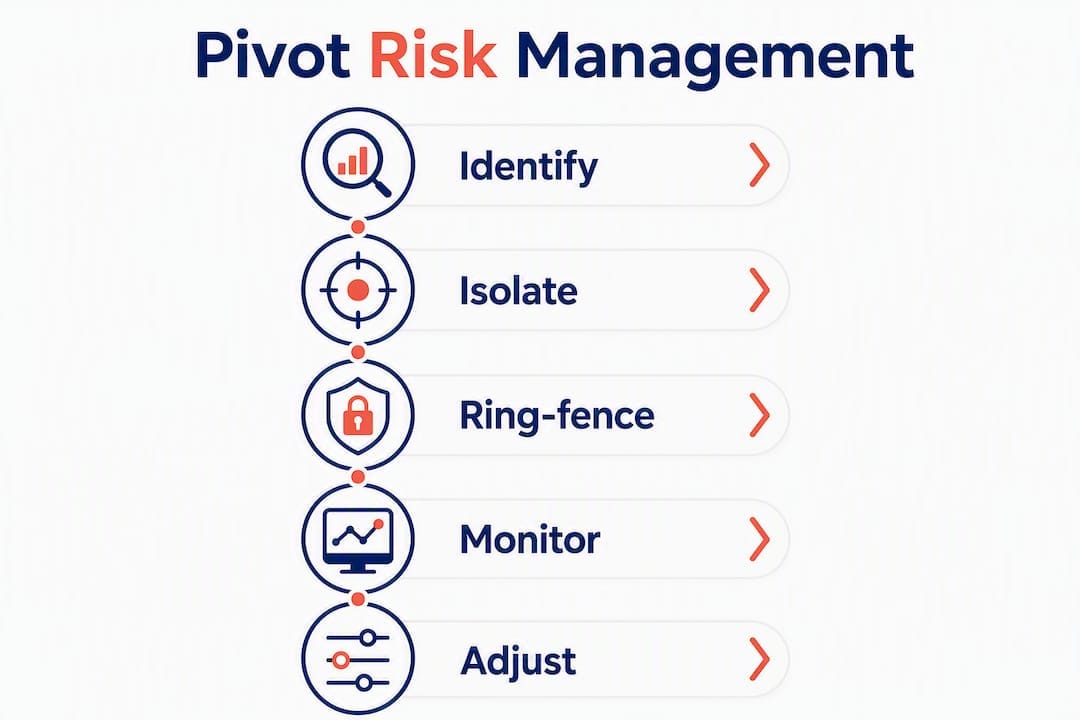
Operationally, isolate the pivot initiative in a dedicated team or pilot unit. Ring-fence its budget so it is not raided when the core business hits a rough quarter. Plan for technical debt remediation as a line item, not an afterthought. And build explicit decision gates into the calendar so the pivot never drifts indefinitely without accountability.
How to communicate a pivot to employees, customers, and investors
Transparency reduces resistance and preserves morale. The message structure differs by audience, but the principle is the same: explain the why before the what.
Employees: “Our mission is unchanged. We are changing how we pursue it because [specific signal]. Here is what changes for your team, here is what stays the same, and here is the owner for each workstream.” Weekly syncs and a named decision owner prevent rumor from filling the vacuum.
Customers: Lead with the benefit to them, not the internal logic. “We are focusing on [new capability] because our customers told us it solves [specific problem] better. Here is how we will help you migrate.” A direct email sequence with a clear migration path reduces churn.
Investors: State the thesis shift, the metrics that triggered it, and the timeline for the pilot. “We are testing [new direction] over 90 days. Our success threshold is [specific metric]. We will update you at the 45-day mark.” Investors respond to structure, not reassurance.
Update cadence matters as much as message quality. Weekly team syncs, a customer email at launch and at the 30-day mark, and a monthly investor brief keep everyone oriented without creating noise.
KPIs to track and a sample pilot timeline
Choose metrics that match your pivot type. Acquisition and activation metrics tell you whether the new direction attracts the right customers; conversion and retention tell you whether it keeps them.
| Pivot phase | Key metrics | “Good early traction” signal |
|---|---|---|
| Days 1–30: MVP launch | Activation rate, early conversion | — |
| Days 30–45: Validation | CAC, cohort retention at 30 days | CAC payback trending under 6 months |
| Days 60–90: Decision gate | Revenue per user, NPS, referral rate | Month-over-month retention improving |
| Days 90+: Scale or kill | Unit economics, gross margin | Gross margin at or above core business |
At each gate, compare actuals to your 90-day hypothesis. If two consecutive gates miss thresholds, iterate the hypothesis before scaling. If both exceed them, accelerate resource allocation. A milestone-based decision process keeps the pilot from drifting into an indefinite experiment.
How immersive programs help teams pivot faster
Structured, facilitated programs compress the pivot cycle in ways that solo founder work rarely matches. Nomad Excel’s bootcamps and retreats are designed specifically for this kind of accelerated decision-making.
During the recognition phase, facilitated workshops surface the KPI gaps and customer-fit signals that founders often rationalize away when working alone. During testing, structured sprints give teams a contained environment to run hypothesis experiments with daily accountability. During reconfiguration, cross-functional alignment sessions resolve the incentive conflicts that typically slow resource reallocation.
The teams that benefit most from immersive facilitation are early-stage founders facing a customer-segment or revenue-model pivot, and cross-functional teams managing a platform or channel shift. Both situations require rapid alignment across people with different incentives, which is exactly what a well-facilitated retreat or bootcamp accelerates. Entrepreneurship bootcamps provide the peer accountability and expert mentorship that make the difference between a pivot that stalls in planning and one that reaches a decision gate in 90 days.
Key Takeaways
A business pivot succeeds when you define a testable hypothesis, preserve existing revenue while piloting, and use hard decision gates to accelerate or kill the new direction before it drains your runway.
| Point | Details |
|---|---|
| Define the hypothesis first | Write a 90-day success statement with a specific metric and a hard decision date before changing anything. |
| Preserve runway | Keep the current revenue model running in parallel while the pilot is active. |
| Isolate the experiment | Assign a dedicated team and ring-fenced budget to prevent the legacy model from absorbing the new initiative. |
| Communicate with structure | Give employees, customers, and investors a clear message: why the pivot, what changes, what stays, and who owns it. |
| Nomadexcel accelerates the cycle | Bootcamps and retreats compress hypothesis testing, team alignment, and decision-making into structured, accountable sprints. |
The pivot lesson most founders learn too late
The conventional wisdom says a pivot is a sign of failure. That framing is wrong, and it causes real damage. Founders who internalize it either avoid pivoting until the business is in crisis, or they pivot reactively without a hypothesis, which is just thrashing with extra steps.
The harder truth is that most pivots fail not because the new direction was wrong, but because the founder killed the old model before the new one could prove itself. One team I have seen described in founder communities ran a services business while quietly building a software product on the side. When the software hit early traction, they had the cash flow and the customer relationships to migrate deliberately. The teams that shut down services on day one of the software experiment had no such cushion.
The other underestimated factor is the emotional work. Pivoting means telling your team, your customers, and sometimes yourself that the original plan was not the right one. That conversation requires clarity and confidence, not apology. The founders who communicate a pivot as a disciplined, evidence-based decision earn more trust than those who frame it as a crisis response.
Agility matters, but as HBR’s 2024 guidance makes clear, agility without discipline is just instability. Change the means, keep the goals stable, and let the data drive the gate decisions.
Nomadexcel’s bootcamps and retreats for founders navigating a pivot
Founders who want structured support running a pivot have a concrete option in Nomadexcel’s online entrepreneurship bootcamp and company retreats. The programs are built around the same four-phase pivot cycle covered in this article: hypothesis design, rapid testing, cross-functional alignment, and reconfiguration. Participants work through facilitated sprints with experienced mentors and a peer cohort that challenges assumptions in real time. For teams managing a model change, the startup retreat format adds the structured alignment sessions that prevent incentive conflicts from stalling execution. If you are ready to move from signals to a tested hypothesis, check the current bootcamp dates and apply directly.
Useful sources and further reading
- Shopify: What Is a Business Pivot? — Definitions, pivot types, and real-world examples; good starting reference for founders new to the concept.
- First Round Review: Pivot Meaning — Practitioner-level guidance on timing, parallel running, and organizational design for pivots.
- DigitalOcean: When and How to Make a Business Pivot — Step-by-step execution checklist including post-mortem, customer research, and launch steps.
- HBR: Is It Time to Pivot Your Strategy? — Disciplined agility framework; essential reading before deciding whether a pivot is actually warranted.
- Shopify Enterprise: Business Model Transformation — Leadership guide to sequencing model changes and selecting levers; includes pilot measurement guidance.
- TIJAB: Rethinking Pivot Decisions — Academic systematic review of pivot frameworks; source for the four-phase process model.
- Blueprint AI: Technical Blueprints for Startups — Practical guide to avoiding technical debt and sequencing architecture decisions during a model change.
- Nomadexcel: Lean Startup Rapid Validated Growth — Internal explainer on Lean Startup experiments and validation methods for founders.
Comments are closed.