
Why Alignment Drives Growth for Entrepreneurs and Teams
Alignment is the operating mechanism that converts strategy into measurable, repeatable growth. When your teams share the same priorities, decision rights, and feedback loops, execution accelerates. Without it, even a well-funded company with a sharp strategy stalls. Companies that unify marketing, sales, and service functions are significantly more likely to exceed revenue targets, and frameworks like OKRs give that unity a single source of truth. Nomadexcel’s bootcamps and retreats are built around exactly this principle: close the gaps first, then scale.
Three gaps block most teams before they ever reach their growth targets:
- Translation Gap: Strategy stays at the leadership level and never becomes clear team-level objectives.
- Visibility Gap: Teams work in parallel without seeing each other’s priorities, creating duplicated effort and wasted resources.
- Feedback Gap: Customer and operational signals get trapped in one function, so the rest of the organization keeps making decisions on stale assumptions.
Table of Contents
- What are the three alignment gaps that actually stop growth?
- How closing those gaps produces measurable growth
- Which practical levers create and lock in alignment?
- Why leadership alignment has to come first
- How to run a practical 90-day alignment sprint
- How do you measure alignment and the ROI it creates?
- What immersive bootcamps and retreats do for alignment speed
- Key Takeaways
- A practitioner’s perspective on what alignment actually requires
- Nomadexcel can help your team align faster
- Suggested further reading and sources
What are the three alignment gaps that actually stop growth?
As teams scale beyond informal coordination, what worked at eight people breaks at twenty-five. The three gaps above are not communication problems. They are structural failures with predictable operational consequences.
- Translation Gap: The CEO announces a pivot to enterprise. Product keeps building for SMBs. Sales still pitches the old ICP. The strategy never lands because no one translated it into team-level objectives with owners and deadlines.
- Visibility Gap: Marketing launches a campaign the same week product ships a conflicting feature. Neither team knew. The result is duplicated effort, confused buyers, and a slower sales cycle.
- Feedback Gap: Support logs fifty tickets about a broken onboarding step. That insight never reaches product or marketing. The feedback loop between execution and leadership stays broken, and the offer keeps underperforming.
Each gap has a direct cost: wasted sprint capacity, missed revenue, and slower learning cycles that compound over quarters.
How closing those gaps produces measurable growth
Alignment creates three causal chains that directly affect revenue and margin.
- Clarity drives speed. When every team knows the three company priorities this quarter, decisions that used to require a meeting happen in a Slack thread. Cascading goals preserve strategic fidelity from leadership to front-line teams, cutting decision latency.
- Visibility eliminates duplication. Shared dashboards and integrated roadmaps mean two teams stop building the same feature or running overlapping campaigns. That recovered capacity goes toward growth initiatives instead.
- Feedback accelerates learning. A closed feedback loop means a pricing experiment in sales informs the next product sprint within days, not quarters.
Companies that unify marketing, sales, and service are twice as likely to exceed revenue targets, according to McKinsey research cited by Martech.org. Coordination makes strategy executable.
On the operational side, consolidating internal platforms and decommissioning redundant tools frees capital directly. Organizations that reduce tool sprawl report measurable drops in software spend, and those savings flow straight to margin. Alignment, in other words, is both a revenue lever and a cost lever working simultaneously.
Which practical levers create and lock in alignment?
Frameworks
- OKRs act as the single source of truth that translates strategy into measurable team objectives. Every team’s key results connect to a company-level objective, so priorities are never ambiguous.
- Team charters define decision rights, escalation paths, and meeting norms before conflict forces the conversation.
- Org principles (written, public, updated quarterly) set the rules of the game so new hires align faster.
Platform consolidation
Reduce your tool count deliberately. When updates live in too many places, teams spend more time reconstructing context than moving work forward. Pick one project-management platform, one communication hub, and one shared dashboard. Decommission everything else.

Operating rhythms
Enterprises that sustain alignment use fixed cadences to keep vision, strategy, and execution connected:
- Weekly team updates close the Visibility Gap by surfacing blockers before they compound.
- Monthly business reviews check OKR progress and surface cross-functional dependencies.
- Quarterly planning resets priorities and reallocates resources based on what the data shows.
Implementation priority:
- Define 3–5 company priorities this quarter (one session, CEO-led).
- Cascade to team OKRs within two weeks.
- Stand up a shared dashboard with leading metrics.
- Lock in the weekly and monthly cadences before adding anything else.
Pro Tip: Minimum viable management means enough process to coordinate, not enough to suffocate speed. Start with one weekly sync and one shared doc before you build a full operating system.
Why leadership alignment has to come first
Leadership alignment is the precursor to organizational alignment. Without a clear, shared understanding of who makes which decisions, cascading accountability fails before it starts. A study of 120 organizations found consensus among only 9% of respondents when asked who sits on their leadership team. That ambiguity is where most alignment efforts collapse.
Checklist for clarifying leadership composition:
- Name every member of the leadership team explicitly, in writing.
- Define decision thresholds: what each leader can decide alone vs. what requires the group.
- Set an escalation path for cross-functional conflicts.
- Assign collective accountability for at least one cross-functional OKR.
Sample leadership-level OKR:
- Objective: Achieve profitable growth in the core product line this quarter.
- KR1: Increase net revenue retention to 110% by end of quarter.
- KR2: Reduce customer acquisition cost by 15% through shared GTM priorities.
- KR3: Ship one cross-functional initiative (product + marketing + sales) on schedule.
When trust, transparency, and shared decision-making are present at the leadership level, execution speeds up throughout the organization without lowering standards.
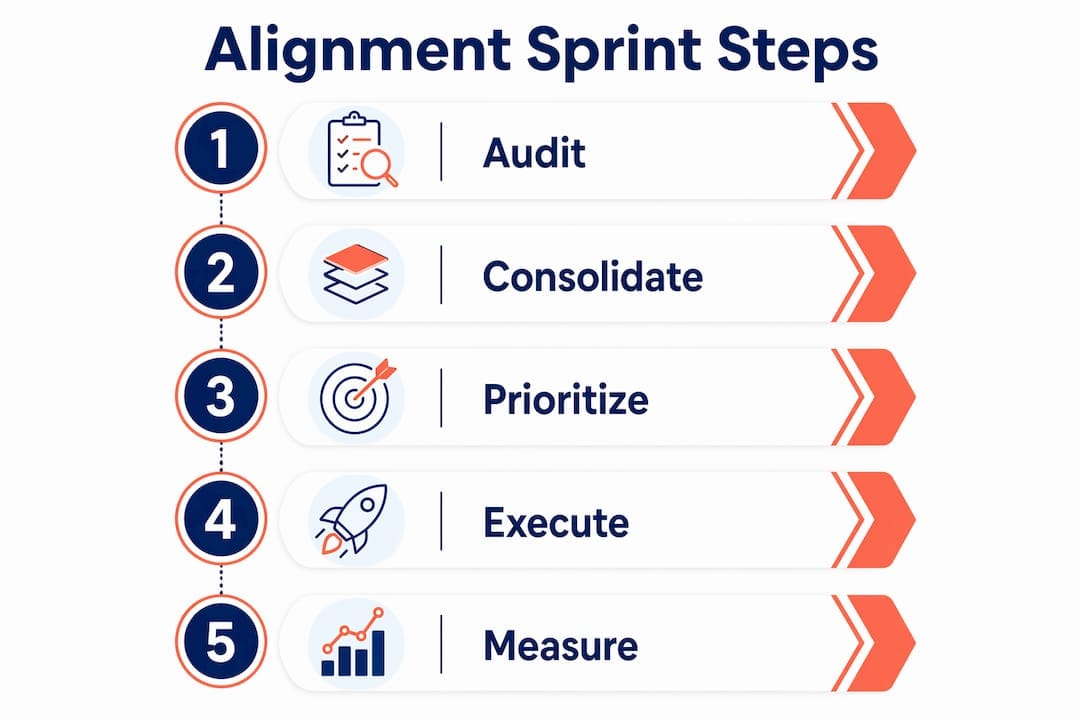
How to run a practical 90-day alignment sprint
| Phase | Weeks | Owner | Key Artifact | Expected Outcome |
|---|---|---|---|---|
| — | — | CEO/Founder | Alignment audit | Gaps identified, sprint scoped |
| Phase 1: Diagnose | Weeks 1–4 | CEO + Heads | Team charters, company OKRs | 3–5 shared priorities, decision rights clear |
| Phase 2: Execute | Weeks 5–7 | Ops + GTM + Product | Integrated roadmap, shared dashboard | Tool consolidation begun, weekly cadence live |
| Phase 3: Measure | Weeks 8–12 | All leads | Feedback loop, retrospective | ROI measured, successful pilots scaled |
Sprint launch checklist:
- Alignment audit complete (survey or structured interviews)
- Leadership team composition confirmed in writing
- Company OKRs drafted and reviewed
- Tool inventory completed; redundant platforms flagged
- Weekly sync scheduled for all team leads
Phase outcomes to expect: reduced tool spend, one shared dashboard, 3–5 company priorities with named owners, and a feedback loop that surfaces customer signals within the same sprint cycle. For setting team goals that hold across the sprint, build each team OKR directly from the company-level objective before Phase 1 closes.
How do you measure alignment and the ROI it creates?
Leading metrics tell you whether alignment is building before revenue moves:
- Employee alignment score (quarterly pulse survey)
- OKR completion velocity (percentage of key results on track at week 6)
- Meeting-to-decision ratio (decisions made per meeting vs. decisions deferred)
- Dependency success rate (cross-team handoffs completed on time)
Lagging metrics confirm the financial impact:
- On-time delivery of strategic initiatives
- Revenue growth rate vs. target (before/after cohort comparison)
- Tool-cost savings after platform consolidation
- Retention of key performers (a leading proxy for cultural alignment)
A simple attribution method: run a pilot in one business unit with full alignment practices, keep a control unit running as-is, and compare initiative delivery speed and revenue contribution at the 90-day mark. The delta is your alignment ROI. Pair this with a shared dashboard tracking OKR progress, tool spend, and customer satisfaction in one view.
What immersive bootcamps and retreats do for alignment speed
The fastest way to close all three gaps simultaneously is to remove the team from daily operations and work on the business in a structured, facilitated environment. A Nomadexcel-style retreat compresses weeks of misaligned meetings into two to four focused days.
A typical retreat rhythm looks like this:
- Day 1: Alignment audit, leadership team composition confirmed, Translation Gap mapped.
- Day 2: Company OKRs drafted, tool inventory completed, redundant platforms flagged for decommission.
- Day 3: Integrated roadmap built, cross-functional dependencies named, owners assigned.
- Day 4: 90-day sprint launched, weekly cadence locked, accountability structure confirmed.
Participant outcomes from this format include one integrated roadmap, a consolidated tool stack, a clear owner structure, and immediate clarity on the three to five priorities that will drive the next quarter. The peer collaboration that happens between founders and team leads during these sessions accelerates trust-building in ways that no weekly sync can replicate.
A focused 2–4 day retreat followed by a 90-day accountability cadence is the shortest path from strategic intent to measurable execution. The immersive format forces the decisions that distributed teams defer for months.
For teams that want to replicate this independently, the same structure applies: block two days off-site, run the audit and OKR session on day one, build the roadmap and consolidate tools on day two, then hold weekly check-ins for the following twelve weeks.
Key Takeaways
Alignment is the operating mechanism that turns strategy into repeatable growth, and the fastest teams close the Translation, Visibility, and Feedback gaps before they try to scale anything else.
| Point | Details |
|---|---|
| Close the three gaps first | Translation, Visibility, and Feedback gaps each have a direct cost; fix them before scaling. |
| Leadership alignment is the starting point | Only 9% of organizations agree on who is on their leadership team — clarify this in week one. |
| OKRs as single source of truth | Cascade company OKRs to team level within two weeks of setting company priorities. |
| Measure leading and lagging metrics | Track OKR velocity and meeting-to-decision ratio before revenue moves; use tool-cost savings as ROI proof. |
| Nomadexcel accelerates the curve | A Nomadexcel bootcamp or retreat compresses the 90-day sprint into a structured, facilitated format with daily accountability. |
A practitioner’s perspective on what alignment actually requires
Most teams arrive at an alignment conversation believing they have a communication problem. What they actually have is a decision-rights problem. No amount of better messaging fixes a team where no one is sure who owns the call.
The other thing worth saying plainly: alignment is not consensus. It is shared understanding of trade-offs, clear ownership, and commitment to decisions even when individuals disagree. The leadership teams that move fastest are not the ones where everyone agrees. They are the ones where disagreement happens quickly, a decision gets made, and everyone executes. That distinction changes how you design your operating rhythms, your OKRs, and your retreat agendas. Build for commitment, not comfort.
Nomadexcel can help your team align faster
If the 90-day sprint in this guide maps to where your team is right now, Nomadexcel’s entrepreneurship bootcamps and team retreats are built to run exactly that sprint in a structured, immersive format. Each program combines facilitated alignment workshops, daily accountability, mentorship from experienced operators, and a peer community that keeps the momentum going after the program ends. For teams evaluating the right format, the retreats vs. bootcamps comparison page walks through which structure fits your situation. Reach out to scope a program or check the next cohort start date.
Suggested further reading and sources
- Why internal alignment is your real growth engine — Martech.org; covers the revenue impact of unified functions and the mechanics of operational clarity.
- Leadership Team Alignment: Lessons From the Trenches — INSEAD Knowledge; the 9% consensus finding and collective accountability framework.
- Business alignment and OKRs — The OKR Hub; practical guidance on cascading objectives as a single source of truth.
- Strategic alignment in enterprise organizations — Profit.co; operating rhythms and the three-gap framework.
- The ROI of alignment: how internal coordination fuels growth — Balances.cloud; tool consolidation and margin improvement data.
- How to Keep Teams Aligned During Growth — Startupik; scaling alignment systems beyond informal communication.
- Nomadexcel Online Entrepreneurship Bootcamp — Primary program page for cohorts; use this if you want a structured sprint with facilitation and mentorship.
- Inspiring Business Retreats for Remote Teams — Nomadexcel retreat page; use this if your team needs an off-site alignment format rather than a multi-week bootcamp.
- What Is Entrepreneurial Alignment and Why It Matters — Nomadexcel; foundational reading on alignment for entrepreneurs and early-stage teams.
Comments are closed.