
Step-by-Step Mentoring Process for Bootcamp Founders
TL;DR:
- A five-stage mentoring process helps bootcamp mentors and mentees achieve measurable business results through structured relationships.
- Using a signed Personalized Development Plan and clear goals, this approach maximizes accountability and progress.
A repeatable step-by-step mentoring process for bootcamps uses five stages and a written Personalized Development Plan (PDP) to convert mentor time into measurable business outcomes. The five stages are: rapport and grounding, setting direction and goals, progression and action, winding down, and closure and celebration. To start immediately, do three things in the next 48 hours: draft your PDP with at least two specific goals and success metrics, schedule your first mentoring session with a 30-minute launch agenda, and share both documents with your mentor before that first call.
Your first 3 actions (next 48 hours):
- Draft your PDP: name two specific goals, one success metric each, and a target date.
- Block a 30-minute kickoff session with your mentor and send a short agenda in advance.
- Create a shared session-notes document so both parties can log commitments and follow-ups.
Table of Contents
- What is the five-stage mentoring framework and why does it work?
- How to build a week-by-week mentoring plan for any bootcamp length
- How to build a PDP and Mentoring Agreement that actually holds
- What does a single mentoring session actually look like?
- How do you measure progress and know when to pivot?
- How to end a mentorship well and keep momentum going
- Common pitfalls and how to fix them fast
- Key Takeaways
- Why structure is the real accelerant in mentorship
- Nomadexcel’s bootcamps put this process into practice
- Useful sources and further reading
What is the five-stage mentoring framework and why does it work?
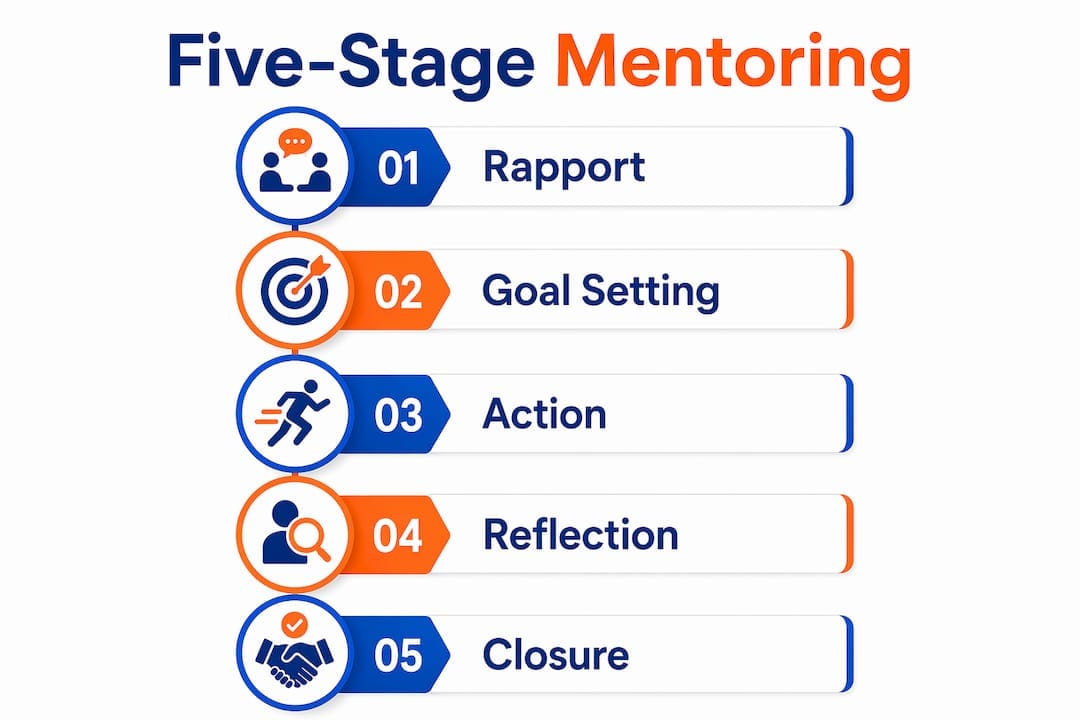
The five-stage framework gives every bootcamp pair a shared map, so neither mentor nor mentee wastes time figuring out what the relationship is supposed to do. Structured mentoring programs use this cycle to align expectations, communication frequency, and accountability from day one. Each stage has a distinct purpose, and moving through them in sequence is what separates a productive mentoring relationship from a series of good conversations.
Here is a one-sentence intent for each stage:
- Rapport and grounding: Build the trust and self-awareness both parties need before any goal-setting begins.
- Setting direction and goals: Agree on specific, measurable outcomes and the plan to reach them.
- Progression and action: Execute, iterate, and track results inside structured sessions.
- Winding down: Consolidate learning, assess progress, and prepare for independence.
- Closure and celebration: Document outcomes, express gratitude, and hand off to the next stage of growth.
The sequence matters because skipping rapport to rush into goals produces misaligned plans, while skipping closure leaves entrepreneurs without a clear record of what they achieved. Research on effective mentoring relationships confirms that a structured approach consistently improves outcomes compared to informal arrangements.
| Stage | Purpose | Quick checklist |
|---|---|---|
| Rapport and grounding | Establish trust and shared values | Introductions, values alignment, communication style check |
| Direction and goals | Set measurable targets | PDP drafted, S.M.A.R.T. goals agreed, milestones mapped |
| Progression and action | Execute and iterate | Weekly sessions, KPI tracking, feedback loops active |
| Winding down | Consolidate and transfer ownership | Progress review, PDP revisited, independence assessed |
| Closure and celebration | Document and celebrate | Final review, outcomes recorded, alumni handoff complete |
Stage durations shift with program length. In a one-week intensive, rapport and goal-setting compress into a single two-hour kickoff. A four-week sprint allocates roughly one week per stage. An 8–12 week cohort program allows two to three weeks for the action stage, giving entrepreneurs enough time to run real customer experiments before the final review.
How to build a week-by-week mentoring plan for any bootcamp length
The plan below adapts to three common formats. Treat it as a starting template, not a rigid script.
Week 0 (onboarding, all formats):
- Mentors and mentees complete a one-page expectations brief covering availability, communication preferences, and non-negotiable boundaries.
- Both parties co-author the PDP/Mentoring Agreement before the first official session.
- Set up a shared workspace (Google Docs, Notion, or a structured mentoring platform like Mentoloop) for session notes, KPI tracking, and document storage.
1-week intensive:
- Day 1 morning: kickoff session, PDP finalized, first goal confirmed.
- Days 2–4: one 30-minute daily check-in; mentor asks two open-ended questions per session, mentee reports on one concrete action completed.
- Day 5: closure session, outcomes documented, next-step commitments written down.
4-week sprint:
- Week 1: rapport and goal-setting; PDP signed, first KPI baseline recorded.
- Weeks 2–3: two sessions per week, alternating between challenge-focused and progress-review formats.
- Week 4: winding down and closure; final review, celebration, alumni handoff.
8–12 week cohort program:
- Weeks 1–2: onboarding and rapport; mentor and mentee meet twice, PDP finalized by end of week 2.
- Weeks 3–8: weekly 60-minute sessions; mid-program review at week 5 or 6.
- Weeks 9–11: winding down; mentee leads sessions, mentor shifts to coaching questions only.
- Week 12: closure session, documented outcomes, 30/90-day follow-up plan agreed.
Mentor responsibilities each week: prepare two to three open-ended questions, review the mentee’s progress notes before each session, and send a brief written reflection within 24 hours of each meeting.
Mentee responsibilities each week: complete agreed actions before the next session, update the shared KPI tracker, and bring one specific challenge to every meeting.
Pro Tip: In short intensives, compress the winding-down stage into the final session’s last 15 minutes rather than skipping it. Entrepreneurs who articulate what they learned out loud retain and apply it at a measurably higher rate than those who simply move on.
How to build a PDP and Mentoring Agreement that actually holds
A signed PDP is the single document that keeps a mentoring relationship from drifting after the first two weeks. Programs that require PDPs see better alignment and sustained engagement throughout the program cycle. Fill in every field at onboarding, not after the first session.
Required PDP fields:
- Competency goals: two to three specific skills or business outcomes (e.g., “complete five customer discovery interviews by week 3”).
- Success metrics: one measurable indicator per goal (revenue target, prototype milestone, number of paying users).
- Timeline and milestones: dates for each milestone, not just a program end date.
- Communication cadence: meeting frequency, preferred channel, and expected response time.
- Confidentiality and boundaries: what stays inside the relationship and what topics are off-limits.
- Review cadence: scheduled mid-program and end-of-program review dates.
Making goals S.M.A.R.T. in a bootcamp context:
- Replace vague intentions (“grow my audience”) with output-based targets (“publish two lead-generation posts per week and track click-through rate”).
- Attach a deadline to every goal, even if it is a rolling weekly target.
- Agree on how you will both know the goal has been met before the program ends.
A PDP that lists boundaries and off-limits topics is the most underused tool for preserving momentum past the first month. Without it, scope creep and mismatched expectations are almost inevitable. The NEXT-Mentoring program model uses a PDP form that specifies goals, resources, barriers, meeting frequency, and responsibilities as a standard onboarding requirement.
What does a single mentoring session actually look like?
Every session should follow a reproducible structure so neither party walks away wondering what just happened.
60-minute session agenda:
- 0–5 min: check-in (energy level, one win since last session)
- 5–15 min: progress update against last session’s commitments
- 15–40 min: focused challenge (mentee presents one problem; mentor asks, does not solve)
- 40–50 min: options discussion (mentor offers two to three perspectives as possibilities, not directives)
- 50–58 min: commitments (mentee states two specific actions with deadlines)
- 58–60 min: close (one-sentence reflection from each party)
30-minute version: cut the options discussion to five minutes and limit commitments to one action.
Mentor question prompts that surface limiting beliefs without prescribing answers:
- “What would you do if you knew you couldn’t fail?”
- “What’s the real cost of not deciding this week?”
- “What have you tried that hasn’t worked, and what did it tell you?”
- “Who else has solved a version of this problem, and what can you borrow from them?”
These prompts draw on the principle that effective mentors ask more questions than they give instructions, which builds the mentee’s independent decision-making over time. Treat sessions as strategic “knowledge capture” moments, not tactical execution reviews.
Pro Tip: Practice gradual release of responsibility. In weeks 1–2, a mentor might offer a direct suggestion. By weeks 5–6, the same mentor should be responding almost entirely with questions. The shift signals that the mentee is ready to own their decisions, and that transition is where real independence gets built.

How do you measure progress and know when to pivot?
Tracking progress objectively prevents the common trap of feeling busy without moving forward. Define KPIs at the PDP stage, not mid-program.
Practical KPIs for early-stage entrepreneurs:
- Number of customer discovery interviews completed
- Prototype or MVP milestone reached (yes/no per week)
- Revenue or pre-sales generated
- Weekly commitment completion rate (actions agreed vs. actions done)
- Skills demonstration (e.g., delivered a pitch, ran a sales call)
| KPI | Week 2 baseline | Week 5 check | Week 8 target | Status |
|---|---|---|---|---|
| Customer interviews | 0 | 3 | 8 | On track |
| Commitment completion | — | 60% | — | Needs attention |
| Revenue/pre-sales | $0 | $0 | — | At risk |
| Prototype milestone | Draft | V1 live | V2 tested | On track |
Mid-program review checklist:
- Has the mentee completed at least 70% of agreed actions?
- Are KPIs trending toward targets, or have they stalled for two consecutive weeks?
- Does the PDP still reflect the mentee’s actual priorities?
- Is the mentor-mentee relationship still productive and respectful?
Decision rules: if two consecutive KPI reviews show no movement, re-scope the PDP. If the mentor-mentee fit is genuinely broken after an honest reset conversation, a graceful reassignment is better than a stalled relationship. Qualitative indicators matter too: growing confidence, more independent problem framing, and fewer “what should I do?” questions are all signs the process is working.
How to end a mentorship well and keep momentum going
Closure is the stage most often skipped, and skipping it leaves entrepreneurs without a clear record of what they built. A structured ending preserves gains and creates a natural bridge into community support.
Closure checklist:
- Schedule a dedicated final review session (not tacked onto a regular meeting).
- Document three to five concrete outcomes the mentee achieved during the program.
- Celebrate: a written acknowledgment, a short video message, or a cohort shoutout all work.
- Complete the alumni handoff: introduce the mentee to relevant community channels, peer groups, or next-stage resources.
- Agree on a 30-day and 90-day check-in, even if it is just a brief async message.
Short celebration rituals reinforce learning and create social proof. A mentee who articulates their wins publicly, even in a small cohort Slack channel, is more likely to sustain momentum than one who quietly moves on. Post-mentorship follow-up plans work best when they are written into the PDP at the start, not improvised at the end.
Common pitfalls and how to fix them fast
Even well-structured mentoring relationships hit friction. Recognizing the pattern early is what separates a recoverable dip from a stalled program.
Red flags and corrective actions:
- Missed meetings (two or more in a row): Reset cadence immediately. Send a short message: “I want to make sure this is still working for you. Can we agree on a new meeting time and what happens if one of us needs to reschedule?”
- Mentor doing the execution: Reframe every tactical request with a question: “What’s your instinct here?” Mentors who force their experience onto mentees risk stunting independent thinking.
- Scope creep (new goals added without removing old ones): Return to the PDP. Agree that adding a goal requires removing or deferring another.
- Over-dependence: Shift to coaching questions exclusively for two sessions. If the mentee still cannot move without explicit direction, name the pattern directly and discuss it.
- Bandwidth mismatch: If a mentor cannot consistently show up, a graceful exit is better than a half-present relationship. Use this script: “I want to be honest that my availability has changed. Let’s talk about whether a different cadence or a different mentor would serve you better right now.”
Boundary issues are easier to prevent than to fix. The PDP’s confidentiality and off-limits fields exist precisely for this reason. Revisit them at the mid-program review, not only at onboarding.
Key Takeaways
A structured, five-stage mentoring process with a signed PDP is the most reliable way to turn bootcamp mentor time into concrete, measurable business progress.
| Point | Details |
|---|---|
| Start with a signed PDP | Define two to three specific goals, success metrics, and a review cadence before the first session. |
| Match stage duration to program length | Compress or expand each stage to fit 1-week intensives, 4-week sprints, or 8–12 week cohorts. |
| Use KPIs from day one | Track customer interviews, commitment completion, and revenue milestones weekly, not just at program end. |
| Gradual release of responsibility | Shift from direct advice to coaching questions by mid-program to build mentee independence. |
| Nomadexcel bootcamps | Nomadexcel applies this five-stage framework across its immersive entrepreneurship bootcamps, pairing daily accountability with structured mentor sessions. |
Why structure is the real accelerant in mentorship
Most mentoring relationships fail not because of bad chemistry but because of missing architecture. Two people with good intentions and no shared framework will drift into pleasant conversations that produce no accountability and no measurable change. The five-stage process is not bureaucracy; it is the scaffolding that lets the human relationship do its best work.
What gets underestimated is the PDP’s role past the first week. Mentors and mentees who revisit their agreement at the mid-program review consistently catch misalignment before it becomes a stalled relationship. The document is not a contract; it is a shared memory of what both parties agreed mattered. Early-stage mentorship is particularly vulnerable to drift because founders are moving fast and priorities shift weekly. The PDP holds the line.
The gradual release of responsibility is the other piece most programs skip. A mentor who is still giving direct answers in week eight has not mentored; they have consulted. The goal is an entrepreneur who can frame their own problems, generate their own options, and make confident decisions. That only happens when the mentor deliberately steps back, and the session agenda is the mechanism that makes stepping back feel structured rather than abandoning.
Nomadexcel’s bootcamps put this process into practice
Nomadexcel builds the five-stage mentoring framework directly into its online entrepreneurship bootcamp, pairing each participant with experienced mentors who follow structured session agendas, PDP-based goal tracking, and weekly accountability sprints. Participants leave with documented outcomes, a peer community that stays active after the program ends, and the decision-making confidence that comes from a mentor who knew when to ask instead of answer. If you are ready to put this process to work inside a program designed for it, explore the Nomadexcel bootcamp program and apply for the next cohort.
Useful sources and further reading
- Key steps for a promising mentoring program (PMC) — primary source for PDP/Mentoring Agreement templates and onboarding checklists.
- 5 Steps for Developing Effective Mentoring Relationships (CSPS) — structured framework reference for the five-stage cycle and goal-setting guidance.
- How to be a good mentor (IMD) — source for active listening principles, gradual release of responsibility, and session question prompts.
- 6 Things Every Mentor Should Do (HBR) — foundational guidance on mentor behaviors and relationship dynamics.
- How to be an effective mentor (CFA Institute) — source for avoiding mentor projection and customizing guidance to the mentee’s context.
- How to be an amazing mentor (HubSpot) — practical tips for session agendas, expectation-setting, and onboarding checklists.
- Mentoring Fundamentals: the five-stage process (LeadAFI) — detailed breakdown of each stage and the integrated training approach for both mentor and mentee.
- Nomadexcel Mentorship Program Guide — Nomadexcel’s applied framework for entrepreneur mentorship, including program structure and best practices.
Comments are closed.