
What Is a Curated Bootcamp? A Guide for Entrepreneurs
TL;DR:
- A curated bootcamp is an intensive, application-based program with selective cohorts, tailored curricula, and mentor matching focused on producing concrete deliverables. It is designed for early-stage founders, incubator applicants, and teams who need structured, outcome-oriented training to build prototypes or validate ideas. Participants leave with tangible assets, real-world feedback, and a valuable peer network built through deliberate cohort composition and accountability.
A curated bootcamp is an intensive, application-based training program where the cohort, curriculum, mentors, and deliverables are deliberately selected to match a specific participant profile and outcome. It is not open enrollment. You apply, you get assessed, and if accepted, you join a small group of peers at a similar stage working toward the same concrete goal.
This model is the right choice when you need more than knowledge. If you are building an MVP, preparing for an incubator application, or leading a team that needs aligned deliverables by a fixed date, a curated program gives you the structure and peer pressure that a self-paced course simply cannot replicate.
At a glance, expect:
- A small, hand-picked cohort (often under 20 participants)
- A tailored curriculum built around your stage and goals
- Mentor matching based on your industry or challenge
- Tangible project deliverables: prototype, pitch deck, or validated assumptions
Table of Contents
- What does “curated” actually mean in a bootcamp?
- How does a curated bootcamp differ from a standard course or program?
- What format, timeline, and outcomes should you expect?
- How are curated bootcamps organized and run week to week?
- Who benefits most, and what will you leave with?
- Questions to ask before you apply or pay
- How Nomadexcel runs curated entrepreneurship bootcamps
- Key Takeaways
- The intensity is the point, not the obstacle
- Nomadexcel’s curated bootcamps are built for founders who are ready to execute
- Useful sources and further reading
What does “curated” actually mean in a bootcamp?
Curation in a learning program means three deliberate design decisions: who gets in, what they work on, and who guides them. Strip away any one of those, and you have a standard bootcamp, not a curated one.

The cohort is the first signal. Curated cohorts limit seats and require an application specifically to control the skill mix and stage mix of the group. A room where half the participants are pre-revenue founders and the other half are scaling to $1M creates richer peer critique than a room of 200 strangers at the same beginner level. That peer friction is a feature, not a side effect.
The curriculum is the second signal. Rather than a fixed syllabus delivered identically to every cohort, a curated program sequences content around the group’s actual gaps. If the cohort skews strong on product and weak on go-to-market, the facilitators shift emphasis. Adaptive platforms like AnyLearns can support this kind of personalized pacing inside a cohort structure, letting programs scale without losing the individual pathway.
The third signal is mentor matching. Generic bootcamps assign whoever is available. Curated programs match mentors to participants by industry, business model, or challenge type, so office hours produce specific, usable feedback rather than generic advice.
Instructional designers increasingly measure program success by performance-based outputs rather than knowledge retention scores. That shift matters: a curated bootcamp is designed to produce assets, not just awareness.
How to spot true curation vs. marketing language:
- Ask for the cohort selection criteria in writing
- Request mentor bios and confirm they match your industry
- Confirm that deliverables are required, not optional
- Check whether the curriculum adapts between cohorts or stays identical
Pro Tip: Ask the program coordinator what percentage of the last cohort completed their final deliverable. A credible curated program tracks this number and will share it.
How does a curated bootcamp differ from a standard course or program?
The clearest way to see the difference is at the point of entry. A standard online course accepts anyone who pays. A curated bootcamp screens applicants and builds the cohort intentionally. That selection step changes everything downstream.
Bootcamps are structured, intensive, and outcome-oriented compared with flexible online courses, which let learners move at their own pace with no accountability to peers. The curated variant takes that intensity further by adding cohort design and mentor matching on top of the sprint structure.
Direct contrasts worth knowing before you choose:
- Selection: Curated bootcamp requires an application and shortlisting; online courses use open enrollment
- Pacing: Curated programs run in fixed sprints with weekly milestones; courses are modular and self-directed
- Assessment: Bootcamps measure deliverables and demo-day performance; courses typically use quizzes or completion rates
- Network value: A curated cohort of 15 vetted founders is worth more professionally than a course community of thousands of strangers
- Cost: Curated programs carry a higher price point, reflecting smaller cohorts and dedicated mentor time
Is a curated bootcamp just a course with a cohort? No. The cohort in an online course is incidental. In a curated bootcamp, the cohort is the product. The peer critique, the shared accountability, and the mentor matching only work because the group was built with intention.
What format, timeline, and outcomes should you expect?
Bootcamps emphasize intensity, time-bound structure, and performance-based assessment, and the curated variant holds to all three while adding the deliverable layer. Formats vary more than most applicants expect.
| Format | Duration | Hours per week | Typical deliverable |
|---|---|---|---|
| Multi-day intensive | several days | 8–10 hrs/day | Validated concept, pitch draft |
| Short sprint | a few weeks | 10–15 hrs/week | MVP or prototype |
| Full cohort program | 8 weeks | 15–20 hrs/week | Pitch deck, revenue model, customer interviews |
| Part-time hybrid | several months | 6–10 hrs/week | Full business plan, demo day presentation |
Career-focused tech bootcamps often run 3–6 months and include job-prep elements. Entrepreneur-focused curated programs commonly use an eight-week format as exemplified by Curated Studios, balancing a condensed timeline with real deliverables.
Typical program structures include live sessions, practical tasks, mentorship, community interaction, and a final project to demonstrate competency. In a curated entrepreneurship bootcamp, that final project is usually a working prototype, a pitch deck, or a set of validated customer assumptions, not a theoretical case study.
Success is measured at the demo day: did you ship something real? Traction metrics, mentor sign-offs, and alumni outcomes in the months following the program are the longer-term indicators that credible programs track and publish.
How are curated bootcamps organized and run week to week?
The operational mechanics follow a predictable lifecycle, even when the content varies by cohort.
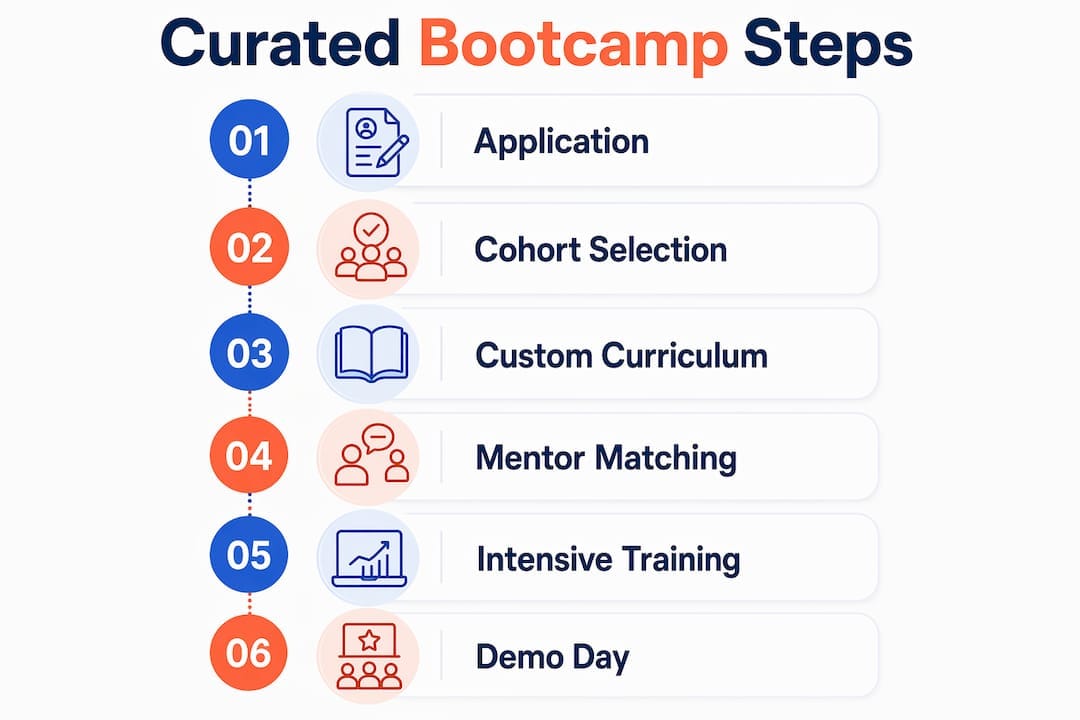
Typical program lifecycle:
- Application and shortlisting. Candidates submit a project brief, business stage, and goals. Program managers review for cohort fit, not just individual merit.
- Cohort orientation. Participants meet their cohort, receive the curriculum overview, and set personal milestones for the program.
- Weekly live sessions. Facilitated workshops cover one core topic per week, applied directly to each participant’s project.
- Mentor office hours. Matched mentors meet with small groups or individuals to review progress and unblock specific challenges.
- Peer critique sprints. Structured sessions where participants present work-in-progress and receive structured feedback from peers.
- Milestone reviews. At the midpoint and end, participants present deliverables to mentors and sometimes external judges.
- Demo day. Final presentations to a live audience, often including investors, alumni, or industry partners.
- Alumni follow-up. Credible programs maintain post-program check-ins, alumni networks, and access to mentor relationships.
The startup bootcamp structure at its best runs like a compressed product development cycle: ideate, build, test, present, iterate. Each week has a clear output, and the cohort’s shared accountability keeps participants moving even when motivation dips.
Some programs, like the ScaleUp Bootcamp model, condense the core content into a single intensive session for founders who need a targeted topic covered quickly. That format works for legal roadmaps or networking sprints, but it cannot replace the iteration depth of a multi-week curated program.

Who benefits most, and what will you leave with?
The participant profile that gets the most from a curated bootcamp is specific. You need to bring a real project, a tolerance for direct feedback, and enough time to implement between sessions.
Ideal participants:
- Early-stage founders with an idea or early product who need external validation
- Incubator applicants preparing a pitch or MVP for a selection committee
- Small founding teams that need to align on strategy and divide execution
- Intrapreneurs inside larger organizations running an internal venture
- Product managers who need to move from concept to prototype under deadline
What you leave with depends on the program’s deliverable structure, but credible curated bootcamps produce tangible outputs. Participants typically walk away with a working prototype or MVP, a pitch deck reviewed by experienced mentors, validated customer assumptions from real interviews, a concrete 90-day action plan, and a peer network of founders at a similar stage.
The experiential bootcamp model is particularly effective for entrepreneurs because the learning happens through doing, not watching. Cohort size matters here: a group of 10–20 participants allows for the kind of deep peer critique and mentor attention that larger programs cannot sustain.
Questions to ask before you apply or pay
Most programs look credible on a landing page. The questions below surface the ones that actually deliver.
Applicant checklist:
- What are the selection criteria, and how many applicants compete for each seat?
- Can I see mentor bios and confirm their industry relevance to my project?
- What is the cohort size, and what is the typical stage mix of participants?
- What deliverables are required, and what happens if I miss a milestone?
- What is the weekly time commitment, and is attendance at live sessions mandatory?
- Is there a refund policy, and under what conditions does it apply?
- Can you share alumni names or demo day recordings from the last cohort?
- What alumni outcomes has the program tracked at 3 and 6 months post-graduation?
To verify claims, ask for a sample curriculum from the previous cohort, not a generic overview. Request two or three alumni names you can contact directly. Watch a demo day recording and assess whether the presentations show real work or polished slides with no substance behind them.
Pro Tip: Search LinkedIn for alumni from the last two cohorts and look at what they built in the six months after the program. That pattern tells you more than any testimonial on the program’s website.
How Nomadexcel runs curated entrepreneurship bootcamps
Nomadexcel’s model is a direct application of the curated bootcamp principles described throughout this article. Each program brings together a small, hand-picked group of founders for 1–4 weeks of in-person, hands-on work, with mentorship from experienced entrepreneurs, marketers, and operators matched to each participant’s stage and challenge.
The program structure covers business validation frameworks, offer refinement, and scalable systems, with daily accountability sprints that keep participants executing rather than theorizing. Mentors provide direct critique on real work, not generic advice, and the cohort itself becomes a long-term professional network.
What participants leave with:
- A sharper business strategy with validated assumptions
- Revenue-driving skills applied to their actual business during the program
- A peer community that continues to support and challenge them after the bootcamp ends
- Access to alumni networks and ongoing mentorship relationships
You can review past cohort outcomes to see the kinds of projects participants have built and the results they have reported. If you are ready to apply or want to see current cohort dates, the upcoming bootcamps page has enrollment details and program specifics.
Key Takeaways
A curated bootcamp delivers results because it combines deliberate cohort selection, matched mentorship, and required deliverables into a single time-bound program.
| Point | Details |
|---|---|
| Curation starts at selection | Application-based entry controls cohort quality and peer critique depth. |
| Deliverables define success | Credible programs measure outputs: prototype, pitch deck, or validated assumptions. |
| Format varies widely | Programs run from 3-day intensives to 12-week sprints; match the format to your timeline. |
| Mentor matching matters | Industry-matched mentors produce specific, usable feedback rather than generic guidance. |
| Nomadexcel’s curated model | Nomadexcel runs 1–4 week in-person cohorts for founders, with mentorship and real business deliverables. |
The intensity is the point, not the obstacle
Most people who hesitate before a curated bootcamp are worried about the time commitment. That concern is reasonable, but it misses what the intensity is actually doing. The sprint structure, the peer accountability, and the mandatory deliverables are not features layered on top of the learning. They are the mechanism that produces the learning.
The participants who get the least from curated programs are the ones who arrive without a real project. They go through the motions, produce a theoretical case study, and leave with a certificate. The participants who get the most arrive with a half-built product, a messy pitch, or a business model they cannot explain clearly. The program’s friction forces them to resolve those problems under deadline and in front of people who will tell them the truth.
One thing most applicants underestimate is the value of the cohort itself. The curriculum is replicable. The mentor advice is available in books and podcasts. What you cannot replicate outside a curated program is a room of 15 people at your exact stage who have skin in the game and a reason to give you honest feedback. That peer network, built under pressure, tends to outlast the program by years.
Before you join any program, bring your real work. Set a measurable goal for what you want to have built by demo day. And budget more time than the program schedule suggests, because the implementation work between sessions is where the actual progress happens.
Nomadexcel’s curated bootcamps are built for founders who are ready to execute
If the model described in this article fits what you are looking for, Nomadexcel’s online entrepreneurship bootcamp is a direct match. The program is built around curated cohorts, hands-on deliverables, and mentor relationships that continue after the program ends. It is designed for early-stage founders who want to move from idea to validated business with the support of a vetted peer group and experienced operators. Not a passive course, not a lecture series. A structured sprint with real accountability and real outputs. Check the upcoming cohort schedule to see current enrollment windows and apply for the next available cohort.
Useful sources and further reading
- What Is A Boot Camp Program? (eLearning Industry) — A clear overview of what defines a bootcamp: intensity, time-bound structure, cohort interaction, and performance-based assessment.
- What to Expect From a Bootcamp (Emeritus) — Covers the standard elements of a bootcamp experience, including live sessions, mentorship, and final project requirements.
- What Is A Bootcamp? Getting Into Tech Without A Degree (Forbes) — Useful for understanding typical durations, career outcomes, and what to look for in a credible program.
- What’s a Bootcamp and How Is It Different from an Online Course? (Workforce Institute) — Direct comparison of bootcamp vs. online course formats, pacing, and outcome orientation.
- Methodology Matters: Performance-Based Instructional Design (5moments) — Explains why outcome-driven program design measures success through deliverables rather than knowledge tests.
- The Curated Cohorts (Curated Studios) — A concrete example of a small-group, application-required cohort model with weekly live sessions and real deliverables.
- Why Experiential Bootcamps Matter for Entrepreneurs (Nomadexcel) — Nomadexcel’s explanation of the pedagogical reasoning behind experiential, cohort-based entrepreneurship programs.
Comments are closed.