
Week to 21 Months: How to Choose the Right Emerging Leaders Program
An emerging leaders program is a structured leadership development track built to identify high-potential employees and accelerate their readiness for bigger roles. Most combine live workshops, one-on-one mentorship, and an applied project so participants practice leadership on a real business problem, not a hypothetical one. Programs run anywhere from a single intensive week to an extended period lasting up to nearly two years, depending on the sponsoring university, association, or employer.
TL;DR:
- Most emerging leaders programs last from a few days to nearly two years, with formats including intensive residencies, blended cohorts, and fully online courses.
- Nominees are typically early to mid-career professionals, with selection based on demonstrated initiative, leadership potential, and organizational succession needs.
- The core curriculum focuses on self-leadership, influencing without authority, strategic thinking, financial literacy, and change management, often culminating in an applied project.
- Success measures include promotion rates, leadership behavior improvements, and increased internal talent pipelines, but sustained benefits depend on ongoing organizational support.
- For entrepreneurs or those needing immediate execution, immersive bootcamps like Nomad Excel’s program offer faster, practical leadership skill development compared to traditional longer-term programs.
Table of Contents
- Program Overview: Formats, Duration, and Who Runs Them
- Who Should Participate and What Selectors Look For
- Core Curriculum: Workshops, Mentorship, and Action Learning Projects
- Benefits and Measurable Outcomes
- Logistics: Schedules, Credentials, and Cost
- Application, Selection, and Timeline
- How to Choose the Right Program for You or Your Team
- What Happens After the Program Ends
- Common Challenges and How Participants Work Through Them
- How ELPs Differ From Other Leadership Development Initiatives
- A Different Kind of Emerging Leadership Initiative
- Nomad Excel Perspective: Where Immersive Bootcamps Fit
- Ready to Build Leadership Skills That Move Your Business Now?
- Sources
- FAQ
Program Overview: Formats, Duration, and Who Runs Them
The phrase “emerging leaders program” covers a surprisingly wide range of experiences, and that variety is exactly why so many people search for a plain definition before applying. On one end, you have compact, intensive formats: a week of full-day sessions designed to compress a semester’s worth of leadership theory into rapid-fire practice. On the other, you have extended tracks that unfold over 6 to 21 months, mixing periodic in-person residencies with ongoing virtual coursework.
The CPD SUNY Emerging Leaders Academy illustrates the middle ground well: participants typically commit several hours per week across a multi-week cycle, blending asynchronous coursework with live workshops and peer networking. That pacing lets working professionals build leadership skills without stepping away from their day jobs for weeks at a time.
Three delivery models dominate the space:
- In-person residencies — cohorts gather at a campus or retreat site for concentrated, immersive learning, often the fastest way to build trust among peers.
- Blended cohorts — a mix of live online sessions, occasional in-person intensives, and self-paced modules, common in university executive education.
- Fully online bootcamps — asynchronous content paired with scheduled live discussions, built for geographically dispersed participants.
Who organizes these programs matters as much as the format. Universities and their executive education arms run some of the most recognized versions, alongside professional associations, individual employers building internal pipelines, and independent providers serving multiple companies at once. Cohort size tends to stay small by design, usually somewhere between 15 and 40 participants, because the peer relationships built during the program often outlast the coursework itself. A tighter cohort means more air time with mentors and a stronger network to lean on once the program ends.
Who Should Participate and What Selectors Look For
Emerging leaders programs target people standing at a specific career inflection point: not brand new to the workforce, but not yet running a large team or a major function either. The most common candidate profiles include:
- First-time or early-stage managers looking to formalize skills they’ve picked up informally.
- Mid-level specialists (engineers, analysts, project leads) preparing for their first people-management role.
- Rising professionals across sectors, from nonprofit program officers to corporate finance associates, who have been flagged as high-potential by their organization.
Most programs expect a mid-range professional experience level, generally early to mid-career, though the exact band varies by sponsor. Selectors generally look for evidence of initiative beyond the job description, feedback from managers on collaboration and judgment, and some signal that the person is ready to influence others without formal authority yet.
Organizations nominate people for reasons that go beyond individual development. Succession planning drives a lot of ELP investment: leadership teams want a bench of internal candidates ready to step up when senior roles open. Cross-functional readiness matters too, since many programs deliberately mix departments so participants learn to negotiate and collaborate outside their usual silo.
Pro Tip: If you want a nomination, ask your manager directly what “leadership readiness” looks like on your team, then bring evidence of it to that conversation instead of waiting to be noticed.
Core Curriculum: Workshops, Mentorship, and Action Learning Projects
Strip away the branding and most emerging leaders programs teach the same core competencies through a similar mix of methods. The curriculum tends to cluster around a few consistent themes:
- Leading yourself first — self-awareness, time management, and decision-making under pressure.
- Influencing without authority — negotiation, stakeholder management, and persuasive communication.
- Strategic thinking — reading a market, setting priorities, and connecting daily work to organizational goals.
- Finance and business literacy — enough grounding in budgets and metrics to speak credibly with senior leaders.
- Change management — leading a team through ambiguity, resistance, or restructuring.
Harvard Kennedy School’s Emerging Leaders program structures its curriculum around skill building, integrated communications, and policy analysis, using interactive simulations and case studies alongside a capstone action learning project. That capstone model shows up across nearly every serious program, and for good reason: leadership skills like coaching and structured feedback are teachable competencies, according to leadership research cited in Psychology Today, not traits people either have or lack from birth.
Executive coaching and small peer groups round out the experience, giving participants a confidential space to process feedback and rehearse difficult conversations before trying them at work. Assessments and structured reflection checkpoints, often built around 360 feedback or self-rating scales, track whether behaviors are actually shifting rather than just theoretical understanding improving. The action learning project or capstone remains the real test: participants apply what they’ve learned to an actual problem inside their own organization, then present results to sponsors or faculty before the program closes.

Benefits and Measurable Outcomes
The payoff for participants shows up in three places: promotion readiness, sharper leadership behaviors, and a professional network that often outlasts the program by years. Employers who commit to a well-designed ELP see returns too, and they tend to track a fairly consistent set of metrics.
What Success Looks Like on Paper
Organizations typically measure ROI through capstone project impact (did the applied project move a real business metric), post-program promotion rates among alumni, and retention figures comparing participants to non-participants over the following two to three years.
Organizational gains tend to cluster around three areas:
- A stronger succession pipeline, with more internal candidates ready for leadership openings.
- Improved retention among high-potential employees who might otherwise leave for growth elsewhere.
- Better cross-functional collaboration once alumni carry shared language and frameworks back into their teams.
The catch is that none of these outcomes sustain themselves automatically. A program that ends with a graduation ceremony and no follow-up tends to see behavior change fade within a year. The organizations that get the most out of their investment build in manager check-ins, ongoing mentorship, or a formal alumni structure that keeps the skills active long after the last workshop.
Logistics: Schedules, Credentials, and Cost
Before committing to any program, it helps to know exactly what you’re signing up for in terms of time and money. Scheduling patterns generally fall into three buckets: intensive residencies that consume a full week or more at once, monthly modules spread across half a year or longer, and weekly microlearning sessions that fit around a regular job.
Credentialing varies by sponsor. Some programs award a certificate of completion with no formal accreditation attached; others offer CPE or continuing education credits that count toward professional license, a detail NACUBO’s Emerging Leaders Program highlights for finance and higher-education professionals specifically. University-run tracks sometimes carry executive education recognition that shows up on a resume with more weight than a generic certificate.
- Confirm whether your employer sponsors the fee outright, splits it with you, or expects full personal payment.
- Ask directly about refund policies if a work emergency forces you to drop mid-program.
- Clarify pre-work expectations, since some programs assign reading or assessments weeks before the first session.
- Get explicit sign-off from your manager on time off, especially for residency-style formats that pull you out of the office for days at a time.
Application, Selection, and Timeline
Getting into a competitive emerging leaders program usually follows a predictable sequence:
- Nomination or self-application — some programs require manager nomination; others accept direct applications with a supervisor endorsement letter.
- Submit materials — a résumé, a statement of intent explaining your leadership goals, and often a short essay or video response.
- Selection step — this can include an interview, a group assessment activity, or simply sponsor endorsement carrying the decision.
- Confirmation and pre-work — accepted candidates receive program dates, any required reading, and details on time commitments before the first session.
Application windows typically open several months ahead of the program start, so managers thinking about nominating a staff member should raise the conversation early enough to secure both approval and coverage for that person’s workload.
How to Choose the Right Program for You or Your Team
Not every emerging leaders program suits every candidate, and matching the format to the goal matters more than chasing a prestigious name. Start by lining up the program’s stated outcomes against your own career target or your organization’s succession gaps.
- Check whether the program guarantees real mentor access or just a speaker series with no ongoing relationship.
- Ask whether the applied project connects to an actual business problem or stays purely academic.
- Compare total time commitment, cost, and cohort composition against programs at a similar level.
- Look for an active alumni network, since that community often delivers value well past the program’s end date.
Programs that skip the applied project, dodge specifics about outcomes, or show no sponsor involvement from participating employers tend to underdeliver. Precise audience selection is one of the biggest predictors of program success, according to leadership design guidance from Forbes, so a program that accepts anyone regardless of role or readiness is a red flag worth taking seriously.
Pro Tip: Ask a program for the names of two alumni you can contact directly. A provider confident in its outcomes will connect you; one that hesitates is telling you something.
What Happens After the Program Ends
Graduation from an emerging leaders program rarely leads straight to a title change. What it usually does is compress the timeline to the next promotion by giving participants visible proof of readiness: a completed capstone project, documented feedback, and a track record of handling cross-functional work under scrutiny.
Common next steps include a move into a first formal management role, a lateral shift into a higher-visibility function, or selection for a more advanced leadership track within the same organization. Alumni frequently point to the network built during the program as much as the coursework itself; former cohort members become informal references, sounding boards, and even hiring connections years later.
The advancement curve depends heavily on how the organization treats the credential internally. Companies that tie ELP completion to succession planning tend to fast-track alumni into stretch assignments within 12 to 18 months. Organizations that treat the program as a standalone perk, disconnected from promotion criteria, see far less career movement among graduates. That gap is worth asking about directly before you apply: does completing this program actually change how the organization evaluates you for the next role, or is it viewed as a nice credential with no formal weight attached?
External programs, run by universities or associations, tend to open doors outside your current employer too, since the network spans multiple companies and sectors rather than staying contained inside one organization.
Common Challenges and How Participants Work Through Them
The most frequent complaint from ELP participants isn’t the coursework itself. It’s finding the hours to do it alongside a full workload. Programs that ask for 3 to 5 hours a week on top of a regular job create real strain, especially during residency weeks that pull someone out of the office entirely.
A second challenge shows up around the action learning project: participants sometimes struggle to get buy-in from their own team or manager to implement a capstone recommendation, which can make the project feel more theoretical than intended. The fix here is largely about sequencing. Successful participants loop their manager into the project scope early, before the capstone is finalized, so the recommendation lands as something the team already expects rather than a surprise handed down after the fact.
A third friction point is honest but less discussed: cohort mismatch. When a program mixes people at very different experience levels or from wildly different functions, some participants find sessions either too basic or too disconnected from their actual work. This is where precise audience selection matters again. A cohort built around a clear, narrow readiness band produces sharper discussions than one built purely to fill seats.
Finally, sustaining behavior change after the program ends takes deliberate effort. Structured follow-up, whether that’s a manager check-in schedule or a standing alumni call, makes the difference between skills that stick and skills that fade within a few months of graduation.
How ELPs Differ From Other Leadership Development Initiatives
Emerging leaders programs sit in a specific spot on the leadership development spectrum, distinct from executive coaching, general management training, and one-off leadership workshops. The distinction comes down to audience, structure, and depth.
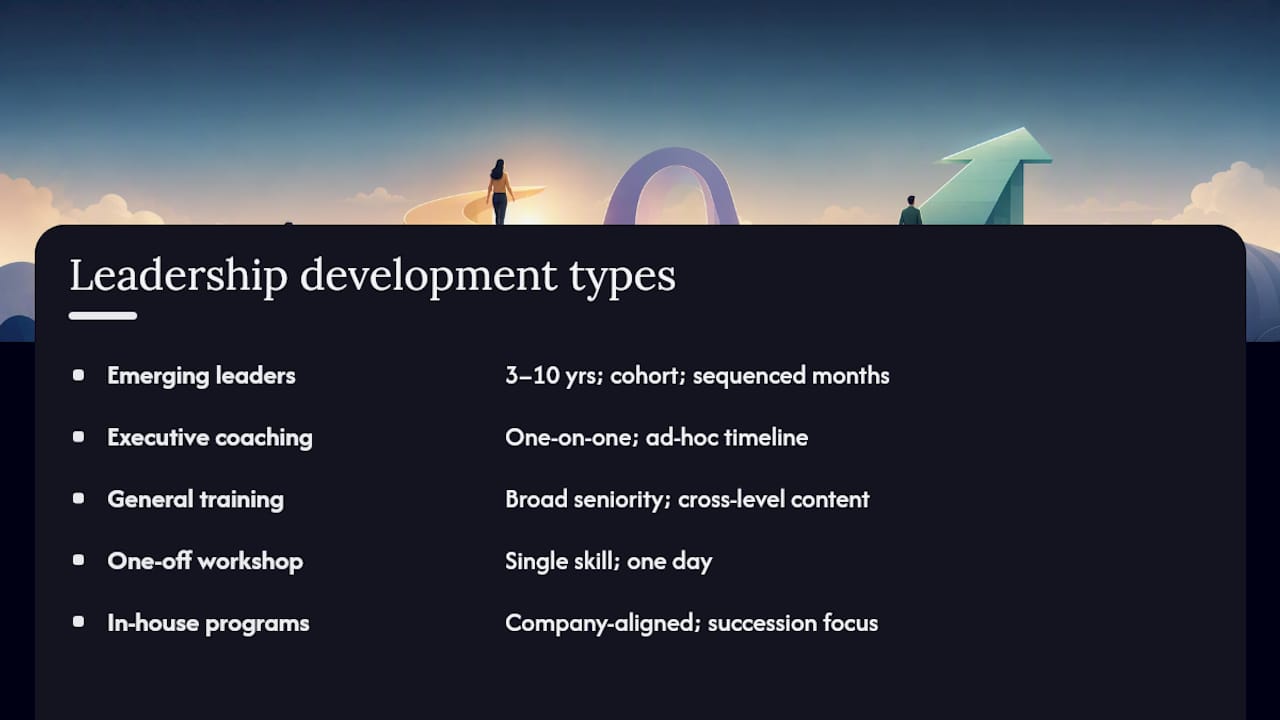
General leadership development programs often serve a broader range of tenure and seniority, from brand-new supervisors to senior directors, with content designed to be relevant across that whole span. Emerging leaders programs narrow the target deliberately, usually to that 3 to 10 year experience band, which lets the curriculum go deeper on the specific transition from individual contributor to people leader.
Executive coaching, by contrast, is typically one-on-one and unstructured in timeline, built around whatever the client’s current challenges happen to be. ELPs are cohort-based by design, and that peer structure is part of the value, not a side effect. A single leadership workshop might teach one skill in a day; an ELP sequences multiple skills over months and forces participants to apply them through a live project.
In-house programs built by a single employer tend to align tightly with that company’s culture and strategic priorities, while externally run programs (university or association-based) trade some of that specificity for a broader network and outside perspective. Many organizations run both simultaneously, using external ELPs for high-potential individual development and in-house programs for role-specific succession planning.
A Different Kind of Emerging Leadership Initiative
Not every rising professional needs a 21-month academic track. Nomad Excel runs immersive entrepreneurship bootcamps and company retreats built for a faster kind of leadership growth: clarity, execution, and community compressed into days rather than months. The bootcamp curriculum pairs business-building frameworks with direct mentorship from working entrepreneurs and operators, which mirrors the applied-project spine of a traditional ELP without the semester-long timeline.
A longer academic ELP still makes sense for someone climbing a corporate succession ladder who needs that institutional credential. But for a founder, freelancer, or early-stage operator who needs leadership skills applied to their own business right now, an intensive format closes that gap faster.
Nomad Excel Perspective: Where Immersive Bootcamps Fit
Academic ELPs excel at building institutional leadership pipelines over many months. Immersive bootcamps solve a narrower, faster problem: turning leadership theory into execution on your own venture within weeks, not a year and a half. If your goal is climbing a corporate succession list, choose the longer track. If you need to lead your own business starting now, an intensive, cohort-based format gets you there faster.
— Amichai
Ready to Build Leadership Skills That Move Your Business Now?
Traditional emerging leaders programs are built for people climbing a corporate ladder over many months, with mentorship and network access as a slow-release benefit. If you’re an entrepreneur or team leader who needs execution now, not in 12 to 18 months, that timeline doesn’t fit your situation. Nomad Excel’s Online Entrepreneurship Bootcamp compresses mentorship, structured accountability, and a working peer community into a format built around getting your business moving, not building a resume line for a future promotion. Teams looking for the same clarity and alignment benefits can also explore Nomad Excel’s company retreats as a faster route to leadership cohesion. Check current bootcamp dates and see if a seat fits your schedule.
Sources
- Emerging Leaders Academy (CPD SUNY)
- Emerging Leaders (Harvard Kennedy School)
- The Right Way To Design Your Emerging Leaders Program (Forbes)
FAQ
What is the purpose of an emerging leaders program?
The purpose is to identify high-potential individuals early and accelerate their readiness for leadership roles through structured workshops, mentorship, and an applied project tied to a real organizational goal.
Is an emerging leaders program worth it?
For candidates who complete the applied project and get manager support afterward, yes: the combination of promotion readiness, network building, and practiced leadership behaviors tends to deliver measurable career movement, though outcomes fade without organizational follow-up.
What is the aim of an emerging leaders program?
The aim is to close the gap between individual contributor and people leader by teaching specific, teachable competencies like influence, strategic thinking, and change management, then testing them through a real capstone project.
How long does an emerging leaders program typically last?
Duration ranges widely, from one-week intensives to programs spanning 6 to 21 months, depending on whether the format is a compressed residency or a blended, multi-module track.
What is the difference between an emerging leaders program and general leadership training?
An emerging leaders program targets a narrower experience band, usually 3 to 10 years, with cohort-based learning and an applied project, while general leadership training often spans a wider range of seniority with less structured, less project-driven content.