
One Page Business Strategy for Early Stage Founders: 3–5 Priority Plan
You develop a business strategy by defining the value you intend to create, diagnosing where your business actually stands today, narrowing a long list of ideas to three to five priority initiatives, and mapping each one to an owner, a timeline, and a measurable KPI. Everything else, the frameworks, the workshops, the review cadence, exists to make that sequence repeatable. The rest of this guide walks through each step, starting with the identity work that has to happen before you write a single objective.
TL;DR:
- Having a clear value proposition that names the customer, problem, and benefit filters all strategic decisions and avoids misplaced focus on tactics as strategy.
- Running a thorough SWOT analysis and identifying three key numbers—gross margin, customer lifetime value against acquisition cost, and retention rate—are essential for accurate diagnosis and effective planning.
- Narrowing ideas through scoring impact versus effort and strategic fit ensures founders focus on three to five initiatives, increasing completion likelihood.
- Regular review of KPIs, resource allocation, and market conditions every quarter helps prevent stagnation, unmasking when to pivot or reallocate resources promptly.
- Building a one-page plan with specific owners, deadlines, and KPIs, combined with daily sprints and peer accountability, accelerates strategy execution and minimizes planning delays.
Table of Contents
- How Do You Develop a Business Strategy Starting With Purpose?
- How Do You Assess Your Current State Before Setting Strategy?
- How Do You Set Strategic Objectives and Pick a Framework?
- How Do You Narrow a Long List of Ideas Into a Real Plan?
- How Do You Turn Strategy Into a Daily Action Plan?
- How Often Should You Review and Adjust Strategy?
- What Does a One-Page Strategy Template Look Like in Practice?
- How Do You Manage Risk When Formulating Strategy?
- Why Does Stakeholder Input Matter in Strategy Development?
- How Do You Position Against Competitors When Building Strategy?
- How Do You Match Resources to Your Strategic Priorities?
- What’s the Honest Take on Strategy Documents Versus Action?
- Build and Execute Your Strategy Faster With Nomad Excel
- Sources
- FAQ
How Do You Develop a Business Strategy Starting With Purpose?
Before you touch a framework, name what you exist to do and for whom. Write a one-sentence value proposition that names the customer, the problem, and the benefit, something like “We help early-stage founders launch validated offers in 90 days instead of 12 months.” That sentence becomes your filter for every decision that follows.
Vision is not a to-do list. It is the destination; your quarterly initiatives are the vehicle. A common mistake founders make is treating operational tasks like marketing tactics as if they were the strategy itself, when tactics should serve a larger direction, not replace one.
Before locking in your vision, run three checks:
- Does a real, paying market exist for this problem, or are you assuming demand?
- Can you name three customers who already behave in a way that supports this vision?
- Would this vision still make sense if your biggest competitor doubled their budget tomorrow?
How Do You Assess Your Current State Before Setting Strategy?
Strategy built on hope instead of evidence collapses fast. Run a SWOT that pulls in more than your own assumptions: talk to customers about why they buy or churn, ask staff where friction actually lives, and check what stakeholders or investors expect to see. A SWOT done solo, at a desk, tends to reflect your biases more than your market.
Alongside the SWOT, pull three numbers:
- Gross margin, so you know whether the business model can support growth at all.
- Customer acquisition cost against lifetime value, so you know if growth is profitable or just busy.
- Retention or repeat-purchase rate, since it reveals whether the offer actually holds up after the sale.
Weak or missing data here is a warning sign, not a detail to skip past. McKinsey’s strategy framework places diagnosis directly after framing for a reason: skip it, and every choice downstream inherits the blind spot.
Pro Tip: Before you diagnose anything, get your leadership team (even if that’s just you and a co-founder) to agree in writing on what questions the strategy actually needs to answer. Skipping this alignment step is why so many strategic plans get built, then quietly ignored.
How Do You Set Strategic Objectives and Pick a Framework?
Strategic objectives describe where the business is headed over one to three years. Operational goals describe what happens this week. “Become the go-to coaching platform for freelance designers” is strategic. “Publish four blog posts this month” is operational. Confusing the two is how founders end up busy without getting anywhere.
Write each objective with a measure attached, either SMART criteria (specific, measurable, achievable, relevant, time-bound) or OKRs (objective plus two to three key results). For early-stage ventures without departmental complexity, a lightweight OKR or value-based approach usually beats a full Balanced Scorecard, which was built for larger organizations tracking financial, customer, process, and learning dimensions at once.
- SMART example: “Grow monthly recurring revenue from $8,000 to $20,000 by December 31.”
- OKR example: “Objective: become the trusted choice for first-time founders. Key result: net promoter score above 50 by Q3.”
Reach for the Balanced Scorecard or a value-based framing once you have multiple teams or product lines to coordinate, not before.
How Do You Narrow a Long List of Ideas Into a Real Plan?
Most founders don’t struggle to generate ideas. They struggle to kill the ones that don’t matter. A structured planning process typically starts with several candidate initiatives, gathered from a brainstorming workshop, customer interviews, and staff input, then narrows that list down hard.
Run the narrowing in four steps:
- Capture every initiative on the table, no filtering yet, with the evidence behind each one.
- Score each idea on impact versus effort, rough numbers are fine.
- Weight the top scorers by strategic fit: does this move the vision forward, or just generate short-term revenue?
- Cut until a few initiatives remain, no more.
A tight shortlist matters more than it sounds like it should. Concentrating a small team’s resources on three to five initiatives measurably increases the odds any of them actually gets finished, compared to spreading effort across ten half-built projects.
How Do You Turn Strategy Into a Daily Action Plan?
A strategy that lives in a slide deck does nothing. Build a one-page action plan that connects each initiative to a name, a deadline, and a number:
- Initiative: what you’re building or fixing.
- Owner: the one person accountable, not a committee.
- Deliverables: the concrete output that proves progress.
- Timeline: a real date, not “soon.”
- KPI: the single metric that tells you if it worked.
A five-year plan commonly holds 10 to 15 objectives, each with one or two SMART measures attached. For a solo founder or small team, that number should sit toward the lower end, more measures than that and nobody checks any of them consistently.
Set a reporting rhythm early: a weekly sprint check on tasks, a monthly review of KPI movement. Tools don’t need to be fancy here, a shared spreadsheet or a simple project board works fine at this stage. What matters is that the one-page action plan gets opened every week, not filed away after the planning meeting ends.
How Often Should You Review and Adjust Strategy?
Strategy is not a document you finish once. It is a decision you revisit on a schedule. A workable rhythm mixes three cadences: weekly tactical check-ins on task progress, monthly KPI reviews to catch drift early, and quarterly strategic reviews to test whether your original assumptions still hold.
Assign real ownership to this rhythm:
- One person owns calling the quarterly review and forcing an honest look at the numbers.
- Someone tracks KPIs monthly and flags drift before it becomes a crisis.
- The full team (even a team of two) walks through weekly tactical blockers together.
Know the difference between a pivot signal and a persistence signal. Consistent misses against your KPI, flat customer feedback, or a market shift that invalidates your original diagnosis all argue for a pivot. A single rough month with a clear, fixable cause argues for recommitting.
The most common failure here isn’t bad strategy, it’s failing to reallocate resources once the review shows something isn’t working. Strategies stall when teams review the numbers, agree something needs to change, and then keep funding the same initiatives anyway.
Pro Tip: Put “resources we will stop funding” as a standing line item on every quarterly review agenda. If that line is empty three quarters in a row, your reviews are theater, not governance.
What Does a One-Page Strategy Template Look Like in Practice?
Here’s a fillable structure you can build in an afternoon:
- Vision (one sentence): who you serve, the problem, the benefit.
- Top 3 objectives: each with one measure attached.
- 3 initiatives: the shortlist that supports those objectives.
- Owners: one name per initiative, no shared accountability.
- KPIs: one number per initiative that proves it worked.
- 90-day sprint tasks: the first three concrete actions for each initiative, due this week.
This is a structure bootcamp cohorts can build on day one, then stress-test through daily sprints and peer feedback for the rest of the program. Compressing the diagnose-to-commit cycle into days instead of months is the entire point of an immersive format: structured sprints and daily accountability push decisions that would normally stall in a planning document into action within the same week.
How Do You Manage Risk When Formulating Strategy?
Every strategic choice carries a cost if the underlying assumption is wrong, and naming that cost before you commit resources is part of the job, not an afterthought. Start by listing the two or three assumptions your strategy depends on most heavily: a certain customer acquisition cost, a specific retention rate, a competitor not reacting for six months. If any of those assumptions breaks, what happens to the plan?
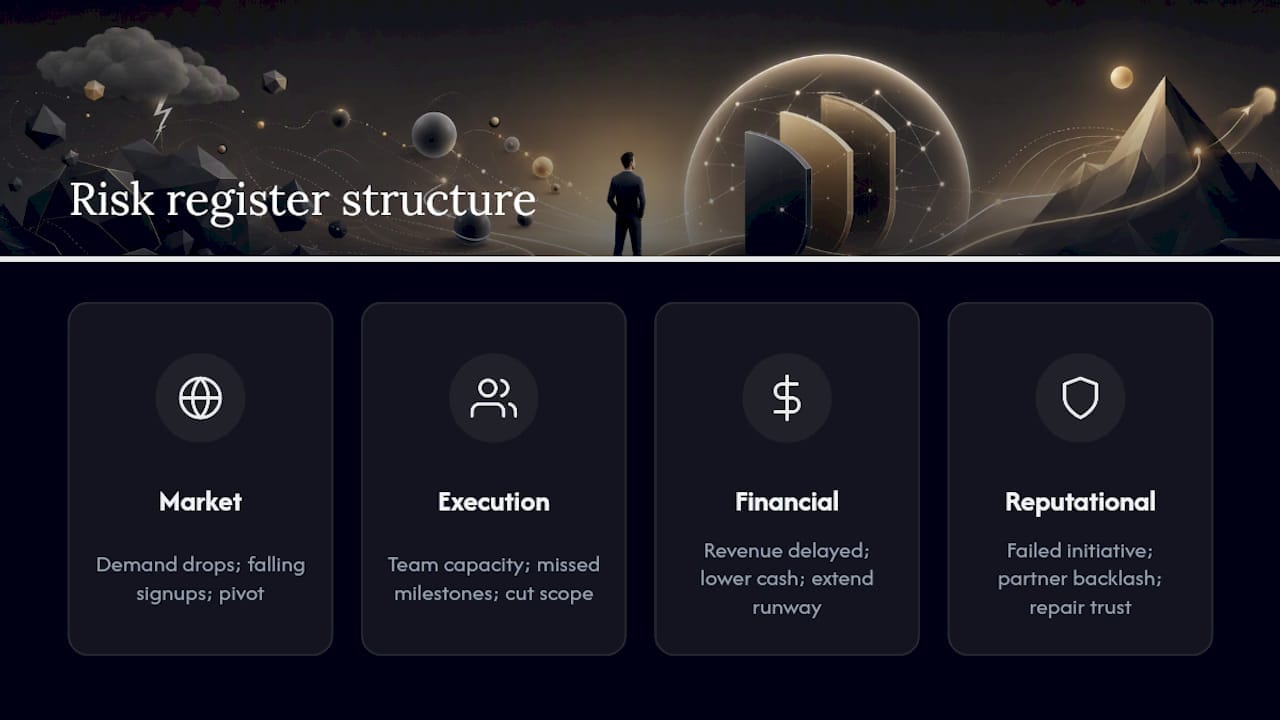
Separate risks into categories you can actually act on. Market risk covers demand disappearing or shifting faster than expected. Execution risk covers your team’s actual capacity to deliver what the plan requires on the timeline you set. Financial risk covers runway, what happens if revenue arrives three months later than projected. Reputational risk covers what a failed initiative costs you with customers or partners even after you’ve moved on from it.
For each major initiative, ask what the early warning signs would look like, and decide in advance what you’ll do if you see them. Waiting until a KPI has been missed for two straight quarters to have that conversation wastes both time and money. A simple risk register, three columns for assumption, warning sign, and response, takes an hour to build and saves far more than an hour once something actually goes sideways.
The goal is not to eliminate risk. Early-stage strategy is inherently a bet. The goal is to make sure you’re taking risks you chose deliberately, not ones you never noticed you were carrying.
Why Does Stakeholder Input Matter in Strategy Development?
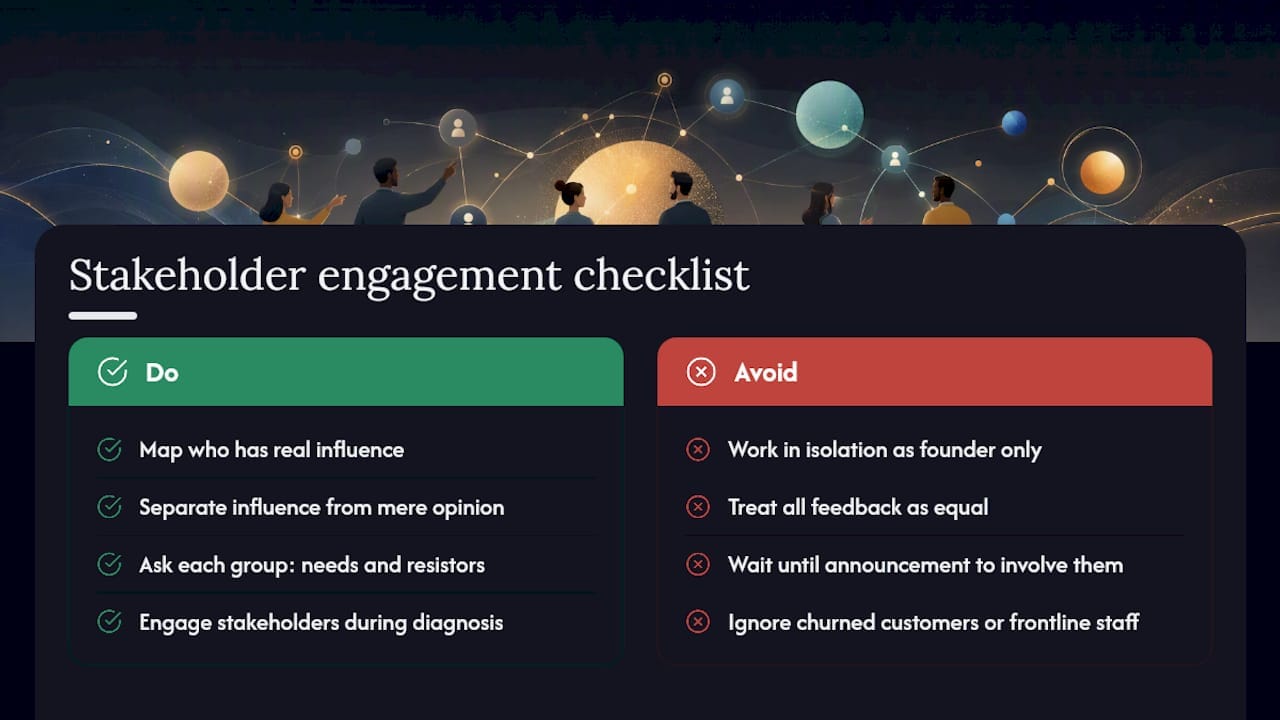
A strategy built entirely in isolation, even a well-reasoned one, tends to hit resistance the moment it needs other people to execute it. Stakeholders include your co-founders, employees, investors, key customers, and sometimes suppliers, anyone whose behavior can help or block your plan.
Start by mapping who has real influence over whether your strategy succeeds, and separate that from who simply has an opinion about it. An investor with veto power over spending matters more to your process than a friend with feedback, however well-intentioned. For each stakeholder group, ask two questions: what do they need from this strategy to support it, and what would make them actively resist it?
Engage stakeholders at the diagnosis stage, not just at the announcement stage. Employees who spot friction with customers daily often catch weak assumptions faster than a founder working from spreadsheets. Customers who’ve already churned can tell you more about your positioning gaps than the ones who stayed. Investors, if you have them, usually want visibility into your reasoning before they want a finished plan; involving them early in framing the strategic questions tends to produce faster buy-in than presenting a completed document and asking for a signature.
The engagement doesn’t need to be exhaustive. A handful of structured conversations before you finalize your top three to five initiatives usually surfaces the objections you’d otherwise hear for the first time after launch, when they’re far more expensive to address.
How Do You Position Against Competitors When Building Strategy?
Competitive analysis for an early-stage business isn’t about tracking every player in your category. It’s about understanding the two or three alternatives your actual target customer considers before choosing you, including the alternative of doing nothing at all.
List your closest competitors and, for each, note what they do well, where they fall short, and what type of customer they serve best. Then be honest about where you genuinely differ, not on marketing language, but on the actual value proposition. If your answer to “why us instead of them” sounds identical to what a competitor would say about themselves, your positioning isn’t sharp enough yet.
Positioning is the output of this analysis, not a separate step. It’s the specific place you occupy in a customer’s mind relative to the alternatives: faster, cheaper, more personal, more technical, whatever your diagnosis actually supports. The value-stick approach frames this well: strategy exists to create more value for customers, employees, and suppliers than competing options do, and your competitive analysis should tell you exactly where that value gap is widest.
Revisit this analysis on the same quarterly cadence as your broader strategy review. Markets shift, a competitor changes pricing, a new entrant reshapes what customers expect, and positioning that worked six months ago can quietly go stale without any single dramatic event marking the moment it happened.
How Do You Match Resources to Your Strategic Priorities?
Every initiative on your shortlist competes for the same finite pool: money, time, and people. Before committing to your three to five priorities, take honest stock of what you actually have to work with, not what you hope to have once revenue picks up.
Start with capability, not budget. What can your current team actually execute well, and where would you be stretching into territory nobody on the team has handled before? An initiative that requires a skill set you don’t have isn’t automatically off the table, but it needs a plan for closing that gap, whether that’s hiring, a contractor, or a partner handling the operational load so your core team can stay focused on what only they can do.
Then map money and time against your shortlist directly. If two initiatives both need your only developer’s attention for the next six weeks, one of them is not actually a Q1 priority, regardless of what the strategy document says. This is where a lot of plans quietly fail: the objectives get set, the KPIs get written, but nobody checks whether the resourcing math actually works before initiatives launch simultaneously.
Revisit resource allocation at the same cadence as your KPI reviews. Capacity shifts as fast as the market does, a key hire leaves, a client project eats more hours than expected, and a plan that assumed steady capacity in January can be quietly unworkable by March if nobody rechecks the assumption.
What’s the Honest Take on Strategy Documents Versus Action?
Most founders overinvest in the document and underinvest in the testing. A polished 40-page plan feels like progress, but a testable, two-week initiative you can measure teaches you more than a quarter spent perfecting slides nobody outside your own head will scrutinize as hard as reality will.
Community accountability compresses that learning curve. Peers who see your numbers weekly catch weak assumptions faster than you catch them alone, and they push you to commit to a date instead of a someday. Favor the shortlist you can test this month over the roadmap you’ll finish revising next quarter.
— Amichai
Build and Execute Your Strategy Faster With Nomad Excel
Reading about strategy gets you halfway. The other half happens when you’re in a room with people who will ask you hard questions about your KPIs before your next meal. Immersive entrepreneurship bootcamps can be built around the sequence covered here: clarifying vision, diagnosing your current state, narrowing to three to five initiatives, and mapping each one to owners and measurable outcomes, compressed into days of structured workshops, sprints, and mentorship instead of months of solo planning.
The format works because accountability is built in daily, not reviewed quarterly after the momentum has already faded. If you want guided, hands-on help turning this framework into your own one-page plan, the Online Entrepreneurship Bootcamp is the place to start. For a broader look at outcomes and program formats, visit Nomad Excel.
Sources
- Mastering the building blocks of strategy (McKinsey)
- How to write a strategic plan (BDC)
- How to write a business strategy (ClearPoint Strategy)
FAQ
What Are the Steps to Develop a Business Strategy?
Define your value proposition, diagnose your current state with a SWOT and key metrics, set three to five prioritized objectives with SMART measures, map each to an owner and KPI, and review the plan on a regular cadence.
How Do You Develop a Business Strategy Example?
A coaching startup might set the objective “grow monthly recurring revenue to $20,000,” pick three initiatives (a referral program, a paid webinar funnel, and a pricing test), assign an owner to each, and track weekly signups against a monthly revenue KPI.
How Many Objectives Should a Business Strategy Have?
A five-year plan commonly includes 10 to 15 objectives with one or two measures each, though early-stage founders should keep active initiatives closer to three to five for realistic execution.
What Is the Difference Between a Business Strategy and a Business Plan?
A business strategy defines the direction and priorities that create value for customers and stakeholders, while a business plan documents operations, financials, and logistics in more detail, often a practical length for full documentation.
Can a Bootcamp Really Help Me Build a Strategy Faster?
Structured formats that combine workshops, sprints, and peer accountability tend to compress decision cycles compared to solo, document-first planning, which is the approach Nomad Excel’s bootcamps are built around.