
The Role of Business Milestones in Startup Growth
TL;DR:
- Business milestones are measurable checkpoints that show how well a business is progressing toward its goals. They connect strategy to execution and provide clarity, alignment, and credibility for early-stage entrepreneurs. Regular monthly reviews and clear ownership improve tracking and increase success chances.
Business milestones are defined as measurable checkpoints that confirm meaningful progress toward your core business goals. They are not tasks on a to-do list. They are the markers that tell you whether your business is actually moving forward or just staying busy. The role of business milestones goes far beyond planning. They connect your long-term vision to the decisions you make every week, and they give you the evidence you need to course-correct before small problems become expensive ones. For early-stage entrepreneurs, understanding how to set, sequence, and review milestones is one of the highest-leverage skills you can build.
What is the role of business milestones in early-stage success?
A milestone is a measurable checkpoint of progress, not merely a task or a date on the calendar. That distinction matters more than most founders realize. When you confuse completing a task with reaching a milestone, your planning loses its grip on reality. A milestone answers the question: “What must be true for us to say we have genuinely advanced?”

The importance of business milestones shows up most clearly in how they connect strategy to execution. Your annual goals are too big to act on directly. Milestones break those goals into stages that your team can actually work toward, week by week. They also create natural moments to pause, assess, and decide whether your current path still makes sense.
Milestones create clarity, alignment, and momentum by turning strategy into something measurable and achievable. That is not a soft benefit. It is the difference between a team that knows what winning looks like and one that is simply working hard without direction.
Early-stage businesses that use milestone planning also gain a significant advantage in communication. When you speak to investors, partners, or early hires, milestones give you a credible, concrete picture of where you are and where you are headed. That credibility is hard to build any other way.
What are the key benefits of setting business milestones?
The benefits of setting milestones reach across every part of your early business, from daily focus to long-term risk management. Here are the most significant ones:
- Early problem detection. Milestones force you to check progress at regular intervals. When something is off, you catch it while it is still fixable, not after months of wasted effort.
- Team alignment. When everyone knows the next milestone, there is no ambiguity about priorities. The team pulls in the same direction without needing constant direction from you.
- Investor confidence. Investors do not fund ideas. They fund demonstrated progress. Hitting milestones on schedule signals that you can execute, not just plan.
- Accountability. Assigning individual ownership to each milestone eliminates confusion and keeps focus during growth. One person owns each milestone. That ownership is non-negotiable.
- Operational realism. SMART milestones, those that are Specific, Measurable, Achievable, Relevant, and Time-bound, force you to test whether your plan is actually grounded in reality before you commit resources to it.
Implementing SMART milestones provides critical accountability and helps reduce the 50% failure rate by year five that plagues startups. That statistic reflects what happens when businesses grow without structured checkpoints to validate their direction.
Milestone ownership deserves special attention. When two people share responsibility for a milestone, accountability dissolves. The moment a milestone has a single named owner, the conversation shifts from “we should probably look at that” to “this is yours to deliver.” That shift in language produces a real shift in behavior.
Pro Tip: Assign every milestone to one person by name before your planning cycle begins. If you cannot name the owner, the milestone is not ready to be set.
How to effectively set and sequence milestones for your first year
The business milestone process works best when you define outcomes before you set deadlines. Defining milestones before timelines leads to higher quality planning and avoids rushed execution. When you reverse the order and pick a date first, you create artificial pressure that distorts your judgment about what is actually achievable.
Here is a practical sequence for setting milestones in your first year:
- Define the outcome first. Write down what must be true at each stage of your business. “We have validated product-market fit with 20 paying customers” is a milestone. “We worked on product development” is not.
- Limit your milestones to 5–7 for the first year. Early-stage businesses should target 5–7 core milestones for their first-year plan. More than that fragments your focus. Fewer than that leaves too much space between checkpoints.
- Spread milestones evenly across the year. No more than 15% of milestones should be concentrated in a single month. Uneven distribution is a common blind spot among early-stage founders, and it leads to burnout followed by stalled momentum.
- Assign a single owner to each milestone. Ownership is not a formality. It is the mechanism that turns a plan into a commitment.
- Schedule monthly reviews from day one. Do not wait until the end of the quarter to check your progress. Monthly check-ins give you enough time to adjust without losing the year.
Groups that distribute milestone completions evenly across the calendar year show 15–20% higher success rates in hitting long-term targets. Even pacing is not just good for morale. It is a measurable performance advantage.
Pro Tip: Before finalizing your milestone plan, map each milestone to a specific month on a calendar. If three or more milestones land in the same month, redistribute them. Your future self will thank you.
What types of milestones drive early startup growth?
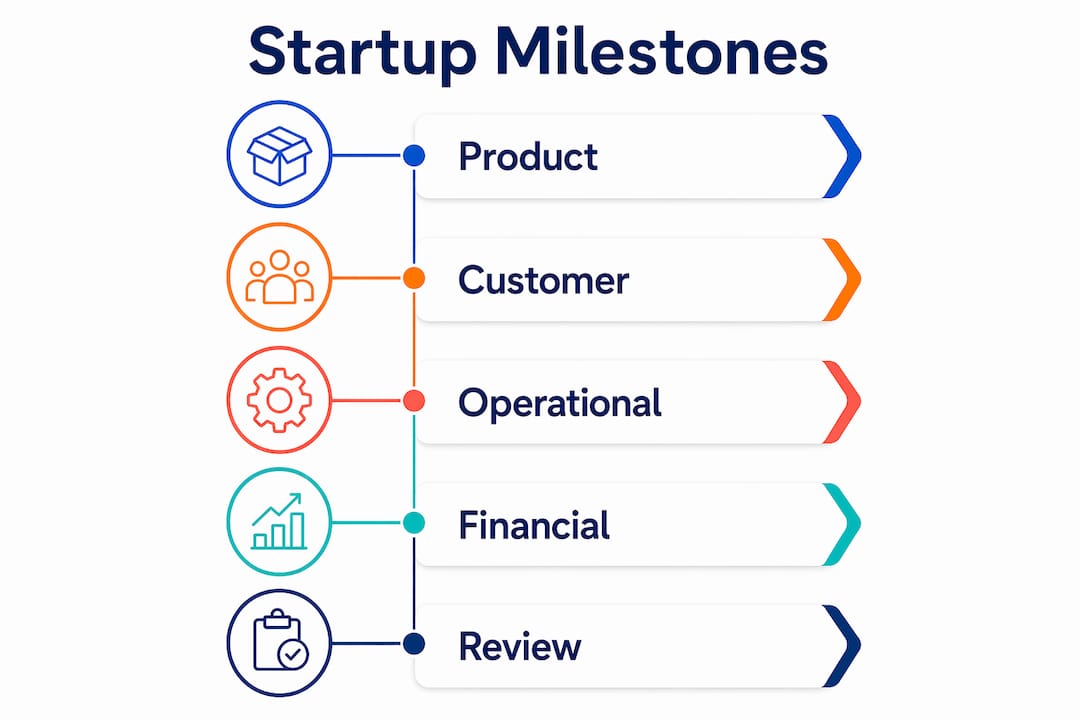
Business growth milestones fall into a few clear categories. Understanding each type helps you build a plan that covers the full picture of your business, not just the parts you find most exciting.
Product and market validation milestones
These milestones confirm that your product solves a real problem for real people. Examples include completing your first customer interview series, launching a minimum viable product, or reaching a defined number of paying users. Without these, every other milestone is built on assumptions.
Customer acquisition and revenue milestones
These are the milestones most founders think of first. Reaching your first $10,000 in monthly revenue, acquiring your first 100 customers, or achieving a defined customer retention rate all qualify. They measure whether your business model actually works in the market.
Operational milestones
These often get overlooked, but they are critical for sustainability. Hiring your first employee, launching your website, setting up your accounting system, or protecting your intellectual property are all operational milestones that build the foundation your growth depends on.
Financial milestones
Achieving your first month of profitability, closing a funding round, or reaching a defined cash runway target are financial milestones. They signal that your business is not just growing but doing so in a way that is financially sustainable.
Here is a quick reference for milestone types and what they confirm:
| Milestone type | What it confirms |
|---|---|
| Product validation | Your solution solves a real, paying customer problem |
| Customer acquisition | Your go-to-market approach is working |
| Operational setup | Your business has the infrastructure to scale |
| Financial health | Your model generates real, sustainable value |
| Plan review and pivot | Your strategy still fits current market conditions |
Each category serves a different diagnostic purpose. A business that only tracks revenue milestones will miss operational or product problems until they become crises.
How do you track and adjust milestones to stay on course?
Monthly milestone reviews are more effective than quarterly ones for early-stage businesses. Quarterly reviews leave too much time between signals. By the time you notice a problem in a quarterly review, you have often lost 60 or 90 days of momentum that you cannot recover.
Regular milestone reviews catch problems early when they are still fixable, avoiding costly late-stage failures. That is the core logic behind monthly check-ins. They are not bureaucratic exercises. They are your early warning system.
Milestones act as diagnostic tools that trigger evaluation moments for operational health and growth readiness. They expose hidden inefficiencies and help you avoid burnout by surfacing issues before they compound. Think of each milestone review as a health check for your business, not just a progress report.
Common mistakes to avoid in milestone tracking:
- Confusing tasks with milestones. Completing 10 sales calls is a task. Closing your first three paying customers is a milestone. The distinction keeps your plan focused on outcomes, not activity.
- Setting arbitrary deadlines. Deadlines should follow from the work required, not from a desire to look ambitious. Artificial pressure produces shortcuts, not results.
- Skipping reviews when things are going well. Good periods are exactly when you should review. They reveal what is working so you can do more of it deliberately.
- Failing to adjust when the market shifts. A milestone that made sense six months ago may no longer reflect your actual business reality. Adjusting is not failure. It is good management.
The entrepreneurial frameworks that support sustainable growth all share one feature: they build in regular feedback loops. Milestone reviews are your most practical version of that loop.
Key Takeaways
Business milestones are the most direct tool early-stage entrepreneurs have for turning strategy into measurable, accountable progress.
| Point | Details |
|---|---|
| Define outcomes before deadlines | Set what must be true at each stage before assigning a date to avoid artificial pressure. |
| Limit to 5–7 milestones per year | Fewer milestones sharpen focus and reduce the risk of fragmented execution. |
| Assign single ownership | One named person per milestone eliminates accountability gaps and drives consistent follow-through. |
| Review monthly, not quarterly | Monthly check-ins catch problems while they are still small enough to fix without losing the year. |
| Spread milestones evenly | Even distribution across the calendar year correlates with higher long-term success rates. |
Why most founders get milestones wrong (and how to fix it)
I have worked with hundreds of early-stage founders, and the pattern is almost always the same. They set milestones that are really just tasks dressed up with a deadline. “Launch the website by March 15” feels like a milestone. But it is not. The real milestone is “website live and generating first 50 qualified leads.” That shift from activity to outcome changes everything about how a team prepares and executes.
The second mistake I see constantly is shared ownership. Two co-founders both “responsible” for a milestone means neither one is truly accountable. The moment something gets hard, the conversation becomes about who should have done what. Absolute, single-person ownership is the only structure that actually holds.
The third pattern is setting too many milestones out of enthusiasm. A founder who lists 15 milestones for their first year is not being thorough. They are spreading their attention so thin that nothing gets the focus it deserves. The startup success factors that consistently show up in research all point to concentrated effort, not distributed effort.
My honest recommendation: treat your milestone plan as a living document, not a contract. Set it with care, review it monthly, and adjust it without guilt when the market or your business changes. The goal is not to predict the future perfectly. The goal is to stay close enough to reality that you can respond to it.
— Amichai
How Nomadexcel helps you build a milestone-driven business
Milestone planning is a skill, and like any skill, it develops faster with the right guidance and community around you. Nomadexcel’s Online Entrepreneurship Bootcamp is built specifically for aspiring and early-stage entrepreneurs who want to move from ideas to execution with clarity and confidence. The program teaches you how to set SMART milestones, assign ownership, and build the review habits that keep your business on track. You work alongside a curated group of founders, get direct mentorship from experienced operators, and leave with a concrete plan you can act on immediately. Business education of this kind pays for itself the first time it prevents a costly strategic mistake.
FAQ
What is a business milestone?
A business milestone is a measurable checkpoint that confirms meaningful progress toward a specific business goal, not just a completed task or a date on a calendar.
How many milestones should a startup set in its first year?
Early-stage businesses should target 5–7 core milestones for their first year. That range maintains focus without leaving too much space between progress checkpoints.
Why does milestone ownership matter?
Assigning a single named owner to each milestone eliminates shared-responsibility gaps. When one person is accountable, execution becomes consistent and follow-through improves significantly.
How often should you review business milestones?
Monthly reviews are more effective than quarterly ones for early-stage businesses. They catch problems early enough to fix without losing significant time or momentum.
What is the difference between a task and a milestone?
A task is an activity you complete. A milestone is a significant outcome that confirms your business has advanced toward a meaningful goal. Confusing the two leads to plans that measure effort instead of progress.
Comments are closed.