
Startup Goal Setting Workflow for Founders in 2026
TL;DR:
- A startup goal setting workflow involves defining, tracking, and reviewing objectives in quarterly cycles using OKRs. It emphasizes focused goals, clear ownership, weekly check-ins, and honest retrospectives to build a repeatable process that improves over time.
A startup goal setting workflow is a structured system for defining, tracking, and achieving business objectives in repeatable quarterly cycles. The most effective version combines OKRs (Objectives and Key Results) with clear ownership, weekly check-ins, and honest retrospectives. Transparent shared objectives tied to mission increase team productivity and morale significantly. Without this structure, early-stage founders often chase too many priorities at once, diluting focus and stalling growth before it starts.
What are the essential components of a startup goal setting workflow?
The foundation of any effective goal setting system is a small number of focused objectives with measurable results attached to each one. Industry-standard OKR frameworks recommend setting no more than 1–3 company-level objectives per quarter, with 2–4 measurable key results per objective. That constraint is not a limitation. It is the entire point.
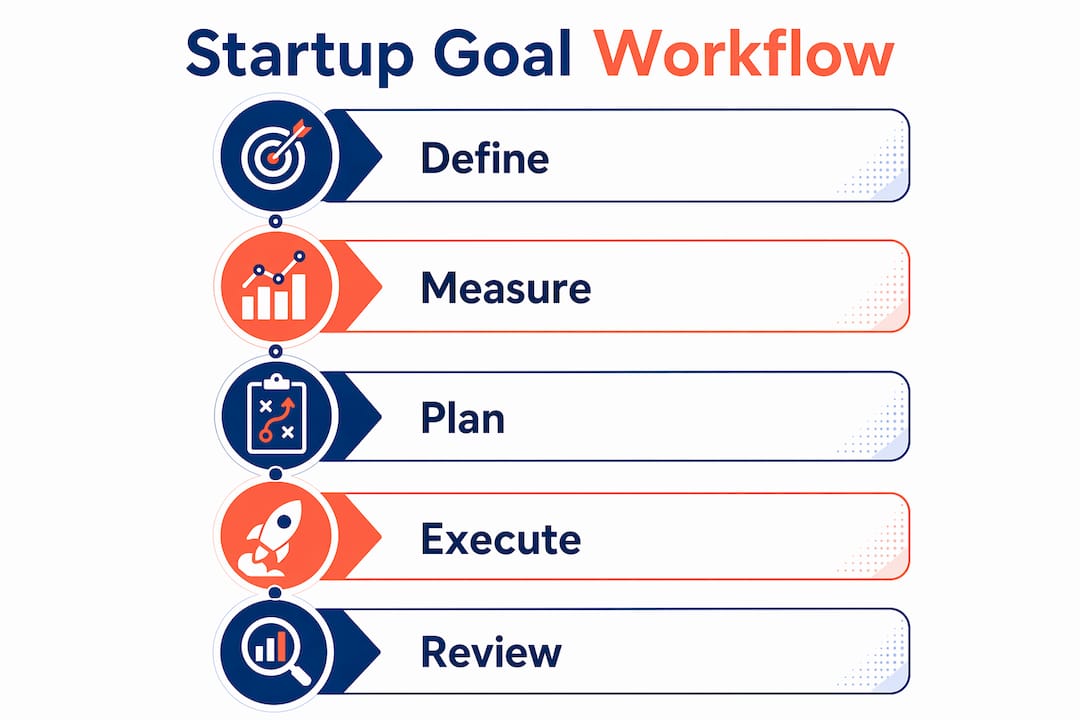
Before building your workflow, you need to understand the difference between two commonly confused tools: KPIs and OKRs. KPIs track operational health as persistent metrics, like monthly revenue or churn rate. OKRs are fixed-period directional bets designed to shift the business in a specific window of time. Think of KPIs as monitoring your engine and OKRs as deciding where to drive.

Every objective needs a single named owner. Unclear ownership leads to stalled initiatives because no one feels personally responsible for the outcome. Assign one person per objective at the leadership level before the quarter begins.
The core components of a working startup objectives framework are:
- Objectives: 1–3 ambitious but achievable company-level goals per quarter
- Key Results: 2–4 measurable outcomes per objective (not tasks, but results)
- Owners: One named person accountable per objective
- Cadence: A 13-week cycle with weekly check-ins and a closing retrospective
- Scoring: Honest end-of-quarter ratings based on actual data
Pro Tip: Write each key result as a number that moves. “Increase referral sign-ups from 22% to 35%” is a key result. “Launch referral program” is a task. The difference matters more than most founders realize.
How to implement the 13-week startup goal setting workflow step by step
The 13-week goal cycle is the most effective rhythm for early-stage startups. It is long enough to produce meaningful results and short enough to stay relevant as conditions change. Here is how each phase works in practice.
Weeks 1–2: Draft and publish your OKRs. Gather your leadership team for a collaborative planning session. Write your objectives together, assign owners, and define the key results that will signal success. Publish the final OKRs somewhere every team member can see them. Visibility is not optional. It is what turns a document into a commitment.
Weeks 3–11: Run weekly 5-minute check-ins. Weekly OKR check-ins build the habit of accountability and integrate goal review into everyday decision-making. Each owner updates their key results with actual data, not impressions. The check-in should take no longer than five minutes per objective. If it takes longer, your key results are probably not specific enough.
Week 12: Score your results honestly. Rate each key result on a 0–1 scale using objective data. A score of 0.7 is considered a strong result in OKR methodology. Consistently hitting 1.0 means your goals were not ambitious enough. Consistently hitting 0.2 means they were unrealistic or under-resourced.
Week 13: Run a 60-minute retrospective. Spend 30–60 minutes as a team analyzing what drove results and what held you back. Ask three questions: What worked? What did not? What will we change next quarter? This retrospective is where the real learning happens, and skipping it is the single most common reason startups fail to improve quarter over quarter.
Pro Tip: Most startups need 2–3 quarters to settle into effective OKR execution. Your first quarter is about building the rhythm, not perfecting the results. Treat it as a practice run with real stakes.
A well-executed startup planning process like this one gives founders a repeatable structure that compounds over time. Each quarter you run it, your team gets faster at setting goals and more honest about tracking them.

What tools and methods best support startup goal tracking?
The right tool for goal tracking depends on your team size and current complexity. Start with shared spreadsheets before scaling to dedicated software. Simplicity aids transparency and adoption in early-stage startups. A Google Sheet that everyone updates is more effective than a sophisticated platform that no one opens.
The table below outlines the most practical tracking approaches by stage:
| Stage | Recommended tool | Key benefit |
|---|---|---|
| Pre-revenue (1–5 people) | Shared spreadsheet (Google Sheets) | Zero cost, easy access, fast setup |
| Early traction (5–15 people) | Notion or Airtable database | Structured views, linked data |
| Growth stage (15+ people) | Dedicated OKR platform | Automated check-ins, reporting |
Beyond the tool itself, the method matters more than the software. Four practices separate teams that track goals well from those that do not:
- Single source of truth: All OKRs and data updates live in one place. No parallel spreadsheets, no duplicate trackers.
- Weekly visible dashboards: Post a summary of key result progress somewhere the whole team sees it, even if it is just a Slack message every Monday.
- Data integrity rules: Each owner updates their key result with real numbers, not estimates or feelings. If the data is not available, note why.
- Timely updates: Check-ins happen on a fixed day each week. Missed updates break the rhythm and erode trust in the system.
For founders who also want to track website performance alongside business goals, understanding how to measure website KPIs gives you a practical framework for connecting digital metrics to your OKRs.
What common mistakes should startups avoid in goal setting workflows?
The most damaging mistake in any goal setting workflow is setting too many objectives. Discipline lies in deletion, not addition. When founders list eight objectives for a quarter, they are not being ambitious. They are avoiding the hard choice of deciding what actually matters most. Apply “kill criteria” decisively: if an objective does not directly move your most critical metric this quarter, cut it.
“Confusing key results with tasks is the most common OKR mistake. ‘Launch referral program’ is a task. ‘Increase referral sign-ups from 22% to 35%’ is a measurable key result. One tells you what to do. The other tells you whether it worked.”
A second major pitfall is cascading OKRs to individual contributors too early. Early-stage founders should master OKRs at the leadership level before pushing them down to individuals. Cascading too soon creates what practitioners call “corporate theater,” where people fill out goal templates without genuine buy-in or understanding. Get your leadership team running the system well for at least one quarter before expanding it.
Other mistakes that consistently weaken goal setting workflows include:
- Skipping the weekly check-in because things feel “on track.” Feelings are not data.
- Writing vague objectives like “grow the business” with no measurable key results attached.
- Treating the retrospective as optional. It is the mechanism that makes each quarter better than the last.
- Ignoring a goal that is clearly off track instead of adjusting it mid-quarter when circumstances change.
For a detailed walkthrough of avoiding goal setting pitfalls, the step-by-step breakdown covers each of these failure modes with practical fixes.
Key Takeaways
A startup goal setting workflow succeeds when it combines focused OKRs, single ownership, weekly data-driven check-ins, and honest quarterly retrospectives run consistently over multiple cycles.
| Point | Details |
|---|---|
| Limit objectives per quarter | Set no more than 1–3 company-level objectives to maintain focus and execution quality. |
| Distinguish KPIs from OKRs | KPIs monitor ongoing health; OKRs are time-bound bets designed to shift the business. |
| Assign one owner per objective | Single ownership prevents diffused accountability and keeps initiatives moving forward. |
| Run the 13-week cycle fully | Weekly check-ins and a closing retrospective are what make the system compound over time. |
| Start simple with tools | A shared spreadsheet beats unused software every time at the early stage. |
Why I think most founders get goal setting backwards
Most early-stage founders treat goal setting as a planning exercise. They spend hours crafting the perfect OKR document, then check it again at the end of the quarter. That approach misses the entire point.
The real value of a goal setting workflow is not the goals themselves. It is the weekly rhythm of looking at real data and asking, “Are we still pointed in the right direction?” Successful founders treat goal documents as rolling hypotheses, updating them as they gather insights. That mindset shift changes everything.
I have also seen founders resist the 70-20-10 capacity rule because it feels too rigid for a startup. In practice, it is the opposite. Allocating 70% of your effort to your main growth driver, 20% to secondary priorities, and 10% to experiments gives you permission to say no to the things that feel urgent but are not important. That clarity is rare and worth protecting.
The founders who build the best goal setting habits share one trait: they prioritize mastering the rhythm before scaling the complexity. Run one quarter with three objectives and weekly check-ins. Get that working well. Then add layers. Trying to build a full cascaded OKR system in your first quarter is the fastest way to abandon the whole thing by week six.
Transparency is the last piece most people underestimate. When your whole team can see the OKRs and the weekly progress data, something shifts. People connect their daily work to the company’s direction. That connection is what turns a goal setting workflow into a genuine competitive advantage.
— Amichai
How Nomadexcel supports founders in building goal setting systems
Founders who want structured guidance on building and running effective goal setting workflows will find that Nomadexcel’s online entrepreneurship bootcamp covers exactly this. The program includes training on proven OKR systems, execution methods, and the weekly rhythms that make quarterly planning stick. Participants work through real goal setting exercises with mentorship from experienced operators and a peer community that holds them accountable beyond the program itself. For early-stage founders who want to move from scattered priorities to a clear, repeatable system, the bootcamp offers both the framework and the support to make it work. Learn more about what the program includes and whether it fits where you are right now.
FAQ
What is a startup goal setting workflow?
A startup goal setting workflow is a structured process for defining, tracking, and reviewing business objectives in repeatable cycles, typically using OKR frameworks with quarterly planning and weekly check-ins.
How many goals should a startup set per quarter?
Industry-standard OKR practice recommends no more than 1–3 company-level objectives per quarter, each with 2–4 measurable key results to maintain focus and execution quality.
What is the difference between OKRs and KPIs?
KPIs are persistent metrics that monitor ongoing operational health, while OKRs are fixed-period directional goals designed to shift the business in a specific timeframe.
How long does it take to get good at OKRs?
Most startups need 2–3 quarters to settle into effective OKR execution. The first quarter focuses on building the rhythm of check-ins and retrospectives rather than perfecting results.
When should a startup cascade OKRs to individual team members?
Founders should master OKRs at the leadership level for at least one quarter before cascading to individuals, since premature cascading creates compliance without genuine buy-in.
Comments are closed.