
The Role of Business Facilitation in Team Growth
TL;DR:
- Business facilitation guides group interactions to produce effective decisions and stronger team alignment. It involves managing participation, choosing techniques, and maintaining neutrality to build trust and foster collaboration. Proper facilitation accelerates decision-making and learning, especially for small businesses seeking growth and strategic clarity.
Business facilitation is defined as the deliberate process of guiding group interactions to produce collaborative, effective, and actionable outcomes. The role of business facilitation goes far beyond running meetings. It structures how teams think together, make decisions, and move from conversation to commitment. The Investment Facilitation Index tracks 101 specific measures across 142 economies to quantify how structured facilitation frameworks reduce procedural complexity and cost. That scope signals something important: facilitation is not a soft skill reserved for large corporations. For small business owners and individual entrepreneurs, it is one of the most practical tools available for turning chaotic discussions into clear decisions.
What is the role of business facilitation in meetings and workshops?
A facilitator is not the provider of answers. As research confirms, a facilitator acts as a conductor who sets the framework, balances participation, synthesizes ideas, and moves the group toward results. That distinction matters enormously for small teams, where one dominant voice can derail an entire planning session.
The core functions of a business facilitator include:
- Guide: Keeps the group focused on the stated objective and prevents tangents from consuming the session.
- Motivator: Draws out quieter participants and creates psychological safety so every voice contributes.
- Bridge-builder: Connects conflicting perspectives and finds common ground across stakeholders with different priorities.
- Timekeeper: Manages airtime so no single participant monopolizes discussion.
- Synthesizer: Distills scattered ideas into clear themes the group can act on.
Managing participant airtime and using visual tools like sticky notes, whiteboards, or digital canvases help groups stay focused and reflective. Deliberate silence after a question is one of the most underused facilitation techniques. It signals to participants that deeper thinking is expected, not just the first answer that comes to mind.
The facilitator’s neutrality is what makes all of this work. When participants trust that the facilitator has no stake in the outcome, they engage more honestly. That trust is the invisible foundation of every productive session.

Pro Tip: Before any session, write the meeting objective in one sentence and share it with participants 24 hours in advance. Groups that arrive knowing the goal spend less time orienting and more time deciding.
Which business facilitation techniques optimize collaboration and decision-making?
Professional facilitators choose techniques based on the meeting objective. The two primary categories are divergent methods for generating ideas and convergent methods for narrowing and deciding.

| Technique | Type | Best used when |
|---|---|---|
| Brainstorming | Divergent | You need a wide range of ideas without judgment |
| Affinity mapping | Divergent | You have many ideas and need to find patterns |
| Dot voting | Convergent | A group needs to prioritize quickly and democratically |
| Prioritization matrix | Convergent | Decisions require weighing impact against effort |
| Round-robin sharing | Divergent | Quieter participants need structured space to contribute |
Brainstorming works best in the early stages of a project, when the goal is quantity over quality. Affinity mapping follows naturally: participants cluster related ideas on a board, revealing themes the group did not consciously plan. These two techniques together form a powerful opening sequence for any strategy session.
Dot voting and prioritization matrices serve the opposite purpose. Once ideas are on the table, dot voting gives every participant equal influence over which ideas move forward. A prioritization matrix adds rigor by scoring each option against criteria like cost, time, and strategic fit. Small business owners find this combination particularly useful when resources are tight and every decision carries real risk.
Choosing the wrong technique for the meeting goal is one of the most common facilitation mistakes. Running a brainstorm when the group needs to decide wastes time and frustrates participants. Running a vote when the group still needs to generate options shuts down creativity too early.
Pro Tip: Match your technique to the meeting phase, not the topic. Ask yourself: “Are we generating or deciding?” That single question will guide your technique selection every time.
How does effective business facilitation impact small businesses and teams?
Effective facilitation reduces information asymmetry and procedural complexity, enabling businesses to shift from survival planning to strategic growth. For a small team of five people, that shift can mean the difference between reacting to problems and building systems that prevent them.
The tangible benefits of well-facilitated sessions include:
- Faster decision cycles: Structured sessions with clear objectives cut meeting time and produce decisions in a single session rather than across multiple follow-ups.
- Democratic participation: Facilitation techniques promote democratic decision-making, improve morale, and encourage participation from all members. Teams that feel heard are more committed to outcomes.
- Reduced power struggles: When a neutral facilitator manages the process, seniority and personality stop determining whose ideas win.
- Stronger stakeholder alignment: Groups that work through a facilitated process arrive at shared understanding, not just shared agreement. That distinction reduces rework and misalignment downstream.
- Time and resource savings: A 90-minute facilitated session that produces a clear decision saves hours of follow-up emails, informal debates, and revisited choices.
“Facilitation’s impact is often invisible, but it creates an essential environment for business confidence and strategic growth by reducing complexity.” — World Bank
The compounding effect of these benefits is what makes facilitation so valuable for small businesses. One well-run session builds trust. That trust makes the next session more productive. Over time, teams develop a shared language and rhythm that accelerates every collaborative effort.
A practical example: a five-person startup using affinity mapping and dot voting in a quarterly planning session can align on three priorities in under two hours. Without facilitation, the same conversation often takes multiple meetings and still ends without full buy-in.
What are best practices and common pitfalls in business facilitation?
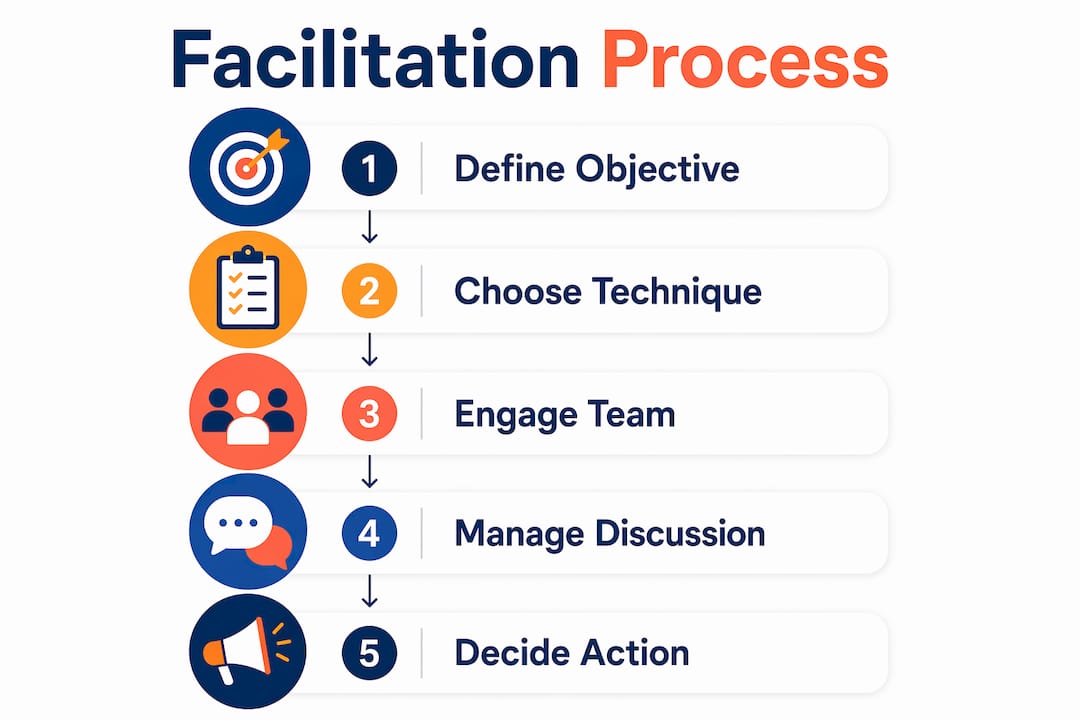
Effective facilitation does not happen by accident. Workshops have three phases, and skipping any one of them reduces quality and results. Here is how to execute each phase well and avoid the most common mistakes.
Prepare with precision. Define the session objective in one sentence. Select participants based on who needs to contribute, not who wants to attend. Choose your techniques before the session, not during it. Prepare visual templates, timing guides, and any pre-read materials at least 48 hours in advance.
Open with alignment. Start every session by stating the objective aloud and confirming that participants agree on the goal. This single step prevents the most common facilitation failure: a group that spends an hour discussing the wrong question.
Manage the room actively. Watch for participants who dominate and those who go quiet. Use round-robin sharing or written input to rebalance participation. When conflict arises, name it neutrally: “I’m hearing two different views here. Let’s make sure both are understood before we move forward.”
Close with clarity. End every session with a documented summary of decisions made, actions assigned, and owners named. A session that ends without clear next steps produces no lasting change.
Debrief and improve. Facilitation skill grows through repeated practice, personal debriefs, and co-facilitation with experienced mentors. After each session, ask yourself what worked, what slowed the group, and what you would change. This reflection is what separates a competent facilitator from a great one.
The most common pitfall is overstepping neutrality. When a facilitator starts advocating for a particular outcome, participants lose trust in the process. A second common mistake is running unfocused sessions with no clear objective, which leaves participants feeling their time was wasted. Both errors are entirely avoidable with preparation.
Key Takeaways
Business facilitation is the structured practice of guiding group interactions to produce clear decisions, stronger alignment, and faster execution for small businesses and teams.
| Point | Details |
|---|---|
| Facilitator as conductor | A facilitator guides process and balances participation without advocating for any specific outcome. |
| Match technique to goal | Use divergent methods like brainstorming for idea generation and convergent tools like dot voting for decisions. |
| Three-phase structure | Prepare thoroughly, run the session actively, and close with documented decisions and assigned actions. |
| Facilitation builds trust | Repeated well-run sessions create a shared team rhythm that accelerates every future collaboration. |
| Facilitation is learnable | Skill grows through practice, personal debriefs, and co-facilitation with experienced mentors. |
Why facilitation is the most underrated skill in small business
Most small business owners I have worked with treat meetings as a necessary cost. They sit down, talk through problems, and hope something useful comes out the other end. Facilitation flips that assumption entirely. It treats every group conversation as a designed experience with a specific output.
The part that surprises people most is how much of the work happens before anyone enters the room. Choosing the right technique, writing a clear objective, and selecting the right participants are decisions that determine the session’s outcome before it starts. The visible work of running the session is actually the smaller part of the job.
What I find most compelling about facilitation is that it is entirely learnable. It is not a personality trait or a gift. Skill acquisition in facilitation is a progressive craft built through repeated practice, debriefing, and co-facilitation. Every entrepreneur who commits to learning it gains a permanent advantage in how their team thinks and decides together.
The businesses I have seen grow fastest are not always the ones with the best ideas. They are the ones where the team can get aligned quickly, make decisions with confidence, and move. Facilitation is the mechanism that makes that possible. If you want to build a business that scales, start by building a team that can think together effectively.
— Amichai
How Nomadexcel helps entrepreneurs build facilitation skills
Nomadexcel designs programs specifically for entrepreneurs and small teams who want to grow faster through better collaboration and execution. The online entrepreneurship bootcamp gives participants hands-on practice with the exact frameworks covered in this article: structured decision-making, team alignment, and facilitated workshops that produce real results. For teams, Nomadexcel’s business retreats combine expert facilitation with immersive experiences designed to strengthen communication and strategic clarity. Both programs are built around the principle that facilitation is a learnable craft, and that the right environment accelerates that learning significantly. If you are ready to turn your team’s conversations into committed action, Nomadexcel’s programs offer the structure and mentorship to get there.
FAQ
What is the role of business facilitation?
Business facilitation is the structured process of guiding group interactions to produce collaborative decisions and clear outcomes. A facilitator manages participation, selects appropriate techniques, and moves the group from discussion to action without advocating for any specific result.
What are the most effective business facilitation techniques?
Brainstorming and affinity mapping work best for generating ideas, while dot voting and prioritization matrices drive decisions. Professional facilitators choose techniques based on whether the session goal is divergent thinking or convergent decision-making.
How does facilitation improve team productivity?
Well-facilitated meetings promote democratic participation, reduce power struggles, and produce faster decisions. Teams that use structured facilitation consistently report stronger alignment and less time spent revisiting decisions.
Can small business owners learn to facilitate effectively?
Facilitation is a learnable skill, not an innate talent. It develops through repeated practice, post-session debriefs, and co-facilitation with experienced mentors. Small business owners who invest in learning workshop facilitation gain a direct advantage in how their teams collaborate and decide.
What is the biggest mistake in business facilitation?
Overstepping neutrality is the most damaging facilitation error. When a facilitator advocates for a specific outcome, participants lose trust in the process and disengage. The second most common mistake is running sessions without a clearly defined objective, which wastes time and produces no lasting decisions.
Comments are closed.