
Founder Mindset: The Key to Entrepreneurial Growth
Most startups with an american founder survive just five years, yet the right mindset can turn early volatility into lasting success. Shifting to a founder mindset is not about luck or personality, but about choice and deliberate practice. For aspiring entrepreneurs in global bootcamps, understanding what sets the American approach apart and mastering these core concepts will help you lead teams through uncertainty and unlock true business growth.
Table of Contents
- Defining Founder Mindset And Core Concepts
- Key Traits Of Successful Founders
- Founder Mindset Versus Employee Mindset
- How Founder Mindset Drives Growth
- Common Pitfalls And How To Avoid Them
- Practical Steps To Cultivate Founder Mindset
Key Takeaways
| Point | Details |
|---|---|
| Founder Mindset | The founder mindset fosters innovation by embracing challenges and viewing uncertainty as a growth opportunity. |
| Key Traits of Founders | Successful founders exhibit cognitive flexibility, resilience, and a commitment to ongoing learning and adaptation. |
| Differences in Mindset | Founders operate with a risk-taking and innovative orientation, contrasting with employees who prioritize stability and structured roles. |
| Cultivation Strategies | To develop a founder mindset, engage in low-risk experiments and seek diverse feedback to enhance strategic decision-making abilities. |
Defining Founder Mindset and Core Concepts
The founder mindset represents a unique psychological framework that enables entrepreneurs to transform innovative ideas into successful ventures. At its core, this mindset is about challenging existing paradigms and embracing uncertainty as an opportunity for growth. Distinctive personality traits characterize entrepreneurs who can navigate complex business landscapes with resilience and strategic thinking.
A founder mindset goes beyond simple business strategy – it encompasses a holistic approach to problem solving that involves taking calculated risks, maintaining adaptability, and possessing an unwavering commitment to vision. Successful founders demonstrate an ability to make critical decisions under conditions of significant ambiguity, often exercising judgment with limited experience. This means developing a capacity to pivot quickly, learn continuously, and view obstacles as opportunities for innovation.
The key characteristics of a founder mindset include:
- Proactive problem identification
- Willingness to challenge status quo
- Comfort with uncertainty
- Rapid learning and adaptation
- Strategic risk assessment
- Strong vision and execution skills
Pro tip: Cultivate your founder mindset by deliberately seeking out challenging situations that require creative problem solving and maintaining a growth-oriented perspective.
Key Traits of Successful Founders
Successful founders are distinguished by a unique combination of cognitive abilities, personal characteristics, and strategic thinking that enable them to transform innovative ideas into thriving businesses. Entrepreneurial personality traits reveal that there is no single template for founder success, but rather a dynamic mix of qualities that drive venture performance.

The most impactful founders demonstrate key characteristics that set them apart. These include an exceptional ability to evaluate strategic factors and personal competencies that influence business outcomes. They possess a remarkable capacity for taking calculated risks, maintaining high initiative levels, and displaying an openness to novel approaches that challenge conventional business wisdom.
Key traits of extraordinary founders include:
- High cognitive flexibility
- Strong strategic decision-making skills
- Exceptional resilience under uncertainty
- Ability to build and leverage diverse founding teams
- Intrinsic motivation and persistent learning mindset
- Advanced problem-solving capabilities
Successful entrepreneurs understand that their founding team’s collective capabilities matter as much as individual skills. Research indicates that personality diversity within founding teams can significantly enhance startup potential, creating a robust ecosystem of complementary strengths and perspectives.
Pro tip: Systematically assess and develop your entrepreneurial traits by seeking diverse experiences, embracing continuous learning, and deliberately challenging your existing mental frameworks.
Founder Mindset versus Employee Mindset
The fundamental difference between founder and employee mindsets lies in their approach to risk, innovation, and organizational dynamics. Calculated risk-taking defines the founder’s perspective, where entrepreneurs view uncertainty as an opportunity for growth and learning, unlike traditional employees who typically prioritize stability and predictable outcomes.
Employees often operate within structured environments with predefined roles and expectations, while founders navigate complex growth challenges through mission-driven leadership. This fundamental distinction manifests in several key areas of thinking and action. Founders embrace experimentation, viewing failures as valuable feedback mechanisms, whereas employees tend to minimize risks and focus on maintaining established processes.
Key differences between founder and employee mindsets include:
- Risk perception
- Decision-making approach
- Ownership mentality
- Tolerance for uncertainty
- Innovation orientation
- Organizational perspective
Founders fundamentally see themselves as creators and problem solvers, constantly challenging existing paradigms. They understand that sustainable growth requires continuous adaptation, learning, and the willingness to pivot when necessary. This stands in stark contrast to the employee mindset, which typically emphasizes consistency, compliance, and incremental improvement within existing frameworks.
Pro tip: Develop a founder’s perspective by intentionally seeking opportunities that push you beyond your comfort zone and cultivating a mindset of continuous learning and strategic experimentation.
How Founder Mindset Drives Growth
Founder mindset is the critical engine that propels business growth beyond traditional operational strategies. Preserving entrepreneurial culture drives exceptional performance, enabling organizations to navigate complex challenges and maintain innovative momentum. This unique approach transforms potential obstacles into opportunities for strategic advancement.
The fundamental mechanism of founder mindset growth involves creating an environment of rapid decision-making, strategic adaptability, and mission-driven execution. Founders maintain growth by assembling motivated teams who can operate effectively under uncertain conditions. They understand that scalability requires continuous learning, willingness to pivot, and a resilient approach to organizational challenges.
Key growth drivers of the founder mindset include:
- Rapid strategic decision-making
- Continuous innovation
- Resource optimization
- Adaptable leadership
- Mission-focused execution
- Resilience against organizational barriers
Successful founders recognize that growth is not merely about increasing revenue, but about creating robust systems that can evolve dynamically. They view challenges as opportunities for refinement, maintaining an experimental approach that allows their ventures to stay ahead of market shifts and emerging trends. This perspective transforms potential setbacks into valuable learning experiences that ultimately strengthen the organization’s competitive position.
This table summarizes how the founder mindset uniquely contributes to business growth compared to standard operational approaches:
| Growth Factor | Founder Mindset Approach | Traditional Operations Approach |
|---|---|---|
| Decision Speed | Rapid and adaptive | Cautious and procedural |
| Response to Obstacles | Sees as innovation opportunities | Views as risks to minimize |
| Leadership Style | Mission-driven and empowering | Hierarchy-focused |
| Learning Orientation | Continuous self-improvement | Occasional training |
Pro tip: Cultivate your founder mindset by regularly challenging your existing assumptions, seeking feedback from diverse perspectives, and treating every business challenge as a strategic learning opportunity.
Common Pitfalls and How to Avoid Them
Founders frequently encounter complex challenges that can derail their entrepreneurial journey if not carefully navigated. Organizational complexity threatens startup momentum, creating potential scenarios of stagnation or complete business collapse. Understanding these potential pitfalls is the first critical step toward sustainable growth and strategic resilience.
One of the most significant risks involves misalignment during startup scaling. Founders often struggle with effectively delegating responsibilities, which can lead to burnout and organizational inefficiencies. The transition from a hands-on startup environment to a more structured organization requires deliberate strategy and emotional intelligence.
Common founder pitfalls include:
- Micromanaging team members
- Failing to delegate effectively
- Resisting organizational structure
- Neglecting personal development
- Avoiding difficult strategic conversations
- Maintaining rigid initial business models
Successful founders recognize that avoiding these pitfalls requires continuous self-reflection, adaptability, and a commitment to personal and organizational growth. They understand that maintaining the startup’s innovative spirit while building sustainable processes is a delicate but crucial balance. Strategic awareness and proactive management can transform potential obstacles into opportunities for meaningful development.
Here’s a reference table outlining practical actions to avoid common founder pitfalls:
| Potential Pitfall | Proactive Strategy | Expected Outcome |
|---|---|---|
| Micromanaging team members | Set clear roles and trust teams | Higher team autonomy |
| Neglecting personal growth | Schedule regular skill assessments | Improved founder capabilities |
| Resisting structured processes | Incrementally implement systems | Sustainable scaling |
| Avoiding tough conversations | Prepare and address issues early | Stronger team alignment |
Pro tip: Regularly conduct personal and organizational audits, seeking external perspectives and maintaining flexibility in your leadership approach to preemptively address potential scaling challenges.
Practical Steps to Cultivate Founder Mindset
Cultivating a founder mindset requires deliberate practice and a strategic approach to personal and professional development. It involves transforming your thinking from traditional risk-averse perspectives to an innovative, opportunity-driven framework that embraces uncertainty as a pathway to growth and learning.
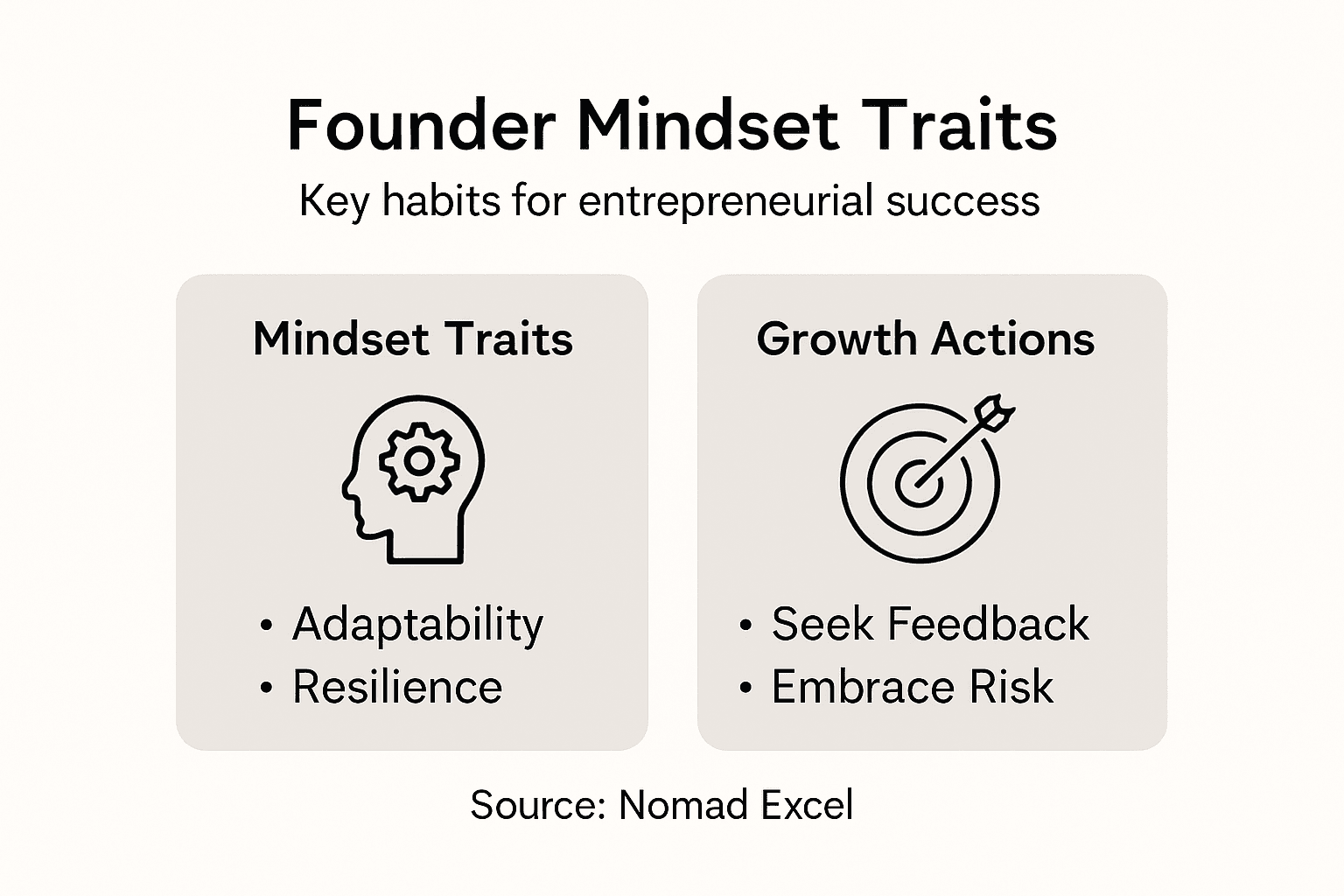
Practical cultivation involves systematically challenging existing mental models and developing resilience through incremental experimentation. Entrepreneurial thinking requires integrating innovation strategies that encourage continuous learning, adaptability, and strategic risk-taking. Successful founders understand that mindset development is an ongoing process of self-reflection and intentional skill-building.
Key steps to developing a founder mindset include:
- Start with low-risk experiments
- Reframe failures as learning opportunities
- Build a network of diverse, supportive entrepreneurs
- Practice rapid decision-making skills
- Develop comfort with uncertainty
- Create personal innovation routines
- Seek continuous feedback and mentorship
The most transformative founders recognize that mindset cultivation is not about eliminating fear, but about developing the courage to act despite uncertainty. They view challenges as opportunities for growth, maintain a curious and open perspective, and continuously invest in their personal and professional development.
Pro tip: Implement a weekly personal challenge that pushes you outside your comfort zone, systematically building your capacity for strategic risk-taking and entrepreneurial thinking.
Unlock Your Founder Mindset with Nomad Excel
The journey to fostering a powerful founder mindset requires more than just theory. This article highlights the pain points many entrepreneurs face such as navigating uncertainty, overcoming scaling challenges, and embracing rapid experimentation. If you are ready to develop critical traits like strategic risk-taking, rapid decision-making, and resilience, then engaging with hands-on experiences is essential. Nomad Excel specializes in helping founders and teams embody these qualities through immersive programs designed to accelerate growth.
Explore our Entrepreneurship Archives for insights that complement your learning as you build your founder mindset. If you want structured guidance and expert mentorship, our bootcamps and retreats offer tailored support that transforms ambition into execution. Take the next step today by visiting us at Nomad Excel and discover how you can join a community dedicated to real-world growth. Don’t wait to turn challenges into opportunities; your entrepreneurial adventure starts now.
Learn more about our programs at Program Archives and get inspired at Inspiration Archives.
Frequently Asked Questions
What is a founder mindset?
A founder mindset is a unique psychological framework that enables entrepreneurs to navigate uncertainties, take calculated risks, and transform innovative ideas into successful businesses. It involves proactive problem-solving, adaptability, and a strong vision.
How can I develop a founder mindset?
You can develop a founder mindset by intentionally seeking out challenging situations, practicing rapid decision-making, reframing failures as learning opportunities, and nurturing a network of diverse entrepreneurs for support and mentorship.
What are the key traits of successful founders?
Key traits of successful founders include high cognitive flexibility, resilience under uncertainty, strong strategic decision-making skills, intrinsic motivation, and the ability to build diverse teams that leverage complementary strengths.
How does a founder mindset drive business growth?
A founder mindset drives business growth by fostering rapid decision-making, continuous innovation, and adaptable leadership, enabling organizations to effectively navigate challenges and seize emerging opportunities.
Recommended
- Growth Mindset in Business: Unlocking Team Potential
- The Essential Guide to Benefits of Entrepreneurial Mindset – Nomad Excel – Your Entrepreneurial Adventure Starts Here
- The Essential Guide to Cultivating Entrepreneurial Independence
- Entrepreneur Mindset Guide for Growth and Independence – Nomad Excel – Your Entrepreneurial Adventure Starts Here
Comments are closed.