
Finish a Sales Plan in 5 Days for Founders and Early Teams
A sales plan is a one- to three-page operational blueprint that turns a revenue target into owned actions, and the first move is choosing a planning period and reversing that revenue target into team quotas. Everything else, from forecasting to territory maps, builds on that single decision. The steps below walk through the full process, with worked examples and a checklist you can fill in as you go.
TL;DR:
- Audit 12 to 24 months of CRM history, including win rates, average deal size, and sales cycle length, before ranking priority customer segments.
- Divide the revenue target by average deal size, then by realistic deals per representative; keep pipeline at three to four times quota before launch.
- Use inside sales for smaller deals and short cycles, enterprise outreach for high value accounts, and partners when they already own customer access.
- Teams under twenty people or still testing product market fit can use a one page plan, reviewed monthly; board reporting warrants a fuller document.
- Refresh quarterly, or sooner after a product launch, pricing change, or entry into a new market, because each can invalidate existing quotas and territories.
Table of Contents
- What a sales plan is and how it differs from a strategy or business plan
- Step-by-step process to develop a sales plan from raw data to signed-off plan
- Key elements every sales plan document needs
- How to set realistic goals, forecast, and allocate capacity
- Designing sales strategies and playbooks for each target segment
- Turning strategy into a 30-60-90 action plan with clear milestones
- Measuring, reviewing, and iterating on the plan once it is live
- Presenting the plan and winning stakeholder buy-in
- A bootcamp-style checklist for building the plan in a sprint
- One-page plan or formal annual plan: which one do you need?
- Build your sales plan faster with a guided bootcamp
- FAQ
- Sources
What a sales plan is and how it differs from a strategy or business plan
A sales plan is a working document that connects revenue goals to the people, accounts, and activities that will hit them. Salesforce defines it as a blueprint that combines objectives, target customers, strategies, team roles, and measurement into one place leadership and reps can both use. It is not a mission statement or a pitch deck. It is closer to a project plan for revenue, built to be read in ten minutes and acted on the same day.
People often use “sales plan,” “sales strategy,” and “business plan” interchangeably, but they answer different questions:
- Business plan: why the company exists, what it sells, and how it makes money overall.
- Sales strategy: the long-term approach to winning customers, including positioning and market choices.
- Sales plan: the operational document that turns that strategy into quotas, territories, and weekly actions.
- Account plan: a narrower document for one specific customer or prospect, usually nested inside the broader sales plan.
Most teams create a fresh sales plan once a year and refresh it quarterly. You should also rebuild one whenever a major product launches, pricing changes, or a new market segment opens up, since any of those shifts can make last year’s quotas and territories obsolete overnight.
Step-by-step process to develop a sales plan from raw data to signed-off plan
Building a credible sales plan is less about inspiration and more about sequence. Skip a step and the later numbers stop making sense, so work through these in order.
- Define objectives and the planning horizon. Decide whether you are planning for a quarter, a half, or a full year, and write down the single revenue number you are solving for. Shorter horizons suit new teams or volatile markets; annual plans suit established teams with stable pipelines.
- Pull and audit your CRM data. HubSpot’s guide to sales planning recommends reviewing 12 to 24 months of CRM history, win rates, average deal size, and sales cycle length, then running a quick SWOT to flag where the team is strong, exposed, or sitting on an untapped opportunity.
- Define your ideal customer profiles and priority segments. List the firmographic and behavioral traits of your best past customers, then rank segments by deal size, close rate, and sales cycle so you know where to spend the most effort.
- Forecast capacity and calculate quotas. Take your revenue target, divide it by the average deal size to get the number of deals needed, then divide by expected win rate to get required pipeline. This step also surfaces staffing gaps before they become quarter-end surprises.
- Select strategies and build playbooks per segment. Match outreach motion, messaging, and pricing approach to each ICP rather than running one generic process for every account type.
- Convert each initiative into actions with owners, deadlines, and metrics. A strategy that has no owner or date attached to it rarely survives past the kickoff meeting.
- Finalize the measurement dashboard and review cadence. Decide in advance what gets tracked weekly, monthly, and quarterly, and who is responsible for flagging when a number drifts off course.
Pro Tip: Draft the dashboard and review cadence in step 7 before you present the plan, not after. A plan without a built-in way to check itself gets ignored by week three.
Key elements every sales plan document needs
A sales plan earns its place on someone’s desk when it is organized the same way every time, so reviewers know exactly where to look for a number or a name. Use these sections as your template skeleton:
- Executive summary and mission: the revenue target, planning period, and one paragraph on why this plan will work.
- Revenue breakdown and activity targets: quota by rep, by segment, and by month or quarter, plus the activity volume (calls, demos, proposals) needed to hit it.
- ICP, buyer personas, and segmentation table: who you sell to, ranked by priority, with the criteria that define a qualified lead.
- Sales process map and playbook summary: the stages a deal moves through and which play applies to which segment.
- Enablement needs: training, battlecards, or content gaps the team needs closed before the plan can run at full speed.
- Team map, roles, and territories: who owns which accounts, and how compensation or incentives line up with the quotas above.
- Budget, tools, and risk assumptions: what the plan costs to run, which systems support it, and the two or three risks most likely to derail it.
Keep each section to a page or less wherever possible. A sales plan that reads like a strategy memo will get skimmed once and shelved; a sales plan with specific names, numbers, and dates gets opened every Monday.
How to set realistic goals, forecast, and allocate capacity
Vague goals produce vague plans, so write targets in SMART terms: specific, measurable, achievable, relevant, and time-bound. “Grow revenue” becomes “close $1.2 million in net new revenue across the enterprise segment by the end of Q2.” Once the goal is specific, forecasting and capacity planning become arithmetic rather than guesswork.
Start from historical conversion rates, average deal size, and sales cycle length, then build capacity using a simple formula:
- Divide the target revenue by the average deal size to get the number of deals needed.
- Divide the number of deals needed by the realistic quota per rep to get the number of reps required.
- Compare that number against current headcount to spot hiring gaps early.
- Apply a pipeline coverage ratio (commonly three to four times the quota in open pipeline) as a sanity check before the quarter starts.
43.8% was the quota attainment rate reported in the RepVue Cloud Sales Index for Q4 2025, with stronger results in mid-market and data and AI sub-verticals. That figure is a useful reminder that quotas set purely on last year’s best quarter tend to break; build in realistic capacity rather than aspirational math.
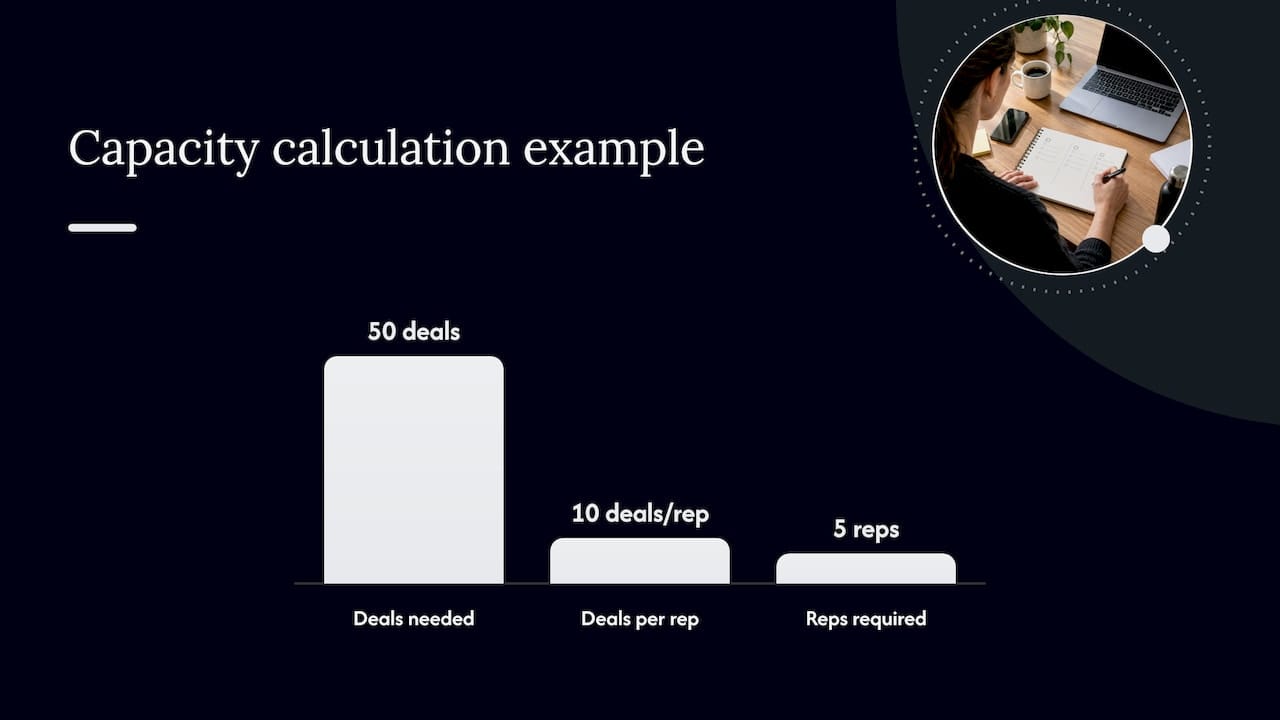
Here is a worked example using illustrative numbers only. Say your target is $1,000,000 in new revenue for the quarter, your average deal size is $20,000, and each rep can realistically close 10 deals a quarter. You need 50 deals ($1,000,000 ÷ $20,000), which means you need 5 reps (50 ÷ 10).
Designing sales strategies and playbooks for each target segment
A single sales motion rarely fits every customer you sell to, so match the play to the segment before you match the messaging to the play.
- Inbound or inside sales suits smaller deal sizes and shorter cycles, where volume and speed of response matter more than deep customization.
- Account-based or enterprise motions suit high-ACV accounts, where multiple stakeholders and longer cycles call for tailored outreach and executive involvement.
- Channel or partner motions suit markets where a third party already owns the customer relationship and can introduce you faster than cold outreach would.
Each playbook needs the same backbone regardless of motion: a trigger that starts the sequence, an outreach cadence, a qualification script, a demo or proof-of-concept approach, and a defined pricing motion. Build the enablement to match, including onboarding material, battlecards, and objection handling specific to that segment, so a new rep can run the play without reinventing it from memory.
For a high-ACV enterprise play, the outline might run: trigger from an inbound request or referral, multi-touch outreach over two weeks, a discovery call to confirm budget and authority, a tailored proof-of-concept, then a negotiated pricing proposal. For a volume SMB play, the outline compresses: trigger from a form fill, same-day outreach, a short qualification call, a self-serve or guided demo, and a fixed-price close within the week.
Pro Tip: Write the qualification script before the outreach cadence. If you cannot describe a qualified lead in one sentence, the cadence will chase the wrong accounts.
Turning strategy into a 30-60-90 action plan with clear milestones
A plan only becomes real once every initiative has a date, an owner, and a way to check progress. Build this out as a simple table with four columns: milestone, owner, target date, and the metric that proves it happened.
- Build a 30-60-90 structure for ramp or launch periods. The first 30 days focus on training, territory assignment, and pipeline building; days 31 to 60 shift to active selling and early deal reviews; days 61 to 90 focus on closing, forecasting accuracy, and adjusting quotas based on real results.
- Set the review cadence to match the planning horizon. Monthly cadences work for fast-moving segments or new teams still finding their footing; quarterly cadences suit mature teams running predictable cycles. Weekly stand-ups report activity and pipeline movement; monthly reviews report quota attainment and conversion trends; quarterly reviews report forecast accuracy and decide whether targets need resetting.
- Run basic what-if scenarios before committing budget or headcount. Model what happens to the forecast if win rate drops five points, or if a planned hire starts a month late. A forecasting guide like Statohub’s walks through the kind of scenario modeling that turns a single-point forecast into a range you can actually defend.
Measuring, reviewing, and iterating on the plan once it is live
A plan that never gets revisited is a forecast, not a management tool. Build the measurement layer before launch so the team already knows what good and bad look like.
- Pick three to five leading indicators, such as qualified opportunities created, demo-to-proposal rate, and average sales cycle length, since these move before revenue does.
- Pick one or two lagging KPIs, typically closed revenue and quota attainment, to confirm whether the leading indicators were predicting correctly.
- Design a dashboard by pipeline stage, with a named owner for each stage so a stalled number has someone accountable for explaining it.
- Set review cadences with decision rules attached: a weekly check for activity gaps, a monthly check for conversion trends, and a quarterly check for whether the target itself still makes sense.
43.8% quota attainment reported for Q4 2025 by the RepVue Cloud Sales Index also shows that attainment correlates with deal size, with larger average contract values linked to stronger results. Use that pattern as a signal: when attainment slips, check whether the issue is effort or whether the deal mix has shifted toward smaller, less efficient accounts. Adjust targets only when the underlying capacity has genuinely changed; adjust tactics first when the gap looks like an execution problem rather than a math problem.
Presenting the plan and winning stakeholder buy-in
Leadership, finance, and marketing care about three things above all else: return on investment, risk, and timeline. Open with the answer to those three questions before walking through the detail behind them.
- Lead with the recommended scenario, not a menu of options, and show the one contingency that matters most if conditions shift.
- Tie every budget line and hire to a measurable outcome, so a request for a new rep or tool reads as a forecasted return rather than a cost.
- Use a short, consistent slide outline: target and timeline, key assumptions, the recommended plan, resourcing needs, and the review cadence that will keep everyone informed.
- Bring a one-page meeting checklist: confirm who approves budget, who owns each milestone, and what happens if the forecast misses by more than an agreed margin.
A business development plan built the same way can run alongside this document when sales goals need to tie into broader growth initiatives, which makes the stakeholder conversation easier since both plans point at the same numbers.
A bootcamp-style checklist for building the plan in a sprint
Some teams need a full planning cycle. Others need a plan drafted this week. For the second group, a short, structured sprint forces the same decisions a multi-week process would, just compressed.
- Day 1: lock the revenue target and planning period, draft the mission statement.
- Day 2: audit CRM data, run the SWOT, define ICPs and priority segments.
- Day 3: calculate capacity and quotas, identify staffing gaps.
- Day 4: build the playbooks per segment and draft the enablement list.
- Day 5: convert every initiative into owners, dates, and metrics, and finalize the dashboard.
This mirrors the format used in some experiential business education programs: cohorts of founders and operators work through business fundamentals in structured daily sprints with direct mentorship rather than open-ended theory, which is exactly the kind of forcing function a sales plan benefits from. Our experiential approach to business education explains more about why hands-on sprints tend to produce finished documents rather than drafts that sit in a shared drive.
One-page plan or formal annual plan: which one do you need?
Founders and early-stage teams rarely need a formal annual plan. A one-page summary paired with a 30-60-90 action table gives enough structure to run the next quarter without burning a week on documentation that will be outdated by the time it is approved.
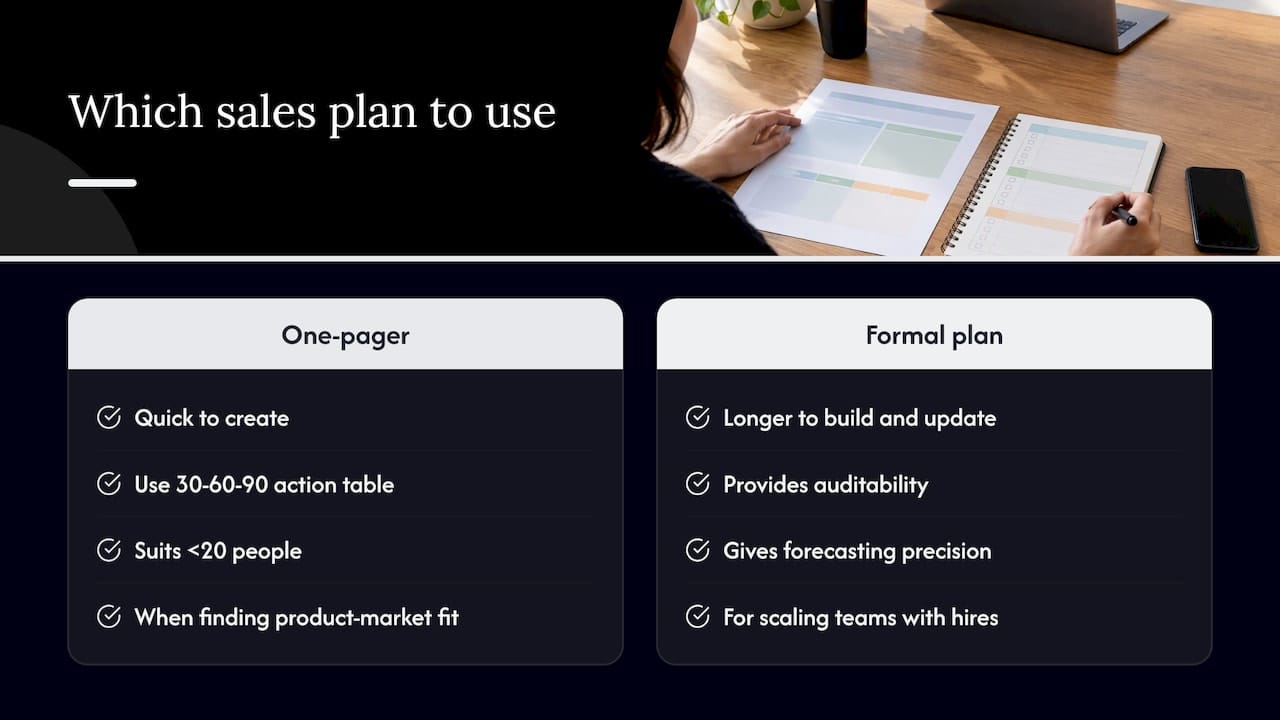
Scaling teams face a different trade-off. A formal, multi-page plan takes longer to build and update, but it gives finance and leadership the auditability and forecasting precision a board or an investor will expect.
Our recommendation: if you are under twenty people or still finding product-market fit, default to the one-pager and revisit it monthly. Once you are hiring a dedicated sales team and reporting into a board, invest in the fuller document, because the cost of imprecise forecasting grows with headcount.
— Amichai
Build your sales plan faster with a guided bootcamp
Reading a framework gets you most of the way there, but a deadline and a room full of other founders working through the same exercise gets the plan finished. Our Online Entrepreneurship Bootcamp walks participants through the same mission-to-metrics sequence covered above, with direct mentorship replacing the guesswork of doing it alone. Our in-person sprint bootcamps and tailored retreats apply the same structure for teams that need alignment on goals and resourcing, not just a document.
- Leave with a completed plan, not a template to finish later.
- Get mentor feedback on your quotas and segmentation before you commit budget.
- Work alongside other founders solving the same forecasting and hiring questions.
Explore our full program lineup to find the format that fits your stage and timeline.
FAQ
What are the 5 C’s of sales?
The 5 C’s commonly referenced in sales planning are company, customers, competitors, collaborators, and climate, used as a quick scan of the internal and external factors shaping a sales strategy. Definitions vary across sources, so treat it as a planning lens rather than a fixed checklist.
What is the 30-60-90 rule in sales?
The 30-60-90 rule breaks a ramp or launch period into three phases: the first 30 days for training and pipeline building, the next 30 for active selling and deal reviews, and the final 30 for closing and adjusting forecasts based on real results. It gives new reps and new initiatives a structured path instead of an open-ended ramp.
How often should a sales plan be updated?
Most guides, including HubSpot’s sales planning framework, recommend a quarterly review with a full annual refresh. Update it sooner if a product launch, pricing change, or new market shifts the assumptions the plan was built on.
What is the difference between a sales plan and a sales strategy?
A sales strategy is the longer-term approach to winning customers, including positioning and market choices, while a sales plan is the operational document that turns that strategy into quotas, territories, and weekly actions. The strategy answers why and where; the plan answers who does what and by when.
How do I calculate how many sales reps I need?
Divide your target revenue by your average deal size to get the number of deals needed, then divide that number by the realistic quota per rep. For example, if a rep can realistically close 10 deals a quarter, calculate accordingly to find the number of deals and reps needed to hit your target.
Sources
- What is a Sales Plan? How to Create + Examples | Salesforce
- Want to create a sales plan? Let me show you how +8 sales plan examples (HubSpot)
- RepVue Cloud Sales Index Q4 2025
Comments are closed.