
What Is Experiential Business Education? A Practical Guide
TL;DR:
- Experiential business education emphasizes active learning through real or simulated business challenges, fostering durable skills.
- Kolb’s learning cycle guides this process, with reflection, experimentation, and engagement in ambiguous, accountable scenarios.
Experiential business education is defined as learning where students develop business skills by applying theory directly in real or simulated business scenarios, rather than passively receiving information through lectures. The industry term for this approach is experiential learning, a concept formalized by David Kolb and now embedded in accreditation frameworks from institutions like AACSB and George Washington University. Where traditional business education teaches you about decision-making, experiential education puts you inside the decision. For entrepreneurs and professionals, this distinction is not academic. It is the difference between knowing a framework and knowing how to use it when the stakes are real.
What is experiential business education and how does it work?
Experiential business education is learning through active engagement in real or simulated business scenarios, where participants build skills through doing rather than observing. AACSB describes activities like simulations, live projects, internships, and entrepreneurial challenges that replicate real-world uncertainty and decision-making. The core premise is that knowledge sticks when it is tested against genuine complexity. Passive instruction can explain a supply chain disruption; experiential learning puts you in charge of resolving one.

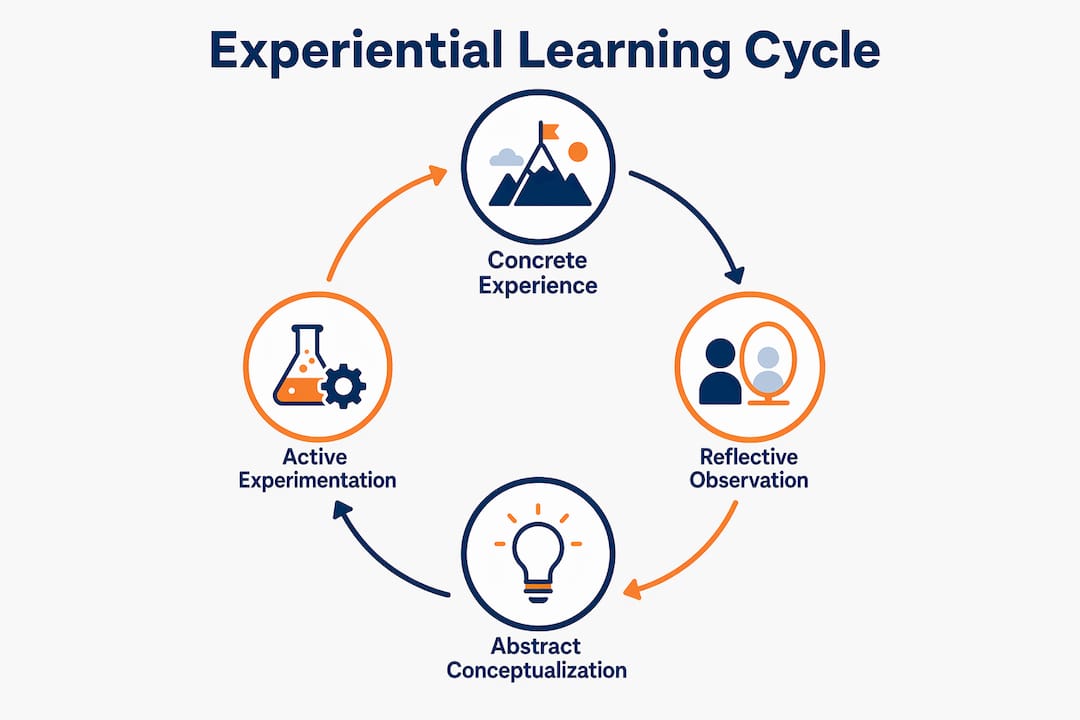
The theoretical backbone comes from Kolb’s learning cycle, which moves through four stages: concrete experience, reflective observation, abstract conceptualization, and active experimentation. Each stage builds on the last. You do something, you reflect on what happened, you form a principle, and then you test that principle in a new situation. George Washington University’s School of Business organizes its experiential programs around this exact cycle, using it to structure both problem-based and project-based learning formats.
What separates experiential business education from a simple class project is the presence of ambiguity, accountability, and iteration. A well-designed experiential program does not give you a clean problem with a known answer. It gives you a messy situation with incomplete information and asks you to move forward anyway. That friction is where the learning lives.
What are the main models behind experiential business learning?
Two primary structures define how experiential learning in business is delivered in practice.
Problem-based learning (PBL) begins with learner curiosity and centers on tackling complex, real-world problems. The learner drives the inquiry. There is no prescribed path to the answer, which forces participants to develop problem decomposition skills and tolerance for ambiguity. In a business context, PBL might involve analyzing why a mid-market retailer is losing margin and proposing a solution with real financial data.
Project-based learning involves extended tasks with autonomous work that culminate in realistic deliverables. John Thomas (2000) defines these as complex tasks requiring sustained effort, independent judgment, and a final presentation or product. Business schools use this format for consulting projects, product launches, and market entry analyses delivered to actual companies.
Both models support deeper learning because they require:
- Sustained engagement over days or weeks, not a single class session
- Collaboration with peers who have different knowledge and perspectives
- Presentation of findings to external stakeholders who ask hard questions
- Iteration based on feedback, which mirrors real business cycles
Kolb’s four-stage cycle runs through both models. In a project-based course, the concrete experience is the project itself. Reflection happens in debriefs and journals. Conceptualization occurs when students connect what they observed to frameworks from their coursework. Active experimentation happens in the next project or sprint. The cycle repeats, and each pass builds more durable capability.
How do industry partnerships strengthen real-world business training?
Industry partnerships are the mechanism that transforms experiential learning from a classroom exercise into genuine professional preparation. AACSB highlights programs where partnerships with over 15 companies in sales innovation programs give students direct access to real business challenges, real data, and real executives. That access changes the quality of the learning entirely.
Industry-embedded learning involves sustained relationships with organizations, not one-off guest lectures. AACSB research on cohort-based programs shows that continuous faculty mentorship and direct work with executives and real organizational data create a depth of experiential engagement that classroom simulations cannot replicate. The relationship-building, project calibration, and lead time required are significant. But the payoff is proportional.
“Partnerships with industry and community organizations do more than add opportunities. They enable the development of leadership and soft skills through collaborative problem-solving.” — AACSB
The skills that emerge from these partnerships go beyond technical business knowledge. Participants develop:
- Leadership under pressure: Making calls when information is incomplete and time is short
- Communication across hierarchies: Presenting to senior executives who have no patience for vague recommendations
- Negotiation and stakeholder management: Aligning people with competing priorities around a shared outcome
- Adaptability: Adjusting strategy when the client changes the brief mid-project
Entrepreneurship accelerators and hands-on business training programs that embed these partnership structures produce graduates who can operate in real organizations from day one. For entrepreneurs specifically, the exposure to how established companies make decisions is as valuable as the technical skills themselves.
What are the career readiness benefits of experiential education?
Experiential learning develops critical skills under ambiguity including decision-making, adaptability, communication, and leadership that traditional lectures cannot cultivate effectively. AACSB notes these skills are best developed through immersive experiences that mimic unpredictable real business environments. Employers do not just value these skills in the abstract. They use experiential credentials as signals of future performance.
AACSB research on career readiness signals identifies a clear hierarchy of signal strength based on four factors:
- Proximity to real execution: Did the work involve actual business consequences, or was it a safe simulation?
- Exposure to ambiguity: Was the problem genuinely uncertain, or did it have a known answer?
- External accountability: Were deliverables reviewed by people outside the classroom who had real stakes?
- Difficulty in faking competence: Could a student pass the experience without actually developing the skill?
The strongest signals come from internships, live consulting projects, and entrepreneurial ventures where all four factors are present. A case competition scores lower because the problem is artificial and the accountability is limited. A six-month consulting engagement with a real company scores high because failure has visible consequences.
Pro Tip: When building your portfolio or résumé, prioritize experiences that score high on all four signal factors. A single well-documented consulting project with a named company and measurable outcomes outweighs three generic case competitions.
One emerging challenge is the use of AI tools in experiential programs. AACSB warns that AI must be integrated with faculty-imposed guardrails to keep decision-making and problem decomposition central to the experience. When AI handles the thinking, the learning evaporates. The tool should accelerate execution, not replace judgment.
How can entrepreneurs apply experiential learning principles outside academia?
Experiential business education principles are not confined to university programs. Entrepreneurs and professionals can embed the same methodology into their own development by treating every business challenge as a structured learning opportunity. The key is to move through Kolb’s cycle deliberately: act, reflect, extract a principle, and test it again.
Converting experience into career assets requires guided reflection. AACSB warns that without this step, learning evaporates after the activity ends. For entrepreneurs, this means building reflection into your operating rhythm. A weekly review that asks “what did I try, what happened, and what does that tell me” is a simple but powerful application of the experiential cycle.
Bootcamps and mentorship programs that use experiential approaches for entrepreneurs replicate the structure of academic experiential programs in compressed, high-intensity formats. The best ones embed real projects, external accountability, and structured reflection into every day of the program. Credit-bearing courses do this within academic frameworks; bootcamps do it through cohort accountability and mentor feedback.
For professionals applying these principles in their careers, the practical steps are straightforward. Volunteer for projects with genuine uncertainty and external stakeholders. Document what you learn in writing, not just in memory. Seek feedback from people who have real stakes in the outcome, not just colleagues who want to be supportive. Build a portfolio of experiences that score high on the four signal factors described above. The role of experiential business strategy in career development is not about collecting credentials. It is about building a track record of navigating real complexity.
Pro Tip: After completing any significant project, write a one-page case study covering the problem, your approach, the outcome, and what you would do differently. This converts raw experience into a career asset you can articulate in any interview or pitch.
Key takeaways
Experiential business education works because it places learners inside real complexity, requiring genuine problem-solving, reflection, and accountability that passive instruction cannot replicate.
| Point | Details |
|---|---|
| Core definition | Experiential business education develops skills through active engagement in real or simulated business scenarios, not passive lectures. |
| Foundational framework | Kolb’s four-stage learning cycle structures how experience becomes durable knowledge through reflection and experimentation. |
| Industry partnerships | Sustained collaborations with real organizations produce stronger learning signals than classroom simulations alone. |
| Career readiness signals | Experiences with external accountability, genuine ambiguity, and real consequences carry the most weight with employers. |
| Reflection is non-negotiable | Without structured reflection, participation in experiential activities does not convert into lasting skills or career assets. |
Why experiential education changed how I think about business growth
I have watched hundreds of entrepreneurs go through programs that promised transformation and delivered information. The gap between the two is almost always the same thing: the absence of genuine stakes. When a learner knows the worst outcome is a bad grade, they optimize for the grade. When the outcome is a real client relationship, a real revenue number, or a real team depending on them, they optimize for the result. That shift in orientation is where actual growth happens.
The most capable founders I have encountered are not the ones who read the most books or completed the most courses. They are the ones who put themselves in situations where they had to figure things out under pressure, reflected honestly on what happened, and went back in. That is Kolb’s cycle in practice, even if they have never heard his name.
What concerns me about the current moment is the temptation to use AI to shortcut the hard parts of experiential learning. Generating a market analysis in 30 seconds feels productive. But if you did not wrestle with the data yourself, you did not build the judgment that makes the next analysis better. Faculty guardrails in academic programs exist for this reason. Entrepreneurs need to impose those guardrails on themselves.
The programs that produce the most durable results are the ones that combine real projects, honest mentorship, and a community that holds you accountable long after the formal program ends. That combination is rare. When you find it, commit fully.
— Amichai
Ready to learn by doing? Nomadexcel can help
Nomadexcel builds entrepreneurship programs around the same principles that make experiential business education effective: real projects, direct mentorship, and a community that creates genuine accountability. The online entrepreneurship bootcamp puts you inside real business challenges with experienced founders guiding every step. You leave with sharper strategy, new skills you have actually used, and a network that continues to push your growth. If you are ready to move from theory to execution, explore Nomadexcel’s bootcamp programs and find the format that fits your stage and goals.
FAQ
What is experiential business education in simple terms?
Experiential business education is learning by doing. Students develop business skills by working through real or simulated challenges rather than absorbing information passively through lectures.
How does Kolb’s learning cycle apply to business education?
Kolb’s cycle moves through four stages: concrete experience, reflective observation, abstract conceptualization, and active experimentation. Business programs use this framework to structure projects and debriefs so that each experience builds transferable knowledge.
What makes an experiential learning activity a strong career signal?
AACSB identifies four factors: proximity to real execution, exposure to genuine ambiguity, accountability to external stakeholders, and difficulty in faking competence. Internships and live consulting projects score highest on all four.
Can entrepreneurs use experiential learning outside a university?
Yes. Entrepreneurs apply experiential principles by treating business challenges as structured learning cycles, building in deliberate reflection, seeking feedback from people with real stakes, and documenting outcomes as career assets.
How does hands-on business training differ from traditional education?
Traditional education transfers knowledge through instruction. Hands-on business training develops capability through practice, iteration, and accountability, producing skills that hold up under real-world pressure.
Comments are closed.