
5 Ways Fixed and Growth Mindsets Shape Learning, and What Actually Works
A growth mindset is the belief that intelligence and ability develop through effort, strategy, and learning. A fixed mindset treats those same traits as fixed at birth, so effort feels pointless and failure feels like a verdict on your worth. The practical takeaway: growth mindset supports learning because it turns setbacks into feedback, while a fixed mindset treats setbacks as evidence to avoid the next challenge.
TL;DR:
- Growth mindset encourages taking on harder challenges and persisting longer, which leads to better resilience and well-being over time.
- Effective interventions pair mindset shifts with specific feedback, deliberate practice, and an environment tolerant of visible failure.
- Simply praising effort without strategy can backfire, and mindset is domain-specific, meaning a person may hold fixed beliefs about certain skills but not others.
- Changing beliefs alone does not guarantee improvement; implementing structured strategies is necessary for real skill development.
- People with a growth mindset set more stretch goals, view setbacks as learning opportunities, and are more likely to stick with difficult tasks.
Table of Contents
- Growth Mindset vs. Fixed Mindset: A Side-by-Side Comparison
- Where the Terms Came From, and What the Research Actually Shows
- What a Growth Mindset Actually Delivers, and Where It Falls Short
- Do You Lean Fixed or Growth? A Quick Self-Check
- How to Actually Build a Growth Mindset (Not Just Talk About One)
- Three Things People Get Wrong About Growth Mindset
- What This Means for Personal Development and Wellbeing
- Fixed and Growth Mindset in Action: Real Situations
- How Mindset Shapes the Way You Learn and Stay Motivated
- How Mindset Changes the Goals You Set and Actually Reach
- A Publisher’s Take: Why Mindset Needs a Room, Not Just a Belief
- Sources
Growth Mindset vs. Fixed Mindset: A Side-by-Side Comparison
The gap between these two mindsets shows up long before anyone fails at anything. It shows up in how a person talks about a challenge before they’ve even tried it.
Someone with a growth mindset treats ability as a moving target, something built through practice and better strategy, not a fixed number stamped on them at birth. Someone with a fixed mindset sees intelligence and talent as inherent traits that don’t change much, which makes every difficult task feel like a referendum on their worth rather than a chance to improve.
That difference plays out across five areas:
- Core belief about ability. Growth mindset: skills are buildable. Fixed mindset: skills are largely set.
- Response to failure. Growth mindset treats a poor result as data to adjust the approach. Fixed mindset treats it as proof of a ceiling, which often triggers avoidance next time.
- Attitude toward effort. Growth mindset sees effort as the mechanism that produces improvement. Fixed mindset sees heavy effort as embarrassing, a sign you weren’t naturally good enough.
- Learning behavior and feedback use. Growth mindset actively seeks correction and mines it for specifics. Fixed mindset hears feedback as criticism and either shuts down or gets defensive.
- Outcome implications. Growth mindset tends to sustain motivation and resilience over time. Fixed mindset burns out faster once the easy wins run out.
Picture two people learning Spanish. One stumbles through a conversation, gets corrected on verb conjugation, and writes the correction down to drill tomorrow. The other stumbles once, decides they’re “just not a language person,” and quietly stops practicing. Same mistake, opposite trajectory, and the difference has nothing to do with talent.
Where the Terms Came From, and What the Research Actually Shows
Psychologist Carol Dweck coined both terms through decades of research at Stanford, building on earlier work studying how children respond to failure. Her core finding: people who believe ability is malleable approach setbacks differently than people who believe it’s fixed, and that difference in belief predicts real differences in behavior.
The evidence since then is genuinely encouraging, with real limits attached.
- A 2024 longitudinal analysis links growth-mindset endorsement to greater resilience and better wellbeing outcomes in adults, tracked over time rather than in a single snapshot.
- Scientific American’s summary of the broader literature finds that students and employees with growth mindsets tend to take on harder challenges and persist longer than peers with fixed mindsets.
- A review of mindset research cautions that effects are real but uneven. Intervention size and consistency shift depending on context, how the study measured mindset, and how faithfully the intervention was implemented.
The heterogeneity matters. A short pep talk about believing in yourself is not the same intervention as a structured program built on feedback and strategy, and the research pool doesn’t treat them as equivalent. Readers who want to go deeper should start with Dweck’s own writing and the Stanford resources linked above rather than secondhand summaries that flatten the nuance.
What a Growth Mindset Actually Delivers, and Where It Falls Short
A growth mindset earns its reputation. People who hold it tend to seek out harder problems, stick with tasks longer after a setback, and report better resilience and wellbeing over time, according to the longitudinal research tracking adults across contexts.
But belief alone doesn’t teach a skill. Mindset without a change in behavior mostly produces the same results wrapped in nicer self-talk.
- Reliable benefits: stronger motivation to attempt hard things, faster recovery from setbacks, and better use of feedback once it arrives.
- Where it stalls: interventions show weaker or inconsistent effects when they aren’t paired with concrete strategy changes, according to the PMC review on context and implementation.
- What has to come with it: specific feedback, a strategy to test, and an environment that tolerates visible failure. Mindset is the fuel, not the engine.
Pro Tip: Pair every mindset shift with a deliberate practice loop. Pick one skill, one specific thing to change about how you do it, and one way to measure whether the change worked within a week.
A guide on what a growth-focused mindset actually requires goes deeper into building that structure around belief.
Do You Lean Fixed or Growth? A Quick Self-Check
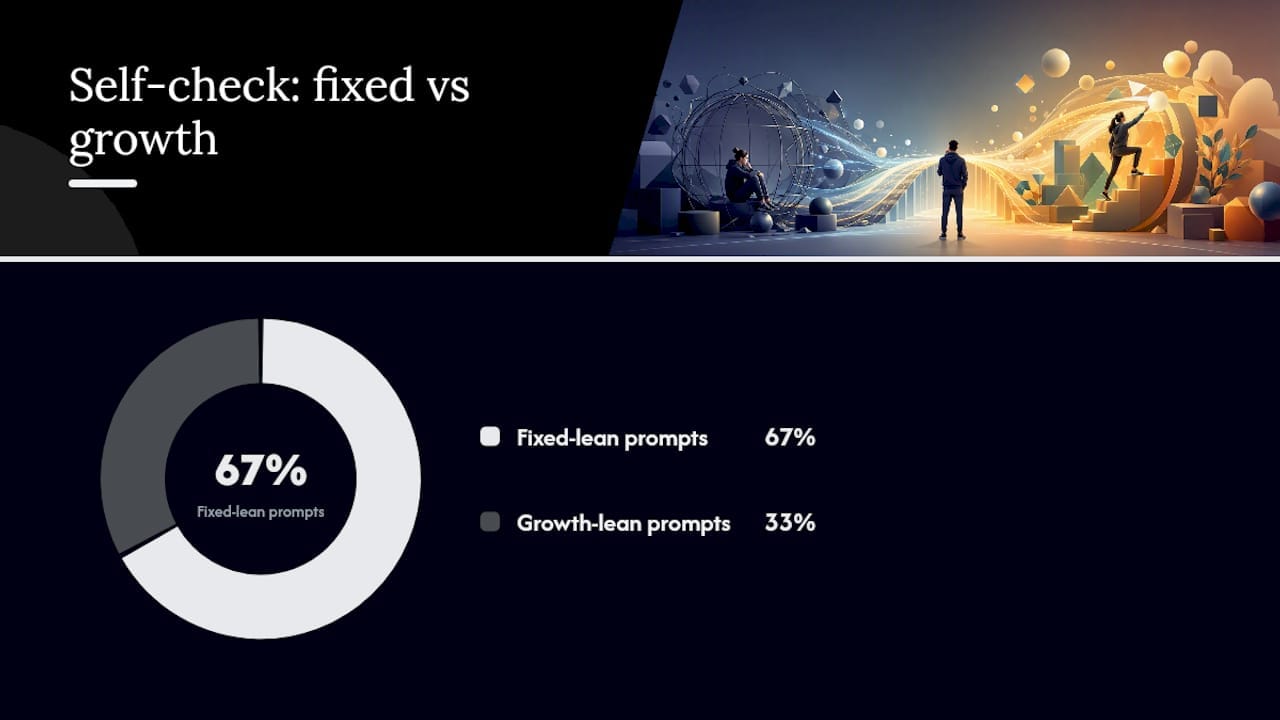
Mindsets aren’t permanent personality traits. Most people run a growth mindset in one area of life and a stubbornly fixed one in another, so this check works best applied to a specific skill or situation, not your whole identity.
Signs you’re leaning fixed right now:
- You avoid a challenge because you might look incompetent trying it.
- You equate needing to work hard with not being naturally good at something.
- Criticism makes you want to defend yourself rather than ask what to fix.
- You compare yourself to people who make it look easy and conclude you’re behind for good.
Signs you’re leaning growth right now:
5. You ask for specific feedback instead of just reassurance.
6. A setback makes you curious about what to try differently, not defensive.
Score yourself with this six-prompt gut check: Do you avoid tasks where you might fail publicly? Do you think effort signals weakness? Do you get defensive when corrected? Do you compare your raw ability to others’? Do you ask “what should I change” after a miss? Do you see a skill gap as temporary rather than permanent? More “yes” answers to the first four suggest a fixed lean in that domain; more “yes” answers to the last two suggest growth. As Psychology Today notes, the same person can score differently on this depending on whether you’re asking about public speaking or spreadsheet skills.
How to Actually Build a Growth Mindset (Not Just Talk About One)
Believing “I can improve” changes nothing until it changes what you do on a Tuesday afternoon. These five steps, in order, turn the idea into a habit.
- Shift the language first. Replace “I’m not good at this” with “I’m not good at this yet.” It sounds small, but it reframes a permanent judgment into a temporary status update.
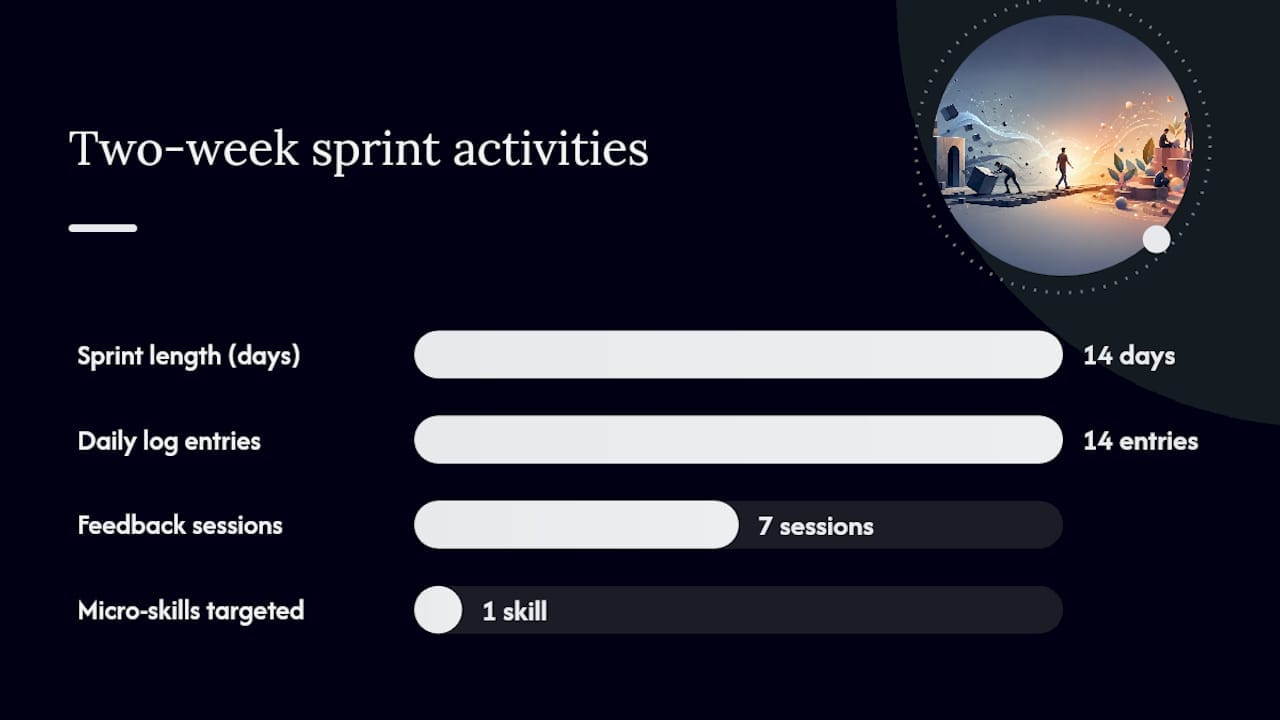
- Design a micro-experiment. Pick one narrow skill, set a two-week window, and define what “improved” looks like before you start. Verywell Mind frames this as testing a specific strategy, not just logging hours.
- Practice deliberately, not just often. Deliberate practice means focusing on the one weak point in your technique and measuring whether it moved, rather than repeating the same comfortable reps.
- Chase corrective feedback and map it to one action. Vague encouragement doesn’t help. Ask “what specifically should I change next time,” then write down the answer as a single next step.
- Build the habit with a log and a witness. A short daily log of what you tried and what happened, shared with a mentor or peer group, keeps the experiment honest instead of letting motivation quietly fade.
One version of this that scales well: a two-week learning sprint where you pick a micro-skill, log daily practice on one specific strategy, request feedback every other day, and check for measurable movement at day 14.
Pro Tip: Skip the general goal (“get better at public speaking”) and set a testable one (“cut filler words by half in a five-minute recorded pitch by day 14”). Testable goals generate feedback; vague goals just generate hope.
For a structured version of this process, Nomadexcel’s guide to building a growth mindset for entrepreneurial success breaks the sequence down further.
Three Things People Get Wrong About Growth Mindset
The idea gets watered down almost every time it leaves an academic paper, and the distortions cause real damage.
- “Praise the effort” isn’t the whole strategy. Praising effort with no attention to strategy can backfire, rewarding busywork instead of improvement. Dweck herself warns against this exact simplification, sometimes called a “false growth mindset.”
- Nobody is purely one type. Mindsets are domain-specific; you can hold a growth mindset about your cooking and a fixed one about your math ability, often without noticing the split.
- It’s not “just try harder.” Growth mindset requires a strategy to test and feedback to act on. Effort with no adjustment is just repetition, and repetition without correction rarely produces improvement.
The fix is simple: praise the specific strategy someone used and name the next thing to try, rather than just telling them they worked hard.
What This Means for Personal Development and Wellbeing
Mindset shapes far more than test scores or job performance. It shapes how you interpret your own life story, which is a heavier lift than it sounds.
A fixed mindset tends to narrate setbacks as confirmation: “This proves I’m not cut out for this.” A growth mindset narrates the same event as information: “This tells me what to adjust.” Over years, those two internal narrators produce very different relationships with risk, ambition, and self-worth. The longitudinal wellbeing data backs this up, linking growth-mindset endorsement to better adjustment outcomes tracked across adult life stages, not just short-term mood boosts.
That matters most in the moments that feel highest stakes: a career pivot, a difficult relationship conversation, a health goal that isn’t going well. People with a growth orientation toward these domains tend to stay in the process longer, because a bad week reads as a data point rather than a final judgment.
None of this means mindset alone fixes wellbeing. It means the belief you hold about whether you can change shapes whether you keep trying to.
Fixed and Growth Mindset in Action: Real Situations
Abstract definitions are easy to nod along to. They get more useful once you see them at work.
In education: A student who bombs a calculus quiz with a fixed mindset concludes “I’m just not a math person” and starts avoiding the subject. A student with a growth mindset asks the teacher which specific concept broke down and redoes those problems.
In the workplace: A manager gives an employee blunt feedback on a presentation. The fixed-mindset employee hears an attack on their competence and gets defensive in the room. The growth-mindset employee asks a follow-up question, takes notes, and revises the deck that night.
In relationships: A fixed mindset toward relationships treats conflict as proof of incompatibility, “we just don’t work.” A growth mindset treats the same conflict as a communication pattern that can be identified and changed, which is a large part of why couples counseling works at all for the people who stick with it.
The pattern repeats everywhere: fixed mindset treats friction as a verdict, growth mindset treats it as a signal.
How Mindset Shapes the Way You Learn and Stay Motivated
Mindset changes the machinery underneath learning, not just the mood around it. When ability feels fixed, a hard problem threatens your self-image, so the instinct is to protect that image by avoiding the problem or by giving up the moment it gets difficult.
When ability feels buildable, a hard problem becomes interesting rather than threatening. That single reframe changes which tasks you choose, how long you stick with them, and how you process the correction that comes back. Scientific American’s review of the broader research found this pattern consistently: growth-oriented learners choose harder tasks and persist through failure longer than fixed-mindset peers facing the identical material.
Motivation isn’t a fixed reserve you either have or don’t. It’s a byproduct of how you interpret difficulty in the moment. Treat friction as informative and motivation holds up. Treat friction as a verdict and motivation collapses fast, usually right when you need it most.
How Mindset Changes the Goals You Set and Actually Reach
Fixed mindset and growth mindset don’t just change how you feel about a goal. They change what kind of goal you set in the first place.
Someone with a fixed mindset tends to choose goals that protect their image, safe targets they’re already confident they can hit, because a miss feels like exposure. Someone with a growth mindset is more willing to set a stretch goal, because a miss just means recalibrating the strategy rather than confirming a limitation.
That difference compounds over time. Stretch goals, tested and adjusted rather than abandoned at the first miss, tend to produce more skill growth than safe goals that never get revised. The research on growth mindset characteristics points to the same mechanism driving how to build the mindset in the first place: specific, testable targets paired with real feedback outperform vague aspirations paired with willpower.
A Publisher’s Take: Why Mindset Needs a Room, Not Just a Belief
Growth mindset research gets treated like a self-help slogan, and that’s the part I’d push back on hardest. Believing effort matters changes nothing on its own. What actually moves people is being put in a room where the strategy, the feedback, and the accountability are already built into the structure around them.
That’s the entire logic behind experiential, mentor-led formats. A cohort of founders working through the same execution sprints gets the corrective feedback and the specific next step that Dweck’s own research says separates real growth from wishful thinking. Nomadexcel’s entrepreneurship bootcamps are built around that exact mechanism: daily accountability and mentorship instead of a slogan about believing in yourself.
Belief is the starting condition. Structure is what makes it stick.
— Amichai
Sources
- Growth mindset (Stanford Center for Teaching and Learning)
- What having a ‘growth mindset’ actually means (HBR)
- PMC review: Mindsets research and evidence (2024/2020 series)
- The remarkable reach of growth mindsets (Scientific American)