
Brainstorming for Creative Business Ideas: A Founder’s Playbook
Run one focused, timeboxed ideation sprint — frame the right problem with a How Might We (HMW) question, mix silent brainwriting with group synthesis, score ideas on a weighted rubric, and launch a 7–14 day speed-to-truth experiment — and you’ll surface your best business opportunity faster than any open-ended session ever will.
Your 72-hour action plan:
- Now: Write your HMW challenge statement and distribute it to participants 24 hours before the session
- Day 1: Run a 60–90 minute hybrid ideation sprint (silent phase → group synthesis → dot voting)
- Days 2–3: Score your top three ideas on a weighted scorecard and assign one experiment owner per idea
- Days 4–14: Run one cheap validation experiment per top idea (landing page, concierge offer, or pre-sale)
Who does what in the next 72 hours:
- Founder or team lead writes the HMW statement and books the session room or Miro board
- Facilitator prepares materials, shares pre-read data, and sets the agenda
- Each participant reviews the problem brief independently before arriving
Key Takeaways
A single, well-structured ideation sprint — starting with a sharp HMW question and ending with a named experiment owner — produces more usable business ideas than hours of open-ended discussion.
| Point | Details |
|---|---|
| Frame before you ideate | Write a specific HMW question and share it 24 hours before the session to focus the room. |
| Use the silent-then-group hybrid | Silent brainwriting followed by group synthesis reduces production blocking and surfaces more diverse ideas. |
| Score ideas, don’t debate them | A weighted scorecard covering problem severity, founder fit, feasibility, and speed-to-validate removes bias from the decision. |
| Validate with money, not enthusiasm | Run a landing page, concierge offer, or pre-sale within 7–14 days; payment is the only signal that counts. |
| Nomadexcel accelerates the process | Nomadexcel’s bootcamps and retreats deliver this full sprint with mentor accountability and a live validation plan. |
Table of Contents
- How brainstorming for creative business thinking starts with problem framing
- Which brainstorming techniques should you use, and when?
- How do you run a session that actually produces usable outputs?
- How do you pick the best ideas from a crowded shortlist?
- How do you validate a business idea in 7–14 days?
- How do you keep experiments moving after the session ends?
- What mistakes do facilitators and teams make most often?
- Which tools work best for remote and in-person ideation sessions?
- How Nomadexcel runs ideation workshops and what you can expect
- The moment that changes every session
- Nomadexcel’s bootcamps and retreats put this playbook into practice
- Sources
How brainstorming for creative business thinking starts with problem framing
Effective brainstorming starts with a sharply framed challenge; skipping problem framing is the single most consequential facilitator error. Before a single idea gets generated, your team needs to agree on exactly what problem they’re solving.
A well-written HMW question is specific enough to focus thinking but open enough to allow creative solutions. Here are three examples calibrated for business contexts:
- Too broad: “How might we grow revenue?”
- Better: “How might we help solo consultants close their first $5,000 client in under 30 days?”
- Best: “How might we reduce the time a first-time founder spends validating a product idea from 3 months to 2 weeks?”
Pre-session checklist (distribute 24+ hours ahead):
- Confirmed participant list (5–8 people is the productive range)
- One-page problem brief with relevant customer data, failed assumptions, and market context
- Session goals: what a “win” looks like (e.g., “three testable hypotheses with assigned owners”)
- Core assumptions to challenge and success metrics for the session itself
Pro Tip: Write your HMW question in three versions — one narrow, one mid-range, one wide — and let the group vote on which framing to use. This five-minute exercise surfaces alignment gaps before ideation begins.
Which brainstorming techniques should you use, and when?
Design-thinking exercises like SCAMPER, Crazy 8s, mind mapping, and affinity mapping give teams structured prompts for alternating between divergent and convergent thinking. The right technique depends on your session goal.
Technique catalog with timeboxes:
- Silent brainwriting (10 min): Each participant writes ideas independently on sticky notes or a shared doc. No talking. Eliminates production blocking and leader bias. Best default opening move. Research confirms that a hybrid format — silent individual brainwriting followed by group brainstorming — outperforms either method alone.
- Crazy 8s (8 min): Each person sketches eight distinct concepts in eight minutes. Forces quantity over quality and breaks mental fixation on the first “good” idea.
- SCAMPER (15–20 min): Substitute, Combine, Adapt, Modify, Put to other uses, Eliminate, Reverse. Apply each lens to your existing concept or competitor model to generate variants.
- Reverse brainstorming (10 min): Ask “How might we make this problem worse?” then flip the answers. Surfaces hidden assumptions and overlooked failure modes.
- Starbursting (10 min): Generate questions rather than answers — Who, What, Where, When, Why, How. Useful when the team is converging too early.
- Affinity mapping (15 min): Group raw ideas into clusters by theme. The convergent counterpart to divergent techniques; run it after brainwriting or Crazy 8s.
Remote vs. in-person adaptations: For hybrid or fully remote teams, default to digital-first tools so every participant contributes simultaneously. Miro and Mural both support parallel sticky-note input; Google Slides works for Crazy 8s sketches; Notion handles structured idea logs; Typeform collects pre-session input asynchronously.
Pro Tip: Open every session with 5–10 minutes of silent individual ideation before any group discussion. This single habit reduces production blocking and ensures quieter team members contribute ideas before louder voices set the frame.
How do you run a session that actually produces usable outputs?
Good facilitation is mostly about enforcing structure, not generating ideas. Business workshop facilitation lives or dies on four core rules: defer all judgment during divergence, enforce silence during the ideation phase, actively police leader bias (the founder speaks last, not first), and use silent dot voting before any verbal discussion of results.
Roles and responsibilities:
- Facilitator: Manages time, enforces rules, reads energy, and redirects tangents
- Timekeeper: Calls transitions; uses a visible timer everyone can see
- Recorder: Captures ideas in real time on a shared board or doc
- Stakeholder reviewer: Joins only for the prioritization phase to avoid anchoring ideation
Three ready-to-run agendas:
| Session length | Phase | Duration | Deliverable |
|---|---|---|---|
| 60–90 minutes | HMW framing + silent brainwriting | 15 min | Raw idea pool |
| 60–90 minutes | Affinity mapping + dot voting | 20 min | Top 3 idea clusters |
| 60–90 minutes | Owner assignment | 10 min | Named next steps |
| 90 minutes | HMW framing + problem brief review | 15 min | Shared problem frame |
| 90 minutes | Silent brainwriting + Crazy 8s | 25 min | Divergent idea pool |
| 90 minutes | Affinity mapping | 20 min | Clustered themes |
| 90 minutes | Weighted scoring + dot voting | 20 min | Prioritized shortlist |
| 90 minutes | Experiment assignment | 10 min | Owners + timelines |
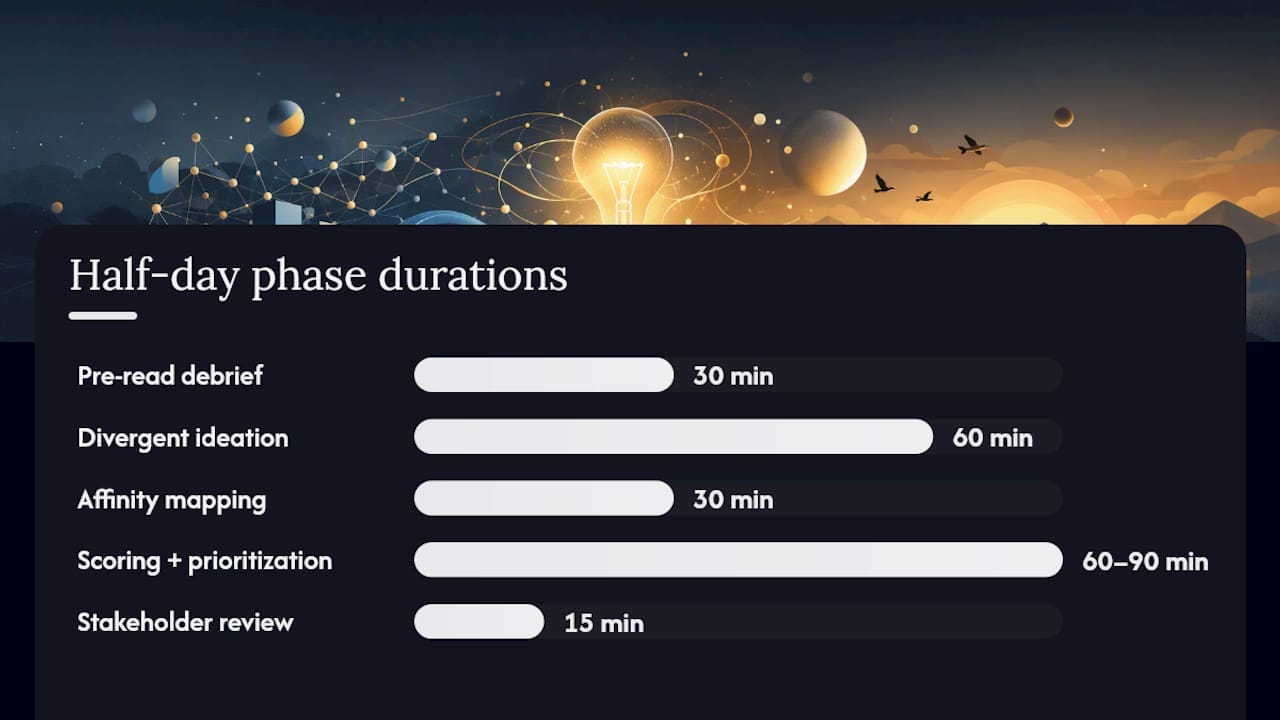
| Half-day | Full HMW + pre-read debrief | 30 min | Aligned problem frame |
| Half-day | Divergent ideation (3 techniques) | 60 min | Large idea pool |
| Half-day | Affinity mapping + clustering | 30 min | Organized themes |
| Half-day | Scoring + prioritization | 60–90 minutes | Top 3 ideas scored |
| Half-day | Experiment design + owner assignment | 30 min | Validation plan |
| Half-day | Stakeholder review + next steps | 15 min | Committed action items |
How do you pick the best ideas from a crowded shortlist?
A weighted scorecard and short validation sprints are the most reliable tools for choosing between competing concepts. Scoring helps facilitate honest comparison and reduces bias toward the most enthusiastically pitched idea.
Weighted scorecard template (score each criterion 1–5):
- Problem severity (weight: 30%) — How painful is this problem for the target customer, and how often do they experience it?
- Founder-market fit (weight: 25%) — Does your team have relevant experience, relationships, or credibility in this space?
- Feasibility (weight: 20%) — Can you build or deliver a first version within 30 days with current resources?
- Speed-to-validate (weight: 15%) — How quickly can you run a cheap test to confirm or deny the core assumption?
- Market potential (weight: 10%) — Is there a plausible path to meaningful revenue if the assumption holds?
Example scoring walkthrough:
- Idea A — B2B onboarding tool: Severity 4, Fit 5, Feasibility 3, Speed 4, Market 4 → weighted score: 3.95
- Idea B — Consumer wellness app: Severity 3, Fit 2, Feasibility 2, Speed 2, Market 5 → weighted score: 2.65
- Idea C — Consulting productized service: Severity 5, Fit 4, Feasibility 5, Speed 5, Market 3 → weighted score: 4.55
Idea C wins on this scorecard. The math matters less than the conversation it forces.
Decision-rule checklist:
- Advance the top 1–2 ideas to validation (not three or more — focus is the constraint)
- Kill an idea if it scores below 3.0 on problem severity or founder-market fit regardless of total score
- Assign one named owner per advancing idea before leaving the room
How do you validate a business idea in 7–14 days?
Market validation should focus on speed to truth: fast, cheap tests that reveal real willingness to pay or invest time, because founders routinely mistake enthusiasm for demand. Three experiment blueprints get you there quickly.
Experiment 1 — Landing page + traffic (Days 1–5):
- Build a one-page site describing the offer (Carrd, Webflow, or a Google Doc link works)
- Drive 200–500 targeted visitors via LinkedIn outreach, a Reddit post, or a $100 paid ad
- Measure: email signup rate (target: 15%+) or waitlist conversion
Experiment 2 — Manual concierge delivery (Days 1–10):
- Offer the service manually to 3–5 real customers before building anything
- Charge a real price, even a discounted one — money is the strongest signal
- Measure: willingness to pay, time-to-close, and what objections surface
Experiment 3 — Pre-sale or refundable deposit (Days 3–14):
- Ask customers to put money down before the product exists
- Use Stripe, Gumroad, or a simple invoice
- Measure: number of pre-commitments and average deal size
For idea validation, pre-sales and concierge offers consistently outperform surveys because they separate polite interest from real demand.
How do you keep experiments moving after the session ends?
Ideas die in the gap between the whiteboard and the calendar. The fix is a minimal experiment tracker with four fields per idea: hypothesis, success metric, owner, and deadline.
Ownership template (DACI-lite):
- Driver: The one person accountable for running the experiment
- Approver: Founder or team lead who signs off on go/no-go
- Contributor: Anyone providing support (design, copy, outreach)
- Informed: Stakeholders who receive weekly updates
Sample 4-week follow-up timeline:
- Week 1: Experiment live, daily check-ins on leading metrics
- Week 2: Mid-point review — is the signal strong enough to continue or pivot?
- Week 3: Final data collection, customer interviews to explain the numbers
- Week 4: Go/no-go decision, next sprint planning
Pivot when the signal is weak but a different customer segment or price point shows promise.
What mistakes do facilitators and teams make most often?
Most session failures are predictable. Each one has a direct fix.
- Jumping to solutions: Replace open discussion with silent brainwriting in the first 10 minutes. Ideas generated before group discussion are more diverse and less anchored to the first suggestion.
- Leader bias: The most senior person in the room speaks last during ideation and votes anonymously. Non-negotiable.
- Production blocking: In groups larger than six, switch to electronic brainstorming or parallel digital input (Miro, Mural) so everyone contributes simultaneously rather than waiting for a turn.
- Mistaking excitement for demand: A room full of enthusiastic head-nods is not a signal. Payment or a time commitment is. Run an experiment before celebrating.
- Skipping convergence: Divergent techniques generate ideas; affinity mapping and scoring convert them into decisions. Both phases are required.
- Vague next steps: Every session must end with named owners, specific deadlines, and a defined success metric. “We’ll follow up” is not a next step.
For a deeper look at team workshop facilitation, the facilitator’s job is to protect the process, not contribute ideas.
Which tools work best for remote and in-person ideation sessions?
Templates to prepare and share before every session:
- HMW prompt template with three framing variants
- Affinity mapping board (pre-built in Miro or Mural with labeled swim lanes)
- Weighted prioritization matrix (spreadsheet with formula-driven scoring)
- Experiment brief (one page: hypothesis, method, metric, owner, deadline)
How Nomadexcel runs ideation workshops and what you can expect
Nomadexcel’s workshop process follows the same validation-first sequence this guide describes, with one addition: mentorship and daily accountability sprints are built into the program so ideas don’t stall between sessions.
A typical Nomadexcel ideation engagement produces:
- A prioritized shortlist of 2–3 testable ideas with scored rationale
- A validated experiment plan with assigned owners and 7–14 day timelines
- A documented set of core assumptions and the evidence that challenges or supports them
- Direct mentor feedback on scoring decisions and experiment design
The mentorship process at Nomadexcel pairs founders with experienced operators who have run these experiments themselves. Daily accountability sprints keep validation moving; weekly reviews surface pivots before they become expensive detours. For teams running company retreats, the same framework applies at the organizational level — aligning leadership around strategic priorities rather than product ideas.
The moment that changes every session
Most teams arrive at a brainstorming session believing the hard part is generating ideas. It isn’t. The hard part is resisting the urge to fall in love with an idea before a single real customer has responded to it.

The turning point in almost every session I’ve facilitated comes when the scoring exercise forces a team to confront the gap between “we’re excited about this” and “a customer will pay for this.” That gap is where the real work begins. A well-run session doesn’t produce a winning idea. It produces the right experiment to find out whether an idea has a chance.
Nomadexcel’s bootcamps and retreats put this playbook into practice
Running this process solo is possible. Running it with experienced facilitators, a cohort of peers who’ve done it before, and daily accountability is faster. Nomadexcel’s online entrepreneurship bootcamp gives founders a structured environment to run exactly this sprint — problem framing, hybrid ideation, scoring, and a live validation experiment — with mentor guidance at every stage. For company teams, Nomadexcel’s business retreats for remote teams deliver the same facilitated process offsite, combining strategic alignment with real execution. Book an intake call at Nomadexcel to find the right format for your team.
Sources
- Brainstorming: Method, Rules, Variants, and What Research Really Shows | SI Labs
- How to Run a Brainstorming Session That Actually Works | Workshop Weaver Blog
- Market validation: How to determine whether customers want your product | HBS Online
- How to Choose Between Startup Ideas: A Founder’s Framework – DEV Community
- Brainstorming Resources, Activities & Exercises – IDEO U
Comments are closed.