
Execution-Focused Business Planning: Your 90-Day Guide
TL;DR:
- Effective business execution involves short-term, owner-led sprints focused on binary milestones and weekly reviews. Building a 90-day plan with clear objectives, milestones, and sequencing, combined with consistent cadence, accelerates progress and reduces failures. Engaging the team, maintaining transparency, and managing risks through disciplined routines ensure sustained momentum over time.
Execution-focused business planning is a short-term operating system that converts strategy into owner-led weekly sprints with binary milestones, named deadlines, and a single scoreboard everyone checks. The plan is not a document you file away. It is the machine you run every week. Authorities including Perdoo, Harvard Business Review, Businessmap, and Nomadexcel all converge on the same principle: mobilization, not more planning, is where early teams win or lose.
Start here — your next 72 hours:
- Within 24 hours: Write one sentence naming your single most important outcome for the next 90 days and the one person who owns it.
- Within 48 hours: Break that outcome into three binary milestones (done or not done, no partial credit) and assign a deadline to each.
- Within 72 hours: Schedule a 30-minute weekly review meeting for every week of the next 12 weeks and send the invite before you close your laptop.
Table of Contents
- How do you build an execution-focused 90-day plan?
- What operating cadence keeps the plan alive?
- Which tools and templates help you run the plan?
- What execution traps do early founders fall into?
- What does a concrete 90-day plan look like week by week?
- How do you measure progress and know when to pivot?
- How do bootcamps accelerate your execution trajectory?
- How do you build team buy-in during execution?
- How do you keep stakeholders aligned during sprints?
- How do you manage risk inside a rapid execution cycle?
- Key Takeaways
- What actually separates founders who execute from those who plan forever?
- Authoritative sources and further reading
How do you build an execution-focused 90-day plan?
Effective action-oriented planning answers four questions: what exactly you will do, who owns it, in what sequence, and how you will know it is working. Here is a step-by-step process to build yours.
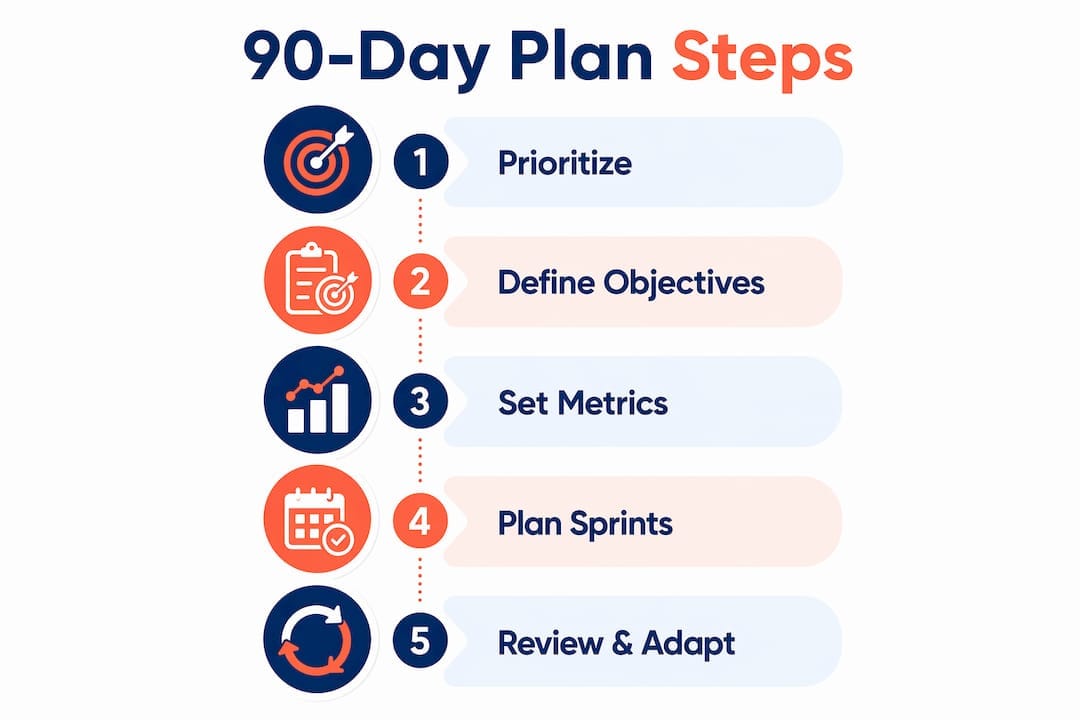
Step 1: Pick 1–3 quarterly priorities.
Choose the outcomes that, if achieved, make everything else easier. These are your wildly important goals. Write each as a binary milestone: “Signed 10 paying customers” passes; “Grow revenue” fails.
Step 2: Fill in the 90-day template for each priority.
| Field | Your entry |
|---|---|
| Objective | One-sentence outcome statement |
| Key Result (metric) | Specific, measurable number |
| Initiatives | 2–3 actions that drive the metric |
| Owner | One named person |
| Deadline | Specific date |
| Done criteria | Binary: yes or no |
Step 3: Sequence your milestones.
Map three monthly checkpoints across the 90 days. Month 1 validates your assumptions. Month 2 builds the minimum viable offer. Month 3 converts early interest into revenue.
Step 4: Convert strategy elements into weekly tasks.
- Identify your target customer and write their single biggest pain point.
- Name the one revenue lever you will pull first (outreach, referral, paid ad).
- Choose the core metric that proves the lever is working (calls booked, conversion rate, revenue).
- Assign 3–5 weekly tasks that move that metric. Nothing else goes on the sprint board.
Step 5: Chunk the 90 days into sprint blocks.
Use 4-week monthly milestones as your macro rhythm and 2-week sprint blocks as your micro rhythm. Each sprint ends with a review: did the milestone move? If not, why not?
Business frameworks for growth give this sequencing structure, connecting daily tasks to the strategic goal rather than letting them drift.

What operating cadence keeps the plan alive?
Short sprints and brief weekly reviews are the engine of goal-oriented business plans. Effective progress management uses these sessions to flag obstacles and make decisions before small deviations grow into full derailments.
Recommended rhythm:
- Sprint length: 1–2 weeks for early-stage teams. Shorter cycles surface problems faster and keep energy high.
- Weekly review: 30 minutes, same day, same time, every week without exception.
Weekly review agenda (30 minutes):
- Minutes 1–5: Each owner reports status on their milestone: done, on track, or blocked.
- Minutes 6–15: Blockers only. What is stopping progress? Who can remove it?
- Minutes 16–25: Decisions. Every blocker must end with a named decision and a named next action.
- Minutes 26–30: Commitments for the coming week. Each person states one specific deliverable.
Roles that make it work:
- Owner: the single person accountable for a milestone. One owner per milestone, never two.
- Reviewer: the founder or team lead who runs the meeting and holds owners to their commitments.
- Blocker-resolver: whoever has the authority or resources to remove an obstacle within 24 hours.
Pro Tip: Convert every status update into a decision before the meeting ends. If an owner says “I’m almost done,” ask “What is the specific deliverable and when exactly will it be complete?” Almost done is not a status.
Running business sprints effectively requires this discipline from the first session, not after the team has already drifted.
Which tools and templates help you run the plan?
Lightweight tooling beats elaborate systems for early teams. The goal is a single source of truth you can set up in one bootcamp session, not a platform that takes weeks to configure.
Tool categories and quick setup notes:
- Goal/OKR tracker: Perdoo or a simple Google Sheet with columns for Objective, Key Result, Owner, and Status. Track weekly. Color-code: green (on track), yellow (at risk), red (blocked).
- Task board: Trello, Notion, or a physical whiteboard with three columns: To Do, In Progress, Done. Limit work in progress to 3 tasks per person per sprint.
- Dashboard: One shared document showing your core metric, weekly actuals vs. target, and the current sprint’s open blockers. Update it before every weekly review.
- Meeting timer: A visible countdown during the weekly review keeps the agenda tight.
Templates to bring into every sprint:
- 90-day plan template (Objective, Key Result, Initiatives, Owner, Deadline, Done criteria)
- Weekly review sheet (Status, Blockers, Decisions, Commitments)
- Meeting agenda (30-minute format above)
- Owner checklist (one milestone, one owner, one binary deliverable, one deadline)
What to avoid early: Do not automate before you have run at least two full sprint cycles manually. Automation locks in broken processes. Document your highest-frequency workflows first, then add reminders and triggers once the process is proven.
What execution traps do early founders fall into?
Analysis paralysis and lack of execution infrastructure cause many new ventures to fail before they generate meaningful traction. Recognizing the traps early is half the fix.
- Analysis paralysis. Fix: run a 2-week smoke test. Build a landing page, send 20 outreach messages, and measure response rate. Data from the market beats data from your spreadsheet every time.
- No named owner. Fix: for every milestone, write one person’s name. If two people own it, nobody owns it.
- Phantom progress (“almost done”). Fix: apply binary completion rules. A milestone is either done or not done. “90% complete” counts as not done until the acceptance criteria are met.
- Tracking vanity metrics. Fix: tie every metric directly to revenue or customer demand. Page views without conversion data tell you nothing useful.
- Over-planning the next quarter before closing the current one. Fix: run the 90-day review before opening the next planning cycle. Businessmap notes that 4 in 5 executives say strategy is not understood by their teams, often because new priorities pile on before old ones are resolved.
Stall prototype and immediate fix: A founder reports that the product prototype is “almost ready” for the third week in a row. The fix is immediate: apply the binary rule, declare the milestone blocked, re-sequence the sprint board to deprioritize the prototype, and assign a customer discovery task as the new Week 1 priority. Ship the conversation before you ship the product.
What does a concrete 90-day plan look like week by week?
| Month | Milestone | Weekly sprint focus | Owner | Done criteria |
|---|---|---|---|---|
| Month 1 | Validate customer demand | Weeks 1–2: 20 customer interviews; Weeks 3–4: smoke test landing page | Founder A | 20 interviews complete; landing page live with 50 signups |
| Month 2 | Build minimum viable offer | Weeks 5–6: draft offer and pricing; Weeks 7–8: deliver to 3 beta customers | Founder B | 3 beta customers using the offer |
| Month 3 | Generate initial revenue | Weeks 9–10: outreach to 50 prospects; Weeks 11–12: close first paying customers | Founder A | First paid invoice received |
Week-by-week task highlights:
- Weeks 1–2: Conduct 20 structured customer interviews. Document the top three pain points verbatim.
- Weeks 3–4: Launch a smoke test. A simple landing page with a clear offer and a call to action reveals real demand faster than any market research report.
- Weeks 5–6: Draft your minimum viable offer. One sentence: who it is for, what problem it solves, and what they pay.
- Weeks 7–8: Deliver the offer to three beta customers. Collect feedback in writing.
- Weeks 9–10: Send 50 outreach messages using the pain points from your interviews as the hook.
- Weeks 11–12: Close your first paying customers and document the sales conversation as a repeatable process.
Real-world business projects at bootcamps follow this exact arc, compressing months of solo trial-and-error into a structured, peer-accountable sprint cycle.
How do you measure progress and know when to pivot?
KPI selection checklist:
- Does this metric prove a customer wants what you are selling? (outcome measure)
- Does it move before revenue moves? (lead measure)
- Can one person own it and report it in 60 seconds? (operational measure)
Minimum dashboard fields:
- Core metric: actual vs. target this week
- Sprint milestone status: done / on track / blocked
- Open blockers: who owns the fix and by when
Perdoo’s research shows top-performing organizations complete execution cycles in roughly 13.7 months compared to 34 months for low performers. Shorter review cycles are the primary driver of that gap.
Iteration decision rules:
| Signal | Action |
|---|---|
| Core metric moving, milestone on track | Persevere. Do not change what is working. |
| Core metric flat for 2 consecutive sprints | Investigate the lead measure. Change one variable. |
| Core metric declining and blocker unresolved | Pivot. Re-sequence priorities at the next weekly review. |
| 90-day milestone missed by more than 20% | Run a 90-day review. Reset milestones before starting the next cycle. |
How do bootcamps accelerate your execution trajectory?
Harvard Business Review identifies mobilization as the critical work between choosing a strategy and doing the work, and the place where most organizations fail. Immersive bootcamps compress that mobilization window from months to days.
Nomadexcel’s entrepreneurship bootcamp structure forces three outcomes that solo planning rarely achieves:
- Owner assignment under peer pressure. When a room of founders watches you commit to a milestone and a deadline, the social contract is real. Accountability is not a system feature; it is a human dynamic.
- Early customer contact within the first sprint. Facilitated sessions push founders to make their first 10 outreach attempts before the bootcamp ends, generating real market data instead of assumptions.
- Decisions made in the room. Mentor office hours and peer reviews surface blockers immediately and force resolution, rather than letting them sit in a backlog for weeks.
Investing in structured entrepreneurship education consistently shortens the time from plan to first revenue for early-stage founders.
How do you build team buy-in during execution?
Change resistance is one of the most cited reasons execution stalls. Businessmap reports that 47% of businesses say resistance slows adoption. The fix is not a motivational speech. It is structural.
Involve team members in milestone-setting before the sprint begins, not after. When people write the acceptance criteria themselves, they own the outcome. Run a brief “concerns round” at the start of each sprint: each person names one risk they see. Naming it publicly reduces the chance it becomes a silent blocker. Adapt the plan when evidence demands it, and say so explicitly. Teams that watch a leader ignore contradictory data stop trusting the plan entirely.
How do you keep stakeholders aligned during sprints?
A communication plan for a small founding team does not need to be elaborate. It needs to be consistent. Three channels cover most early-stage needs:
- Weekly review meeting: the primary alignment moment. Every stakeholder who influences a milestone attends or receives the written summary within 24 hours.
- Async sprint update: a brief written post (Slack, email, or shared doc) sent at the end of each sprint. Format: what we completed, what is blocked, what we are doing next.
- 90-day review: a longer session at the end of each cycle where the full team sees actual results vs. targets and agrees on the next quarter’s priorities together.
Transparency is not about sharing everything. It is about sharing the right things at the right cadence so no one is surprised at the 90-day review.
How do you manage risk inside a rapid execution cycle?
Risk in a 90-day cycle is not a strategic planning exercise. It is a weekly operational question: what could stop this sprint from closing on time? Build a short risk log directly into your sprint board with three columns: Risk, Likelihood (high/medium/low), and Owner of the mitigation.
The highest-frequency risks for early teams are cash runway shortfall, a key dependency on one external party, and founder single points of failure on critical processes. Document your most-repeated workflows (customer outreach, onboarding, invoicing) and assign a backup owner for each. When a risk materializes, it becomes a blocker on the weekly review agenda and gets resolved before the next sprint opens, not deferred to the next quarter.
Key Takeaways
Execution-focused business planning works because it replaces a static document with a 90-day operating system built on named owners, binary milestones, and weekly sprint reviews.
| Point | Details |
|---|---|
| Start with one owner | Every milestone needs one named person accountable; shared ownership produces no ownership. |
| Use binary milestones | Done or not done. “Almost complete” is not a status and hides real blockers. |
| Run weekly 30-minute reviews | Short, decision-focused reviews catch deviations before they compound across sprints. |
| Measure lead indicators | Track the metric that moves before revenue moves, not vanity metrics after the fact. |
| Mobilize before you plan more | Over-investing in mobilization, not additional strategy design, is what separates teams that execute from those that stall. |
What actually separates founders who execute from those who plan forever?
The pattern that shows up most consistently in bootcamp settings is not a lack of ideas or even a lack of skill. It is a reluctance to commit publicly to a binary outcome. Founders who write “increase sales” as a milestone can always argue they made progress. Founders who write “close 5 paying customers by March 31” cannot. That specificity feels uncomfortable precisely because it removes the escape hatch.
The second pattern is mistaking activity for progress. A packed calendar and a full task list can coexist with zero milestone movement. The weekly review exists to surface that gap before it becomes a quarter-long illusion. When the scoreboard shows a metric flat for two consecutive sprints, the honest response is to change one variable and measure again, not to add more tasks.
Cadence is the discipline that makes everything else work. Teams that skip even one weekly review tend to skip the next one too, and by week six the plan is a document again rather than an operating system. The founders who leave bootcamps with real momentum are almost always the ones who treated the 30-minute weekly review as non-optional from day one.
Authoritative sources and further reading
- Perdoo: Strategy Execution Guide — the most thorough publicly available guide to cascading OKRs and measuring execution cycle speed. Start here for framework depth.
- Harvard Business Review: Strategy Mobilization — the essential read on why mobilization, not strategy design, is where organizations fail.
- Businessmap: 7 Pillars of Strategy Execution — practical breakdown of alignment, visibility, and cadence with data on common organizational failure points.
- Nomadexcel programs and templates:
- Online Entrepreneurship Bootcamp — facilitated sprint cycles, mentor office hours, and peer accountability for founders ready to run their first 90-day execution cycle.
- What is a business sprint? — practical guide to structuring and running sprints for early-stage teams.
Comments are closed.