
Startup Acceleration Explained: A Founder’s Guide
Startup acceleration is a fixed-term, cohort-based program that fast-tracks early-stage companies through intensive mentorship, curriculum, and investor access, typically over 3–4 months, in exchange for 3%–8% equity. Programs like Google for Startups and SCORE represent two ends of the spectrum, while immersive bootcamps like Nomadexcel offer a non-equity path for founders focused on execution over fundraising.
Every startup accelerator program delivers a core set of components:
- Mentorship: One-on-one advisor sessions and curated mentor pools
- Curriculum: Structured modules covering product-market fit, customer acquisition, and fundraising
- Seed capital or non-equity options: Equity stakes, convertible notes, or grants depending on the program
- Cohort network: Peer accountability and cross-founder collaboration
- Demo day: A public pitch event giving startups direct investor access
Table of Contents
- What makes a program a true startup accelerator?
- Accelerator vs. incubator vs. bootcamp: which fits your stage?
- Who should apply, and what do accelerators expect?
- Benefits and real risks of joining an accelerator
- How a 3–4 month accelerator actually unfolds
- How to evaluate and choose the right program
- U.S. alternatives: SCORE, university programs, and immersive bootcamps
- How Nomadexcel’s bootcamp model compares to a traditional accelerator
- Key Takeaways
- What founders get wrong about acceleration
- Nomadexcel bootcamps: execution-first growth without equity
- Useful sources and further reading
What makes a program a true startup accelerator?
Not every intensive program qualifies. A genuine accelerator has five defining features working together: a fixed end date, a cohort structure, a structured curriculum, seed funding of some kind, and a demo day.
The curriculum structure typically runs through product-market fit validation, customer acquisition tactics, and fundraising preparation, delivered through workshops, mentor sessions, and milestone-driven sprints. That sequencing matters because each module builds on the last.
Mentorship intensity is what separates accelerators from most other programs. Founders get one-on-one advisor hours, open mentor office hours, and access to a curated pool of operators and investors. The peer cohort adds a second layer of accountability that compounds the learning. According to Harvard Business Review, this network effect, combining peer accountability with curated mentor pools, is the component founders consistently rate as most valuable because it condenses months of learning into weeks.

Funding models vary more than most guides acknowledge. Some programs take 5%–10% equity in exchange for capital and services; others operate in the 3%–8% range. A smaller number offer convertible notes or non-dilutive grants. NYU’s Summer Launchpad, for example, provides a $15,000 non-dilutive grant alongside mentorship and a demo day pitch, with no equity required.
Pro Tip: Before accepting any offer, ask the program director for a list of the last two cohorts’ investors who attended demo day. If the investor list doesn’t match your sector, the demo day won’t move your fundraising forward regardless of how strong your pitch is.
Accelerator vs. incubator vs. bootcamp: which fits your stage?
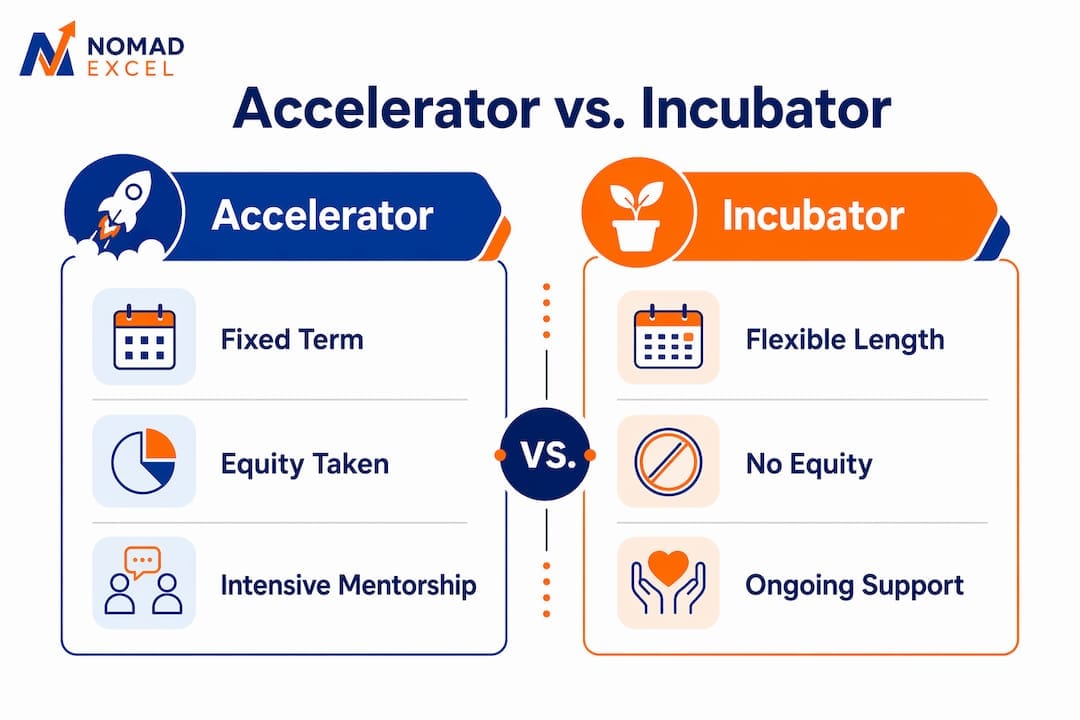
Founders often conflate these three formats. The practical differences come down to duration, structure, funding model, and the stage they expect you to be at when you walk in.
| Format | Typical length | Equity model | Entry stage | Demo day |
|---|---|---|---|---|
| Short-term cohort program (accelerator) | Several months | Small equity stake | MVP or initial traction | Yes |
| Long-term incubator | One to multiple years | Often none or minimal | Idea stage | Rarely |
| Immersive bootcamp/retreat | One to a few weeks | None | Any stage | No |
The decision rule is straightforward. Choose an accelerator if you have an MVP, need investor introductions, and are willing to trade equity for speed. Choose a long-term incubator if you’re still validating a concept and want ongoing, low-pressure guidance. Choose an immersive bootcamp or retreat if your priority is execution, team alignment, or revenue growth without giving up ownership.
Who should apply, and what do accelerators expect?
Accelerators are not idea-stage programs. High-performing programs prioritize teams with a working prototype or MVP, initial market traction, and a technical co-founder. Solo founders can apply, but cohort-based programs consistently favor teams of two or more because the workload during a sprint-heavy program is genuinely difficult to carry alone.
A typical application asks for a pitch deck, traction metrics (active users, revenue, pilot customers), and team bios. Acceptance rates at well-known programs are highly competitive. If your product is still a concept and you have no customer evidence, an accelerator application is premature. A bootcamp or SCORE mentoring session is a better first step to build the proof points you’ll need later.
Benefits and real risks of joining an accelerator
The upside of a startup accelerator program is real and well-documented. The top benefits are:
- Network effect: Instant access to mentors, investors, and a peer cohort that would take years to build independently
- Compressed learning: Months of business development compressed into weeks through structured sprints
- Investor introductions: Demo day puts your company in front of investors who are already in the room and primed to write checks
- Forced milestones: Weekly checkpoints that prevent the drift that kills many early-stage companies
The risks are equally real. Equity dilution is permanent. Mentorship fatigue is a documented problem when programs lack structure; Chicago Booth’s Polsky Center notes that effective programs must set specific goals and milestones for each mentor session, or sessions become a distraction rather than an accelerant. Time commitment is heavy, and the product can stall while founders are in workshops. And if demo day doesn’t produce follow-on funding, startups can enter a post-program dead zone with depleted runway and no clear next step.
Pro Tip: Negotiate your equity terms before signing. Some programs have flexibility on the percentage, especially for teams with strong traction. More importantly, build three months of post-demo-day runway into your financial plan before the program starts, not after.
How a 3–4 month accelerator actually unfolds
The benefits of startup acceleration are most visible when founders understand the weekly rhythm before they commit. A typical cohort moves through four phases:
- Weeks 1–2, Onboarding and discovery: Team introductions, mentor matching, and baseline assessment of your product, market, and metrics
- Weeks 3–6, Product and market sprints: Rapid customer interviews, MVP iteration, and early revenue experiments with weekly milestone reviews
- Weeks 7–10, Fundraising preparation: Pitch deck refinement, financial modeling, and investor meeting practice with program mentors
- Weeks 11–12, Demo day and graduation: Final pitch rehearsals, the public demo day event, and immediate post-program investor follow-up
The milestones that matter most are MVP validation by week four, a defined customer acquisition metric by week eight, and complete fundraising materials at least two weeks before demo day. Programs that treat demo day as a week-twelve surprise rather than a week-one priority consistently produce weaker outcomes.
How to evaluate and choose the right program
Choosing well requires looking past brand recognition. Evaluate every program on these criteria:
- Equity and funding terms: What percentage, what capital, and are convertible notes or grants available?
- Mentor network quality: Do the mentors have direct experience in your sector, or are they generalists?
- Alumni outcomes: How many alumni from the last two cohorts raised follow-on funding, and at what stage?
- Timeline vs. your runway: Can you survive three to four months of reduced focus on revenue?
- Geographic or virtual format: Does the location or format fit your team’s situation?
Questions worth asking directly: Who are the lead investors at demo day? What is the average follow-on funding rate for alumni? Can you speak with two founders from the last cohort? What happens if you need to leave early? A program that resists these questions is a red flag. For a deeper look at evaluating program quality, the criteria above apply equally to bootcamps and accelerators.
U.S. alternatives: SCORE, university programs, and immersive bootcamps
Not every founder needs an equity accelerator. Three non-equity paths are worth knowing.
SCORE is the nation’s largest network of volunteer business mentors and offers free, ongoing one-on-one mentoring for the life of your business. It covers financing, business planning, and operations, with no equity and no time limit. For founders at the idea stage or those who need ongoing guidance without a cohort structure, SCORE is often the right first call.
University-affiliated programs offer a middle path. Tulane’s Startup Team Mentoring connects teams to 3–5 experienced mentors over longer terms with monthly sessions, a model better suited to founders who need sustained guidance rather than a sprint. NYU’s Summer Launchpad provides a $15,000 non-dilutive grant alongside mentorship and investor access, with no equity required.
Immersive bootcamps and retreats serve a different need entirely. When the priority is execution, team alignment, or rapid skill transfer rather than fundraising, a 1–4 week bootcamp often delivers more immediate value than a three-month equity program. Founders who need to build revenue before they’re ready for investors, or teams that need to align around a growth strategy, tend to get more from an execution-focused bootcamp than from a demo-day-oriented accelerator.
Non-U.S. founders evaluating U.S.-based programs should also consider entity structure early. A Delaware C Corp is the standard vehicle most U.S. accelerators require before they’ll issue equity, so formation timing matters.
How Nomadexcel’s bootcamp model compares to a traditional accelerator
Nomadexcel runs 1–4 week immersive bootcamps and company retreats built around daily accountability, structured sprints, and direct mentorship from experienced entrepreneurs and operators. The format is execution-first by design.
Key differences from a traditional equity accelerator:
- Equity: None. Founders keep full ownership.
- Intensity: High, with daily structured sessions and real-world deliverables
- Investor access: Limited compared to a demo-day program, but not the goal
- Follow-on support: Active alumni community and ongoing peer network
- Entry stage: Open to early-stage founders and established teams alike
The honest caveat: if your primary goal is raising a seed round in the next six months and you have an MVP with traction, a traditional accelerator’s investor network will serve you better. Nomadexcel’s programs are the stronger choice when your team needs to sharpen strategy, build revenue-driving skills, or align around execution before you’re ready to pitch investors.
Key Takeaways
Startup acceleration compresses months of mentorship, curriculum, and investor access into a 3–4 month cohort program, typically in exchange for 3%–8% equity, and it works best for founders who already have an MVP and a clear fundraising goal.
| Point | Details |
|---|---|
| Core definition | Accelerators are fixed-term, cohort-based programs lasting 3–4 months that trade 3%–8% equity for mentorship and investor access. |
| Entry standard | Most programs expect a prototype or MVP and initial traction; idea-stage founders are better served by SCORE or a bootcamp first. |
| Main trade-off | Equity dilution is permanent; weigh it against the network and investor access the program actually delivers in your sector. |
| Non-equity alternatives | SCORE offers free lifetime mentoring; university programs like NYU Summer Launchpad provide non-dilutive grants with no equity required. |
| Nomadexcel option | Nomadexcel’s immersive bootcamps offer high-intensity, execution-first growth with no equity and an active alumni community. |
What founders get wrong about acceleration
Most founders walk into an accelerator treating it like a course. The ones who get the most out of it treat it like a sprint with a hard deadline.
The biggest mistake is passive mentorship consumption. Founders who show up to mentor sessions without a specific decision to make or a hypothesis to test leave with advice they don’t use. The programs that structure mentorship around milestones consistently produce better outcomes because every session has a job to do.
The second mistake is treating demo day as the finish line. It’s a funding event, not a graduation. Founders who secure follow-on runway before demo day, rather than hoping for it after, tend to survive the post-program period. Build the financial cushion before week one, not week twelve.
For teams that aren’t ready for an equity program, or who need to build execution muscle before pitching investors, an immersive bootcamp is often the smarter first move. The mentorship process at Nomadexcel is designed specifically for that gap: high accountability, real deliverables, and a community that keeps pushing after the program ends.
Nomadexcel bootcamps: execution-first growth without equity
For founders who want the intensity of an accelerator without giving up ownership, Nomadexcel’s entrepreneurship bootcamps deliver daily accountability, direct mentorship, and a peer community built for real execution. Programs run 1–4 weeks and are designed for early-stage founders and business teams who need sharper strategy and revenue-driving skills now, not after a three-month cohort cycle. There’s no equity, no long-term commitment, and no waiting for a demo day to see results. If your team is ready to move fast, explore the program details and find the format that fits your stage.
Useful sources and further reading
- Harvard Business Review: The most-cited academic analysis of what accelerators actually do and how outcomes are measured. Start here for research-backed context.
- TechTarget’s accelerator definition: Clear, practical breakdown of program mechanics and how accelerators differ from other early-stage support.
- DigitalOcean’s accelerator guide: Useful for understanding curriculum structure and comparing equity vs. non-equity formats.
- SCORE via SBA: The starting point for free, ongoing U.S. business mentoring with no equity and no time limit.
- NYU Summer Launchpad: A strong example of a university-affiliated non-dilutive program with a $15,000 grant and investor demo day access.
- Nomadexcel program overview: Details on immersive bootcamp and retreat formats for founders and teams seeking execution-first growth.
Comments are closed.